Your neighbor’s oak tree looks lush and green in August. Yours didn’t make it through July. If that scenario sounds familiar, you’re not alone, and the problem probably isn’t your effort. It’s your tree selection. Choosing the right drought tolerant trees Houston homeowners can actually rely on means understanding something most planting guides skip entirely: Houston’s clay soil creates a paradox where your trees must survive blistering summer dry spells while tolerating the waterlogged conditions that follow a heavy winter rain.
That’s a tough ask. And it’s exactly why so many well-intentioned landscaping projects end in dead trees, wasted money, and a front yard that looks worse than when you started. You already know Houston summers are brutal. You’ve felt the sting of a high water bill and still watched a tree decline anyway.
This guide cuts through the confusion. You’ll discover which trees are genuinely built for Houston’s climate, how to sidestep the clay soil trap, and how a professionally planted, water-wise landscape can lower your maintenance costs while building real curb appeal that holds up year after year.
Key Takeaways
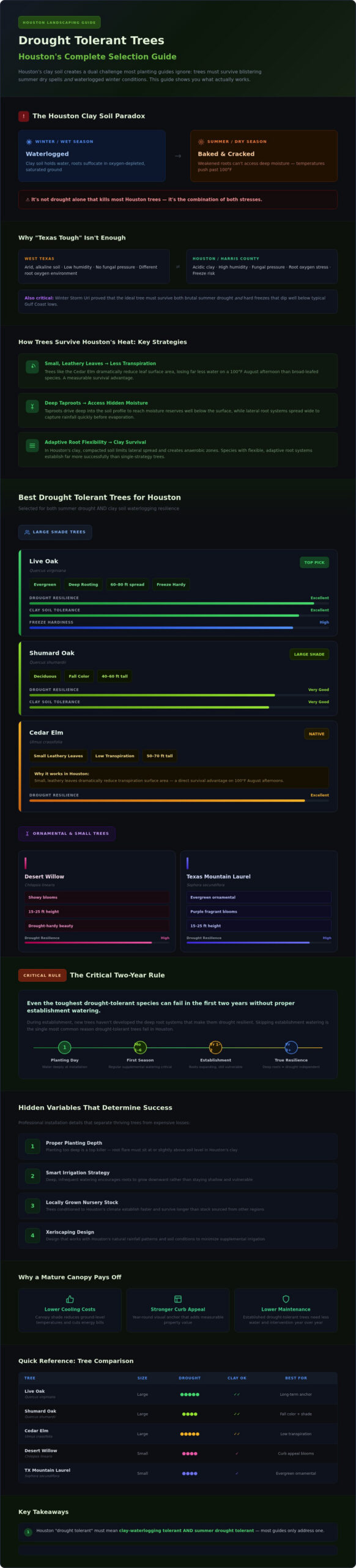
- The best drought tolerant trees Houston homeowners can plant must handle both summer dry spells and the waterlogged clay soil that follows heavy rain — a dual challenge most planting guides ignore entirely.
- Large shade trees like Live Oak and Cedar Elm offer deep-rooting resilience that makes them reliable anchors for Houston properties, while smaller ornamentals like Desert Willow deliver drought-hardy beauty without sacrificing curb appeal.
- Even the toughest drought-tolerant species can fail in the first two years without proper establishment watering — learning the “Critical Two-Year” rule is what separates thriving trees from expensive losses.
- Where you buy matters as much as what you buy: locally grown nursery stock conditioned to Houston’s climate establishes faster and survives longer than trees sourced from other regions.
- Professional installation, proper planting depth, and smart irrigation strategy are the hidden variables that determine whether your investment grows or declines — and they’re all worth getting right from day one.
Understanding Houston’s Drought Challenges & The Clay Soil Paradox
Drought tolerance means something different in Southeast Texas than it does anywhere else in the country. Houston’s Gulf Coast climate layers high summer humidity over scorching heat, creating a stress combination that forces trees to manage both atmospheric moisture demand and soil moisture deficit simultaneously. A tree rated “drought tolerant” in a catalog written for Phoenix or Tucson may struggle badly in Harris County. The conditions simply aren’t comparable.
Then there’s the soil. Houston’s infamous gumbo clay sits at the center of what experienced landscapers call the Clay Soil Paradox: the very ground that holds water during a wet winter becomes a baked, cracked, oxygen-depleted slab by mid-August. Trees planted without accounting for this cycle face a double threat. Roots suffocate during waterlogged periods, then the weakened root system can’t access the deep moisture reserves needed to survive summer dry spells. It’s not drought that kills most trees here. It’s the combination.
The Science of Drought Survival in Houston
Trees have evolved specific strategies to manage water loss, and those strategies matter enormously in Houston’s climate. The Cedar Elm is a strong example. Its small, leathery leaves dramatically reduce the surface area available for transpiration, meaning the tree loses far less water to the air on a 100-degree August afternoon than a broad-leafed species would. That’s a measurable survival advantage.
Root architecture matters just as much as leaf structure. Taproots drive deep into the soil profile to access moisture reserves well below the surface, while lateral root systems spread wide to capture rainfall quickly before it evaporates or runs off. In Houston’s clay, lateral roots face a real challenge: compacted soil limits spread and creates anaerobic zones that roots simply can’t penetrate. Species that naturally develop flexible, adaptive root systems establish far more successfully here than those that rely on one strategy alone.
Xeriscaping, in the Houston Gulf Coast context, means designing a landscape that works with the region’s natural rainfall patterns and soil conditions to minimize supplemental irrigation without sacrificing tree health or aesthetics.
Why “Texas Tough” Isn’t Enough
West Texas drought tolerance and East Texas drought tolerance are not the same thing. A species thriving in the arid, alkaline soils of the Trans-Pecos may fail completely in Harris County’s acidic, waterlogged clay. The humidity alone changes the equation. Trees adapted to low-humidity arid zones often struggle with the fungal pressure and root oxygen stress that come standard with Houston’s climate.
Cold hardiness adds another layer of complexity. Winter Storm Uri reminded every Houston homeowner that a single freeze event can eliminate species that had survived years of summer heat without complaint. The ideal selection survives both extremes: brutal summer drought and occasional hard freezes that dip well below typical Gulf Coast lows.
Balancing all of these variables is genuinely complex. That’s where landscaping services Houston professionals can add real value, helping homeowners plan for the full range of climate extremes rather than optimizing for just one season. Choosing the right drought tolerant trees Houston properties can sustain long-term starts with understanding the local conditions in full, not just the headline heat numbers.
The Best Large Shade Trees for Houston’s Drought Resilience
Size matters when summer temperatures push past 100 degrees. A mature canopy doesn’t just add beauty to a Houston property; it actively reduces ground-level temperatures, cuts cooling costs, and creates the kind of microclimate that makes the rest of your landscape easier to maintain. But only if you choose the right tree for the right spot. Here’s where to start.
The Mighty Oaks: Houston’s Best Defense Against Heat
No category of drought tolerant trees Houston homeowners can plant outperforms the oaks for long-term resilience. Live Oak and Shumard Oak are the two most commonly planted, and they serve different purposes well.
The Live Oak is the anchor choice for large properties. Its deep taproot system, combined with an aggressive lateral root network, gives it access to soil moisture that shallower-rooted species simply can’t reach during a dry August. It’s semi-evergreen, meaning it holds its canopy through winter and provides year-round shade density. For a deep dive into care and siting, our Live Oak guide covers everything from planting depth to long-term pruning strategy.
The Shumard Oak trades some of that shade density for something the Live Oak can’t offer: genuine fall color. Its leaves turn a rich crimson-red in autumn, giving Houston yards a seasonal display that’s rare in the Gulf Coast region. It handles heat and clay soil well, and its moderate growth rate makes it a practical choice for mid-sized lots where a Live Oak’s eventual spread would be too aggressive.
The Mexican White Oak (Monterrey Oak) is the fastest-growing of the three and has earned a strong following in Houston’s master-planned communities for exactly that reason. It establishes quickly, delivers a dense canopy within a few years of planting, and handles both summer drought stress and occasional hard freezes with solid resilience. For homeowners who want meaningful shade within a shorter timeline, it’s a compelling option.
Elms and Maples: Diversity in the Drought-Tolerant Canopy
Planting a single species across your entire property is a risk management problem. Pest pressure, disease cycles, and climate stress events rarely affect all species equally. A diverse canopy protects your landscape investment in ways that a monoculture simply can’t.
The Cedar Elm is the gold standard for heavy clay performance among the elms. Its small, leathery leaves minimize water loss during dry spells, while its root system has adapted over generations to tolerate the anaerobic conditions that follow heavy Houston rains. It’s one of the few trees that genuinely thrives in gumbo clay without compromise.
The Drummond Red Maple rounds out a well-balanced canopy with a native option that handles both wet feet in winter and dry summers with equal composure. It’s a practical choice for low-lying areas of a property where standing water is a seasonal reality.
- Live Oak: Best for large properties needing year-round shade and deep drought resilience
- Shumard Oak: Ideal for homeowners who want fall color without sacrificing heat tolerance
- Mexican White Oak: The fast-establishing choice for newer developments and shorter timelines
- Cedar Elm: The top performer in heavy clay soil during dry spells
- Drummond Red Maple: A native option that bridges wet and dry seasonal extremes
Getting this selection right from the start is what separates a landscape that thrives from one that costs you money year after year. If you’re ready to match the right species to your specific property conditions, talk to the team at Verdant Tree Farm about nursery-direct options grown and conditioned specifically for Houston’s climate.
Ornamental and Small Trees That Thrive in Texas Heat
Large shade trees anchor a Houston landscape, but they don’t finish it. The ornamental and small-scale trees you choose for the mid-layer and focal points are what give a yard its character, its seasonal interest, and its year-round color. The good news: some of the most visually striking options available are also the most resilient drought tolerant trees Houston homeowners can plant.
Flowering Beauties for Water-Wise Yards
The Desert Willow is the standout performer in this category. It produces trumpet-shaped blooms in shades of pink, lavender, and white from late spring through fall, and it achieves all of that on remarkably little water. The key to keeping it healthy is counterintuitive: overwatering is the primary cause of failure. Desert Willow wants well-drained soil and infrequent deep irrigation rather than regular shallow watering. In Houston’s clay, that means raised planting or amended beds are worth the extra effort at installation. Get the drainage right once, and this tree essentially takes care of itself.
The Redbud comparison is one that comes up often, and it’s worth addressing directly. Texas Redbud and Mexican Redbud both deliver stunning early-spring blooms before the leaves emerge, but they suit different parts of a Houston property. Texas Redbud handles the heavier clay soils found in low-lying areas better than its Mexican counterpart. Mexican Redbud, with its glossy, wavy-edged leaves, performs better in slightly elevated spots with faster drainage and tolerates reflected heat from pavement and walls more gracefully. Both are genuinely tough, but matching the variety to your specific microclimate makes a real difference in long-term performance. For a broader look at color options across the season, the flowering trees Houston guide covers additional varieties worth considering.
Vitex, also called Chaste Tree, earns its reputation as the tree that thrives on neglect. It blooms heavily in summer, precisely when most flowering trees are struggling, and its lavender flower spikes are a magnet for pollinators. It tolerates heat, poor soil, and dry conditions without complaint. The only real management task is a hard cutback in late winter to keep its form tidy.
Evergreen Ornamentals for Year-Round Resilience
Texas Mountain Laurel addresses the freeze-and-drought dual challenge that trips up so many ornamental selections. It’s evergreen, cold-hardy, and once established, requires almost no supplemental irrigation. The trade-off is patience: it grows slowly, typically adding less than a foot per year. What you get in return is a dense, fragrant tree with grape-scented purple blooms in early spring and near-zero maintenance demands for decades. For a property built around long-term value rather than quick results, it’s a strong investment.
For privacy screening applications, Wax Myrtle and holly varieties including Savannah Holly, Eagleston Holly, and Nellie R. Stevens Holly offer drought-tolerant evergreen structure that holds its density through both summer dry spells and hard winter freezes. They layer well with the larger canopy trees covered earlier, creating a complete landscape rather than isolated specimens. For larger-scale screening projects, the best evergreen trees for Houston guide covers the full range of options.
- Desert Willow: Maximum blooms with minimal water; drainage is the critical success factor
- Texas Redbud: Best for heavier clay and lower-lying spots on the property
- Mexican Redbud: Performs better in elevated, fast-draining areas with heat reflection
- Vitex: Summer blooms, pollinator-friendly, thrives on neglect
- Texas Mountain Laurel: Slow-growing, fragrant, and built for the long haul
Every one of these species is available nursery-direct through Verdant Tree Farm, grown and conditioned specifically for Houston’s climate so they establish faster and survive longer than stock sourced from other regions.
Establishing Your Landscape: Planting and Irrigation Strategies
Here’s the mistake that kills more drought tolerant trees Houston homeowners plant than any species selection error: treating “drought tolerant” as a synonym for “plant it and forget it.” Even the toughest Live Oak or Cedar Elm needs consistent support during its first two years in the ground. Root systems that haven’t had time to establish deep soil connections simply can’t access the moisture reserves that make these species resilient. Water them like they’re established before they actually are, and you’ll lose them in their first August.
This is the Critical Two-Year Rule. For the first two summers after planting, your tree needs regular, deep watering regardless of its mature drought tolerance. Once the root system has anchored itself into the soil profile and begun accessing deeper moisture reserves, you can scale back significantly. Before that point, you’re the tree’s only lifeline during a dry spell.
Planting depth is the other variable that separates success from failure. The root flare, the point where the trunk begins to widen at the base, must sit at or slightly above grade. Burying it even a few inches too deep starves the root zone of oxygen and invites fungal disease at the crown. The “mulch volcano” error compounds this: piling mulch against the trunk traps moisture against the bark and accelerates rot. Apply a three-to-four inch layer of mulch in a wide ring around the tree, but keep it pulled back a few inches from the trunk itself.
In Houston’s heavy clay, soil amendment at planting time gives root systems a genuine head start. Mixing expanded shale or composted organic matter into the backfill improves drainage and aeration in the immediate root zone without creating the “bathtub effect” that occurs when you amend too large an area and water pools at the interface between amended and native soil. Amend thoughtfully, not aggressively.
The Professional Installation Advantage
Getting the planting depth, soil preparation, and initial irrigation schedule right from day one is harder than it sounds, and the consequences of getting it wrong are expensive. Professional installation significantly improves first-summer survival rates by ensuring root stimulators are applied at planting, initial fertilization is matched to Houston’s soil chemistry, and the tree is positioned and staked correctly from the start. Verdant Tree Farm backs every professionally installed tree with a three-month warranty, giving you real protection during the most vulnerable window of your tree’s life. That warranty isn’t just a confidence signal; it’s a practical safety net that no DIY planting can replicate.
Smart Irrigation for Established Trees
Shallow, frequent watering trains roots to stay near the surface, exactly where you don’t want them during a Houston dry spell. Deep, infrequent watering drives roots downward toward the moisture reserves that sustain trees through summer drought. Soaker hoses placed at the drip line and tree gator bags for younger specimens are the most effective tools for delivering water slowly enough that clay soil can actually absorb it rather than letting it run off. Water deeply, then let the soil dry partially before watering again. For a complete approach to managing moisture across your entire yard, the lawn care Houston guide covers holistic irrigation strategies that protect both your trees and the surrounding landscape.
If you’re ready to get the establishment phase right from the first day, talk to the Verdant Tree Farm team about professional installation options that give your trees the strongest possible start in Houston’s demanding climate.
Selecting Resilient Nursery Stock at Verdant Tree Farm
Species selection and planting technique matter enormously, but there’s a variable that determines success before you ever dig a hole: where your tree was grown. A Live Oak conditioned in a North Carolina nursery and shipped to Houston faces a brutal acclimatization shock on top of the establishment stress every new tree experiences. Its root system developed in different soil. Its vascular tissue calibrated to different humidity levels. Its tolerance for gumbo clay was never tested. That’s a significant disadvantage built in before the first summer arrives.
Verdant Tree Farm is Houston’s largest independent nursery, and the distinction matters for one practical reason: the inventory is grown and conditioned specifically for Harris County conditions. These trees have already adapted to Houston’s clay soil, Gulf Coast humidity, and the freeze-to-drought temperature swings that eliminate less-prepared stock. That local conditioning is a head start that no big-box retailer sourcing from regional distribution centers can replicate.
Nursery-Direct Quality vs. Big Box Retailers
Walk through a big-box garden center and you’ll find trees that look healthy in the pot. What you can’t see is root circling from extended container time, stress from long-distance transport, or inventory that sat in a parking lot through a July heat wave before you arrived. Identifying genuinely healthy nursery stock means checking for a firm, intact root ball without circling or girdling roots at the soil surface, a trunk with no bark damage or sunscald, and foliage that shows no signs of transplant stress or dehydration. Verdant’s team curates inventory specifically for Harris County soil conditions, which means you’re selecting from trees that were never compromised by conditions they weren’t built for.
Maintenance consultations are another advantage that no retail shelf can offer. Knowing which drought tolerant trees Houston properties need and knowing how to keep them thriving through year three are two different problems. Expert guidance on fertilization timing, pruning approach, and irrigation adjustment as trees establish gives your investment a significantly better long-term trajectory.
The 3D landscape design service adds another layer of practical value. Shade placement isn’t intuitive. A tree positioned fifteen feet too far west may deliver minimal cooling benefit to your home while a better-sited specimen would cut your afternoon energy load meaningfully. 3D design maps canopy coverage, sun angles, and water flow across your specific property before a single tree goes in the ground, letting you optimize for both shade and water efficiency from day one.
Verdant Tree Farm is also veteran-owned and operated, a detail that reflects something real about how the business runs: accountability, reliability, and a long-term commitment to the Houston community rather than a transactional approach to landscaping.
Start Your Water-Wise Project Today
Seeing a mature specimen in person changes the decision. You can read about a Cedar Elm’s canopy spread or a Desert Willow’s bloom cycle, but standing next to a well-established tree tells you something no description can. Verdant’s farm gives you that perspective before you commit, so your selection is grounded in reality rather than a catalog photo.
Whether you’re planning a single focal tree or a complete water-wise landscape, the starting point is a consultation that connects your property’s specific conditions to the right species, the right placement, and the right establishment plan. Visit Verdant Tree Farm to explore the inventory, request a landscaping consultation, and find the resilient trees that will define your Houston property for decades to come.
Build a Houston Landscape That Lasts
Choosing the right drought tolerant trees Houston properties can sustain long-term comes down to three things working together: selecting species genuinely adapted to Gulf Coast conditions, planting them correctly from day one, and sourcing stock that’s already conditioned to Harris County’s clay soil and humidity. Skip any one of those steps, and even the toughest Live Oak or Cedar Elm becomes an expensive gamble.
The good news is that getting all three right doesn’t have to be complicated. Houston’s largest independent nursery has the locally grown inventory, the professional installation expertise, and the 3D design capability to take the guesswork out of every stage. As a veteran-owned operation, Verdant Tree Farm is built around accountability and long-term results, not a one-time transaction.
Your yard can handle whatever Houston’s summers throw at it. The right trees, planted right, make that possible. Browse our drought-tolerant inventory at Verdant Tree Farm and start building a landscape that grows stronger every year.
Frequently Asked Questions About Drought Tolerant Trees in Houston
What is the most drought-tolerant tree for Houston’s clay soil?
The Cedar Elm is the top performer in Houston’s heavy clay. Its small, leathery leaves minimize water loss during dry spells, and its root system tolerates the anaerobic conditions that follow heavy rainfall better than almost any other shade tree. Live Oak is a close second for larger properties, with a deep taproot that accesses soil moisture well below the surface during dry summers.
Do drought-tolerant trees need to be watered at all?
Yes, absolutely. Drought tolerance describes a tree’s mature capability, not its needs during establishment. Every drought tolerant tree Houston homeowners plant requires consistent, deep watering for the first two years while its root system anchors into the soil profile. Skip that window and even the toughest species can fail in its first August. Once established, supplemental irrigation can be scaled back significantly.
Can I plant drought-tolerant trees in the summer?
It’s possible but not ideal. Summer planting puts a new tree under immediate heat and moisture stress before its roots have any foothold in the soil. Fall planting is strongly preferred in the Houston area: cooler temperatures reduce transplant stress, and the winter wet season gives roots time to establish before summer heat arrives. If you must plant in summer, professional installation with proper root stimulators and an aggressive initial watering schedule improves survival odds considerably.
Are native Texas trees always more drought-tolerant than non-natives?
Not automatically. “Native to Texas” covers an enormous range of conditions, from the arid Trans-Pecos to the humid Piney Woods, and a tree native to West Texas may struggle badly in Houston’s clay soil and Gulf Coast humidity. Species selection matters more than native status alone. Trees like Cedar Elm and Live Oak are both native and genuinely adapted to Harris County’s specific conditions, but that combination isn’t guaranteed just because a species carries a Texas origin.
How do I know if my tree is suffering from drought or overwatering in clay soil?
The symptoms overlap frustratingly: wilting, yellowing leaves, and early leaf drop appear in both cases. The diagnostic step is checking soil moisture six to eight inches below the surface, not just at the top. If the soil is wet and compacted at depth while the tree looks stressed, overwatering and poor drainage are the likely culprits. If the soil is dry and cracked at depth, drought stress is the problem. In Houston’s clay, overwatering is underdiagnosed because the surface dries out quickly even when the root zone stays saturated.
What are the best small drought-tolerant trees for a small Houston backyard?
Desert Willow, Texas Redbud, Mexican Redbud, Vitex, and Texas Mountain Laurel are all strong choices for smaller spaces. Desert Willow delivers season-long blooms on minimal water once drainage is handled correctly. Vitex blooms heavily in summer when few other trees flower. Texas Mountain Laurel grows slowly but requires almost no maintenance once established, making it a practical long-term investment for compact yards where low upkeep matters as much as size.
Will drought-tolerant trees survive a hard freeze like Winter Storm Uri?
It depends on the species. Live Oak, Cedar Elm, Shumard Oak, and Texas Mountain Laurel handled that event well in most Houston landscapes. Species with tropical or subtropical origins, including some palm varieties, suffered significant damage or loss. Cold hardiness and drought tolerance are separate traits, and the best selections for Houston balance both. When browsing nursery stock, checking a species’ cold hardiness zone alongside its drought rating gives you a more complete picture of long-term resilience.
How long does it take for a tree to become fully drought-tolerant?
Most species reach functional drought tolerance between two and four years after planting, depending on species, soil conditions, and how well the establishment phase was managed. Trees planted at proper depth with good soil preparation and consistent deep watering during their first two summers develop root systems capable of accessing deep soil moisture much faster than trees that were stressed or improperly watered early on. Getting the establishment phase right isn’t just about survival; it directly determines how quickly your tree becomes self-sufficient.