If your grass looks like straw by July, you don’t need more water; you need a better strategy for the 60% clay content hiding beneath your roots. Many homeowners think a brown yard is just a Texas tradition, but the truth is that traditional lawn care houston methods often fail because they ignore our unique “gumbo” soil. You’ve likely spent hundreds on irrigation only to find Dollarweed and Nutsedge thriving while your St. Augustine withers in 105-degree heat.
We understand the frustration of watching your curb appeal disappear during a drought. As Houston’s Premier Tree Farm, we’ve spent years helping families build landscapes that last. We grow, deliver, and install solutions that work. This 2026 guide promises to unlock the professional secrets of soil aeration and heat-tolerant turf management that we use as a family owned and operated business. You will learn how to transform compacted clay into a nutrient-rich foundation, eliminate aggressive weeds for good, and maintain a premium lawn while enjoying the same expertise we provide through our wholesale to the public pricing.
Key Takeaways
- Learn how to master the heavy “Houston Gumbo” clay soil to ensure your turf stays resilient against the intense Gulf Coast heat.
- Identify the perfect grass variety for your property’s specific needs, whether you require high-traffic durability or shade tolerance for wooded lots.
- Discover professional strategies to manage root competition and keep your lawn lush even under the canopy of mature Live Oaks.
- Follow our 2026 month-by-month maintenance calendar to simplify lawn care houston and time your fertilization perfectly for a vibrant yard.
- Avoid the “mow-and-blow” trap by learning what to look for in a professional landscaping partner to protect your long-term property value.
The Houston Lawn Challenge: Navigating ‘Gumbo’ Soil and Gulf Coast Heat
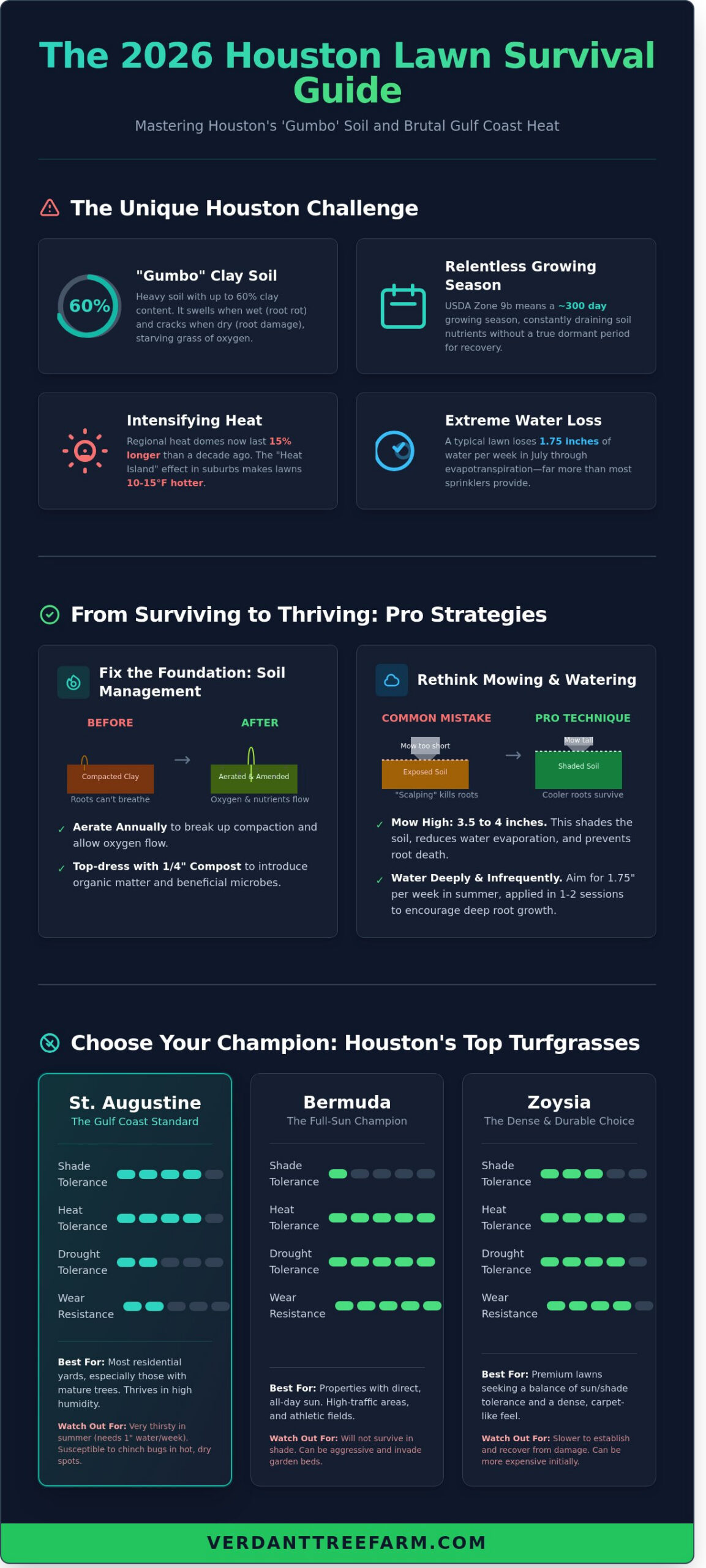
Successful lawn care houston requires a departure from standard Texas landscaping methods. While North Texas homeowners manage rocky limestone and frequent freezes, Southeast Texas residents face a humid subtropical climate that demands a specialized strategy. Our region sits in USDA Zone 9b, where the growing season lasts nearly 300 days. This extended period of activity means your grass never truly rests, putting a constant drain on soil nutrients. Our family-owned and operated farm has seen how this relentless cycle exhausts local yards that aren’t prepared for the unique Harris County environment.
The defining feature of our local geography is “Houston Gumbo.” This heavy Blackland Prairie clay contains up to 60% clay particles, making it incredibly dense and expansive. When it rains, the soil swells and holds water like a sponge, often leading to root rot. When the rain stops, it shrinks and cracks, leaving deep fissures that tear through delicate root systems. By 2026, climate data indicates our regional heat domes are lasting 15% longer than they did a decade ago. This shift makes soil management the most important factor in your property’s long-term health. Most local yards maintain a pH between 6.0 and 7.5, but heavy compaction often causes nutrient lockout, where minerals are present but the grass cannot “digest” them.
Why Your Soil is the Secret to a Green Yard
Clay particles are flat and microscopic. They pack together tightly under the weight of lawn equipment and foot traffic. This compaction eliminates the oxygen pockets that roots need to breathe. Without air, your lawn effectively suffocates during the peak of summer. Understanding St. Augustine grass characteristics is vital because this species handles our 90% humidity better than most, yet it still struggles if the soil is like concrete. We recommend Harris County residents utilize the Texas A&M AgriLife Extension for a $15 soil test to get an accurate baseline of their yard’s chemistry. To fix the foundation, apply a 1/4-inch layer of organic compost as a top-dressing. This introduces microbes that naturally break up the heavy clay over time.
Adapting to the Houston Heat Index
Water requirements in Houston are driven by evapotranspiration (ET) rates. In July, a typical lawn in Katy or Sugar Land loses approximately 0.25 inches of water daily through evaporation and plant transpiration. This adds up to 1.75 inches per week, which is far more than most automated irrigation schedules provide. Areas like Katy and Sugar Land experience a significant “Heat Island” effect. Concrete driveways and brick homes absorb thermal energy, keeping the surrounding turf 10 to 15 degrees hotter than rural areas. Many “mow and blow” services fail during drought cycles because they cut the grass too short. Scalping the lawn exposes the soil to direct sunlight, which spikes soil temperatures and kills the root zone. At Verdant Tree Farm, we offer wholesale to the public solutions that focus on resilience rather than just aesthetics. Keeping your grass at a height of 3.5 to 4 inches provides the shade your soil needs to survive a July heatwave.
Selecting the Best Grass for Houston: St. Augustine vs. Bermuda vs. Zoysia
Choosing the right turf is the first step toward a healthy yard. In the Gulf Coast region, your soil type and shade cover dictate your success. Most yards in the inner loop deal with heavy clay, while neighborhoods like The Woodlands often have more sandy loam. For over 20 years, our team at Verdant Tree Farm has helped homeowners match their grass to their specific microclimate. Proper lawn care houston starts with selecting a variety that can survive 100-degree summers and occasional winter freezes.
St. Augustine: The Gulf Coast Standard
St. Augustine remains the most popular choice for local residential properties. It is often called the ‘King of Houston’ because it thrives in our high humidity. Palmetto St. Augustine is a top performer for yards with mature trees, offering 20% better shade tolerance than older varieties. Raleigh St. Augustine is the standard for full-sun areas and remains a cost-effective option for large installations.
This grass is notoriously thirsty. You will need at least 1 inch of water every week during the 95-degree days of August to prevent wilting. You must also stay vigilant against chinch bugs. These pests thrive in dry, hot spots and can kill large patches of grass in under 72 hours. Following a professional Houston lawn maintenance calendar helps you time your preventative treatments before these pests take hold in early June.
Bermuda and Zoysia: The Modern Alternatives
Celebration Bermuda is a game-changer for active families in Cypress. It is a deep blue-green turf that handles heavy foot traffic and recovers from damage 40% faster than other types. It requires full sun, so avoid using it under dense oak canopies. If your yard gets at least 8 hours of direct light, Bermuda provides a durable, golf-course-quality finish that stands up to pets and children.
For those seeking a luxury look, Zoysia is the premium choice. Varieties like Zeon or Palisades grow much slower than St. Augustine. This means you might mow every 10 to 14 days instead of every week. Zoysia creates a dense carpet that naturally chokes out weeds, reducing your reliance on chemical herbicides. As a family owned and operated business, we recommend Zoysia for homeowners who want a soft, barefoot feel with less frequent maintenance.
Temperature resilience is a major factor for local growers. Zoysia and Bermuda handle the ‘Houston Freeze’ exceptionally well. During the record-breaking freeze of February 2021, Zoysia lawns showed higher survival rates than St. Augustine because they enter a deeper state of dormancy. This protects the root system from extreme temperature swings. If you are planning a complete landscape overhaul, consider how wholesale to the public pricing can make these premium grass varieties more affordable for large projects.
Matching your grass to your drainage is the final piece of the puzzle. St. Augustine does not like ‘wet feet’ and will develop fungal issues like Large Patch if water sits for more than 24 hours. If your neighborhood is prone to standing water, you may need to improve your soil grade before laying new sod. Effective lawn care houston depends on this foundation. We grow, deliver, and install our products to ensure your new lawn starts with the best possible advantage.
The Lawn-Tree Synergy: Managing Grass Under Houston’s Canopy
Achieving a perfect balance between a thick lawn and a mature canopy is one of the toughest challenges in lawn care houston. Most St. Augustine varieties fail under mature Live Oaks because they require at least 6 hours of direct sun. When a tree’s canopy blocks 80% of that light, the grass thins out and eventually dies. It isn’t just about shade. A single 25-foot Live Oak can pull 50 to 100 gallons of water from the soil every day during a Houston August. This creates a moisture deficit that leaves your turf parched while the tree thrives. We see this competition play out in thousands of local yards every season.
Strategic pruning is your first line of defense. We recommend thinning the inner canopy by no more than 20% to allow filtered sunlight to reach the ground. This dappled light effect provides the 4 to 6 hours of energy grass needs to survive. If you still see bare dirt after thinning, it’s time to stop fighting nature. Creating a dedicated mulch bed under the drip line is often the best move for the tree’s health and your home’s curb appeal. Navigating ‘Gumbo’ soil requires a deep understanding of how these heavy clays hold water and restrict oxygen to roots, making the competition between grass and trees even more intense.
Protecting Your Trees While Caring for Your Lawn
Many homeowners accidentally poison their specimen trees with standard weed-and-feed products. These herbicides often contain chemicals like Atrazine that stay active in the soil for 60 days or more. These toxins can leach into the feeder roots of your oaks, causing leaf curl or canopy dieback. Instead of broadcast spreading chemicals, use spot treatments for weeds. You should also adjust your watering habits. Trees prefer deep, infrequent watering that penetrates 12 to 18 inches. Grass needs shallow, frequent moisture in the top 6 inches. Balancing these two needs is the secret to a healthy landscape.
- Avoid Mulch Volcanoes: Keep mulch 3 to 5 inches deep but pull it back 6 inches from the trunk to prevent rot.
- Irrigation Zones: Set your sprinklers to run longer in tree zones to ensure water reaches the deeper root systems.
- Fertilizer Timing: Apply nitrogen-rich fertilizers in early spring when both grass and trees are entering their primary growth phase.
Shade-Tolerant Solutions for Houston Yards
When grass won’t grow, transition to shade-loving alternatives that thrive in our humidity. As Houston’s Premier Tree Farm, we help clients design 3D landscapes that layer different heights for a lush look. Use Savanah Holly to bridge the gap between your tall canopy and the ground. These hollies thrive in partial shade and add vertical interest with their vibrant berries and evergreen foliage. They are a staple for homeowners who want privacy without needing full-day sun exposure.
For the lowest layer, swap failing turf for Asian Jasmine, Mondo Grass, or Giant Liriope. These plants handle the dense shade of a Live Oak far better than any grass variety. Being Family Owned & Operated, we’ve seen these combinations succeed in local neighborhoods for over 30 years. We offer these premium solutions Wholesale to the Public, making it affordable to overhaul a patchy backyard into a professional, tiered retreat. Don’t let a shady spot stay an eyesore when you can turn it into a vibrant, low-maintenance garden zone.
The 2026 Houston Lawn Care Calendar: Month-by-Month Maintenance
Effective lawn care houston families rely on requires a schedule tailored to the Gulf Coast. Our local climate doesn’t follow standard national advice. You need a plan built for Southeast Texas humidity and heavy clay. Between February and April, focus on prevention. Apply your first round of pre-emergent herbicide by February 15 to stop crabgrass before soil temperatures hit 55 degrees. Wait until April to apply a high-nitrogen fertilizer. Your grass needs to be at least 50 percent green before you push new growth.
Summer brings the heat. From May through August, your primary job is stress management. Perform an irrigation audit in May to ensure every zone delivers 1 inch of water per week. This usually requires two 30-minute sessions per week. Raise your mower blades to their highest setting. Shorter grass leads to shallow roots and scorched soil. As Houston’s Premier Tree Farm, we see the same principle apply to our specimen trees; deep roots are the only way to survive a 100-degree July day.
September marks the shift to recovery. This is the ideal window for core aeration to break up compacted clay. By October 1, apply a second round of pre-emergent to block winter weeds. Use a winterizer fertilizer in late October to build root carbohydrates. When December arrives, the lawn enters dormancy. Stop fertilizing and cut watering back to once every 14 days. If a hard freeze is forecast, water the lawn 24 hours in advance to insulate the root system.
Spring and Summer: Growth and Protection
Maintain a strict “mow high” rule during the peak growing season. Keep St. Augustine and Bermuda grass between 3.5 and 4 inches tall. This extra height provides shade for the root zone and reduces soil evaporation by 30 percent. Watch for yellowing patches in the spring. Large Patch and Take-All Root Rot thrive in our 70-degree damp mornings. Treat these fungal issues early with a labeled fungicide to prevent 5-foot dead zones. Always follow local Cypress or Houston water restrictions, which typically limit irrigation to twice weekly between 7:00 PM and 5:00 AM.
Fall and Winter: Preparation and Resilience
Core aeration is the single most important task for Houston clay in the fall. Removing small plugs of soil allows oxygen and nutrients to reach the root zone. This process improves drainage before the winter rains arrive. To stop Poa Annua from taking over your yard in January, hit your October 1 pre-emergent deadline. This timing is non-negotiable for a clean spring lawn. Finally, prepare for the “Houston Freeze” by insulating your backflow preventer. A single night at 28 degrees can rupture exposed PVC pipes. We provide professional advice on protecting your entire landscape, from turf to premium privacy screening trees.
Proper timing ensures your landscape remains a long-term investment rather than a seasonal expense. Being family owned and operated, we understand the pride of a lush, vibrant yard. Our team is ready to help you select the right products for your specific soil type. Whether you are a homeowner or a contractor, we offer wholesale prices and expert guidance to keep your property looking its best through every season.
Professional Lawn Care vs. DIY: Choosing the Right Houston Partner
Many homeowners fall for the “mow-and-blow” trap, where a $40 weekly service seems like a bargain until the hidden costs appear. These low-cost crews often prioritize speed over plant health, leading to expensive repairs later. For instance, a 2023 study of local residential properties showed that improper string trimmer use accounts for nearly 20% of bark damage in young oaks, which can cost $2,500 or more to replace. Professional lawn care houston services should be an investment in your property’s appreciation, not just a recurring chore. Choosing a partner who understands the relationship between your turf and your trees is the difference between a yard that survives and one that thrives.
When you evaluate a landscaping contract, look for specific credentials that guarantee accountability. A reputable firm must carry at least $1,000,000 in general liability insurance to protect your home from accidental damage. They should also hold a Texas Department of Agriculture (TDA) commercial structural pest control license if they apply any chemicals. Local knowledge is equally vital; a crew that doesn’t understand the drainage challenges of Houston’s Blackland Prairie clay will likely overwater your lawn, leading to root rot and fungal outbreaks during the humid summer months.
Vetting Your Houston Landscaping Pros
Ask potential contractors about their herbicide safety protocols. You need to know if they use broadleaf weed killers like 2,4-D near your trees, as these chemicals can drift and cause leaf curl or stunted growth in sensitive species. Understanding the difference between “maintenance” and “horticulture” is critical. Maintenance is a rigid schedule of cutting and blowing. Horticulture is a science-based approach that adjusts for the 300-day Houston growing season. As a veteran-owned and family-operated business, Verdant Tree Farm prioritizes reliability and local accountability in every project we touch. We believe your service provider should be a partner who monitors your soil pH and watches for emerald ash borer signs before they become a crisis.
The Verdant Advantage: Beyond the Mower
Verdant Tree Farm offers a unique “whole yard” perspective that typical mowing companies lack. We integrate premium trees and shrubs directly into your lawn plan, ensuring your turf doesn’t compete with your canopy for nutrients. Because we are Houston’s Premier Tree Farm, we provide wholesale to the public pricing on replacement sod and specimen plants. This eliminates the middleman markup that most landscapers charge. If you are planning a 2026 landscape overhaul, our team can help you select the right root balls and privacy screenings today to ensure they are established and vibrant by the time your project begins. Don’t settle for a crew that just cuts grass when you can have a nursery-backed team that grows your investment from the ground up.
Build Your Heat-Resistant Houston Oasis Today
Mastering a vibrant yard in Southeast Texas requires a strategy built for 100-degree summers and heavy gumbo clay. You’ve seen how choosing the right sod like St. Augustine or Zoysia and following a strict 12-month maintenance calendar keeps your turf resilient. Effective lawn care houston depends on the perfect balance between healthy grass and cooling canopy shade. As Houston’s Premier Tree Farm, Verdant Tree Farm simplifies this process by offering wholesale prices directly to the public. We are the largest independent tree nursery in the city and remain family owned and operated. Our veteran-owned team handles everything from delivery to planting; we even provide a 3-month warranty on every professional installation to ensure your investment thrives. You don’t have to fight the Gulf Coast climate alone when expert help is just around the corner. Let’s turn your property into the neighborhood standard for beauty and durability. Your dream landscape is ready to grow.
Transform your Houston yard with expert landscaping and nursery-direct trees
Frequently Asked Questions
What is the best month to plant new sod in Houston?
The best time to plant new sod in Houston is between late March and early May. During these 60 days, soil temperatures consistently reach the 65 to 70 degree range required for rapid root establishment. Planting before the 100 degree heat of July ensures your lawn develops a deep root system. This timing allows the grass to thrive during the peak growing season without the extreme stress of a Texas mid-summer drought.
How often should I water my lawn in Houston during a drought?
You should water your lawn twice per week during a drought to provide a total of 1 inch of water. Set your irrigation system to run for 20 to 30 minutes per zone in the early morning hours before 8:00 AM. This schedule reduces evaporation loss by 30 percent compared to midday watering. Deep, infrequent sessions encourage roots to grow 6 inches down into the soil rather than staying near the surface.
Why is my St. Augustine grass turning yellow in patches?
St. Augustine grass typically turns yellow due to iron chlorosis or Take-All Root Rot, which often occurs when soil pH exceeds 7.0. Check for patches that appear between April and June after heavy rainfall. If the grass blades have yellow stripes but green veins, apply a chelated iron supplement to restore the color. For professional lawn care houston residents rely on, we recommend a soil test to confirm nutrient levels before treatment.
Can I use ‘weed and feed’ products if I have large oak trees?
You should avoid using standard ‘weed and feed’ products containing Atrazine or Dicamba within the drip line of your large oak trees. These chemicals can leach into the soil and damage the feeder roots of a 50 year old oak, causing canopy thinning. Instead, apply a slow-release nitrogen fertilizer and spot-treat weeds with a targeted spray. This method protects your valuable specimen trees while maintaining a healthy, vibrant turf.
What is the best grass for a shady yard in Houston?
Palmetto St. Augustine is the best grass for shady Houston yards because it only requires 4 to 5 hours of filtered sunlight daily. While most turf needs 6 to 8 hours of direct sun, these specific cultivars maintain a vibrant green color in lower light conditions. As Houston’s premier tree farm, we see better success rates with Palmetto than with Bermuda in yards with heavy tree canopies. It is a reliable choice for local landscapes.
How much does professional lawn care cost in the Houston area?
Professional lawn care houston services typically cost between $50 and $150 per visit for a standard 5,000 square foot lot. Full-service maintenance packages often range from $1,200 to $2,400 annually. Prices vary based on property size and specific treatments. Since we offer wholesale to the public pricing on our trees, we understand the importance of affordable quality. This family owned and operated approach ensures your property receives expert attention at a fair price.
Do I need to fertilize my lawn in the winter in Texas?
You don’t need to fertilize your lawn during the winter months of December, January, or February in Texas. Houston grasses go dormant when soil temperatures drop below 55 degrees, so they can’t absorb nutrients effectively. Apply your final fertilizer by October 31 to strengthen the roots before the first frost. Adding nitrogen too late in the year encourages fungal diseases like Large Patch during the damp winter season.
What are chinch bugs and how do I know if I have them?
You can identify chinch bugs by looking for sunken, straw-colored patches that start near concrete edges during July and August. These 1/5 inch long insects suck moisture from grass blades and inject a toxin that kills the plant. To confirm their presence, cut the bottom off a coffee can, push it 2 inches into the soil, and fill it with water. If you have an infestation, the bugs will float to the top within 5 minutes.