A single row of trees may screen traffic from view without making it noticeably quieter. Planting trees to reduce road noise works best with a wide, dense buffer: a 100-foot-wide planted buffer can reduce noise by 5 to 8 dBA, while narrow plantings often have little effect on sound levels. Setback and the buffer’s position also matter.
It’s understandable to expect a leafy screen to create a quieter yard, especially when traffic is a constant presence. Trees and shrubs can soften the view and make an outdoor space feel more sheltered, but planting design matters when planting trees to reduce road noise. This article explains how buffer width, distance from the road, and dense, ground-level foliage affect results. You’ll also learn why planting may improve the feel of a space without blocking much sound, and what to consider when planning a landscape near a busy Houston road.
Key Takeaways
- Positioning a planted buffer close to the road can matter more than placing it halfway between traffic and your home.
- Plan the buffer’s length as well as its width so sound cannot easily travel around its ends.
- Choose dense vegetation with foliage near the ground; gaps and seasonal leaf loss can weaken the screen.
- For stronger sound control, consider how planting, existing landforms, and a solid barrier can work together.
What Affects How Much Noise Is Reduced?
Noise reduction depends on buffer width, density, position, and the land between traffic and the listener. Trees can screen a road, but a narrow row rarely makes a noticeable difference to traffic noise.
Noise Reduction from Trees and Landforms
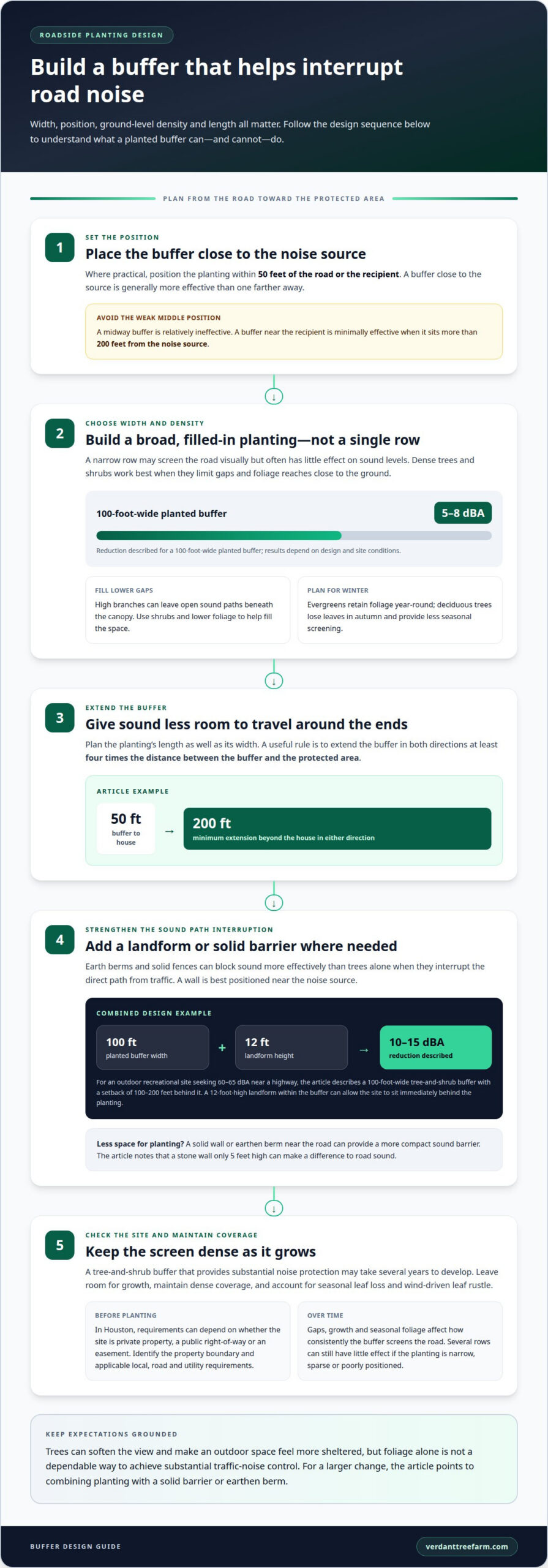
A planted buffer softens traffic noise when dense foliage and branches interrupt the path between the road and a listener. A 100-foot-wide planted buffer can reduce noise by 5 to 8 dBA. Adding a 12-foot-high landform to a 100-foot-wide planted buffer can raise the reduction to 10 to 15 dBA.
Existing slopes and berms can help block the direct line of sight between a road and a home. For a two-story house, the buffer must also block the view from the upper floor to the noise source. A sound path over the planting or landform can limit its effect.
Comparing Trees, Berms, and Fences
Earth berms and solid fences can block sound more effectively than trees alone, especially when they interrupt the direct path from traffic. A properly positioned acoustic barrier is a stronger option for substantial noise control; trees can add a visual screen and soften the landscape. Place a wall near the noise source rather than within the planting.
A stone wall only 5 ft. high can make a difference to road sound. The cost of a tree barrier depends on its scale, plant choices, site preparation, and installation needs. A narrow single row may screen the road visually, but it won’t deliver the effect of a broad, dense buffer.
Factors Affecting Buffer Effectiveness
Width, density, and placement all shape how well a planted buffer performs. Trees and shrubs should fill gaps, and foliage close to the ground helps block sound beneath higher branches. Position the buffer close to the road where practical. A buffer is generally more effective when placed close to the noise source than farther away.
Wind can rustle leaves and add to background noise. Topography matters, too: a natural landform can strengthen the barrier effect. That helps explain why several rows of trees may still make no noticeable difference if the planting is narrow, sparse, or poorly positioned.
Seasonal and Long-Term Noise Reduction
Evergreens provide foliage throughout the year, while deciduous trees lose their leaves in autumn, reducing their screening effect. For winter screening, year-round foliage and dense planting matter. Roadside trees also need room to grow without leaving open gaps in the buffer.
A tree-and-shrub buffer that provides substantial noise protection may take several years to develop. In the meantime, wind-driven leaf rustle and routine upkeep, such as maintaining dense coverage, affect how the screen performs. For broader property enhancements, landscape specialists such as Palisades Outdoor Solutions note that ongoing maintenance consultations can help assess how growth, gaps, and seasonal foliage affect vegetative buffers over time.
Buffer width and setback distance
Buffer design depends on both the planted strip’s width and its position between traffic and the protected area. A tree-and-shrub buffer may need to be wide and dense to help block the line of sight. Setback matters too: a buffer is preferably within 50 feet of the road or the recipient, rather than midway between them.
Plan the buffer’s length as well as its width. A useful rule is to extend it in both directions at least four times the distance between the buffer and the protected area. For example, if a buffer sits 50 feet from a house, it should extend at least 200 feet beyond the house in either direction. This helps limit sound traveling around the planting’s ends.
For an outdoor recreational site seeking 60 to 65 dBA near a highway, a 100-foot-wide tree and shrub buffer needs a setback of 100 to 200 feet behind it. A 12-foot-high landform within the buffer can allow the site to sit immediately behind the planting. These examples show how the intended use and layout shape the design.
If there isn’t room for a wide planting, a solid wall or earthen berm near the road can provide a more compact sound barrier. Planting closer to the home is another option, though a buffer near the recipient is minimally effective when it sits more than 200 feet from the noise source. A midway position is relatively ineffective.
There’s no single cost for a noise-reducing tree barrier. The project’s size, plant choices, site preparation, and installation needs all affect the total. In Houston, planting requirements can depend on whether the site is private property, a public right-of-way, or an easement. Identify the property boundary and determine which local, road, and utility requirements apply before placing trees. A maintenance consultation can help assess how a planting’s layout and growth affect the landscape over time.
Dense vegetation and sound attenuation
Dense vegetation can soften the perceived impact of road noise, but leaves alone rarely create a strong acoustic barrier. The Federal Highway Administration states that trees and other vegetation can provide psychological relief without physically lessening noise levels. A green screen may make a roadside view feel calmer, even when measured sound changes remain limited.
Coverage matters more than simply adding rows. Dense trees and shrubs should limit gaps, with leaves growing close to the ground. High branches leave open routes for sound beneath the canopy. Large trunks can deflect sound, while textured bark and foliage can refract some sound energy. Leaves scatter some higher-frequency sound, but this does not necessarily lower overall noise.
Results vary across sources. A wide, dense vegetative buffer is unlikely to reduce noise by more than 3 to 5 dBA, and about 10 dBA of reduction corresponds to half the apparent noise level. Urban trees may reduce nearby noise by five to ten decibels, but trees alone are not a dependable way to achieve substantial traffic-noise control. A solid barrier or earthen berm may be needed for a larger change.
Plant selection also affects how consistently the screen performs. Evergreens retain foliage through winter, while deciduous trees lose their leaves in autumn. A mix of trees and shrubs can fill lower and upper gaps, but the planting must suit the site and tolerate conditions such as air pollution and de-icing methods where relevant. Wind adds another consideration: rustling leaves can raise background sound.
For a homeowner, the practical test is whether planting forms a continuous screen between the road and the listening area. A scattered row may provide visual relief without meaningfully changing the sound. Dense foliage, ground-level coverage, and a barrier that blocks the sound path work together more effectively than tree count alone. Trees also need time to establish before the buffer reaches its intended density, and arborist specialists such as primetreeservices.co.nz emphasize that ongoing pruning and health management are essential to maintaining dense, resilient foliage over the long term.
How trees and shrubs reduce noise
Roadside vegetation interacts with sound through its leaves, branches, and trunks. Leaves and branches absorb, refract, and deflect some sound-wave energy, while dense trunks can also deflect sound. These effects depend on the planting’s structure, not simply the number of trees. A scattered row leaves open paths for sound to pass through.
Evergreens with foliage extending close to the ground, such as cedar or cypress, can provide year-round screening. Low growth helps cover the gap beneath taller trees. Deciduous trees lose their leaves in autumn, reducing their screening effect in winter. A mix of tree heights and shrubs can create more continuous coverage than trees with bare lower trunks.
Leaf texture and branch density affect how sound moves through a planting. Textured bark and leaves can refract sound, while foliage scatters some higher-frequency sound. But scattering those frequencies does not automatically reduce overall traffic noise. The Federal Highway Administration says vegetation can offer psychological relief without physically lessening noise levels. A leafy view may feel more comfortable, even when measured sound changes little.
That distinction matters when setting expectations. Trees and shrubs can soften the roadside environment, but vegetation alone may not deliver substantial acoustic protection. A 10 dBA reduction requires either a very wide, dense planting or a solid barrier, such as an earthen berm, wall, or fence. Wind also rustles leaves, which can add sound rather than reduce it.
When planting trees to reduce road noise, prioritize continuous foliage over a particular tree count. Choose species suited to the site, then combine ground-level shrubs with trees whose branches and leaves help fill gaps. Consider whether you want year-round screening, since deciduous foliage changes seasonally. Dense growth takes time to develop, so the planting’s initial appearance won’t reflect its mature screening effect.
Use a planting plan suited to your property to match foliage, coverage, and site conditions.
Verdant Tree Farm: Live Oak
Verdant Tree Farm can help you choose trees for a roadside planting that suits your property and landscape goals in Houston. Live Oak, Shumard Oak, Mexican White Oak, and Drummond Red Maple are among the available options. Tree selection is only one part of the design: buffer width, foliage density, placement, and whether a solid barrier is needed also shape noise-control results.
Consider the space available and whether you want year-round foliage before settling on a layout. A tree buffer can add greenery and screen the view, but trees alone may not provide substantial noise reduction. Contact Verdant Tree Farm to discuss tree options and professional installation for your Houston property.
Plan the next step for your landscape
Start by deciding which outdoor space matters most to your household. You might focus on a patio where you spend evenings, a garden beside a bedroom, or a shared area that needs more privacy. Naming the priority helps keep the design grounded in how you use your property every day.
Planting trees to reduce road noise can also create a more inviting landscape, so consider how the planting will look and function as it matures. Think about sightlines, access, and how new trees will fit with existing plants and outdoor features. These details help turn a general goal into a practical plan for your Houston property.
Verdant Tree Farm can help you explore tree choices for your property and its landscape goals. Contact Verdant Tree Farm for advice to discuss a thoughtful next step for your outdoor space.
Frequently Asked Questions
Can Trees and Shrubs Reduce Noise?
Yes, trees and shrubs can soften the experience of road noise, though their visual screening may be more noticeable than any change in sound levels. Leaves scatter some higher-frequency sound, but that doesn’t necessarily reduce overall traffic noise. For a patio, a leafy screen can make the road less visible and the space feel more sheltered, even when traffic remains audible.
How effective are trees at reducing road noise in decibels?
A 100-foot-wide planted buffer can reduce noise by 5 to 8 dBA. That figure is a useful reference, not a promise for every property: the result depends on planting density, gaps, terrain, and the sound path from road to listener. If traffic remains clearly audible, adding trees alone may not create a large change in measured sound.
How wide and dense does a tree buffer need to be to reduce traffic noise?
A buffer made only of trees and shrubs needs to be at least 100 feet wide to block the line of sight. It should also form continuous coverage, rather than leaving open gaps between plants or beneath branches. Think of width and density together: a wide but sparse planting can still leave sound paths through the screen.
What is the best layout for planting trees and shrubs as a noise barrier?
Arrange trees and shrubs as a continuous band, with lower foliage filling spaces beneath taller branches. A staggered arrangement can help avoid straight gaps through multiple rows. Extend the planting beyond the area you want to protect, so sound is less likely to travel around its ends. Keep the layout aligned with the main sound path from road to yard.
How far from a road should trees be planted, and what safety setbacks are needed?
For sound control, placing a buffer within 50 feet of the noise source is preferred, but the road edge isn’t automatically the right planting line. Leave an appropriate setback for roadway safety, accidents, and drifting snow. The usable space depends on the property and road layout. Keep planting clear of the roadway’s required operating area and plan around visibility.
What local rules or permits apply to planting trees near roads and property lines?
Requirements can depend on whether the site is private property, a public right-of-way, or an easement. Identify the property boundary and determine which local, road, and utility requirements apply before planting.