What if the greatest threat to your new landscape isn’t a hurricane, but the first two years of living in Houston’s “gumbo” clay? You have likely invested a significant amount in a beautiful Live Oak or a Drummond Red Maple, only to find yourself second-guessing every drop of water you provide. It’s a common struggle for local homeowners who feel caught between the fear of root rot and the dread of a withered investment. Mastering tree care after planting Houston landscapes requires more than just a garden hose; it requires a strategy built for our specific Gulf Coast environment.
We understand that you want the confidence of a professional contractor and the results of a seasoned arborist. This 2026 survival guide promises to demystify the establishment phase by providing clear, direct advice on soil management and extreme weather protection. You’ll learn the precise watering rhythms needed now that mandatory restrictions are lifted, how to manage drainage in heavy clay, and the vital steps to ensure your tree provides cooling shade for decades to come. We’ll also look at how to navigate city ordinances to keep your property both beautiful and compliant.
Key Takeaways
- Understand the “Establishment Period” rule, which requires one year of dedicated care for every inch of trunk diameter to ensure long-term survival.
- Master deep-watering techniques to prevent the “Clay Bowl” effect, which is a vital part of effective tree care after planting Houston landscapes.
- Apply the 3-3-3 mulching rule using native hardwood to insulate roots and improve the health of our regional clay soil.
- Prepare for Gulf Coast weather extremes by learning proper staking for tropical storms and trunk protection for sudden winter freezes.
- Secure your investment by establishing a relationship with local experts and following specific maintenance guidelines to keep your tree warranty valid.
The Critical First 24 Months: A Houston Tree Establishment Timeline
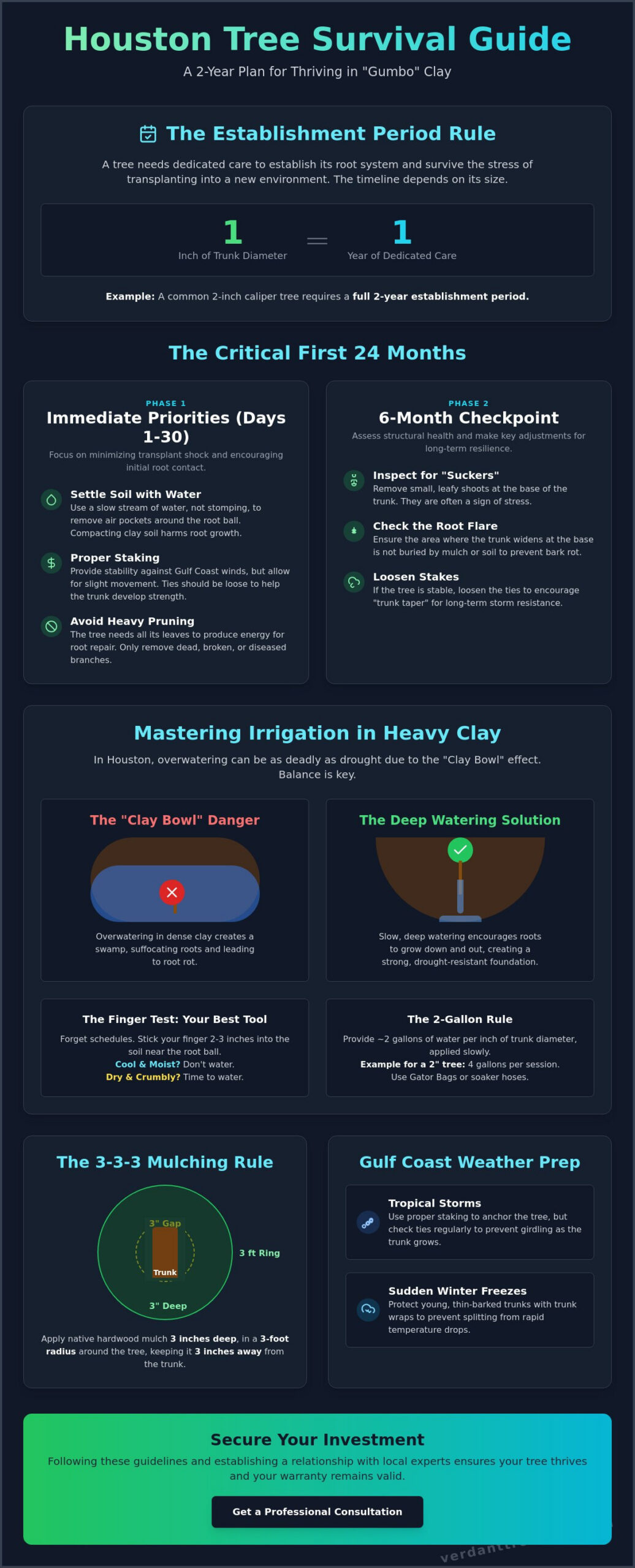
Successful tree care after planting Houston gardens starts with a calendar, not just a shovel. Most homeowners expect their new Live Oak or Drummond Red Maple to take off immediately. However, the first 24 months are a period of quiet, invisible work. This timeline is grounded in the science of arboriculture; which dictates that a tree needs roughly one year of establishment for every inch of trunk diameter. If you’ve planted a 2-inch caliper tree, you’re looking at a two-year “establishment gap” where the root system must outpace the stress of our local environment.
The first 100 days are the most volatile. This is when transplant shock is most likely to occur. While our high Texas humidity can actually help by reducing moisture loss through the leaves, it doesn’t replace the need for vigilant root care. Even during the first winter, when your tree looks dormant and the leaves are gone, the roots are still active. In Houston’s mild climate, soil temperatures rarely drop enough to stop root elongation entirely. This winter growth is what prepares the tree for the brutal heat of the following July. By Year Two, the focus shifts from survival to structural resilience; transitioning from daily monitoring to encouraging deep, independent growth.
Immediate Post-Planting Priorities (Days 1-30)
During the first month, your primary goal is settling the soil. Air pockets around the root ball can cause roots to dry out and die. Instead of stomping the ground, which compacts our heavy clay, use a slow stream of water to naturally settle the earth. Staking is another critical decision. In our windy Gulf Coast region, stakes provide necessary stability for young trees like the Mexican White Oak. However, they should never be “tight.” A tree needs to move slightly to develop a strong, thick trunk. We also recommend avoiding heavy pruning now. Your tree needs every leaf it has to produce the energy required for root repair. Only remove branches that are dead, broken, or diseased.
The 6-Month Checkpoint: Assessing Structural Health
Once you hit the six-month mark, it’s time for a professional-level inspection. Look for “sucker” growth at the base of the trunk. These small, leafy shoots are often a sign that the tree is stressed and trying to bypass its main canopy. You should also check the root flare. Houston’s heavy rains can wash silt and mulch over the base of the tree. If the flare is buried, the bark can rot. Finally, check your stakes. If the tree is stable, loosen the ties. This allows the tree to develop “trunk taper,” which is the natural thickening at the base that provides long-term stability against tropical storms. Effective tree care after planting Houston properties is about these small, timely adjustments.
Mastering Irrigation in Houston’s Heavy Clay Soil
Most Houstonians fear drought, but in our region, the “Clay Bowl” effect is often the silent killer of young trees. When you dig a hole in our dense “black gumbo” soil, you’re essentially creating a non-porous basin. If you overwater, your new Cedar Elm or Bald Cypress will sit in stagnant water, leading to root suffocation. Effective tree care after planting Houston landscapes requires a delicate balance. You must provide enough moisture for establishment without turning the planting hole into a swamp. Surface sprinkling rarely does the job; it only wets the top inch of soil, leaving the deep roots thirsty and encouraging weak, shallow growth.
The “Finger Test” is your most reliable tool for checking moisture. Don’t rely on the appearance of the surface. Stick your finger two to three inches into the soil near the root ball. If the soil feels cool and moist, skip watering for the day. If it feels dry and crumbly, it’s time to irrigate. This hands-on approach is recommended by the Houston Area Urban Forestry Council to prevent the common mistakes of automated systems. For personalized guidance, our team offers maintenance consultations to help you dial in your specific irrigation needs based on your property’s unique drainage patterns.
Calculating Water Volume by Tree Size
A good rule of thumb is the 2-gallon rule. You should provide approximately two gallons of water for every inch of the tree’s trunk diameter. For a standard 2-inch caliper tree, that’s four gallons per watering session. Slow-release methods are the gold standard for this. Gator Bags or soaker hoses deliver water slowly, allowing the clay to actually absorb the moisture rather than letting it run off. Deep watering is the practice of delivering water 12-18 inches below the surface to encourage downward root migration. This technique builds a resilient tree that can survive the dry “dog days” of August when surface moisture evaporates instantly.
Managing Drainage in ‘Gumbo’ Soil
Even with perfect watering, Houston’s flash floods can cause issues. Signs of root rot include yellowing leaves and a distinct “sour” or sulfur-like smell coming from the soil. If your planting site is prone to standing water, you must create breathing room. This might involve slightly elevating the mulch or ensuring the root flare remains visible. Houston’s high humidity also plays a role; it slows down transpiration, meaning trees may hold onto water longer than they would in a drier climate. Watch your tree closely after heavy spring deluges to ensure the roots aren’t drowning in the gumbo. Proper tree care after planting Houston properties means staying active and observant through every season.
Mulching and Fertilization: Fueling Growth in the Gulf Coast
Proper mulching is a cornerstone of tree care after planting Houston area landscapes. It serves as a protective layer that stabilizes soil moisture and temperature during our volatile weather shifts. We recommend the 3-3-3 rule for every new installation, whether it’s a Shumard Oak or a Little Gem Magnolia. This means applying 3 inches of mulch in a 3-foot ring while keeping it 3 inches away from the trunk. Using native hardwood mulch is far superior to dyed cypress options. Hardwood decomposes naturally, adding vital organic matter back into our heavy clay soil. It’s not just about aesthetics; it’s about building long-term soil health.
Fertilization requires a patient, calculated approach. Many homeowners want to feed their trees immediately to see fast growth, but you should wait until the second growing season. Pushing top growth with high-nitrogen fertilizers before the roots are established can cause significant physiological stress. Organic options are generally better than synthetics because they support the fungal networks new roots need. These mycorrhizal fungi act as an extension of the root system. They help the tree navigate the establishment gap by pulling in more water during our dry spells and flash floods.
The Dangers of ‘Volcano Mulching’
Piling mulch against the bark, known as volcano mulching, is a common but dangerous mistake in Houston suburbs. This practice traps moisture against the trunk, inviting rot and opportunistic pests like borers. It can also cause the tree to grow “girdling roots” that eventually strangle the trunk. Mulch acts as a thermal blanket, keeping roots up to 10 degrees cooler during peak summer heat. However, it only works if applied correctly. Keep the root flare clear so the bark can stay dry and healthy. This simple adjustment can prevent a premature death for your investment.
Nutrient Management for Young Trees
Young trees need a solid foundation rather than a quick chemical boost. High-nitrogen synthetic fertilizers often force the canopy to grow faster than the root system can support. This leads to weak, leggy branches that are vulnerable to our frequent tropical storms. We suggest using landscaping services Houston for professional soil testing before adding any amendments. This ensures you’re providing exactly what your specific site lacks. Whether it’s phosphorus for root development or organic matter to break up the gumbo clay, data-driven care is always the smartest route.
Protecting New Trees from Houston’s Extreme Weather
While native species are adapted to our climate, a newly planted tree lacks the root depth to handle 100-degree heat or a 15-degree freeze on its own. Effective tree care after planting Houston properties means acting as a buffer against these environmental shocks. You’ve invested in a quality specimen; now you must help it navigate our local extremes. Native status doesn’t protect a young sapling from a sudden arctic blast if its roots haven’t yet reached below the frost line.
Before a cold snap, water your trees thoroughly. Wet soil has higher thermal mass, which means it releases heat slowly and protects the sensitive root system from freezing. For thin-skinned young trees like the Mexican White Oak, wrap the trunk with burlap or specialized tree wrap from the ground up to the first set of branches. This prevents frost cracks and bark splitting when temperatures fluctuate wildly. Hurricane preparedness is just as vital. Proper staking is a life-saver during tropical storms. Use flexible ties that allow for slight movement but prevent the root ball from rocking in the soil. A rocking root ball breaks the tiny feeder roots just as they try to establish in the clay, setting your progress back by months.
During the peak of summer, recognize that your tree might enter a state of drought dormancy to survive the heat. This is a survival mechanism, not necessarily a death sentence. Sunscald is another real threat. The intense South Texas sun can literally bake the bark on the southwest side of a young tree, leading to permanent scarring. If you’re unsure how to shield your new landscape from these threats, contact Verdant Tree Farm for professional guidance on seasonal protection strategies.
Winterizing Your Young Landscape
Start by selecting the best evergreen trees for Houston that offer natural cold hardiness for our USDA Zone 9 environment. If you use trunk wraps for a freeze, remove them as soon as temperatures rise above 40 degrees. Leaving them on too long traps moisture against the bark. This creates a dark, damp breeding ground for fungal pathogens and opportunistic insects that can weaken the tree’s defense systems.
Summer Stress Management
Shift your watering schedule to the evening to reduce evaporation loss and give the tree all night to absorb moisture. For sensitive understory species like the Texas Redbud, temporary shade structures made of 40% shade cloth can prevent leaf scorch during their first July. Learn to distinguish between heat-related scorch, which typically shows brown edges on all leaves, and fungal infections that appear as localized spots. Keeping the foliage dry while watering the roots is the best way to prevent heat-related disease.
Long-Term Success: Maintenance and Professional Oversight
Long-term success isn’t just about surviving the first year. It’s about ensuring your tree becomes a permanent, value-adding fixture of your property. Establishing a relationship with a local nursery provides you with a reliable resource for year-round support as environmental conditions shift. For those who choose our professional installation, the Verdant Tree Farm 3-month warranty offers essential peace of mind. To keep this warranty valid, homeowners must follow the watering and mulching protocols we’ve established in this guide. This partnership ensures that your tree care after planting Houston homes remains on the right track from the moment the root ball hits the soil.
As your tree matures, the care requirements change. You eventually move from high-frequency “establishment care” to “legacy care.” This stage focuses on maintaining health and preparing the canopy for decades of shade and beauty. If you notice signs of stress that don’t respond to your standard watering rhythm, it’s time for a Maintenance Consultation. Our experts can identify underlying issues before they become terminal, protecting your financial and emotional investment in your landscape.
When to DIY vs. When to Call an Expert
Some tasks are perfect for the weekend gardener, but others require a professional eye to prevent disaster. Spotting pests like Pine Bark Beetles early is critical; look for tiny holes or popcorn-shaped “pitch tubes” on the trunk. Structural pruning is another area where expertise pays off. The decisions made in the first three years determine the tree’s lifetime shape and its resistance to hurricane-force winds. While residential owners can often manage small-scale irrigation, commercial properties or large estates may need professional assessment to ensure coverage is efficient across a massive root zone. Professional oversight simplifies these technical processes for the average homeowner.
Verdant Tree Farm: Your Houston Partner
We take pride in our role as a regional market leader. Our veteran-owned operation focuses on native Texas species like the Shumard Oak and Cedar Elm that are genetically prepared for our specific climate. Because we use a direct-to-consumer model, you receive trees that are already acclimated to Houston’s humidity and “gumbo” soil. This directly reduces transplant shock and streamlines your tree care after planting Houston landscapes. We are more than just a nursery; we are a multi-generational enterprise dedicated to the growth of our community and the long-term health of your property.
Schedule your maintenance consultation with Verdant Tree Farm today to ensure your new trees have everything they need for a long, healthy life.
Secure the Future of Your Houston Canopy
Your new tree is more than just a landscape feature; it’s a living legacy for your home. By mastering the critical 24-month establishment timeline and navigating the unique challenges of our “black gumbo” soil, you’ve taken the most important steps toward a thriving canopy. Remember that consistent, deep irrigation and the 3-3-3 mulching rule are your best tools for long-term health. Mastering tree care after planting Houston landscapes ensures your investment survives our intense summers and sudden winter freezes to provide cooling shade for decades.
We are here to be your dependable partner in this journey. As a veteran-owned and operated business with the largest independent inventory in the city, we provide trees that are already acclimated to our specific regional environment. We stand behind our work with a 3-month warranty on all professional installations. Whether you’re looking for a majestic Live Oak or a vibrant Redbud, we have the expertise to help you succeed. Visit Houston’s Largest Independent Tree Nursery to Find Your Next Tree. Your property’s transformation starts with the right species and the right advice. Let’s grow a greener Houston together.
Frequently Asked Questions
How often should I water my new tree in Houston?
You should water a newly planted tree daily for the first two weeks, then transition to every other day for the following month. In our Gulf Coast heat, providing about two gallons per inch of trunk diameter is the standard volume. Use the “Finger Test” to check moisture levels before each session. This ensures your tree care after planting Houston properties stays consistent without causing root rot in our heavy clay.
Is it possible to overwater a tree in Houston’s clay soil?
Yes, overwatering is a common cause of tree failure in Houston due to the “Clay Bowl” effect. Our dense gumbo soil acts like a basin, trapping stagnant water around the root ball. If you see yellowing leaves or smell a sour odor from the ground, the roots may be suffocating. Always verify that the top few inches of soil have started to dry before you add more water.
When is the best time of year to plant a new tree in Houston?
The best time to plant is between November and February. Planting during these cooler months allows the root system to establish before the intense summer heat arrives. While we can plant year-round with professional installation, the dormant season reduces transplant shock. This timing gives species like the Drummond Red Maple a head start on root development while temperatures are mild and evaporation rates are low.
Do I need to fertilize my tree immediately after planting?
No, you should generally wait until the second growing season to apply fertilizer. A newly planted tree needs to focus its energy on root establishment rather than producing new canopy growth. Adding high-nitrogen fertilizer too early can actually stress the plant. Once the tree is established, use organic amendments that support the natural fungal networks in the soil rather than harsh synthetic chemicals.
How do I protect my young tree from a hard freeze in Houston?
Protect your young tree by watering it thoroughly before the freeze and wrapping the trunk with burlap. Wet soil retains more heat than dry soil, which provides a thermal buffer for the roots. For thin-skinned trees like the Mexican White Oak, wrap from the base up to the first branches to prevent frost cracks. Remove these wraps as soon as the temperature rises above 40 degrees to prevent moisture buildup.
Why are the leaves on my newly planted tree turning yellow?
Yellow leaves are typically a sign of moisture stress, either from overwatering or poor drainage in our clay soil. When roots sit in stagnant water, they can’t absorb oxygen, which leads to chlorosis. However, it can also indicate transplant shock during the first 100 days. Check the soil moisture with your finger; if it’s soggy, reduce your watering frequency immediately to allow the roots to breathe.
Should I remove the stakes from my tree after the first year?
Yes, most trees should have their stakes removed after 12 to 18 months. Stakes are meant to provide temporary stability against Gulf Coast winds while the roots take hold. Leaving them on too long prevents the tree from developing “trunk taper,” which is the natural thickening of the base. If the tree can stand on its own without leaning, it’s time to let it grow independently.
What kind of mulch is best for Houston’s climate?
Native hardwood mulch is the superior choice for tree care after planting Houston landscapes. Unlike dyed cypress or pine bark, native hardwood breaks down into rich organic matter that improves our heavy clay soil. It acts as a thermal blanket, keeping the root zone up to 10 degrees cooler in the summer. Apply it in a 3-inch layer, ensuring it stays away from the trunk to prevent rot.