You don’t have to wait a decade for your backyard to look like a high-end resort. Most homeowners believe that achieving a lush, tropical canopy requires years of patience or a massive budget for fully matured trees. We understand the frustration of watching a new planting struggle in heavy Houston gumbo or worrying that a single winter freeze will wipe out your investment. It’s discouraging to see slow progress when you want an instant escape right now.
In this 2026 guide, you’ll discover the fastest-growing palm species specifically selected for our unique Zone 9 climate. We’ll show you how the Sylvester Palm Houston residents prioritize can become a towering focal point with the right care and installation. You’ll learn expert techniques to bypass the limitations of clay soil and accelerate trunk growth by up to 18 inches per year. We’re diving into the top ten varieties that offer the perfect balance of speed, hardiness, and low-maintenance beauty for your local landscape.
Key Takeaways
- Identify the top-performing species that provide immediate curb appeal and shade for new Houston housing developments.
- Compare the growth rates of local favorites like the Queen Palm and Mexican Fan Palm to plan your landscape timeline accurately.
- Learn to navigate the trade-off between growth speed and freeze resistance to ensure your tropical oasis lasts for years.
- Follow a step-by-step guide for amending Houston’s “gumbo” soil to help a Sylvester Palm Houston residents adore reach its full potential.
- See why professional installation is the most reliable way to handle large specimens and secure a long-term warranty on your greenery.
Why Fast Growing Palms are the Secret to Houston Curb Appeal
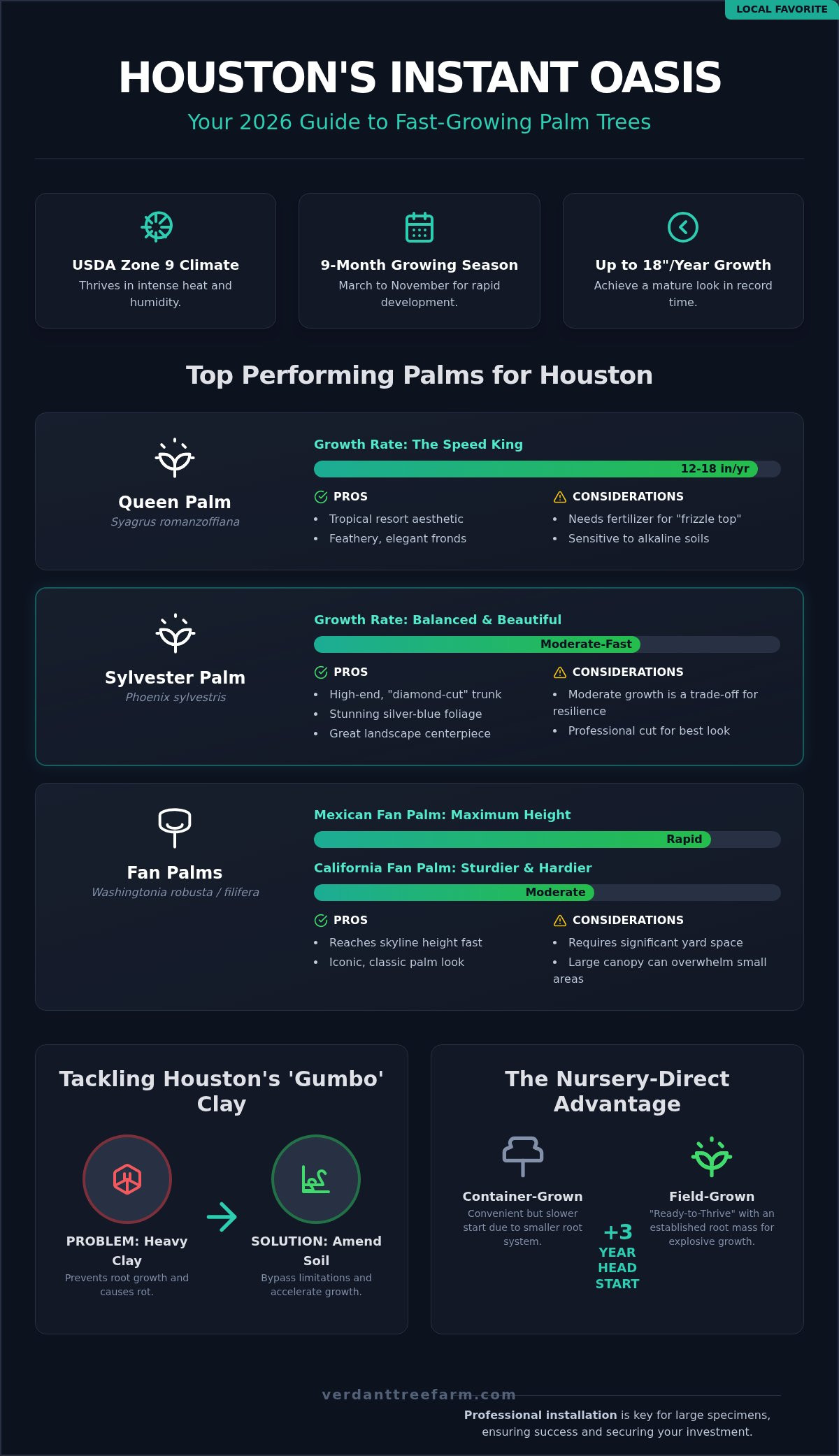
Transforming a bare Houston lot into a lush retreat doesn’t have to take a lifetime. Most new builds in the area start with a blank slate of dirt and sod. By choosing fast-growing palms, you create an “instant oasis” that provides vertical interest and essential shade within a single season. This rapid transformation offers more than just aesthetic value; it provides a psychological sense of home for new owners who want their property to feel established immediately. Houston’s climate is a major ally here. Our growing season typically stretches from March through November. This gives trees nine months of uninterrupted heat to push out new fronds and expand their root systems. A Phoenix sylvestris (Sylvester Palm) is a prime example of a species that thrives in this environment, offering a silver-blue hue that stands out against the green suburban landscape.
Understanding Houston’s USDA Zone 9 Growth Potential
Houston sits in USDA Zone 9. This means we deal with intense humidity and heat, often referred to as the “Houston Steam Bath.” While Florida might have consistent tropical weather, our growth cycles are punctuated by occasional hard freezes. Selecting a Sylvester Palm Houston can handle is about finding that sweet spot where rapid summer growth meets winter resilience. Fast-growing palms in Southeast Texas must be robust enough to handle high moisture levels without succumbing to root rot in our heavy clay. We focus on species that use the high humidity to fuel their development rather than fighting against it.
The Value of Nursery-Direct Sizing
Starting with a larger specimen from a tree nursery Houston residents trust gives your landscape a three-year head start. Container-grown palms are convenient; however, field-grown palms often possess the established root mass needed for explosive growth once they hit your soil. At Verdant Tree Farm, we maintain a “ready-to-thrive” inventory. We prioritize nursery-direct value so homeowners don’t pay middleman markups for trees that have been sitting in a lot for months. Our veteran-owned team understands that a Sylvester Palm Houston landscape is a long-term investment. We ensure every tree is hardened to local conditions before it reaches your yard, guaranteeing that the “fast growth” you see in our nursery continues the moment it’s planted in yours.
The Top 5 Fastest Growing Palm Species for Houston Yards
Selecting the right species for your property involves balancing growth velocity with long-term survival. While many varieties claim to grow quickly, only a handful can handle our local humidity and heavy clay without constant struggle. Finding a Sylvester Palm Houston can support means looking for trees that balance speed with structural integrity. These five species represent the best options for homeowners who want a mature, tropical look without waiting decades for results.
Achieving this sophisticated aesthetic often makes a property the perfect venue for hosting, where the right landscaping meets expert event styling. For those looking to elevate their celebrations with high-end decor, MintFloralStudio offers bespoke floral designs that mirror the luxury and elegance of a well-curated tropical landscape.
The Queen Palm: Maximum Growth for Minimum Wait
The Queen Palm (Syagrus romanzoffiana) is the undisputed speed king for local landscapes. In ideal conditions, this tree can add 12 to 18 inches of trunk height per year. Its feathery fronds create a tropical resort aesthetic that instantly softens the sharp lines of new construction. However, our alkaline soils can lead to “frizzle top,” a manganese deficiency that causes yellowing leaves and stunted growth. Regular applications of high-quality fertilizer are essential to keep these fast-growers healthy. For more options on resilient varieties, you can explore Cold-Hardy Palms for the Houston Climate to see how different species stack up against our winter temperatures.
Mexican Fan Palm vs. California Fan Palm
The Mexican Fan Palm (Washingtonia robusta) is famous for its iconic height and rapid trunk development. It reaches the skyline faster than almost any other variety, making it a favorite for commercial properties and large estates. If you have a smaller urban yard, consider the California Fan Palm instead. It grows slightly slower but features a sturdier, thicker trunk and superior resistance to occasional local freezes. Both varieties require significant space; their massive canopy spread can quickly overwhelm a tight corner or a small patio area.
The Sylvester Palm Houston Guide
A Sylvester Palm Houston residents often choose for their front yards provides a high-end, diamond-cut trunk aesthetic that serves as a landscape centerpiece. It offers a moderate-to-fast growth rate and stunning silver-blue foliage that contrasts beautifully with darker green oaks. This palm is a favorite for entryways because it looks expensive and established very quickly. To keep your investment thriving, follow our Sylvester Palm Care Guide to manage moisture and nutrients correctly. Maintaining that iconic blue hue through the scorching summer months requires consistent deep watering and a steady supply of specific micronutrients.
For those who want a truly unique specimen, the Mule Palm is a rare, fast-growing hybrid. It combines the elegant look of a Queen Palm with the rugged cold hardiness of a Pindo Palm. It is a “best of both worlds” choice for homeowners who fear the occasional hard freeze but still want rapid growth. If you are ready to pick out the perfect specimen for your property, you can browse our nursery-direct inventory at Verdant Tree Farm to see these palms in person.
Resilience vs. Speed: Choosing Palms That Last
Homeowners often fall into the “fast-growing trap.” It’s tempting to choose the species that shoots up the quickest, but in Southeast Texas, speed often comes at the cost of cold hardiness. A Queen Palm might grow 18 inches a year, but it can suffer significant damage during a “blue norther” freeze if temperatures drop into the low 20s. Conversely, the Windmill Palm is nearly bulletproof in a freeze but grows at a much slower pace. Finding a balance is key for a landscape that lasts beyond the next winter storm. Using Proper Palm Planting Techniques helps establish a deep root system; this is your first line of defense against temperature swings. A Sylvester Palm Houston residents plant provides a middle-ground solution, offering respectable growth without the extreme fragility of purely tropical varieties.
The Mule Palm: The Best of Both Worlds
The Mule Palm is often called the “holy grail” for Houston yards. This hybrid between a Pindo Palm and a Queen Palm offers the best of both worlds. It maintains a growth rate that rivals the Queen Palm but inherits the rugged cold hardiness of the Pindo. It’s a sterile hybrid, meaning it won’t drop messy fruit all over your pool deck or driveway. We’ve seen these trees handle local temperature dips far better than their faster-growing cousins. As Houston’s largest independent tree nursery, we prioritize stocking these rare specimens because they offer the reliability our neighbors need. They grow quickly enough to provide shade within a few seasons while remaining standing after a hard freeze.
Reliable Backup: Pindo and Windmill Palms
When survival is the top priority, especially in exposed north-facing yards, Pindo and Windmill Palms are the standard. You might trade off some initial height for a tree that will survive 15-degree nights without a scratch. A smart strategy involves integrating these slower, sturdier species with faster ones like the Sylvester Palm Houston. By layering your landscape, you ensure that even if a record-breaking freeze hits, your entire tropical oasis isn’t wiped out in one night. This creates a resilient, multi-tiered look that provides immediate impact and long-term security. We often recommend placing your sturdiest palms on the outer edges of your property to act as a windbreak for more sensitive, fast-growing species closer to the home.
How to Accelerate Palm Growth in Houston Clay Soil
Most homeowners make the mistake of treating their planting site like a standard flower bed. In Southeast Texas, our heavy gumbo soil acts as a barrier to rapid development. If you simply dig a hole and drop in a tree, you create a “clay bathtub” that traps water and suffocates the root system. Accelerating growth requires a proactive approach to soil structure and drainage. A Sylvester Palm Houston yard won’t reach its full potential if the roots are drowning in standing water. You must transform the planting site into an environment that encourages aggressive root expansion.
Solving the Houston Clay Dilemma
Drainage is the single most important factor for palm velocity. We recommend using “mounding” techniques to ensure the palm’s heart stays above the standing water line during our frequent downpours. You should also incorporate gypsum into the native soil to help break down the tight clay bonds. For a successful Sylvester Palm Houston installation, use a specific amendment mix to fill the gap between the root ball and the native clay:
- One-third sharp sand to facilitate immediate drainage
- One-third organic compost to provide a slow-release nutrient base
- One-third native soil to help the tree acclimate to its permanent home
The Ultimate Palm Feeding Schedule
Palms are heavy feeders that require more than just a generic lawn fertilizer. To see significant trunk development, you must provide high-nitrogen blends supplemented with Magnesium and Manganese. These specific micronutrients prevent the yellowing and stunted growth common in our alkaline environment. Timing is everything for rapid results. Start your feeding program in early March to capitalize on the rising temperatures. Continue every eight weeks through August, then stop. This allows the tree to harden off before the winter months, protecting the new growth you’ve worked so hard to achieve from potential freeze damage.
Watering is the final piece of the growth puzzle. We suggest a “low and slow” irrigation method. Instead of frequent light sprinkles, use a soaker hose for several hours once a week. This encourages the roots to dive deep into the soil, creating a foundation that supports faster vertical growth and better drought resistance. If you’re unsure about your soil’s drainage capacity or nutrient levels, our team at Verdant Tree Farm can provide expert guidance to get your tropical oasis on the fast track.
Professional Installation: The Key to a 2026 Tropical Oasis
Professional installation is the bridge between a good plan and a thriving landscape. When you invest in a large specimen like a Sylvester Palm Houston homeowners demand, you aren’t just buying a tree; you’re buying a permanent fixture for your property. These palms can weigh thousands of pounds. Attempting a DIY install often leads to improper planting depth or damaged root balls, which can stunt growth for years. Our veteran-owned team brings the right equipment and technical precision to every project. We handle the heavy lifting so your “instant oasis” remains healthy from day one. To back our work, we offer a three-month warranty on all products when our professional crews handle the installation.
Nursery-Direct vs. Big Box Store Palms
The hidden cost of big-box store palms often shows up in their lackluster root systems. These trees frequently sit on hot asphalt for weeks, stressed and dehydrated. In contrast, our palm trees for sale Houston residents choose are nursery-direct. This means they’re already acclimated to our specific humidity and soil conditions. We don’t just drop off a tree and leave. We provide maintenance consultations after the job is done. We want to ensure you know exactly how to care for your new investment as it establishes itself in your yard. This long-term support is a hallmark of our multi-generational commitment to the local community.
Designing for Growth with 3D Visualization
Visualizing your yard five years from now is difficult without the right tools. Our landscaping services Houston team uses advanced 3D visualization to remove the guesswork. We can show you exactly how a Sylvester Palm Houston will look as its canopy expands and its trunk develops. This is crucial for tight urban spaces where root zones and shade patterns matter. You’ll see the mature height and spread before the first hole is dug. This process ensures that your fast-growing palms have enough room to reach their full potential without interfering with structures or other plants. We invite you to visit our Houston tree farm to request a custom consultation and see our inventory in person. Our team is ready to help you build a legacy on your property with the highest standards in the industry.
Start Your Tropical Transformation Today
Building an ‘instant’ tropical oasis in Houston is about combining the right species with expert soil management. You’ve learned how to bypass the ‘clay bathtub’ effect that stunts growth. You also know which palms offer the best balance of speed and resilience for our Zone 9 climate. Choosing a Sylvester Palm Houston can support means you’re investing in a tree that offers high-end aesthetics without the long wait for maturity.
At Verdant Tree Farm, we bring the authority of Houston’s largest independent nursery to every project. We’re veteran-owned and operated, and we stand behind our work with a three-month warranty on all professional installations. Our goal is to make your landscaping project straightforward and successful. We use 3D design to help you see the future of your landscape before we ever break ground, ensuring every palm has the room it needs to thrive.
View Our Current Palm Inventory & Request a 3D Design Consultation
We’re ready to help you transform your property into a reliable, low-maintenance retreat today. Let’s get started on your personal oasis.
Once you have created your personal oasis, you can bring that natural aesthetic indoors by printing your favorite garden photos with WoodSnap, which specializes in high-quality custom prints on birch wood.
Frequently Asked Questions
What is the absolute fastest-growing palm tree for Houston?
The Queen Palm is the undisputed fastest-growing palm for the Houston area. In ideal conditions, it can add 12 to 18 inches of trunk height annually. Its feathery fronds and rapid development make it a top choice for homeowners seeking an instant tropical canopy. While it grows quickly, it requires consistent fertilization to handle our local soil chemistry and maintain its vibrant appearance.
Will fast-growing palms survive a Houston freeze?
Survival depends on the specific species and the severity of the winter weather. Most fast-growing palms like the Queen Palm handle light freezes but struggle if temperatures drop below 20 degrees. We recommend selecting varieties like the Sylvester Palm Houston residents trust for their balance of growth and cold hardiness. Proper planting and winter preparation are essential to protect your landscape investment.
How often should I water my new palm tree in Houston’s summer heat?
New palms require deep watering three to four times per week during their first summer in Houston. You should use a “low and slow” method with a soaker hose for several hours to reach the deep root zone. This is more effective than frequent light sprinkles that don’t penetrate the clay. Once established, most palms are drought-tolerant but still benefit from deep irrigation during extended dry spells.
Do I need to fertilize my palms differently because of Houston’s clay soil?
Yes, Houston’s alkaline clay soil requires a fertilizer high in micronutrients like Manganese and Magnesium. Without these, palms often develop yellowing fronds or “frizzle top.” We suggest using a slow-release granular fertilizer specifically formulated for palms. Apply these nutrients from March through August to capitalize on the peak growing season while avoiding the stunting effects of heavy, poorly draining gumbo soil.
When is the best time of year to plant palms in Houston?
The best time to plant palm trees in the Houston area is from mid-November to late February. This window allows the tree to establish its root system during the cooler months before the intense summer heat arrives. Planting during this period reduces transplant shock and gives the palm a head start on the spring growth cycle. It’s the most reliable way to ensure long-term survival.
How do I prevent my Queen Palm from turning yellow?
Yellowing is usually caused by a manganese deficiency, a common issue in our local alkaline soils. To prevent this, apply a palm-specific fertilizer that includes added micronutrients. Ensure your tree has proper drainage to avoid root rot, which can also cause foliage discoloration. Regular maintenance and soil amendments can help keep the fronds vibrant and green throughout the year, even in challenging soil conditions.
What is the difference between a Medjool and a Sylvester Palm Houston?
The main difference lies in their aesthetic and growth habits. A Medjool Date Palm is typically larger and produces edible fruit, while the Sylvester Palm Houston homeowners prefer is an ornamental variety. Sylvesters are known for their striking silver-blue foliage and the iconic diamond-cut pattern on their trunks. They are often more manageable for residential landscapes while still offering a high-end, resort-style look for your property.
What is the best palm for a small Houston backyard?
The Pygmy Date Palm or the Windmill Palm are excellent choices for smaller urban yards. These species have a much smaller footprint and slower growth rates than towering giants like the Mexican Fan Palm. They fit perfectly in tight corners or near pool decks without overwhelming the space. We often use 3D design to help you visualize how these smaller palms will fit your specific property layout.