The biggest threat to your frozen Queen palm isn’t the ice; it’s your pruning shears. That brown, drooping canopy in your backyard looks like a total loss, but grabbing the chainsaw too early could be the most expensive mistake you make this season. In Houston, where winter lows can dip below the Queen palm’s 23 degree hardiness limit, patience is your most valuable horticultural tool. We know it’s frustrating to stare at a landscape that looks more like a graveyard than a tropical oasis, especially when you’re worried about the cost of removal or whether your investment will ever regain its lush, green glow.
This guide provides the professional clarity you need for successful Queen palm freeze damage recovery, moving past conflicting neighborhood advice to give you a definitive survival framework. You’ll learn how to perform the critical spear pull test to check the growing point, which treatments prevent rot while you wait for new growth, and exactly when it’s time to call it a day and explore a fresh installation. Recovery is often a 90 day waiting game, and we’re here to help you navigate every step with expert, local advice tailored for our specific Texas climate.
Key Takeaways
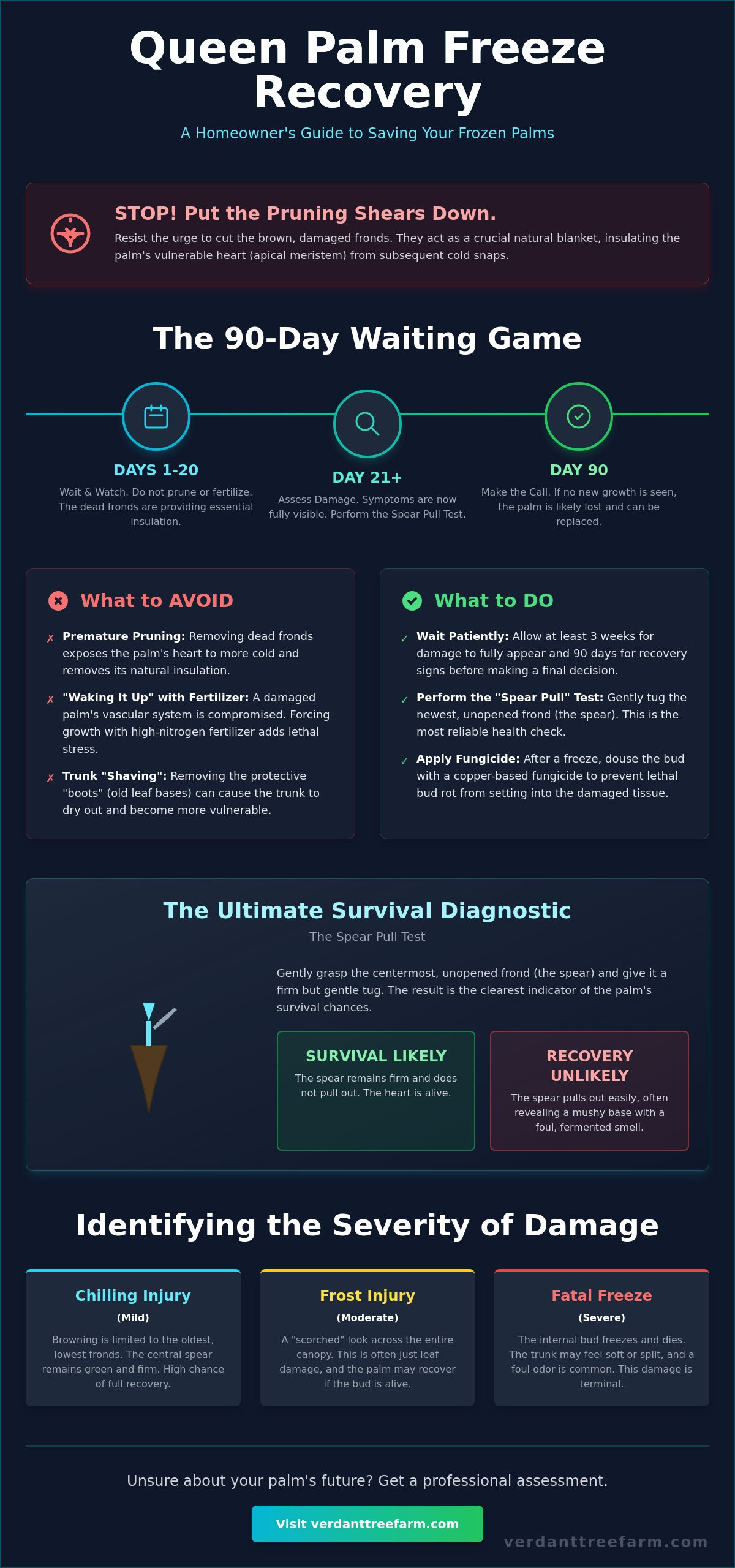
- Avoid the urge to prune brown fronds immediately, as they provide critical thermal insulation for the palm’s apical meristem during subsequent cold snaps.
- Master the timing of Queen palm freeze damage recovery by learning why a 90-day waiting period is essential before making any final removal decisions.
- Perform the “Spear Pull” test to accurately diagnose the health of the palm’s central bud and determine if the tree is truly dead or just dormant.
- Protect your investment with targeted copper-based fungicides to prevent lethal bud rot from taking hold in damaged tissue.
- Identify the definitive signs of total failure, such as trunk splitting, to know exactly when it is time to schedule a professional replacement.
Assessing the Damage: Is Your Queen Palm Dead or Dormant?
After a hard freeze hits Houston, your palms might look deceptively healthy for several days. We call this the “green ghost” phase. Unlike soft-stemmed perennials that wilt within hours, the Queen Palm (Syagrus romanzoffiana) has a dense, fibrous structure that hides cellular death for weeks. You might see a green canopy today, only to watch it turn a brittle, toasted brown by the end of the month. This delay makes Queen palm freeze damage recovery a test of patience for every homeowner.
The survival of your palm depends entirely on the health of the apical meristem, or the “heart.” This is the single growing point located deep within the top of the trunk. If this bud remains alive, the tree can produce new fronds. If ice crystals formed inside this bud, the palm is likely lost. While these trees are generally hardy down to 23°F, once Houston temperatures hit the 20°F mark, the statistical probability of survival drops significantly. At those temperatures, the water inside the palm’s vascular system freezes, expands, and physically ruptures the plant’s cells.
The Three Levels of Cold Injury
Determining the severity of the damage helps you set realistic expectations for recovery. Chilling injury is the mildest form; it typically results in the browning of the oldest, lowest fronds while the center spear remains green and firm. Frost injury occurs when ice forms on the leaf surfaces, creating a “scorched” look across the entire canopy. This is often just leaf necrosis and doesn’t always mean the tree is dead. The most severe is a Fatal freeze. This happens when the internal temperature of the bud drops low enough to cause structural collapse. If the trunk feels soft or you notice a foul, fermented smell near the top, the damage is likely terminal.
The 3-Week Rule for Houston Landscapes
Don’t rush to the garden center just yet. You must wait at least 21 days before making a final health diagnosis. This three-week window allows the palm to fully express its symptoms. In our humid Houston environment, moisture can quickly turn damaged tissue into a breeding ground for rot. Waiting allows you to see if the center spear is still pushing upward, even if only by a fraction of an inch. If you plan to file a warranty claim or need documentation for insurance, take clear photos during this period. We recommend photographing the canopy from multiple angles to track the progression of browning over time. This data is invaluable for our team during maintenance consultations to determine if your palm is a candidate for revival or replacement.
Immediate Post-Freeze Care: What to Do (and Avoid)
The visual impact of a brown, drooping canopy is enough to make any homeowner reach for the pruning shears. Resist that urge. The Golden Rule of Queen palm freeze damage recovery is simple: put the tools away until the threat of frost has completely passed. In Houston, our weather is notoriously unpredictable. Pruning too early exposes the vulnerable heart of the palm to the next cold snap. Those dead, brown fronds might look like an eyesore, but they’re currently serving as critical thermal insulation for the apical meristem. They act as a natural blanket, trapping radiant heat from the trunk and protecting the growing point from further ice crystal formation.
You should also avoid the common “fertilizer trap.” It’s tempting to dump high-nitrogen fertilizer around a damaged tree to “wake it up.” This is often a fatal mistake. A freeze-damaged palm has a compromised vascular system. Forcing the plant to produce new growth before it has repaired its internal plumbing puts undue stress on the tree. This can lead to a total collapse of the remaining healthy tissue. Focus on stability rather than growth during these first few weeks. If you’re unsure about the state of your landscape, scheduling maintenance consultations with a professional can help you develop a safe timeline for nutritional support.
The Pruning Dilemma
While you shouldn’t remove the canopy, you can check the trunk for signs of life. Use your fingernail to gently scratch a small area of the trunk near the top. If you see moist, green tissue underneath, the tree is still moving fluids. Avoid “shaving” or skinning the trunk in the early spring. This process removes the protective “boots” or leaf bases that help the palm retain moisture. If a frond is dangling dangerously and poses a physical risk to your property or family, you can safely trim it. Just ensure you leave several inches of the petiole, or leaf stem, attached to the trunk to maintain that insulating barrier.
Hydration and Soil Management
Houston’s heavy clay soil presents a unique challenge during Queen palm freeze damage recovery. Cold air is often very dry, which can lead to “freeze-dried” roots. You need to keep the root ball hydrated, but you must avoid creating a swamp. Clay holds water for a long time; overwatering a stressed palm in cold soil often leads to root rot. Apply a three-inch layer of organic mulch around the base of the palm, keeping it a few inches away from the actual trunk. This mulch stabilizes soil temperatures and prevents the freeze-thaw cycles that can further damage delicate root hairs. Resume your standard irrigation schedule only when consistent spring temperatures return.
Proactive Recovery: Fungicides and Fertilization Strategies
Once you’ve committed to the 90-day waiting game, your primary job shifts from observation to active defense. The damaged tissues of a frozen palm are highly susceptible to secondary infections. Queen palm freeze damage recovery often fails not because of the cold itself, but because of opportunistic pathogens like Phytophthora, commonly known as “Bud Rot.” This fungus thrives in the cool, damp conditions of a Houston spring. It attacks the weakened apical meristem, turning the heart of your palm into a mushy, fermented mess before new growth ever has a chance to emerge.
To prevent this, we recommend a proactive application of copper-based fungicides. Unlike standard foliar sprays, the application technique is specific. You must pour the solution directly into the center “bud” area where the newest fronds emerge. This ensures the fungicide reaches the exact point of vulnerability. While you’re protecting the crown, keep a close eye on the palm’s nutritional needs. Stressed palms specifically struggle with Magnesium and Manganese deficiencies after a freeze. These micro-nutrients are vital for photosynthesis and cellular repair, helping the tree regain its strength without forcing premature growth.
The Bud Rot Prevention Protocol
Timing is everything. Apply your first round of fungicide immediately after the initial thaw and repeat every 10 to 14 days during wet, humid stretches. Houston’s moisture levels can accelerate fungal growth, so consistency is key. When handling copper-based horticultural chemicals, always wear gloves and eye protection. These products are effective because they are potent. Avoid applying them during the heat of the day to prevent chemical burn on any remaining green tissue. This defensive layer is your palm’s best chance at surviving the transition from winter to spring.
Feeding for Success
Wait for the “first flush” of new green growth before reaching for the fertilizer bag. This visual cue tells you the vascular system is functioning again. When the time is right, use an 8-2-12 palm-specific fertilizer. This ratio is the industry standard for Queen palm freeze damage recovery because it prioritizes root and structural health over rapid leaf production. Avoid “cheap” generic fertilizers often found at big-box stores. These frequently contain high levels of quick-release salts that can dehydrate and burn the already fragile root systems of a recovering Queen palm.
The Spear Pull Test: The Ultimate Survival Diagnostic
The most reliable way to tell if your tree will survive is the spear pull test. This simple diagnostic tool cuts through the guesswork of Queen palm freeze damage recovery. While brown fronds tell you about past damage, the spear tells you about the future. The “spear” is the newest, unopened leaf emerging from the very center of the canopy. It represents the health of the apical meristem. If the spear remains firm and green, your palm has a high probability of making a full recovery. If it pulls out, it indicates that rot has reached the heart, but even this isn’t always a death sentence.
We often see homeowners panic when a spear slides out, assuming the tree is ready for the woodchipper. This isn’t always the case. A pulled spear simply means the tissue at the base of that specific leaf has rotted. If the growing point itself is still alive, it can eventually push out a new leaf. This process takes time and specific care. If your test reveals a slimy, foul-smelling base, you’re dealing with active decay. If the base is dry, the rot may have already stopped. If you’re still unsure after testing, our team can provide maintenance consultations to help you decide if the tree is worth the effort.
How to Perform the Test
Wait until the first warm stretch of spring to perform this test. Reach into the center of the canopy and grasp the newest, central-most leaf. Apply a firm, steady upward pressure with your hands. Don’t use pliers or mechanical tools; your natural grip is enough. You’re looking for resistance. If the leaf remains anchored, the heart is likely intact. If it slides out with little effort, pay close attention to the end you just pulled. A wet, mushy end confirms bud rot, while a dry end suggests the palm might already be trying to wall off the damage.
The “Hole” Treatment
If the spear pulls out, you’re left with an open cavity that leads directly to the palm’s heart. This “hole” is a magnet for Houston’s spring rains and humidity. You must treat it immediately to prevent total collapse. Pour a small amount of hydrogen peroxide or a copper-based fungicide directly into the cavity to kill lingering pathogens. During heavy rain, consider temporarily covering the top of the palm with a bucket or plastic to prevent water from pooling inside. Your goal is to keep the area dry until you see a “Cigar Leaf” emerge. This is a tightly wrapped, blunt-ended green leaf that signals the meristem is officially back in business. Once you see this green spike, your Queen palm freeze damage recovery is successfully underway.
When to Call It: Replacement Strategies for Houston
If June arrives and your canopy remains a brittle brown, the window for a successful Queen palm freeze damage recovery has likely closed. While we always advocate for patience, there’s a point where hope becomes a liability. A dead palm tree isn’t just an eyesore; it’s a structural risk. In our humid Gulf Coast climate, dead palm tissue rots quickly, attracting termites, beetles, and other wood-boring pests that can eventually migrate to healthy parts of your landscape. If you haven’t seen a new green spear movement by the time Houston’s summer heat is in full swing, it’s time to consider a fresh start.
Leaving a dead palm standing also increases the risk of trunk failure during our notorious summer storms. As the internal fibers break down, the tree loses its ability to withstand high winds. Our team can help you transition from a loss to a long-term investment. Through our professional landscaping services in Houston, we handle the entire process from identifying terminal failure to professional installation of a more resilient specimen. We don’t just replace trees; we build landscapes that are better equipped to handle the next big freeze.
Identifying Terminal Failure
Structural signs are often the final word on survival. Check the trunk for deep vertical splitting or “hollowing.” If the base of the tree feels soft or spongy when pressed, the vascular system has likely collapsed. You can also use the “smell test.” Rotting palm hearts produce a distinct, sour, fermented odor that is unmistakable. If you detect this scent near the crown, the internal decay is too advanced for any fungicide to reverse. A total lack of movement in the central spear after 90 days of warm weather is the final indicator that the apical meristem is no longer viable.
Upgrading Your Landscape Resilience
When you’re ready to rebuild, focus on cold-hardy varieties that can withstand our shifting climate. You can create a stunning freeze-resistant palm tree oasis by selecting species with lower hardiness thresholds. The Pindo Palm is an excellent choice, offering a tropical look while remaining hardy down to 15°F. For the ultimate in durability, the Windmill Palm is the gold standard for Houston, surviving temperatures that would easily claim a Queen. If you’re unsure which of your remaining trees are worth keeping, scheduling a Maintenance Consultation is the smartest way to protect your property’s value and plan for a greener future.
Secure Your Landscape’s Future
Successful Queen palm freeze damage recovery requires a blend of horticultural patience and proactive defense. Don’t rush into pruning; instead, focus on preventing secondary bud rot and monitoring for that critical first flush of new growth. By following the spear pull diagnostic and giving your palms the full 90-day window to respond, you ensure you aren’t removing a tree that still has a fighting chance. It’s about making a smart, long-term investment in your property’s health and aesthetic appeal.
If you’re still feeling uncertain about the health of your backyard, let our experts take the guesswork out of the process. As Houston’s largest independent tree nursery, we take pride in being veteran-owned and operated. We provide expert 3D landscape design and installation services alongside technical care for stressed specimens. Schedule a Professional Maintenance Consultation for Your Stressed Palms today to get a definitive answer on your landscape’s viability. We’re here to help you rebuild a stronger, more resilient property that thrives in our unique Texas climate.
Frequently Asked Questions
How long does it take for a Queen palm to recover from a freeze?
Recovery typically takes 3 to 6 months of consistent warm weather. You won’t see the full results of Queen palm freeze damage recovery until the tree has experienced at least 90 days of temperatures above 70 degrees. New fronds grow slowly, so don’t assume the tree is a loss just because it looks stagnant in the early spring months of March or April.
Should I cut off the brown leaves on my Queen palm immediately?
No, you should never cut off brown leaves immediately after a freeze. These dead fronds act as a natural thermal barrier that protects the palm’s central growing point from subsequent frost. Removing them too early exposes the heart to cold air and wind. Wait until the local Houston forecast shows no more freezing temperatures before you begin any major canopy cleanup.
Can a Queen palm survive 20 degrees Fahrenheit?
Survival at 20 degrees Fahrenheit is statistically unlikely for a Queen palm. These trees are generally hardy down to 23 degrees. When temperatures hit the 20-degree mark, ice crystals form inside the plant’s vascular system and rupture the cells. While some mature, sheltered trees might pull through, most will suffer terminal damage at that temperature threshold.
What is the “spear pull” test for palm trees?
The “spear pull” test involves gently tugging the newest, unopened leaf at the center of the canopy to check for resistance. If the leaf remains firmly attached, the growing point is likely alive. If it slides out with a slimy or foul-smelling base, the heart is experiencing active rot. This test is a primary diagnostic tool for Queen palm freeze damage recovery.
What is the best fungicide for a freeze-damaged palm?
Copper-based fungicides are the industry standard for treating stressed palms after a cold snap. These products specifically target “Bud Rot” caused by Phytophthora, which often follows a freeze event in our humid climate. For the best results, pour the liquid fungicide directly into the center bud cavity. This ensures the treatment reaches the delicate tissue where new growth originates.
Will my Queen palm grow back if the top died?
No, your Queen palm will not grow back if the apical meristem, or the “top,” has died. Unlike many hardwoods, palms have only one growing point. If that single heart is killed by the freeze, the tree cannot produce new leaves or trunk height. Once the heart is dead, the palm is officially gone and will eventually require professional removal.
How often should I water my palm after a freeze?
Water your palm once a week during the recovery phase if there is no significant rainfall. You want to keep the root ball hydrated without saturating Houston’s heavy clay soil. Overwatering a stressed tree in cold, wet clay can lead to root rot, which complicates the recovery process. Use a three-inch layer of mulch to help regulate soil moisture.
When is it officially too late to save my palm tree?
It is officially too late to save the palm if you see no new growth by late June or July. If the tree hasn’t pushed out a new green spear after several months of Houston heat, the growing point is likely dead. Other signs of total failure include a splitting trunk, soft spots near the base, or a persistent smell of fermented, rotting tissue near the crown.