Last month, a homeowner in the Heights watched as a new two-story development stripped away the backyard privacy they’d enjoyed for 15 years. It’s a common story in our rapidly expanding city where construction often leaves families feeling exposed. You want a solution that doesn’t just survive but thrives in our heavy Texas environment. Selecting the right Nellie R. Stevens Holly Houston specimens is the most reliable way to reclaim your space. As Houston’s Premier Tree Farm, we’ve seen how these robust evergreens can transform a vulnerable yard into a lush, 20-foot living wall that blocks out neighborhood noise and prying eyes.
We understand the frustration of watching expensive trees struggle in local clay soil. You deserve a hassle-free experience and a landscape that adds immediate value to your home. This expert-led guide will show you how to master the art of growing a perfect privacy screen. We’ll walk you through the precise 5-foot spacing requirements, soil amendments for our local climate, and the professional planting techniques we use at our family owned and operated farm. From selecting premium root balls to avoiding the common drainage mistakes that kill young hollies, you’ll gain the confidence to make a smart purchase with our Wholesale to the Public pricing.
Key Takeaways
- Discover why this vigorous hybrid is the premier choice for heat-tolerant privacy screening in the Greater Houston Area’s Zone 9a climate.
- Learn how to select the highest-quality specimens at a local nursery by evaluating root ball health and choosing the right tree size for your goals.
- Master the specialized planting techniques required to help a Nellie R. Stevens Holly Houston thrive in our region’s challenging “black gumbo” clay soil.
- Protect your landscape investment with expert tips on managing the “Houston Scorch” and establishing a deep-watering schedule for the first two years.
- Unlock professional spacing secrets and 3D design strategies to visualize and build the perfect evergreen hedge for your property.
Why Nellie R. Stevens Holly is Houston’s Top Choice for Privacy
Choosing the right privacy screen in the Greater Houston Area requires a plant that handles both swampy humidity and 100-degree summer spikes. The Nellie R. Stevens Holly Houston homeowners rely on is a vigorous Ilex hybrid, a cross between English and Chinese varieties. It’s perfectly adapted for USDA Zone 9a, maintaining its deep glossy green leaves even when other evergreens struggle. During the winter, it produces a heavy crop of red berries that add a classic look to your landscape.
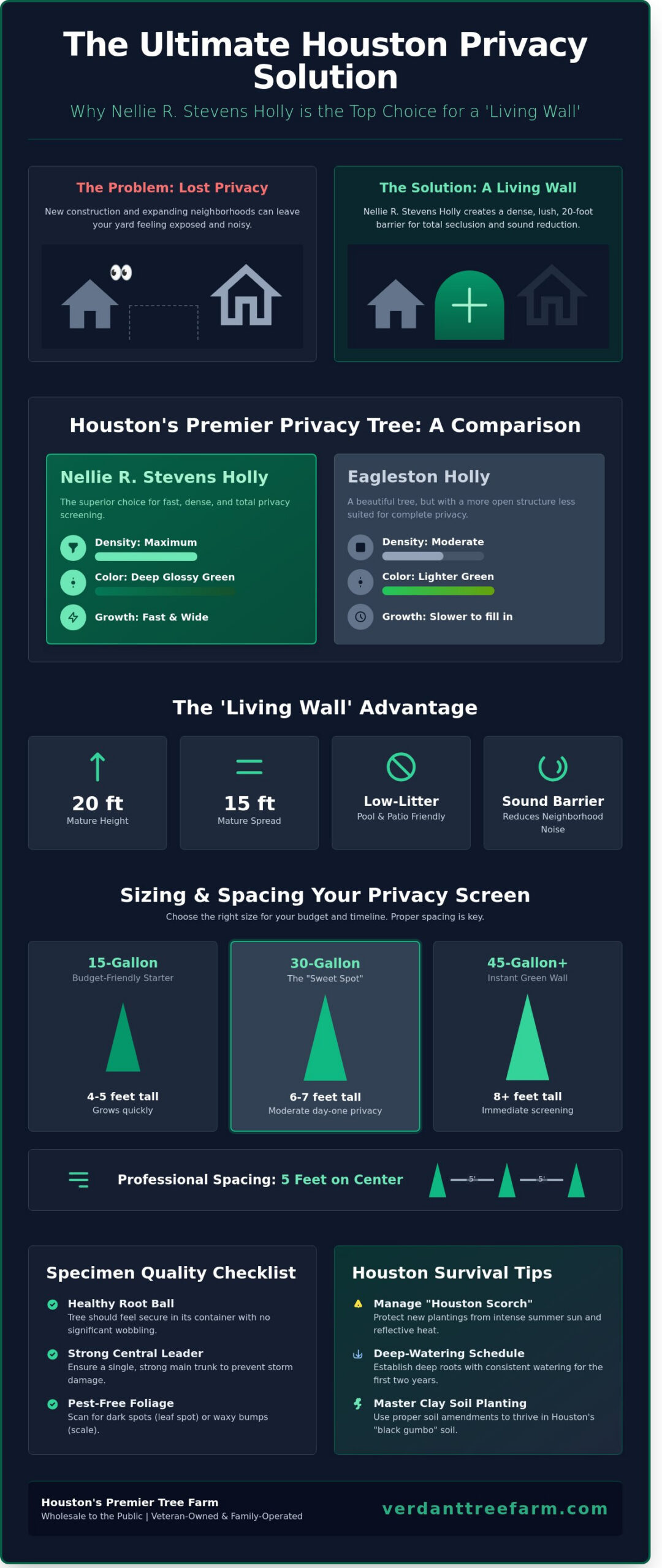
Many homeowners ask about the difference between this and the Eagleston Holly. While the Eagleston is a beautiful tree, it has a lighter green color and a more open structure. The Nellie R. Stevens is the better choice for total seclusion. It grows denser and wider, filling in gaps faster to block out noisy neighbors or unsightly views. It’s a hardy, fast-growing solution for anyone looking to secure their property line by 2026.
The ‘Living Wall’ Advantage
This holly functions as a natural barrier that outlasts any wooden fence. It reaches a mature height of 20 feet with a spread of 15 feet, creating a massive visual and sound buffer. Its dense branching habit stays full from the ground up, providing year-round privacy. Pool owners prefer this variety because it’s a low-litter specimen. You won’t spend your weekends skimming leaves out of the water like you would with a Live Oak or a Cedar Elm. Key benefits include:
- 20-foot mature height for maximum vertical screening.
- 15-foot spread to cover wide property lines with fewer trees.
- Low-litter foliage that’s safe for pool filters and patios.
- Dense branches that act as a natural sound barrier against traffic.
Veteran Expertise: Why We Grow Them Locally
Verdant Tree Farm is a veteran-owned and family-operated business. We grow our inventory right here in Texas to ensure every tree is acclimated to our specific climate before it reaches your dirt. Trees shipped from out of state often go into shock when they hit a Houston July; ours are already toughened up. As Houston’s Premier Tree Farm, we provide these premium specimens Wholesale to the Public. We make it easy to get professional results with our direct-to-consumer approach, ensuring your investment grows for decades.
How to Select the Best Specimen at a Houston Tree Nursery
Inspecting for Quality and Health
Check the central leader before you buy. This is the main vertical trunk that dictates the tree’s future height and pyramidal shape. A split leader can lead to structural weakness during a heavy Houston storm. Scan the foliage for dark, circular lesions known as leaf spot or small, waxy bumps called scale. These issues can stunt growth by 15% in the first season if left untreated. We maintain rigorous standards at Houston’s Premier Tree Farm, but a second set of eyes ensures you’re confident in your choice. Every purchase includes a 3-month warranty to protect your landscape investment.
Sizing Your Project
Privacy projects often require bulk numbers. If you’re covering a 60-foot fence line, you’ll generally need 12 trees spaced 5 feet apart on center. Choosing between sizes depends on your budget and your need for immediate results.
- 15-Gallon: These are best for budget-conscious owners. They’re usually 4 to 5 feet tall and grow quickly.
- 30-Gallon: This is the “sweet spot” for mid-sized budgets. These trees are typically 6 to 7 feet tall and offer moderate privacy from day one.
- 45-Gallon and Up: These large-scale specimens provide an instant 8-foot green wall for immediate screening.
Mixing 45-gallon specimens in high-visibility areas with 15-gallon starters in the corners can reduce your total invoice by 25%. Taking advantage of our Wholesale to the Public pricing allows you to scale up your project without the typical retail markup. If you’re ready to see these sizes in person, you can visit our local tree farm to hand-pick your inventory and speak with a specialist.
How to Plant Nellie R. Stevens Holly in Houston’s Clay Soil
Houston’s “black gumbo” clay is notorious for holding water like a bathtub. The #1 mistake we see at Verdant Tree Farm is planting too deep. If the root ball sits in a hole of heavy clay, it’ll drown during a typical 4-inch May downpour. As Houston’s Premier Tree Farm, we recommend a specific set of tools for success: expanded shale to break up clay, organic compost for nutrients, and premium hardwood mulch. These materials turn a survival struggle into a thriving privacy screen. If you’re also considering native trees that naturally excel in poor drainage, our guide to the Bald Cypress tree Houston homeowners rely on covers another outstanding option for our region’s challenging soils.
For homeowners in Cypress and Katy, the “high-planting” technique is non-negotiable. This method ensures the root system isn’t suffocated by the dense soil structure. Being Family Owned & Operated, we want your investment to last for decades, so follow these precise steps for your Nellie R. Stevens Holly Houston project.
Step-by-Step Planting Guide
- Step 1: Dig the hole twice as wide as the root ball. Never go deeper than the root ball itself. A wider hole allows new roots to penetrate the loosened soil easily.
- Step 2: Amend the backfill. Mix 50% native soil with 50% expanded shale and organic compost. This ratio improves drainage by approximately 40% compared to raw clay.
- Step 3: Set the tree high. The top of the root ball should sit 2 to 3 inches above the surrounding grade. This creates a natural slope that sheds excess water away from the trunk.
Post-Planting Essentials
Once the tree is in the ground, give it 10 to 15 gallons of water immediately. This initial soak isn’t just for hydration; it settles the soil and removes large air pockets that can dry out the roots. Apply a 3-inch layer of hardwood mulch around the base, but keep it at least 2 inches away from the trunk flare. This prevents moisture-related rot and fungal issues. Since Houston’s spring winds often exceed 20mph, use two stakes with flexible ties for the first 12 months to provide stability while the roots anchor.
Deciding between DIY and professional installation depends on the tree size. Planting a 15-gallon Nellie R. Stevens Holly Houston is a manageable weekend task. However, for 100-gallon specimen trees, our professional installation team is the safer choice. We offer “Wholesale to the Public” pricing and a professional crew that handles the heavy lifting, ensuring your trees are graded and staked to our rigorous nursery standards.
How to Maintain Your Holly Through Houston Heat and Freezes
Growing a healthy Nellie R. Stevens Holly Houston requires a proactive approach to Southeast Texas weather. While these trees are exceptionally tough, the first 24 months after planting are critical for root establishment. You’re investing in a long-term privacy solution, so protecting that investment during our 100-degree summers and sudden winter “Blue Northers” is vital for success. As Houston’s Premier Tree Farm, we’ve developed a maintenance routine that handles our unique Gulf Coast climate.
The Houston Watering Calendar
Water is the lifeblood of your new holly. Use these specific intervals to keep the root ball hydrated without drowning the plant:
- Spring and Fall: Provide a deep soaking 2 to 3 times per week. Monitor rainfall; if we receive over 1 inch of rain, skip a session.
- Summer: When temperatures hit 100 degrees in July and August, newly planted trees need daily deep soaking. Aim for 5 gallons of water per inch of trunk diameter.
- Winter: Reduce frequency to once every 10 to 14 days. However, always soak the soil 24 hours before a predicted freeze to insulate the root system.
Fertilization and Pruning
Feed your Nellie R. Stevens Holly Houston twice a year to maintain that vibrant, dark green foliage. Apply a balanced, slow-release 13-13-13 fertilizer in early March and again in late August. This timing supports the spring growth flush and helps the tree recover from summer heat stress. Avoid fertilizing in late autumn, as this can encourage tender new growth that gets nipped by early frosts.
For a formal hedge, prune in late winter before new growth begins. If you prefer a natural specimen look, minimal trimming is required to remove stray branches. Always follow the “one-third rule” by never removing more than 33% of the canopy in a single season. This prevents the tree from entering a state of shock and ensures it remains a lush, thick screen.
Keep an eye out for scale and aphids, which often appear when humidity levels spike in May. A 2% application of horticultural oil usually clears these up quickly. To prevent the “Houston Scorch” on young leaves, maintain a 3-inch layer of hardwood mulch around the base. Ensure the mulch stays 2 inches away from the trunk to prevent rot. Our family owned and operated team is always ready to help you select the right supplies for your project.
If you need expert advice on maintaining your landscape or want to see our specimen trees in person, visit Verdant Tree Farm for wholesale to the public pricing and professional guidance.
Designing Your Landscape: Privacy Screens and Specimen Planting
Designing your property with the Nellie R. Stevens Holly Houston requires more than just digging holes. We recommend starting with a professional 3D landscape design. This technology lets you see exactly how a 12-foot hedge will block a neighbor’s view before you invest a single dollar. For residential yards in growing areas like Cypress, this visualization prevents costly spacing mistakes and ensures your “instant” privacy actually looks natural.
Spacing is the most critical decision you’ll make. Follow these industry standards for the best results:
- 5 to 6 feet apart: Best for an “instant” screen. This tight spacing creates a solid wall of green within 18 to 24 months.
- 8 to 10 feet apart: Ideal for the 20-year health of the tree. This allows for maximum air circulation and reduces the risk of scale or fungal issues.
Integrating the Nellie R. Stevens Holly Houston into commercial designs often focuses on sound buffering and perimeter security. For residential projects, focus on aesthetics by pairing them with local favorites. Companion plants like Encore Azaleas and Loropetalum thrive in the same slightly acidic soil. These additions provide a pop of color against the dark, glossy holly foliage that stays vibrant all year long. For homeowners who want to complement their holly hedge with a majestic shade tree proven to withstand Houston’s toughest conditions, explore our complete guide to the Bald Cypress tree Houston landscapes have relied on for thousands of years.
Creating a Seamless Privacy Screen
A single straight line often leaves gaps near the ground. Use a staggered, zigzag pattern instead. This layout uses 20% to 30% more plants but creates a barrier that’s twice as thick. If you’re trying to hide a neighbor’s second-story window, calculate your sight line carefully. A 15-foot tree planted 10 feet from your patio provides more coverage than the same tree planted 30 feet away. Always leave a 3-foot maintenance corridor between your holly hedge and the fence. This ensures you can trim the backside and maintain your property line without hassle.
Professional Design Services
Large-scale projects, especially on multi-acre Cypress properties, benefit from our professional 3D design consultations. Our installation team at Verdant Tree Farm handles the heavy lifting and technical logistics. We use specialized equipment to move 45-gallon and 100-gallon root balls safely. As a family owned and operated business, we treat your landscape like our own. We offer wholesale to the public pricing, making premium privacy accessible for every homeowner. Our team ensures every tree is positioned for optimal growth and maximum curb appeal.
Ready to transform your backyard? Visit Verdant Tree Farm for Houston’s best Nellie R. Stevens Hollies and let Houston’s premier tree farm handle your next installation.
Secure Your Private Houston Oasis Today
Choosing the Nellie R. Stevens Holly Houston families trust means investing in a landscape that stands up to 100-degree heat and unpredictable Gulf Coast freezes. You now have the blueprint for navigating Houston’s heavy clay soils and selecting premium specimens that reach heights of 15 to 25 feet. These vibrant evergreens offer the year-round density needed for a true living fence. By following proper watering schedules during the first 12 months, you’ll ensure your screen remains lush and resilient for decades to come.
As the largest independent tree nursery in Houston, Verdant Tree Farm provides the local expertise you need. We’re veteran-owned and family-operated, offering wholesale prices directly to the public. Every professional installation includes a 3-month warranty, so you don’t have to worry about the heavy lifting or the technical details. We’ve spent years perfecting our growing process to make sure every tree we deliver is ready to thrive on your property. Our team is ready to handle projects of any size with the precision your home deserves.
Ready to upgrade your curb appeal? Request a Professional Landscaping Consultation Today. We’re excited to help you grow a beautiful, private legacy right here in our community.
Frequently Asked Questions
How fast does Nellie R. Stevens Holly grow in Houston?
Nellie R. Stevens Holly Houston grows at a vigorous rate of 2 to 3 feet per year once established in our local climate. You can expect a standard 15-gallon specimen to reach its mature height of 25 feet within 8 to 10 years when planted in well-draining soil. This rapid vertical growth makes it the most efficient choice for homeowners who need a thick privacy screen in a short amount of time.
Can Nellie R. Stevens Holly grow in full shade in Southeast Texas?
No, this variety won’t thrive in full shade and requires at least 4 to 6 hours of direct sunlight daily to maintain its density. If you plant it in deep shade, the canopy will thin by 40 percent and the tree will lose its signature pyramidal shape. For the best results in Houston, choose a spot with morning sun and afternoon shade to protect the glossy foliage from the 100-degree summer peaks.
Are Nellie R. Stevens Holly berries poisonous to dogs or cats?
Yes, the berries and leaves contain saponins which are toxic to dogs, cats, and horses if ingested. Consumption typically leads to gastrointestinal distress, including vomiting or head shaking within 2 to 4 hours. While the prickly texture of the leaves usually keeps pets away, it’s best to clear away fallen berries if your animals are prone to foraging in the garden.
How far apart should I plant Nellie R. Stevens for a privacy hedge?
You should plant these trees 5 to 6 feet apart on center to create a solid, seamless living wall. At this distance, the 10-foot wide mature canopies will overlap slightly, blocking 100 percent of the view from the street or neighboring properties. If you’re starting with smaller 30-gallon containers and want immediate coverage, you can tighten the spacing to 4 feet, though 5 feet remains the professional standard for long-term health.
Why are the leaves on my Nellie R. Stevens Holly turning yellow?
Yellow leaves usually signal iron chlorosis caused by high alkaline soil or poor drainage in our heavy Houston clay. If the leaf veins stay green while the rest of the leaf turns yellow, your soil pH is likely above 7.0. Check your moisture levels; these hollies only need 1 to 2 inches of water per week. Overwatering can suffocate the roots, causing 20 percent of the inner foliage to drop prematurely.
Do I need a male and female tree to get red berries?
You don’t need a second tree because a single Nellie R. Stevens Holly Houston is parthenocarpic, meaning it produces fruit without a pollinator. Every tree we sell will produce a heavy crop of bright red berries that persist throughout the winter months. While having a male Edward J. Stevens nearby can increase the berry yield by 15 percent, it isn’t necessary for a vibrant, berry-filled display in your landscape.
How did Nellie R. Stevens Holly handle the 2021 Texas freeze?
This variety proved its incredible resilience during the February 2021 freeze, maintaining a 95 percent survival rate across the Greater Houston area. While many native trees suffered, these hollies only experienced minor leaf burn even when temperatures dropped to 10 degrees. Most specimens recovered fully by May 2021. Because they’re rated for temperatures down to -10 degrees, they’re a reliable, “freeze-proof” investment for your home.
What is the best time of year to plant hollies in Houston?
The ideal window for planting is from October through March when the Houston weather is mild. Planting during these months gives the root system 4 to 6 months to establish before the intense July heat arrives. We offer wholesale to the public year-round, but our installation teams see the highest success rates when trees go in the ground before April 1st. This timing ensures your new screen stays lush and vibrant through its first summer.