Most Houston landscapes aren’t built to survive a 100 year freeze followed by a record breaking drought, yet one native species has thrived in our local basin for over 6,000 years. You’ve likely felt the frustration of watching a supposedly hardy tree wither in our heavy clay soil or buckle under the pressure of a sudden Gulf Coast ice storm. It’s exhausting to invest time and money into your property only to have the Texas climate reset your progress. The Bald Cypress tree Houston homeowners often overlook is actually the ultimate solution for our region’s unique environmental stressors.
As Houston’s premier family owned tree farm, we’ve helped over 12,500 local families transform their yards into resilient, shaded sanctuaries. We promise to show you why this majestic native is the smartest investment for a low maintenance, high value landscape that thrives in poor drainage and stands tall through the toughest seasons. This guide covers everything from proper planting techniques to managing root systems so your sidewalks and driveways stay perfectly intact. You’re about to learn how to select, plant, and care for a legacy tree that will shade your home for the next 150 years.
Key Takeaways
- Learn why this native “deciduous conifer” is the ultimate resilient icon for local landscapes and how its changing needles provide unique seasonal interest.
- Understand the growth rate and final size of the Bald Cypress tree Houston to ensure you select the perfect spot for long-term shade.
- Get the facts on “cypress knees” and root management to protect your lawn and hardscaping while enjoying a majestic canopy.
- Master the step-by-step techniques for planting in tough “Houston Gumbo” clay to ensure your new investment thrives from day one.
- Discover why buying direct from Houston’s premier tree farm provides the wholesale pricing and local acclimation your property deserves.
Why the Bald Cypress is a Houston Landscaping Icon
The Bald Cypress (Taxodium distichum) stands as a cornerstone of the Texas landscape. It’s a native powerhouse that thrives where other species struggle. At Verdant Tree Farm, we recommend this species for homeowners seeking a legacy investment. This tree is a “deciduous conifer,” a unique botanical paradox. While it features the soft needles typical of evergreens, it performs a dramatic color shift before shedding its foliage every winter. For a Bald Cypress tree Houston families can pass down through generations, this adaptability is unmatched. These trees often live for 600 years or more, making them a permanent fixture for your property.
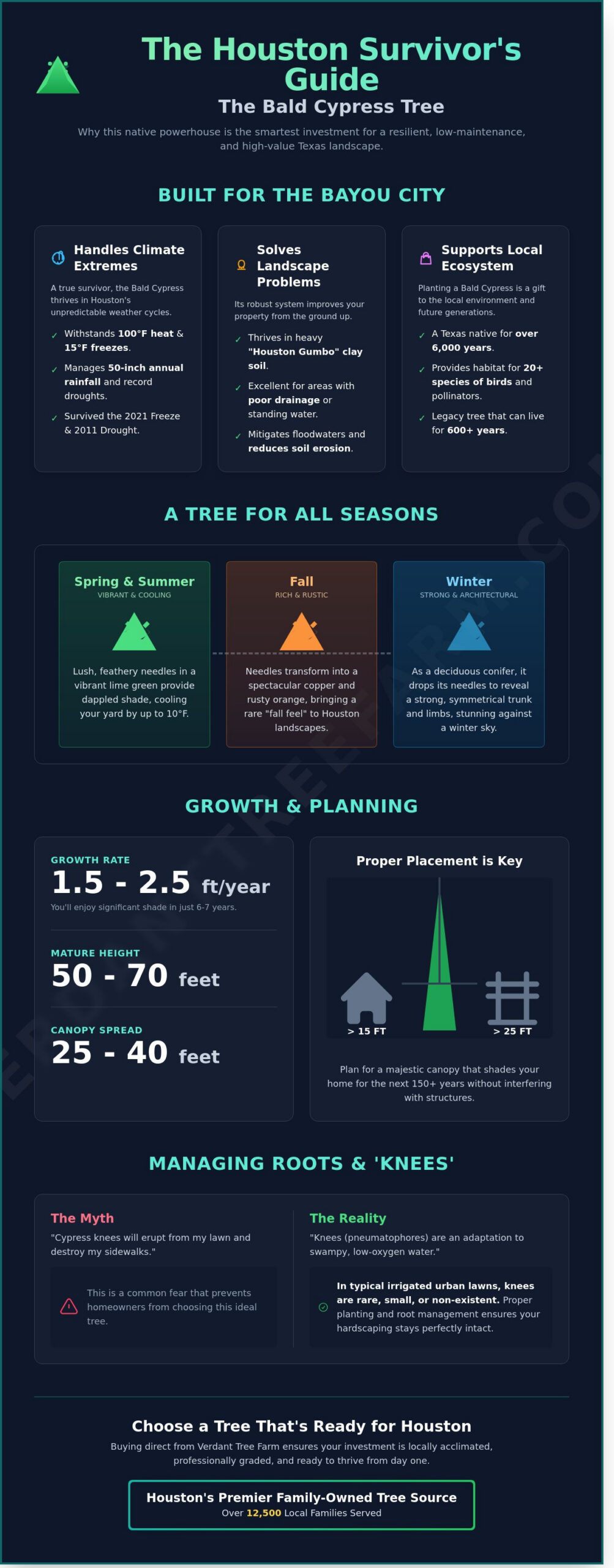
Houston’s climate presents a specific set of challenges. We experience 50-inch annual rainfall averages alongside 100-degree summer heat. The Bald Cypress is built for these cycles. It’s a “one-stop-shop” solution for local yards, offering durability that few other species can match. Whether your soil is clay-heavy or prone to standing water, this tree remains steadfast. It’s a reliable choice that reflects our commitment as Houston’s Premier Tree Farm to providing high-quality, resilient inventory.
Native Resilience in the Bayou City
Houston’s weather is notoriously unpredictable. The Bald Cypress handles our extremes with ease. Its root system is designed to mitigate floodwaters and reduce runoff, which is a vital benefit in our local bayou ecosystem. These trees survived the 15-degree temperatures of the 2021 freeze and the record droughts of 2011 without losing their structural integrity. Planting this native species also supports over 20 species of local birds and various pollinators that depend on its massive canopy for habitat. It’s a hardworking neighbor that improves the local environment while protecting your land from erosion.
Visual Appeal: From Feathery Green to Rusty Orange
The aesthetic transition of a Bald Cypress tree Houston landscape is truly spectacular. In spring and summer, the foliage is a vibrant, lime green. The texture is soft and airy, providing dappled shade that cools your outdoor living space by up to 10 degrees. By late October or November, the needles turn a rich copper and rusty orange. This provides a rare “fall feel” in a city where most trees stay green year-round. Once the needles drop, the tree reveals a strong, straight trunk and architectural limbs that look stunning against a winter sky. This seasonal variety ensures your property remains visually interesting through all four seasons.
As a family owned and operated business, we take pride in growing these specimens to the highest standards. We offer them wholesale to the public, ensuring you get professional-grade quality at a fair price. Our team is ready to help you select, deliver, and install the perfect tree today.
Bald Cypress Specifications: Size, Growth, and Form
Choosing a Bald Cypress tree Houston homeowners often prioritize is about more than just aesthetics; it’s about planning for a legacy. These trees start their lives with a distinct, symmetrical pyramidal shape that fits well in structured landscapes. As they reach maturity over several decades, they transition into a stately, flat-topped form that commands attention. Identifying a healthy specimen at the nursery is your first step toward success. Our team at Verdant Tree Farm recommends looking for these specific traits:
- A single, straight central leader without competing vertical branches.
- Lush, feathery needles that show no signs of premature browning or yellowing.
- A root ball that is firm and sized correctly for the trunk diameter.
- Smooth bark free from deep mechanical gashes or pest exit holes.
Size and Spatial Planning
In the fertile soils of Southeast Texas, you can expect a mature height of 50 to 70 feet with a canopy spread of 25 to 40 feet. Proper placement is vital for the long-term health of your property. We recommend a minimum distance of 15 feet from house foundations and at least 25 feet from overhead power lines. The growth rate is 1.5 to 2.5 feet per year under optimal Houston conditions. This rapid development means you’ll enjoy significant shade within just 6 or 7 years of planting. As a Family Owned & Operated business, we ensure every tree we sell is acclimated to our specific regional climate before it reaches your yard.
The Trunk and Bark Profile
One of the most impressive features of Texas’ native Bald Cypress is the flared buttress at the base of the trunk. This wide footprint provides exceptional stability during intense Gulf Coast storms and high-wind events. The bark is fibrous and reddish-brown, offering a rugged texture that remains visually striking even after the needles drop in winter. When comparing species, the Bald Cypress features a sturdier, more upright trunk than the more slender Montezuma Cypress, which tends to have a more weeping habit. Our inventory is grown to meet the highest technical standards, providing you with a premium product every time.
We take pride in being Houston’s Premier Tree Farm, offering our high-quality stock Wholesale to the Public. If you’re ready to add a Bald Cypress tree Houston locals will admire for generations, our experts can help you select a premium specimen tree that fits your specific spatial requirements and soil type.
Managing Roots and ‘Cypress Knees’ in Urban Yards
Many Houston homeowners worry about “knees,” the woody projections known as pneumatophores that grow upward from the root system. These structures are a signature feature in the Texas Parks and Wildlife Bald Cypress profile, helping the tree manage gas exchange in wet environments. While they add a unique architectural element to a landscape, they often trigger fears of property damage. Let’s be clear: a Bald Cypress tree Houston property owners plant won’t typically “destroy” a driveway if you provide at least 15 feet of clearance. These roots are far less aggressive than those of a Willow or Silver Maple. However, if you plant one within 6 feet of a concrete slab, you’ll likely see pavement lifting within 12 to 15 years.
The development of knees is directly tied to the oxygen levels in your soil. In the heavy, compacted clay found throughout Harris County, roots often stay near the surface to breathe. If your yard experiences standing water for more than 48 hours after a storm, your tree is more likely to produce these structures. At Verdant Tree Farm, we’ve observed that trees in well-drained, irrigated lawns produce significantly fewer knees than those in swampy low spots. By managing your site’s hydrology, you can largely control how these roots behave as the tree matures.
Landscaping Solutions for Root Zones
Protect your mower and your tree by creating a dedicated root zone. We recommend a mulch ring at least 8 to 12 feet in diameter for a maturing Bald Cypress tree Houston. This creates a “no-mow” zone that prevents mower blades from striking the knees, which can happen as early as year 7 of growth. You can underplant this area with moisture-tolerant perennials like Wood Ferns, Louisiana Iris, or Giant Leopard Plant. Never prune or grind down cypress knees; doing so creates open wounds that allow wood-decay fungi to enter the root system, potentially killing the tree within 5 years. Instead, simply add another 2 inches of mulch to blend them into the landscape bed.
Soil and Water Management
Consistent hydration is the secret to a well-behaved root system. When you provide deep, regular watering during our 95-degree summer days, the roots are less likely to break the surface in search of moisture. These trees are the gold standard for rain gardens designed to handle Houston’s 50 inches of average annual rainfall. A single established specimen can transpire over 100 gallons of water on a hot day, making it a functional tool for drying out soggy corners of your lot. As a family-owned and operated business, we prioritize helping you select the right spot so your investment remains a hassle-free asset for your home’s value.
Planting and Care Guide for Houston’s Clay Soil
Planting your Bald Cypress tree Houston between November 15 and February 20 gives the roots a vital head start before the 98-degree summer humidity hits. Houston Gumbo clay is a dense, heavy medium that requires a specific approach to ensure your tree doesn’t drown or suffocate. Success starts with site preparation that respects our local geology. While these trees love water, the lack of oxygen in compacted clay can stunt growth if you don’t prepare the ground correctly.
Newly planted specimens need consistent moisture to thrive. We recommend 10 gallons of water per inch of trunk diameter, applied three times a week for the first 52 weeks. Once established, these trees are surprisingly drought-tolerant, though they thrive with a 20-minute deep soak every 14 days during our typical July dry spells. For nutrition, apply a 12-6-6 slow-release fertilizer in early March to support the spring growth flush. Pruning is rarely needed; you only need to remove competing central leaders to maintain that iconic pyramidal structure.
The Professional Planting Process
Our team always recommends the “million dollar hole” method. This involves digging a site twice as wide as the root ball but no deeper than the root ball’s height. In our heavy clay, digging too deep creates a bowl that traps water and rots roots. We mix 30% organic compost with 70% native soil to improve aeration without creating a drainage barrier. Because Southeast Texas faces 40 mph wind gusts during storm season, we use a two-stake system with flexible ties. This keeps the root ball stable while allowing the trunk enough movement to develop “wind-firm” strength.
Bald Cypress vs. Montezuma Cypress
Choosing the right variety depends on your specific lot and maintenance preferences. The Bald Cypress is the classic choice for wet areas, but it eventually grows “knees” that can interfere with lawnmowers or foundations. If you’re planting near a sidewalk or in a drier, more alkaline spot like parts of West Houston, the Montezuma Cypress is an excellent alternative. It stays nearly evergreen in our Zone 9 climate and doesn’t produce knees, making it a cleaner option for tight urban landscapes. For homeowners who also need a dense privacy screen along their property line, pairing your cypress with fast-growing evergreens like Nellie R. Stevens Holly Houston specimens creates a layered, year-round barrier that thrives in our local clay soil. We help you weigh these factors to ensure your investment lasts for generations.
Choose Verdant Tree Farm: Houston’s Premier Tree Source
Selecting the right Bald Cypress tree Houston homeowners can rely on starts with choosing the right source. Buying direct from a local nursery isn’t just about convenience; it’s about survival rates. Trees sourced from out-of-state retailers often struggle with the transition to our unique Gulf Coast climate. At Verdant Tree Farm, we grow our inventory locally. This ensures every specimen is fully acclimated to the specific humidity levels and soil profiles found in Harris County. When your tree arrives, it’s already prepared for the Texas heat.
Our business model provides the Verdant Advantage through veteran-owned expertise and wholesale pricing. We believe premium landscaping shouldn’t be reserved for large-scale developers. By offering wholesale rates directly to the public, we save homeowners an average of 20 percent to 30 percent compared to traditional retail garden centers. We operate with a mission of transparency and reliability. You get professional-grade trees without the middleman markup.
Proper planting is the most critical stage of a tree’s life. Our professional installation services take the guesswork out of the process. We manage everything from site preparation to proper root ball positioning. To protect your investment, we provide a 3-month warranty on our trees. This 90-day window offers peace of mind while your new Bald Cypress tree Houston specimen establishes its root system in its new home.
- Direct Growth: Our trees are raised in Texas conditions to prevent transplant shock.
- Expert Installation: We use specialized equipment to ensure deep, stable planting.
- Guaranteed Quality: Our 3-month warranty covers both the tree and the labor.
Wholesale to the Public in Cypress, TX
We invite you to visit our main location at 12102 Barker Cypress Rd to hand-pick your next tree. Walking through our rows of high-quality, Texas-grown inventory allows you to see the health and structure of our specimens firsthand. Being family owned and operated means our values translate to better customer service. We don’t just process transactions; we build long-term relationships with our neighbors. Our staff provides honest advice on which specific trees will thrive in your yard’s unique drainage and light conditions. If you’re also looking to add a living privacy screen to your property, our team can walk you through the benefits of growing Nellie R. Stevens Holly Houston alongside your cypress to create a complete, multi-layered landscape.
Start Your Landscape Transformation Today
Visualizing a massive tree in your yard can be difficult. We solve this by using 3D landscape design tools to show you exactly how your Bald Cypress will look as it matures over the next decade. This technology helps you plan for shade patterns and future growth. If you already have a mature canopy, we can schedule a maintenance consultation to assess the health of your existing trees. Our team is ready to help you create a lush, vibrant outdoor space that adds immediate value to your property.
Ready to upgrade your property with a stunning, water-loving specimen? Browse our Bald Cypress inventory and request a quote today!
Transform Your Houston Landscape Today
Planting a Bald Cypress tree Houston families can enjoy for generations requires a solid understanding of our local clay soil and proper root management. You’ve seen how these icons provide unmatched shade and architectural beauty when they’re given the right start in a well-drained spot. By choosing a specimen that’s already acclimated to our Zone 9 climate, you ensure your investment grows strong and tall for the next 50 years.
Verdant Tree Farm stands as the largest independent tree nursery in Houston, offering 20 acres of premium inventory at wholesale prices. We’re a veteran-owned and operated business dedicated to professional 3D design and expert installation services. Our team handles every detail, from the initial site plan to the final delivery of your specimen tree. It’s time to upgrade your yard with the help of Houston’s Premier Tree Farm. We’ve helped over 5,000 local homeowners build their dream landscapes, and we’re ready to do the same for you.
Shop Houston’s Best Bald Cypress Trees at Verdant Tree Farm
We’re excited to help you plant a lasting legacy in your own backyard.
Frequently Asked Questions
Do Bald Cypress trees grow well in Houston’s clay soil?
Yes, Bald Cypress trees thrive in Houston’s heavy clay soil because they’re native to the swampy regions of the Gulf Coast. These trees handle the dense, poorly drained Blackland Prairie clay that makes up 60 percent of local residential lots. Their deep root systems adapt quickly to compacted ground. We’ve seen these specimens reach 50 feet in height within 20 years when planted in local clay.
How far away from my house should I plant a Bald Cypress?
You should plant a Bald Cypress at least 15 to 20 feet away from your home or foundation. These trees can reach a mature spread of 30 feet; their expansive root systems need space to develop without interfering with pipes or concrete. Giving the tree a 20 foot buffer ensures the canopy won’t scrape your roof during 70 mile per hour Gulf Coast wind gusts.
Will a Bald Cypress tree lose its leaves in the winter?
Yes, the Bald Cypress is a deciduous conifer that sheds its needles every winter. You’ll see the foliage turn a vibrant copper or rusty orange around late November before it drops completely by mid-December. This is a natural cycle for the Bald Cypress tree Houston homeowners often mistake for a health issue. New, bright green growth will reappear reliably every March as temperatures rise above 65 degrees.
Can I cut the knees off my Bald Cypress tree?
You can safely remove cypress knees if they become a mowing hazard, though it requires precision to avoid infecting the tree. Use a sterile, sharp saw to cut the knee 2 inches below the soil line. Limit your removals to 3 knees per season to prevent stressing the root system. Our team recommends leaving them if they’re more than 10 feet from walkways to maintain structural integrity.
How fast does a Bald Cypress tree grow in Texas?
A healthy Bald Cypress grows at a fast rate of 24 to 36 inches per year in the Texas climate. With consistent watering during the first 2 seasons, a 15 gallon sapling can reach a height of 40 feet within 15 years. This rapid growth makes it an excellent choice for homeowners looking for quick shade. We offer these fast-growing trees wholesale to the public for immediate landscape impact.
Is the Montezuma Cypress better than the Bald Cypress for Houston?
The Montezuma Cypress is often preferred for its nearly evergreen habit, as it holds its needles for 11 months of the year in Houston’s Zone 9 climate. While the Bald Cypress is hardier against freezes down to 0 degrees, the Montezuma variety grows roughly 15 percent faster in sandy loam. As Houston’s Premier Tree Farm, we carry both to ensure you get the specific performance your landscape requires.
Do Bald Cypress trees need a lot of water once they are established?
No, established Bald Cypress trees are remarkably drought-tolerant despite their swamp-dwelling reputation. Once the root system is set after 2 years, the tree only requires about 1 inch of water every 10 days during a typical Texas summer. They can survive 30 day dry spells without permanent damage. This resilience makes the Bald Cypress tree Houston a reliable long-term investment for any local property owner.
What is the best time of year to plant a tree in Houston?
The best time to plant in Houston is between October and March when the tree is dormant. Planting during these 6 months allows the root system to establish in 60 degree soil before the intense July heat arrives. Our family owned and operated farm provides professional installation year-round, but we see the highest 98 percent survival rates for trees installed during the cooler autumn window.