Imagine a tree that makes your entire backyard smell like a fresh bottle of grape soda every single spring. For many local homeowners, the Texas Mountain Laurel Houston dreams of purple blooms often turn into a struggle against heavy clay and slow growth. You might already know that these trees are notoriously picky about drainage. It’s frustrating to watch a beautiful investment succumb to root rot or caterpillar infestations before it even reaches its prime. We’re here to change that.
This guide provides the professional blueprint for mastering this iconic species in our unique Gulf Coast climate. You will learn the exact soil amendments needed to bypass Houston’s drainage issues and the best practices for pest management. As Houston’s largest independent, veteran-owned nursery, we believe in providing more than just a plant; we provide a long-term investment in your property. Every tree we sell comes with a three-month warranty, giving you peace of mind as you establish your new fragrant centerpiece. We will walk you through the technical details of planting, maintenance, and protection for 2026 so you can enjoy that intoxicating scent for years to come.
Key Takeaways
- Discover how to bring the iconic “grape soda” fragrance to your yard with the slow-growing, evergreen beauty of the Texas Mountain Laurel.
- Learn the specific soil amendment and drainage techniques required to help a Texas Mountain Laurel Houston thrive in heavy clay and avoid fatal root rot.
- Master the seasonal maintenance schedule needed to identify and manage Genista Broom Moth caterpillars before they damage your spring blooms.
- Understand why sourcing mature specimens from a large-scale inventory is the only way to bypass a decade of slow growth and achieve immediate landscape impact.
- Ensure your landscaping investment is protected by choosing veteran-owned expertise and a three-month warranty on all professional tree installations.
Why the Texas Mountain Laurel is Houston’s Favorite Spring Showstopper
The Texas Mountain Laurel (Dermatophyllum secundiflorum) isn’t just a plant; it’s a sensory landmark in the local landscape. Known primarily for its “Grape Soda” nickname, this slow-growing evergreen shrub or small tree offers a unique combination of aesthetic beauty and rugged durability. It typically grows as a multi-trunked specimen, making it an ideal ornamental focal point for front yards or patio areas where its architectural structure can be appreciated up close. While it takes its time to reach its mature height of 15 to 25 feet, the wait is rewarded with a tree that survives almost anything our climate throws its way.
The ‘Grape Soda’ Scent: A Houston Spring Tradition
If you’ve ever walked through a neighborhood in late February or early March and smelled a distinct wave of grape bubblegum, you’ve likely encountered a Texas Mountain Laurel Houston residents have successfully established. The intoxicating aroma is legendary. It fills the air during a peak window that marks the true start of spring in the Gulf Coast region. When you compare this scent profile to other flowering trees Houston homeowners enjoy, nothing else quite captures that nostalgic, sweet fragrance. The visual appeal is equally striking. The tree produces pendulous clusters of purple flowers that resemble wisteria, creating a high-impact display against its deep green foliage.
Evergreen Architecture for Year-Round Appeal
While the spring blooms get all the attention, this tree’s true value lies in its year-round performance. It features thick, waxy, dark green leaves that provide a dense screen of privacy even in the middle of winter. For those looking for the best evergreen trees Houston has to offer, this species is a top contender. It doesn’t drop its leaves or look thin during the colder months, maintaining a lush appearance throughout the seasons. It’s a multi-generational tree with a long lifespan, meaning it becomes a permanent part of your home’s legacy. Its resilience is unmatched; it’s heat-tolerant, drought-tolerant, and perfectly cold-hardy for our occasional freezes. At our veteran-owned nursery, we specialize in these slow-growers because we know they represent a long-term investment. That’s why we back every purchase with a three-month warranty to ensure your landscape’s newest addition thrives from day one.
This appreciation for iconic Texas experiences often extends beyond the garden; for those who enjoy discovering local gems while traveling across the state, Taste Amarillo offers an excellent guide to the best dining and culinary spots in the Panhandle.
Overcoming the Houston ‘Clay Barrier’: Soil and Drainage Requirements
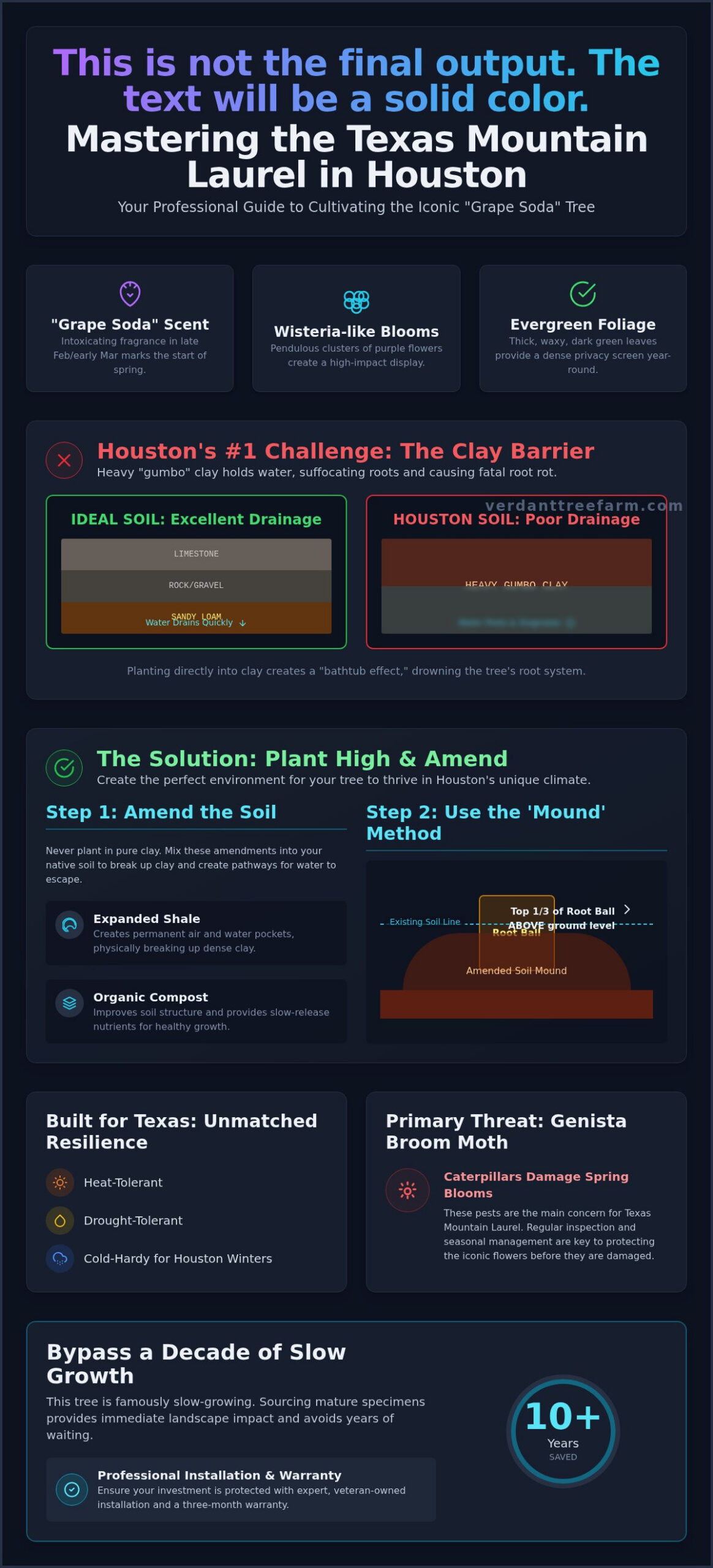
The biggest challenge for a Texas Mountain Laurel Houston grower isn’t the heat or the humidity. It’s the soil. Most online guides are written for the rocky, limestone-rich soils of Central Texas. Houston, however, is built on heavy gumbo clay. This clay acts like a sponge, holding onto water and suffocating the roots. Without proper drainage, these trees quickly develop root rot. Preventing “wet feet” is the single most important factor in your tree’s survival. Growing a healthy Texas Mountain Laurel Houston landscape requires a shift in mindset from traditional gardening techniques.
Amending Houston Gumbo for Native Success
You can’t just dig a hole in the clay and drop the tree in. Doing so creates a “bathtub effect” where water collects at the bottom and drowns the root system. To break up this clay, you need to incorporate expanded shale and organic compost. This Texas A&M AgriLife Extension guide confirms that while the species is adaptable, it requires excellent drainage to thrive. For this native tree, ensuring rapid water movement is far more critical than adding high-fertility fertilizers. Before you plant, test your site by digging a hole and filling it with water; if it doesn’t drain within a few hours, you need a different location or a more aggressive amendment strategy.
The ‘Mound Planting’ Method
In our region, planting “high” is the professional standard. We recommend the mound planting technique, which keeps the top third of the root ball above the existing soil line. This elevation allows excess water to shed away from the trunk rather than pooling around it. Successful native tree beds in Houston generally require a 50/50 mix of native soil and expanded shale, high-quality compost, and a 2 to 3 inch layer of hardwood mulch. It’s vital to keep that mulch away from the trunk to prevent moisture buildup against the bark.
Our landscaping services Houston team uses this specific elevation method on every project to guarantee success. As a veteran-owned business, we take pride in our precision. We don’t just sell you a tree; we ensure it’s positioned to last a lifetime. If you aren’t sure about your yard’s elevation, our team can provide a maintenance consultation to evaluate your drainage before the first shovel hits the ground. Every professional installation we perform includes a three-month warranty to protect your investment from the start.
Landscaping Strategies: Small Yards, Privacy Screens, and Focal Points
Modern Houston subdivisions often leave homeowners with limited backyard space. Finding a tree that provides impact without overtaking the entire lot is a challenge. The Texas Mountain Laurel Houston residents choose most often is prized for its “small footprint” nature. With a mature spread of 10 to 15 feet, it fits perfectly into corner pockets or narrow side yards. Unlike larger canopy trees that can interfere with power lines or foundations, this species offers a controlled growth habit that makes it a safe, high-value addition to any residential property.
Specimen Planting in Modern Houston Landscapes
As a focal point, this tree’s multi-trunked structure is its greatest asset. We recommend framing the tree with professional uplighting to showcase its architectural form after the sun goes down. During the day, you can enhance its deep green foliage by pairing it with native grasses like Gulf Muhly or Mexican Feather Grass at the base. These textures create a sophisticated, low-maintenance look that thrives in our heat. If you’re struggling to visualize how this fits your yard, we offer professional 3D landscape design services. This allows you to see the mature scale of the tree within your specific property layout before we begin the installation process.
Creating a Fragrant Privacy Hedge
If you want a “soft” privacy screen that doesn’t feel like a wall of plastic, consider a row of Texas Mountain Laurels. For a dense, evergreen screen, space your trees approximately 6 to 8 feet apart. You can choose to keep them in their natural shrub-like form for maximum low-level coverage or train them into multi-trunked trees to allow for garden beds beneath. This species is a superior alternative to overused suburban hedges like Ligustrum or Wax Myrtle, which often require constant pruning and lack the iconic spring fragrance. It provides a permanent, lush barrier that stays green through the coldest Houston winters.
When you visit a tree nursery Houston families trust, you’ll see why maturity matters for these slow-growing specimens. Starting with a larger tree ensures you get that privacy and fragrance immediately rather than waiting a decade. As a veteran-owned business, we stand behind the quality of our inventory with a three-month warranty on every tree. Our team is ready to help you select the perfect specimen and handle the professional installation to ensure your landscape investment is a success from the very first day.
Care and Maintenance: Defeating the Genista Broom Moth
Maintaining a healthy Texas Mountain Laurel Houston landscape requires vigilance, specifically against the Genista Broom Moth caterpillar. This pest is the primary cause of spring defoliation in our region. While established trees usually survive an attack, the damage to the foliage and blooms can be devastating for the season’s aesthetic. Because this tree grows so slowly, losing a full season of growth to pests can set your landscape back significantly. Proper care ensures your tree remains the evergreen focal point you intended it to be.
The Caterpillar Defense Plan
Early detection is the key to protecting your tree. Look for small, silken webbing and “skeletonized” leaves where the tissue has been eaten away. This damage typically starts in late spring as temperatures rise. To combat these pests, we recommend using Bacillus thuringiensis (BT). It is an organic, microbial insecticide that specifically targets caterpillars without harming beneficial pollinators like bees or butterflies. Apply the spray thoroughly to the foliage in the evening to ensure the caterpillars ingest it while feeding. In USDA Zone 9, the Genista Broom Moth can produce multiple generations per year, requiring consistent monitoring from April through October.
Pruning and Seed Pod Management
Pruning should be handled with a “less is more” approach. If you need to prune for shape or to remove dead wood, do so immediately after the spring bloom has finished. Pruning too late in the year will remove the developing buds for next year’s purple flowers. Beyond shaping, you must manage the “Mescal Bean” seed pods. These woody pods contain bright red seeds that are highly toxic if ingested by pets or children. Always wear gloves when handling the pods and dispose of them in a secure trash bin rather than a compost pile. To encourage slightly faster growth, you can apply a slow-release, low-nitrogen fertilizer once in early spring. Avoid high-nitrogen options, as they produce weak, succulent growth that is even more attractive to broom moth larvae.
Our team offers expert maintenance consultations to help you identify these pests before they take hold of your yard. As a veteran-owned nursery, we pride ourselves on giving you the technical knowledge to protect your long-term investment. We specialize in large-scale inventory that gives you a head start on growth, and every tree we sell is backed by a three-month warranty. We are here to ensure your Texas Mountain Laurel Houston thrives for generations to come.
Sourcing and Installation: Why Maturity Matters
Nursery-grown mature trees are cultivated under ideal conditions to develop strong root systems and healthy branch structures. At Verdant Tree Farm, our veteran-owned operation focuses on quality control that big-box retailers simply can’t match. We understand that a tree is a long-term investment in your property’s value. Sourcing your Texas Mountain Laurel Houston from the largest independent nursery in the area gives you the unique opportunity to hand-pick the exact specimen that fits your yard’s architecture. You can inspect the trunk structure and branch density in person, ensuring the tree you choose is the perfect match for your landscape goals and 3D design plans.
Professional Installation vs. DIY
A mature, 15-foot Mountain Laurel is incredibly heavy and difficult to transport without specialized equipment. Attempting a DIY installation often leads to damaged root balls or improper planting depth. These mistakes are the primary causes of tree failure in Houston’s heavy clay. Professional installation takes the guesswork out of the process. Our team handles the heavy lifting and ensures the tree is mounded correctly to provide the drainage it needs to survive our rainy seasons. We use specialized equipment to move these heavy specimens, preventing the soil compaction that often kills trees during amateur projects.
We don’t just drop a tree in a hole. We provide a comprehensive service that includes the exact soil amendments and positioning required for success in Gulf Coast gumbo. This professional precision is why we confidently offer a three-month warranty on every tree we sell. We take pride in our work and our community, standing behind our products as a reliable partner in your home’s growth. Visit Verdant Tree Farm to hand-pick your ‘Grape Soda’ tree today and let our experts handle the professional installation to ensure your investment thrives for years to come.
Transform Your Landscape with the Iconic Grape Soda Tree
Success with a Texas Mountain Laurel Houston depends on mastering two specific local challenges: heavy clay drainage and seasonal pest control. By implementing the mound planting technique and monitoring for the Genista broom moth, you can create a thriving evergreen focal point. These trees are a long-term investment in your property’s value and aesthetic appeal. Choosing a mature specimen allows you to enjoy the legendary spring fragrance immediately rather than waiting years for a sapling to establish itself.
Verdant Tree Farm is the largest independent nursery in Houston, offering the region’s best selection of mature specimens. As a veteran-owned and operated business, we take pride in providing reliable expertise and professional installation services. We back every tree with a three-month warranty, ensuring your investment is protected from the very first day. Our team is ready to help you select and plant the perfect addition to your yard. Visit Verdant Tree Farm to find your perfect Texas Mountain Laurel today! We look forward to helping you build a landscape that lasts for generations.
Frequently Asked Questions
Is the Texas Mountain Laurel native to Houston?
While it is a Texas native, this species is more at home in the rocky Hill Country than the Gulf Coast. It can thrive in Houston, but only if you provide the proper drainage discussed in earlier sections. Our local clay is much heavier than its natural habitat. We recommend building a mounded bed with expanded shale to mimic the well-drained, alkaline conditions it prefers.
How fast does a Texas Mountain Laurel grow in Houston?
This is a slow-growing species that typically adds only 6 to 12 inches of height per year. In the humid Texas Mountain Laurel Houston environment, growth can be even more deliberate. This slow pace is why many homeowners prefer to purchase mature specimens from our nursery. Starting with a 15-foot tree allows you to enjoy the fragrance immediately rather than waiting a decade for a sapling to mature.
Are the red seeds of the Texas Mountain Laurel really poisonous?
Yes, the bright red seeds, often called Mescal Beans, are highly toxic to humans and pets if ingested. The hard seed coat usually prevents accidental poisoning if swallowed whole, but broken seeds are dangerous. You should prune the woody pods before they open if you have curious children or dogs in the yard. Always wear gloves when handling the pods and dispose of them in a secure trash bin.
Why is my Texas Mountain Laurel not blooming?
The most common reasons for a lack of blooms are insufficient sunlight or improper pruning. These trees require full sun to produce their iconic purple clusters. If you prune the tree in late summer or winter, you likely removed the flower buds that were setting for the following spring. Always prune immediately after the spring bloom ends to ensure you don’t sacrifice next year’s “grape soda” scent.
Can I grow a Texas Mountain Laurel in a large pot on my patio?
You can definitely grow this tree in a large container, which is a great way to manage Houston’s drainage issues. Because they grow so slowly, they won’t outgrow a pot quickly. Use a high-quality, well-draining potting mix and ensure the container has large drainage holes at the bottom. This setup allows you to enjoy the fragrance on a patio or balcony while keeping the roots away from heavy gumbo soil.
When is the best time of year to plant a Mountain Laurel in Houston?
Fall and early spring are the ideal planting windows for a Texas Mountain Laurel Houston project. Planting in the fall allows the root system to establish itself during the cooler months before the intense summer heat arrives. If you plant in spring, aim for February or March. Our professional installation team can handle the planting year-round, and every tree we install comes with a three-month warranty for your peace of mind.
How much water does a Texas Mountain Laurel need once established?
Once established, these trees are exceptionally drought-tolerant and require very little supplemental water. In fact, overwatering is the most frequent cause of tree failure in our region. You should only water during extended periods of extreme drought. If the soil feels wet several inches down, don’t add more water. Proper drainage is more important than irrigation for this species, as it naturally thrives in arid, rocky environments.
What should I do if I see orange caterpillars on my tree?
These are likely Genista Broom Moth caterpillars, which can quickly strip the foliage from your tree. You should treat the tree with Bacillus thuringiensis (BT) as soon as you notice them. This organic treatment is highly effective and safe for beneficial insects. As a veteran-owned business, we offer maintenance consultations to help you identify these pests early. Monitoring your tree from spring through fall is the best way to prevent significant damage.