A Medjool palm isn’t just a tree; it’s a blue-chip asset for your Houston property. Most homeowners looking to elevate their landscape eventually ask: is a Medjool palm a good investment for my home? It’s a valid question, especially when you’re weighing the desire for a resort-style backyard against the reality of Houston’s unpredictable freezes and heavy clay “gumbo” soil. You want a landscape that reflects your success without the constant fear of losing a high-cost specimen to the next winter storm.
We understand that choosing the right tree is about more than just aesthetics; it’s about long-term value and reliability. This 2026 guide will show you how a Medjool date palm functions as a high-yield luxury asset that can significantly increase your property’s equity and curb appeal. We’ll cut through the confusion surrounding palm sizing and pricing while providing the horticultural precision needed to make your investment thrive. From professional installation techniques to climate-specific care, you’ll discover exactly how to transform your home into a private oasis that pays dividends for years to come.
Key Takeaways
- Learn how mature specimen trees provide an immediate resort-style transformation and can boost your property value by up to 10%.
- Determine if a Medjool palm is a good investment for my home by comparing its massive canopy and trunk girth to the more compact Sylvester palm.
- Understand the critical role of professional installation and proper drainage when planting large palms in Houston’s heavy clay gumbo soil.
- Discover why buying nursery-direct from a veteran-owned local farm ensures your trees are acclimated to the Texas climate while avoiding middleman markups.
The ‘Specimen’ Status: Why Medjool Palms Are a Luxury Real Estate Asset
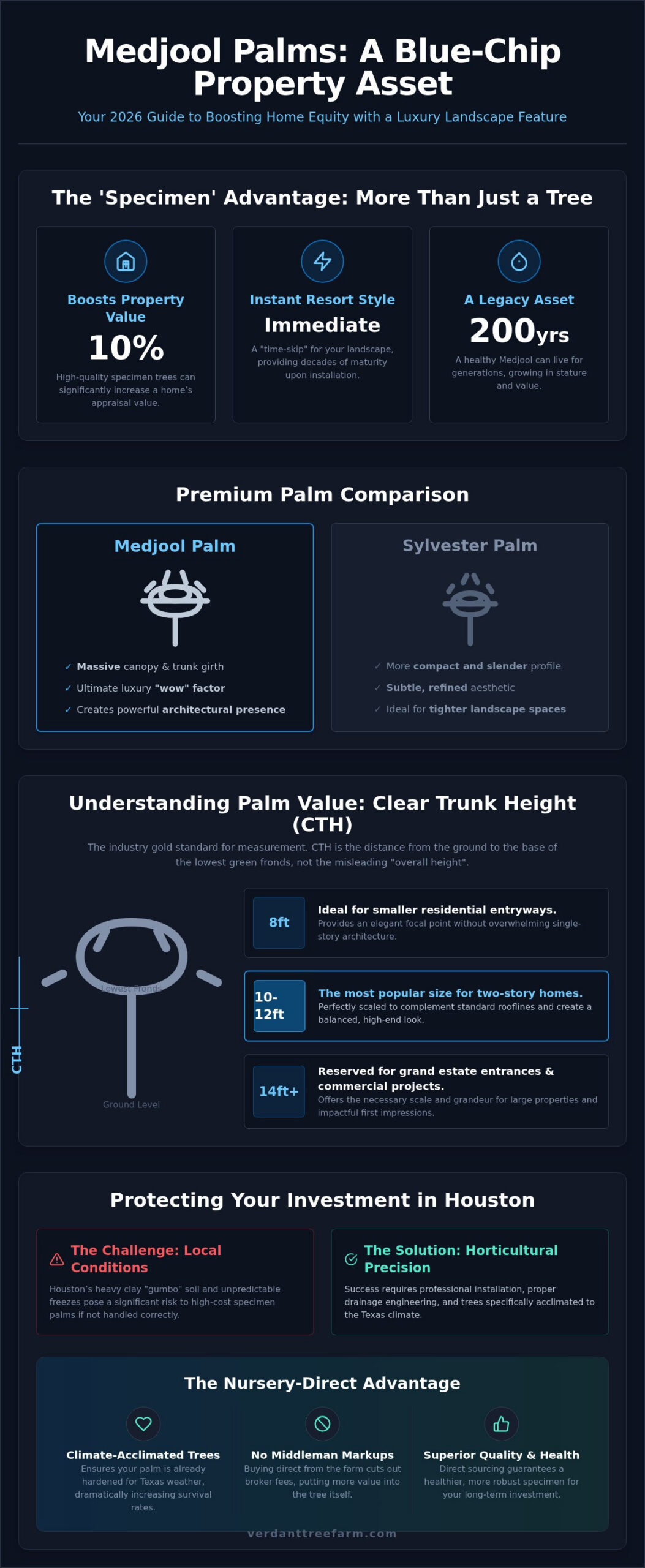
When you ask yourself, is a Medjool palm a good investment for my home, you’re looking at more than just a piece of greenery. You’re evaluating a “specimen” asset. A specimen tree is a mature plant that serves as a landscape’s focal point and increases property value. In the Houston market, the Medjool date palm sits at the top of this elite category. It offers an immediate resort-style transformation that other species simply can’t match. This isn’t a temporary addition to your yard; a healthy Medjool can live for up to 200 years. It’s a legacy asset that grows in stature and value while your neighborhood matures around it.
Visual Impact and Architectural Value
The hallmark of a luxury palm installation is the precision of the diamond-cut trunk. This horticultural technique creates a textured, geometric pattern that adds architectural weight to your front yard or pool-side. The massive, silvery-green canopy provides a striking contrast against the deep blues of a swimming pool or the neutral tones of modern and Mediterranean-style homes. Beyond the looks, these palms offer functional elegance. Their wide fronds create an upper-level privacy screen. This blocks second-story views from neighbors without cluttering your ground-level space with dense hedges or fences.
Immediate Equity vs. Slow Growth
Investing in a mature Medjool is essentially a “time-skip” for your property’s maturity. While native options like a Live Oak or Shumard Oak are excellent for the local ecosystem, they take decades to reach a size that commands attention. A Medjool arrives with instant scale and presence. This creates a powerful psychological impact on potential buyers. They see a finished, high-end environment rather than a work-in-progress landscape. In Houston’s competitive real estate market, that “wow factor” often translates to higher appraisal values and faster closing times. You aren’t just buying a tree. You’re buying the decades of growth it took to reach that specimen status, ensuring that is a Medjool palm a good investment for my home remains a resounding yes for your equity.
Our team at Verdant Tree Farm specializes in sourcing these elite specimen palms that are already acclimated to our specific regional climate. Because we are the largest independent nursery in the area, we can provide these high-impact trees directly from the farm. This ensures you get the architectural “wow” factor without the middleman markups often found with smaller landscape brokers.
Calculating the ROI: How a Medjool Palm Boosts Property Equity
Real estate experts often point to mature landscaping as a primary driver for property appraisal. High-quality specimen trees can increase a home’s value by up to 10%. When you consider the current 2026 market, the question “is a Medjool palm a good investment for my home” becomes a matter of timing. Rising freight costs and a growing scarcity of mature palms have turned these trees into “liquid” assets. They are highly sought after by luxury buyers who want a finished product today rather than waiting a decade for a sapling to grow.
The “cost of time” is the most significant factor in palm pricing. You aren’t just paying for the plant; you’re paying for the 15 to 25 years of professional care required to reach specimen size. In high-end Houston neighborhoods, these palms act as a financial legacy. They maintain their value even as other home features age or go out of style. Because they are slow-growing and difficult to transport, a mature Medjool on your property is a rare commodity that justifies a premium asking price.
Understanding Clear Trunk Height (CTH)
Industry professionals use Clear Trunk Height (CTH) as the gold standard for measuring palm value. CTH refers to the distance from the ground to the base of the lowest green fronds. This is different from “overall height,” which includes the fronds and can be misleading. When budgeting, focus on CTH to ensure you’re getting the scale you expect. Most Houston nurseries categorize these palms in specific increments:
- 8ft CTH: Ideal for smaller residential entryways.
- 10ft to 12ft CTH: The most popular size for standard two-story homes.
- 14ft+ CTH: Reserved for grand estate entrances and large-scale commercial projects.
Long-Term Maintenance Costs vs. Value
Protecting your investment requires minimal but consistent effort. Medjools are prized for being drought-tolerant once established, but they still need proper nutrition to maintain their vibrant canopy. Scheduling regular Maintenance Consultations is the best way to ensure your tree remains a high-value asset. These check-ups cover pruning and fertilization, which prevent nutrient deficiencies common in Houston’s alkaline soil. By treating your palm as a managed asset, you preserve its resale value and ensure it continues to anchor your property’s equity. If you’re ready to see how these specimens look in person, we invite you to visit our nursery and walk through our current inventory.
Medjool vs. Sylvester Palms: Which Premium Palm Offers Better Value?
When homeowners evaluate their landscaping options, the Sylvester palm is the most frequent alternative to the Medjool. Both trees offer a tropical, high-end look, but they serve different roles in a landscape design. The Medjool is a powerhouse. It features a massive trunk girth and a wide, silvery-green canopy that commands attention. In contrast, the Sylvester palm is more slender and compact. While a Sylvester is a beautiful addition, it lacks the sheer physical presence of a mature Medjool. Homeowners often weigh these two options when asking if a Medjool palm a good investment for my home, especially when considering the price gap between the two species.
The “diamond cut” aesthetic is a major selling point for both trees, but the results vary significantly. Because the Medjool has a much thicker trunk, the geometric diamond patterns are larger and more pronounced. This creates a rugged, architectural feel that anchors a property. The Sylvester’s diamond cut is more delicate and refined. If you are looking for a singular “hero” tree for your front yard, the Medjool’s premium price is typically justified by its scale. For a broader look at how these compare to other local favorites, check out our Houston Palm Tree Guide.
Climate Resilience in the Houston Environment
Houston’s weather is a mix of extreme heat, high humidity, and the occasional deep freeze. Both the Medjool and Sylvester have proven their toughness in our regional climate. Here is how they stack up:
- Freeze Tolerance: Both species survived recent major Houston freezes when properly established and mulched. They are among the hardiest “true” palms for our zone.
- Heat and Drought: These trees thrive in the Texas sun. Once their root systems are established in our soil, they require very little supplemental water.
- Humidity: Both palms handle Houston’s moisture well. However, the Medjool’s more open canopy structure can sometimes allow for better airflow, reducing the risk of fungal issues during our wettest months.
Curb Appeal and Resale Preference
Real estate agents frequently identify the Medjool as the “iconic” palm for luxury listings. It has a high level of brand recognition among buyers who associate it with high-end resorts. While the Sylvester works beautifully as a secondary accent or in a grouped trio, the Medjool is the undisputed centerpiece. Choosing between them often comes down to your home’s color palette. The Medjool’s deep, silvery-green fronds complement darker masonry and modern steel accents. The Sylvester’s lighter, silver-blue hue often pairs better with white stucco or light-colored stone. Making the right choice ensures your investment looks intentional and architecturally sound.
Protecting the Investment: Installation and Survival in Houston
The success of your landscaping depends entirely on the foundation. In Houston, that foundation is often “gumbo” clay. This heavy, non-porous soil can easily drown a large root ball by trapping water like a plastic bowl. When homeowners ask, is a Medjool palm a good investment for my home, the answer depends on the quality of the installation. A palm that isn’t planted correctly won’t survive its first year. Professional installation is mandatory for trees of this scale. These specimens can weigh several tons; moving them requires heavy equipment and a team that understands local soil physics.
Initial care is equally critical for your new asset. For the first 90 days, your Medjool requires daily deep watering. This consistent moisture helps the roots push out into the surrounding soil during the establishment phase. Professional installation includes proper staking to prevent leaning while the root ball acclimates. Without this support, the heavy canopy can act like a sail in the Houston wind. This can shift the tree and snap the new, fragile feeder roots before they can anchor the palm.
Drainage and Soil Amendments
Improper drainage is the leading cause of death for new palm investments in East Texas. To combat the clay, we often create a “drainage chimney.” This involves digging deeper than the root ball and backfilling with porous materials to allow water to escape the clay basin. We also use specialized palm fertilizers and soil conditioners to balance pH levels. These amendments provide the magnesium and potassium that Houston’s alkaline soil lacks. Ensuring the root ball can breathe is the most important step in protecting your financial legacy.
The Necessity of Professional Staking
Staking a Medjool requires more than just a few stakes and some twine. We typically use lumber framing with 2x4s or high-strength subsurface anchors for larger specimens. A Medjool must remain staked for at least one full growing season, or roughly 12 months, to withstand the Houston wind. Amateurs often make the mistake of strapping the tree too tightly with abrasive materials. This leads to trunk scarring, which can permanently devalue your specimen. Our veteran-owned team uses padded, industrial-grade straps to protect the bark while keeping the tree perfectly vertical.
Verdant Tree Farm provides a three-month warranty on all professional installations to give you peace of mind. We specialize in trees already acclimated to the local environment and soil conditions. If you want to ensure your luxury asset is planted to the highest industry standards, contact our installation team today to schedule your professional delivery.
Securing Your Legacy: Why Buying Nursery-Direct Matters
A specimen tree is a significant financial commitment. To ensure that is a Medjool palm a good investment for my home, you must consider the source of your tree. Many landscape brokers operate as “truck-to-yard” middlemen. They buy trees from various growers and ship them directly to your property without ever acclimating them to Houston’s specific climate. Buying direct from Verdant Tree Farm eliminates these middleman markups. We are the largest independent nursery in the region, meaning our palms have already spent time adapting to the local humidity and soil conditions before they reach your yard.
Acclimation is the best insurance policy for a high-value plant. Palms that are grown in different environments and immediately installed in Houston’s heavy clay often suffer from severe transplant shock. Because we manage our own inventory, we can verify the health and history of every tree we sell. This direct-to-consumer model provides a level of professional accountability that brokers simply can’t match. For more tips on finding a reliable partner, read our Ultimate Guide to Choosing a Tree Nursery in Houston.
3D Design: Visualizing Your Investment
Placement errors can ruin the ROI of a luxury landscape. A palm that is too small looks lost against a large estate, while one that is too large can overwhelm a standard roofline. Our 3D Landscape Design service prevents these costly mistakes. We allow you to visualize the palm’s scale against your home’s second-story windows and architectural features before the first hole is dug. This ensures the tree complements your home’s geometry. We also specialize in integrating Medjools with other Evergreen Trees for Houston to create a layered, year-round privacy screen that maximizes your property’s curb appeal.
The Verdant Tree Farm Advantage
Our veteran-owned and operated nursery is built on a foundation of reliability and hard work. We provide a turnkey service that handles everything from initial selection to professional installation and long-term health consultations. This end-to-end management is why we can offer a three-month warranty on our installations. We take pride in helping our neighbors build lasting equity in their homes. When you choose us, you’re partnering with a team that values your property’s growth as much as you do. Our massive inventory and internal management structure ensure that you receive the highest quality specimen at the best possible value.
Transform Your Landscape into a High-Yield Asset
A Medjool date palm is more than a plant; it’s a strategic move to boost your home’s curb appeal and long-term equity. By selecting a specimen-grade tree, you bypass years of slow growth and achieve an immediate architectural impact. We’ve explored how proper installation in Houston’s clay soil and buying nursery-direct are the keys to protecting your financial legacy. Ultimately, asking is a Medjool palm a good investment for my home means looking at both property value and personal enjoyment.
Verdant Tree Farm is the largest independent tree nursery in Houston and remains veteran-owned and operated. We provide a three-month warranty on all professional installations to ensure your new luxury asset settles in perfectly. Our team is ready to help you navigate the selection process with 3D design and expert maintenance advice. Request a Free Houston Landscaping Consultation and View Our Medjool Inventory to start your property’s transformation. Let’s build a landscape that reflects your success and stands the test of time.
Frequently Asked Questions
Do Medjool palms produce edible dates in Houston?
Medjool palms typically don’t produce edible fruit in the Houston area because our humidity is too high. While the trees will flower and develop fruit clusters, the moisture causes the dates to ferment or rot before they can ripen properly. In drier desert climates, these palms are agricultural staples; however, in East Texas, they are grown strictly for their majestic ornamental value and resort-style aesthetic.
How much cold can a Medjool date palm survive?
A mature Medjool date palm can generally survive temperatures as low as 15 to 18 degrees Fahrenheit. They have proven their resilience during recent Houston winter storms when homeowners provided proper protection. We recommend mulching the root area and covering the crown if a hard freeze is forecasted. This cold hardiness is a key reason why many believe a Medjool palm is a good investment for my home.
How often should I water a newly planted Medjool palm in Houston?
Newly planted Medjools require daily deep watering for the first 90 days to ensure the root ball stays hydrated while acclimating to the local soil. You should focus on saturating the root zone rather than just wetting the surface. After this initial establishment period, you can gradually reduce the frequency. Our team suggests scheduling a maintenance consultation to create a customized irrigation plan that protects your high-value landscape investment.
Can I plant a Medjool palm near my swimming pool?
Medjool palms are ideal for poolside planting because they create an instant luxury resort atmosphere without the heavy leaf litter of deciduous trees. Their root systems are fibrous and non-invasive, so they won’t damage your pool’s shell or plumbing. The high canopy provides shade and privacy while keeping the pool area open and airy. Just ensure you provide adequate drainage in the surrounding clay to prevent water from pooling.
What is the best time of year to plant a Medjool palm in Texas?
The best time to plant a Medjool palm in Texas is between April and August when the soil temperatures are consistently warm. Warm soil encourages rapid root growth, which is essential for the tree to anchor itself before the winter months. While you can plant them in the fall, the establishment process is much slower. Planting during the peak growing season ensures your palm has the best chance to thrive.
How fast do Medjool palms grow once established?
Once established, Medjool palms grow at a slow to moderate rate of about 1 to 2 feet of trunk height per year. This controlled growth is actually a benefit for residential landscapes, as the tree won’t quickly outgrow its intended space. Because they are slow growers, buying a specimen with the right Clear Trunk Height from the start is important. This ensures you get the immediate architectural impact you desire.
Are Medjool palms messy compared to other palm varieties?
Medjools are relatively clean compared to native oaks or maples that drop thousands of leaves every autumn. You’ll only need to prune the lower fronds once or twice a year as they brown and age. While they do produce flower stalks and fruit clusters, most homeowners choose to have these trimmed off during routine maintenance to prevent any mess. This keeps the diamond cut trunk looking sharp and professional.
Do I need a permit to plant a large specimen palm in Houston?
The City of Houston has a Tree and Shrub Ordinance that sets standards for planting on residential lots, particularly for new construction. While you usually don’t need a city permit to add a palm to an existing backyard, it is always smart to check your specific HOA guidelines. When asking is a Medjool palm a good investment for my home, remember that professional installation ensures all local planting standards are met.