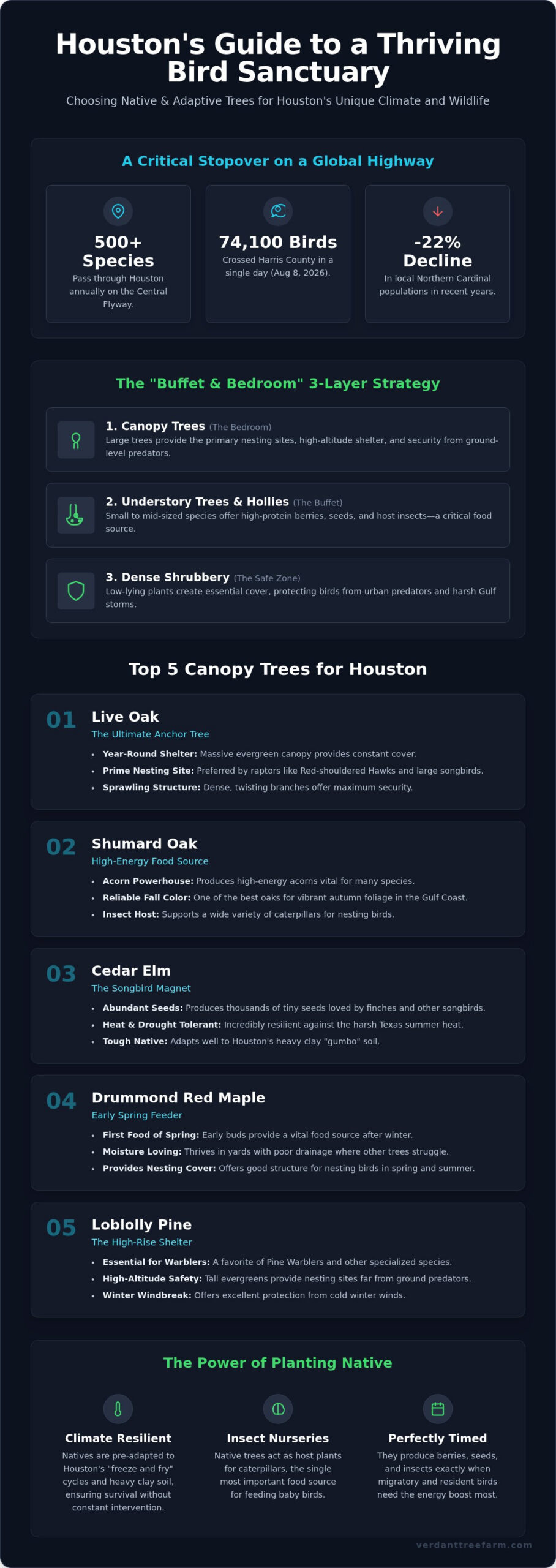
Did you know that over 74,100 birds crossed Harris County during their migration on August 8, 2026? While our city serves as a vital stopover for 500 species, local populations of favorites like the Northern Cardinal have declined by up to 22 percent in recent years. You likely want to help restore this habitat, but finding the best trees for attracting birds in Houston feels like a gamble when you are fighting heavy clay soil and unpredictable deep freezes. It is a common struggle for homeowners who want to support local wildlife without seeing their investment wither during the next weather extreme.
We agree that your yard should be a beautiful, low-maintenance sanctuary that provides shade and privacy without the constant stress of plant failure. This 2026 guide shares expert insights from Houston’s largest tree nursery to help you choose native and adaptive species that actually thrive in our “gumbo” soil. You will discover the top trees for food and shelter, including hardy Hollies and vibrant Redbuds. We also provide professional tips on the “buffet and bedroom” landscaping approach to ensure your feathered visitors have everything they need to stay for good.
Key Takeaways
- Understand why Houston’s location on the Central Flyway makes native trees essential for providing high-protein fuel to migratory birds.
- Master the “Three-Layer” rule to create a complete bird sanctuary using canopy trees, understory species, and dense shrubbery.
- Identify the best trees for attracting birds in Houston, including the nesting benefits of Live Oaks and the winter food supply of Savanah Hollies.
- Learn how to navigate Houston’s heavy clay soil and unpredictable freezes with expert planting techniques and professional installation advice.
- Discover strategic placement tips that protect your feathered visitors from window strikes while providing shade and privacy for your home.
Why Houston is a Critical Hub for Bird-Friendly Landscaping
Houston’s location on the Central Flyway makes our city a high-traffic highway for millions of birds. Every spring and fall, over 500 species pass through the Gulf Coast area. As urban sprawl continues to replace natural forests with concrete, your residential yard becomes an essential refuge. Planting the best trees for attracting birds in Houston isn’t just about aesthetics; it’s about providing the high-protein berries and insects these travelers need to survive long-distance journeys. Beyond the environmental impact, bird-friendly landscaping increases property value by creating a mature, desirable outdoor living space. Birds need reliable food.
The Role of Native Texas Trees
Our local weather is notoriously difficult for landscaping. These “freeze and fry” cycles, ranging from 100-degree summers to sudden winter lows, can kill non-native species quickly. Native trees have survived these extremes for centuries. They co-evolved with local wildlife to produce food exactly when it’s needed most. When you look at the diverse Flora of Texas, you’ll find species perfectly suited for our heavy clay soil that won’t require constant chemical intervention. These trees do more than just look good; they act as host plants for local insects.
Host plants are specific species that serve as the primary food source and nursery for butterfly and moth larvae, providing the essential caterpillar protein nesting birds require to feed their young. Without these native hosts, bird populations struggle to find the soft-bodied insects necessary for their chicks’ survival. Choosing native species ensures your yard is a functioning part of the local ecosystem rather than just a collection of plants.
Beyond Migration: Supporting Resident Birds
While migrants get the headlines, our year-round residents like Northern Cardinals and Blue Jays need constant support. These birds rely on your yard for protection when temperatures drop or during heavy Gulf storms. Evergreen species are particularly valuable in Houston because they offer dense cover and windbreaks during our occasional winter freezes. Lacking this evergreen shelter, resident birds are left exposed to the elements and predators. Cover is life.
Creating a layered landscape is the most effective way to keep these residents safe. By planting a mix of tall canopy trees and mid-sized understory trees, you create “safe zones” that protect birds from urban predators like outdoor cats. This vertical structure gives birds multiple escape routes and various nesting heights. It turns a flat, exposed lawn into a multi-story habitat where birds can forage and hide with confidence. Investing in this kind of variety ensures your bird sightings aren’t just seasonal, but a daily occurrence. Finding the best trees for attracting birds in Houston means looking for species that provide year-round security.
The Top 5 Canopy Trees for Attracting Birds in Houston
While colorful shrubs provide the “buffet,” large canopy trees serve as the “bedroom” for your backyard sanctuary. These giants offer the security and nesting sites that smaller plants simply can’t match. Choosing the best trees for attracting birds in Houston starts with selecting species that can handle our unique environment. From the iconic oaks to the resilient pines, these five native options are the workhorses of a bird-friendly landscape.
- Live Oak: This is the ultimate anchor tree. Its massive, spreading canopy provides year-round evergreen shelter and a sprawling structure for nesting.
- Shumard Oak: A favorite for its high-energy acorns, this tree also offers some of the most reliable fall color in the Gulf Coast region.
- Cedar Elm: This hardy native produces thousands of tiny seeds that songbirds love. It’s incredibly resilient against the Texas heat.
- Drummond Red Maple: Known for its early spring buds, this tree provides a vital early-season food source. It thrives in yards with poor drainage.
- Loblolly Pine: Essential for Pine Warblers, these tall evergreens provide high-altitude shelter and nesting sites away from ground-level predators.
Oaks: The Gold Standard for Houston Bird Life
Oaks are the heavy hitters of the bird world. Live Oaks are the preferred nesting sites for Houston’s raptors, such as Red-shouldered Hawks, and larger songbirds like Blue Jays. Their dense, twisting branches provide a sturdy foundation for heavy nests. If you’re looking for a faster result, the Shumard Oak is an excellent choice. While a Live Oak grows at a moderate pace, a Shumard Oak typically grows faster, reaching its full “insect buffet” potential sooner. This helps feed growing chicks that require thousands of caterpillars during the nesting season. You can find more details on these habits in the Lady Bird Johnson Wildflower Center Native Plant Database.
Hardy Elms and Maples
Not every yard has perfect conditions, but native Elms and Maples are built for Houston’s challenges. Cedar Elms are remarkably drought-tolerant and thrive in our intense summer heat without skipping a beat. On the other end of the spectrum, Drummond Red Maples are the perfect solution for low spots in your yard that tend to stay soggy after a heavy rain. These deciduous trees offer a dual benefit. They provide deep, cooling shade during our brutal July afternoons, but they drop their leaves in winter. This allows warm sunlight to reach your home and garden when the birds need that extra heat most. If you’re ready to start your canopy, view our current inventory of these native giants.
Small Trees and Hollies: Providing Year-Round Berries and Shelter
While the canopy giants discussed earlier provide the high “bedroom” of your landscape, smaller specimen trees fill the critical middle layer of your yard. These are often the best trees for attracting birds in Houston because they bring the activity down to eye level where you can enjoy it from your porch or window. By selecting species that bloom and fruit at different times, you create a 365-day resource. This mid-story layer is where birds forage for berries, hunt for hidden insects, and find quick cover from urban predators.
The Power of the Holly Berry
Hollies are the ultimate winter pantry for local wildlife. When insects are dormant and other fruits have withered, these berries provide a life-saving energy source. The Eagleston Holly is a standout choice for Houston homeowners. It offers a narrow, upright growth habit that works perfectly as a privacy screen while doubling as a massive bird feeder. It produces vibrant red berries that attract Cedar Waxwings and Robins by the dozen. If you need even heavier fruit production, the Nellie R. Stevens Holly is a reliable, fast-growing workhorse that thrives in our local climate.
These species are excellent evergreen trees Houston residents can rely on for thermal cover. During a sudden Gulf Coast freeze, dense evergreen foliage is the only thing standing between a bird and the elements. This thick growth also creates a “safe room” where songbirds can dive to escape hawks or neighborhood cats. Providing this year-round protection is just as important as providing food, especially when temperatures drop unexpectedly.
Spring Blooms and Summer Seeds
As winter fades, your bird sanctuary needs to shift gears to support nesting and migration. The Texas Redbud is one of the first trees to bloom in the spring. Its bright pink flowers offer high-energy nectar for returning hummingbirds. If your yard has intense, reflected heat or full afternoon sun, the Mexican Redbud is a superior choice. Its smaller, waxy leaves are specifically adapted to handle the Texas heat without scorching. Both varieties produce seed pods that provide foraging opportunities later in the year for various songbirds.
For smaller urban lots, the Little Gem Magnolia is a perfect fit. It stays compact but still produces the large, red, protein-rich seeds that birds crave. It provides the same dense evergreen cover as its larger cousins but in a footprint that fits most modern suburban yards. If you want to maximize summer activity, the Vitex (Chaste Tree) is an exceptional drought-tolerant alternative. Its spiked purple flowers act as a magnet for pollinators and hummingbirds during our hottest months, ensuring your yard remains a flurry of activity all summer long.
Planning Your Bird Oasis: Layering and Design for Houston Yards
Creating a bird sanctuary requires more than just buying a few plants; it involves building a functional ecosystem. The Three-Layer Rule is the foundation of professional habitat design. You start with a tall canopy of oaks or pines, add an understory of mid-sized trees like Redbuds or Hollies, and finish with a dense shrub layer. This vertical structure mimics natural forests and provides the best trees for attracting birds in Houston at every height level. Proper planning ensures that birds feel safe while your yard remains manageable and attractive for your family.
Strategic placement is critical for the safety of your feathered visitors. Don’t plant fruit-bearing trees directly against your house. Keeping these trees at least 15 to 20 feet away from windows helps prevent bird strikes, which often occur when birds see reflections of the sky or foliage. Adding a water feature, like a pedestal birdbath under the light shade of a Cedar Elm, creates a high-traffic destination for songbirds. We use 3D landscape design to help you visualize these layers before a single shovel hits the ground. 3D modeling allows us to account for sun exposure and mature tree size, ensuring your sanctuary doesn’t outgrow its space in five years.
Designing for the Houston Suburbs
Balancing bird-friendly features with HOA requirements is a common challenge for many residents. You don’t need a messy or overgrown yard to attract wildlife. Instead, group your trees to create habitat corridors along your fence lines. This allows birds to move through your property under cover while maintaining a clean, intentional look for your neighbors. If you’re unsure how to start, our team provides landscaping services Houston homeowners trust to bridge the gap between wild habitat and curb appeal. We can help you select species that meet neighborhood standards while still providing maximum ecological value.
Selecting Shrubs for the Ground Layer
Shrubs act as the primary “safe zones” for ground-feeding birds like Sparrows and Juncos. Mixing evergreen shrubs with deciduous varieties ensures that your yard offers protection even in the dead of winter. A three-inch layer of hardwood mulch doesn’t just hold moisture; it creates a dark, damp environment for the beetles and larvae that provide essential fats for foraging birds. This creates a natural foraging floor that keeps birds busy all day. Ready to build your oasis? Schedule a design consultation with our experts today to get started on your custom bird sanctuary.
Professional Installation and Care: Ensuring Your Bird-Friendly Landscape Thrives
Selecting the best trees for attracting birds in Houston is only half the battle. Even the hardiest native species can struggle if they aren’t settled into our unique environment properly. Houston’s environmental challenges don’t stop at the weather; they start beneath the surface. Professional installation is a smart investment because it ensures your new canopy trees have the structural support and soil conditions they need to reach maturity. We provide the expertise to turn your initial purchase into a multi-generational asset for your property. Success begins with the right hole.
Overcoming Houston’s Heavy Clay Soil
The heavy clay common in our region acts like a ceramic bowl, trapping water and suffocating roots if a tree is planted too deep. Proper planting depth is the primary factor in tree survival here. We utilize a “wide but shallow” hole technique, ensuring the root flare remains slightly above the soil line. This allows for better oxygen exchange and prevents the root rot that often plagues amateur plantings. Soil amendments and proper drainage are non-negotiable for species that don’t like “wet feet,” such as certain oaks or redbuds. You can’t just dig a hole and hope for the best.
Our professional installation process takes the guesswork out of the equation. We handle the heavy lifting, including precise staking to protect against Gulf Coast winds and applying the correct amount of mulch to retain moisture. By letting a veteran-owned team manage the technical details, you avoid the common mistakes that lead to plant loss. We ensure your sanctuary starts on solid ground. This end-to-end service is designed to protect your investment from day one.
Long-Term Care for Bird Health
Once your trees are established, maintenance becomes about preserving the habitat you’ve built. Pruning schedules should be strategic. We recommend trimming during the late fall or winter to avoid disturbing nesting birds or removing the spring buds they rely on. Keeping your bird sanctuary healthy also means adopting organic pest control methods. Avoiding harsh chemical pesticides keeps the insect “buffet” safe for birds to eat, ensuring they don’t ingest toxins while foraging in your yard. A healthy bird population requires a healthy insect population.
The unpredictable Texas climate can be tough on young plants, which is why we offer a three-month warranty on all trees we sell. This provides peace of mind during those critical first few months of establishment. Regular maintenance consultations can also help you spot potential issues before they become terminal. We aren’t just selling you a plant; we are partnering with you to grow a thriving ecosystem that will bring cardinals and hummingbirds to your windows for decades to come. Consistency is the key to a lasting sanctuary.
Start Growing Your Houston Bird Sanctuary Today
Transforming your yard into a thriving habitat is a long-term investment in our local environment. By using a layered design of native canopy trees and berry-rich hollies, you provide the essential “buffet and bedroom” birds need to survive our unpredictable Gulf Coast weather. Remember that proper installation in our heavy clay soil remains the most critical factor for tree health. Choosing the best trees for attracting birds in Houston is only the beginning of your journey toward a more beautiful, low-maintenance property.
We are here to help you every step of the way. As the largest independent nursery in Houston, we offer veteran-owned local expertise and a massive inventory of field-grown natives. Whether you need professional 3D design services or expert installation with a three-month warranty, our team is equipped to handle your project. Visit Verdant Tree Farm today to browse Houston’s largest inventory of bird-friendly trees! It’s time to bring the songbirds back to your neighborhood and enjoy the privacy and shade of a mature, healthy landscape. Let’s start planting for the future.
Frequently Asked Questions
What is the fastest-growing bird-attracting tree for Houston?
The Shumard Oak is one of the fastest-growing species among the best trees for attracting birds in Houston. It establishes quickly in our local clay soil and can add several feet of height per year under ideal conditions. This rapid growth allows you to create a canopy for nesting and acorn production much sooner than with a Live Oak. Drummond Red Maples also grow quickly in wetter areas of your yard.
Do I need to plant both male and female hollies to get berries?
Most holly species require both a male and female plant nearby to produce the berries birds love. Hollies are dioecious, meaning the flowers are sex-specific. However, some popular varieties like the Nellie R. Stevens Holly are parthenocarpic and will produce fruit without a male pollinator. If you are planting Savanah or Eagleston hollies, check with our nursery team to ensure you have the right mix for a heavy winter crop.
Can I attract hummingbirds with trees, or do I only need flowers?
Trees are essential for attracting hummingbirds because they provide both high-energy nectar and nesting sites. The Texas Redbud offers early spring blooms that serve as a vital food source when these birds first arrive. During the heat of summer, the Vitex (Chaste Tree) acts as a magnet for pollinators and hummingbirds alike. These trees provide the height and security hummingbirds need to feel safe between feedings while they search for insects.
How do I stop birds from flying into my windows if I plant trees nearby?
Strategic placement is the most effective way to prevent window strikes in your bird sanctuary. Plant your trees either very close to the window, within three feet, or further away than twenty feet. This prevents birds from picking up enough speed to cause injury if they become confused by reflections. You can also use external screens or UV-reflective decals on your glass to break up the reflection of the foliage.
Is the Live Oak or Shumard Oak better for birds in Houston?
Both trees offer unique benefits, so the best choice depends on your specific goals. Live Oaks provide superior year-round shelter and dense nesting sites because they are evergreen. Shumard Oaks are deciduous but produce larger, high-energy acorns and typically grow faster than Live Oaks. For a complete habitat, we often recommend planting both species to ensure birds have the evergreen “bedroom” of the Live Oak and the seasonal “buffet” of the Shumard Oak.
What trees provide the best nesting sites for Houston cardinals?
Northern Cardinals prefer the dense, low-profile cover found in small evergreens and thick shrubs. Little Gem Magnolias and Nellie R. Stevens Hollies are excellent choices because their thick foliage hides nests from predators. These trees offer protection from both the summer sun and occasional winter freezes. Cardinals typically nest between five and fifteen feet off the ground, making these mid-sized species the perfect height for their specific nesting requirements.
Are there any trees that attract birds but are also drought-tolerant?
The Cedar Elm and Vitex are two of the most drought-tolerant options for a bird-friendly yard. Cedar Elms are incredibly resilient against Houston’s intense summer heat and provide seeds that songbirds forage for throughout the season. Mexican Redbuds are another hardy choice, featuring waxy leaves that resist scorching in full sun. These species allow you to support local wildlife without seeing a massive spike in your monthly water bill during July and August.
How much water do these bird-friendly trees need in a Houston summer?
Established native trees generally need a deep soaking once or twice a week during a typical Houston summer. New plantings require more frequent attention, often needing water every other day during their first two years in our heavy clay soil. It is better to water deeply and infrequently than to give them shallow daily sprinkles. This encourages roots to grow deeper into the ground, making the tree more resilient against future Texas droughts.