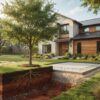
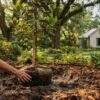
Looking out your window only to lock eyes with your neighbor in their kitchen isn’t the “open concept” you signed up for. In Houston’s rapidly expanding neighborhoods, privacy feels like a luxury that’s harder to find than a cool breeze in July. Finding the best privacy trees for Houston means more than just picking something green. You need a living fence that can survive a flash freeze, handle a month-long drought, and actually grow in our notorious gumbo clay soil.
We agree that it’s frustrating to spend a weekend planting only to watch expensive saplings wither when the weather turns unpredictable. You deserve a year-round screen that blocks out traffic noise and creates a private sanctuary for your family. This guide reveals the most resilient, fast-growing evergreen species specifically tested for our local 9a and 9b climate zones. We will cover everything from the gold standard Nellie R. Stevens Holly to high-speed growers like the Green Giant Arborvitae. You’ll learn how to build a green wall that increases property value and stands up to the Texas heat.
Key Takeaways
- Understand why the transition between USDA Zones 9a and 9b dictates which evergreens will thrive long-term in your specific neighborhood.
- Compare the top five best privacy trees for Houston, from the impenetrable Nellie R. Stevens Holly to the elegant, space-saving Eagleston Holly.
- Determine if your yard requires the vertical height of a tree to block second-story views or the smaller footprint of a privacy shrub.
- Learn the professional “mound” technique for planting in heavy clay to prevent drainage issues and protect your three-month warranty.
- Explore how direct-from-the-farm pricing and 3D design services simplify the process of upgrading your home’s security and aesthetic appeal.
Why Choosing Privacy Trees in Houston is Unique
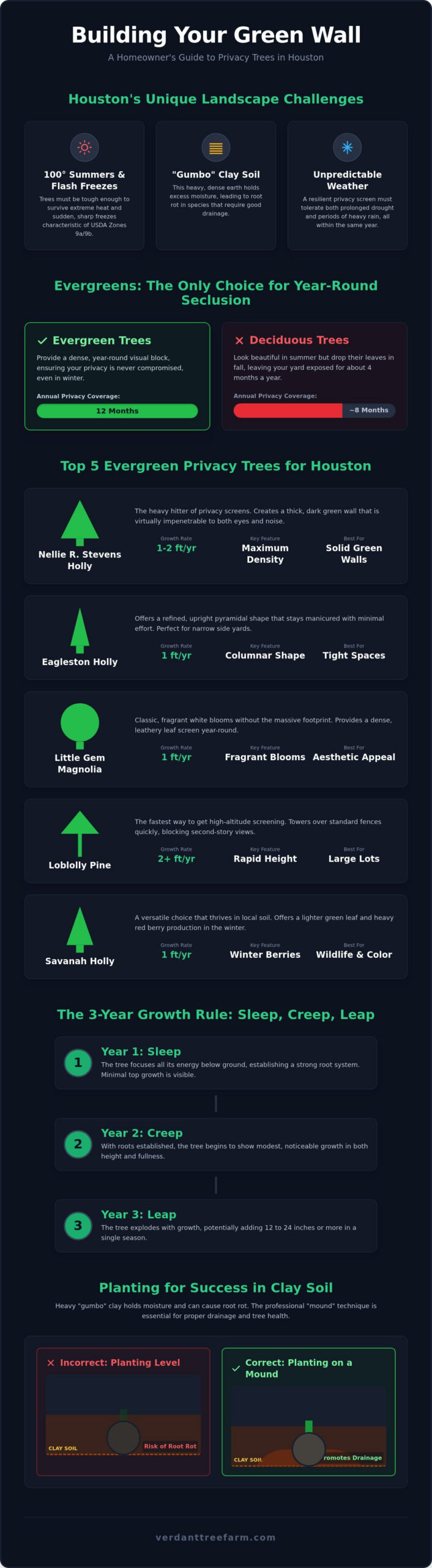
In the landscaping world, a privacy tree is an upright, living screen designed to provide a year-round visual block. Unlike a standard shade tree, these varieties are selected for their dense canopy and vertical growth habits. Choosing the best privacy trees for Houston requires a deep understanding of our specific environmental pressures. We aren’t just dealing with heat; we are managing a transition zone between USDA hardiness zones 9a and 9b. This means a tree must be tough enough to handle 100-degree summers while remaining hardy enough to survive the sharp, sudden freezes we experienced in 2021 and 2024.
The biggest silent killer of privacy hedges in Southeast Texas is our “gumbo” clay soil. This heavy, dense earth holds onto moisture like a sponge, which often leads to root rot in species that require high drainage. If your soil doesn’t drain, your investment won’t last. We focus on species that can tolerate “wet feet” during our rainy seasons while maintaining their structural integrity during August dry spells. Success in Houston starts with picking a tree that views clay as an asset rather than an obstacle.
The Role of Evergreen vs. Deciduous in Screening
For true seclusion, Evergreen trees are the only practical choice. Deciduous trees, such as the popular Natchez Crape Myrtle, look beautiful in the summer but leave your yard completely exposed once they drop their leaves in late fall. Relying on a deciduous screen means losing your privacy for four months out of the year. We also encourage homeowners to avoid planting a “monoculture,” which is a single line of the exact same tree. Mixing two or three compatible species protects your property value if a specific pest or disease targets one variety. This approach ensures that your best privacy trees for Houston provide a resilient, long-term barrier.
Growth Rates in the Houston Humidity
Houston’s high humidity and long growing season act like a natural greenhouse, often accelerating growth beyond what you see in other regions. However, new plantings typically follow the “sleep, creep, leap” rule. They spend the first year establishing roots, the second year showing modest growth, and the third year exploding in height. You can expect most established Houston hollies to grow between 12 and 24 inches per year when properly fertilized and watered. Regular pruning during these early years is essential to ensure the tree grows thick and full rather than tall and spindly. Proper maintenance turns a thin sapling into a dense wall faster than you might expect.
Top 5 Evergreen Privacy Trees for Houston Landscapes
While many big-box stores suggest thin shrubs like Wax Myrtle, true seclusion in a Texas yard requires the structural height of a tree. The best privacy trees for Houston are those that maintain a dense canopy from the ground up, even in our heavy clay. We’ve selected these five varieties based on their proven performance in local neighborhoods and their ability to withstand our specific weather cycles.
- Nellie R. Stevens Holly: This is the heavy hitter of privacy screens. It creates a thick, dark green wall that is virtually impenetrable to both eyes and noise.
- Eagleston Holly: If you’re working with a narrow side yard or a tight suburban lot, this is your solution. It offers a refined, pyramidal shape that stays manicured with minimal effort.
- Little Gem Magnolia: You get the classic, fragrant white blooms of a Magnolia without the massive footprint. It stays compact while providing a dense, leathery leaf screen.
- Loblolly Pine: For homeowners on larger lots in areas like Conroe or Cypress, this is the fastest way to get high-altitude screening. It towers over standard fences quickly.
- Savanah Holly: This variety offers a lighter green leaf and heavy red berry production in the winter. It’s a versatile choice that thrives in our local soil conditions.
Choosing the right species is only half the battle. You need to ensure the tree is adapted to our humidity and soil. While we carry these hardy adapted favorites, many homeowners also incorporate native Texas plants to support local wildlife while maintaining a secure perimeter. Stop by Verdant Tree Farm to see these specimens in person and feel the density of their foliage for yourself.
Hollies: The Ultimate Living Fence
Hollies are the backbone of Houston privacy for a reason. When comparing the Nellie R. Stevens to the Savanah Holly, the Nellie wins on sheer density. It grows into a solid block of green. The Savanah is slightly more open but offers a more traditional aesthetic with its berry display. Both varieties are incredibly freeze-resilient, having survived recent record-breaking winter events with far less damage than other evergreens. To keep them full from top to bottom, don’t just prune the sides. Tip-pruning the lead branches in early spring encourages the interior growth that blocks out the neighbors.
Magnolias for Elegant Screening
The Little Gem Magnolia is the go-to dwarf variety for blocking second-story windows. It typically reaches about 20 feet in height, which is the perfect “sweet spot” for most residential yards. If you have even less space, the Teddy Bear Magnolia is an even more compact alternative, though it grows slower. Be prepared for some leaf drop in the spring as the tree pushes out new growth. This is normal for the species and doesn’t mean your screen is failing. For more year-round options, see our guide on the best evergreen trees for Houston.
Trees vs. Shrubs: Which Privacy Solution Fits Your Yard?
Decide your primary goal before you start digging. If you’re trying to block a neighbor’s second-story balcony or provide afternoon shade for a patio, you need a tree. The best privacy trees for Houston provide the vertical reach that standard six-foot fencing simply can’t match. Shrubs are often a better fit for smaller footprints or when you need a dense boundary at eye level without encroaching on your neighbor’s air space. Choosing the wrong size can lead to expensive removal costs down the road.
Don’t fall for the bamboo myth. While clumping bamboo is often marketed as a “quick fix” for privacy, it’s a risky choice in our local climate. It frequently struggles with the drainage issues common in our clay soil and can look ragged during extended droughts. A tiered approach is often more effective and visually appealing. By planting a row of Eagleston Hollies behind a layer of smaller evergreen shrubs, you create a lush, natural look that provides multi-level security and better noise reduction.
Height and Spread Considerations
Measure your “privacy gap” accurately before visiting the nursery. This is the vertical distance between your existing fence line and the sightline you want to block. You also need to account for the drip line, which is the area directly under the outer circumference of the tree branches. Planting too close to a fence or a swimming pool can lead to structural issues as the tree matures. HOA guidelines in neighborhoods like Katy, Pearland, and The Woodlands often dictate maximum heights or specific setbacks for new plantings. Understanding these canopy dynamics is a key part of our regional urban forestry program, which helps maintain the health and diversity of our local tree population.
Maintenance and Longevity
Trees typically offer a much longer lifespan than shrubs in the intense Texas sun. While a standard hedge might need replacing every decade, a well-selected Little Gem Magnolia can serve your home for forty years or more. Established trees also require less frequent watering than new hedges, which have shallower root systems that dry out quickly in July. Securing the future of your landscape requires more than just digging a hole. Utilizing professional landscaping services in Houston ensures your privacy screen is planted at the correct depth for our unique soil. This professional installation protects your investment and ensures your best privacy trees for Houston thrive for generations.
Planting for Success: Spacing and Installation in Clay Soil
Even the best privacy trees for Houston will struggle if they are dropped into a hole and forgotten. Our heavy clay soil acts like a ceramic bowl. It holds water and suffocates roots if you aren’t careful. Successful installation requires a specific technical approach to ensure your living fence thrives for decades rather than just a few seasons. Follow these five essential steps for a professional-grade installation.
- Step 1: Spacing. Never plant directly against a fence. Give the tree at least three to four feet of clearance from any structure to allow for trunk expansion and airflow.
- Step 2: The ‘Mound’ Technique. This is the secret to Houston landscaping. Plant your tree “high,” with the top third of the root ball slightly above the surrounding soil grade. This prevents the “bathtub effect” where water sits in the hole and rots the roots.
- Step 3: Soil Amendments. Don’t just backfill with raw clay. Mix in high-quality compost or expanded shale to break up the density and improve oxygen flow to the root system.
- Step 4: Irrigation Setup. The first 12 months are the most critical. You must provide deep, infrequent watering rather than daily light sprinkles to encourage roots to grow deep into the earth.
- Step 5: Mulching. Apply a two to three-inch layer of hardwood mulch around the base. This acts as insulation against the 100-degree Houston sun and helps retain moisture during August dry spells.
If you want a professional result without the heavy lifting, you can book our expert installation team to handle the entire process from delivery to digging.
The Correct Way to Space Privacy Trees
Spacing depends entirely on the species you choose. For a solid green wall using Nellie R. Stevens or Savanah Hollies, we recommend spacing them five to eight feet apart. This allows the branches to knit together quickly without the trees competing for nutrients. Magnolias require more room, usually 10 to 12 feet, to account for their wider canopy spread. Planting in a staggered zigzag pattern creates a dense visual screen much faster than a single straight line because the canopies overlap more efficiently.
Post-Planting Care and Warranty
We stand behind our inventory with a three-month warranty on all trees we install. This period is vital for monitoring transplant shock, which often looks like slight leaf yellowing. It’s easy to confuse shock with overwatering in our clay soil, so look for limp, dark leaves as a sign of too much moisture. To keep your new screen in peak condition, consider scheduling a maintenance consultation. Our experts can help you fine-tune your irrigation and fertilization schedule to protect your long-term investment.
Designing Your Dream Backyard with Verdant Tree Farm
Selecting the best privacy trees for Houston is the first step, but how you arrange them determines whether you have a cluttered yard or a professional landscape. At Verdant Tree Farm, we believe in a comprehensive approach that bridges the gap between buying a plant and building a sanctuary. As a veteran-owned and operated business, we bring a level of precision and reliability to every project. We handle the entire process under one roof, from the initial design consultation to the final professional installation. This end-to-end service model ensures that the vision we create together is the exact reality that ends up in your soil.
Our nursery-direct advantage means you aren’t paying middleman markups from a third-party contractor. We grow and maintain our inventory right here in the region, so your trees are already acclimated to the local humidity and clay before they reach your driveway. This direct connection between the grower and the designer results in better plant health and significant cost savings for the homeowner. It’s a smart, straightforward way to invest in your property’s value and your family’s peace of mind.
3D Design: See Your Privacy Screen Before It’s Planted
We use advanced digital tools to remove the guesswork from your landscaping project. Our 3D design services allow you to visualize exactly how your privacy screen will look against your home’s specific architecture. We can simulate growth over 5, 10, and 20 years, showing you how the canopy will fill in over time. This foresight is critical for preventing future property damage, as it ensures you don’t plant a species that will eventually interfere with power lines or foundation slabs. We help you match the right tree to your home’s style, whether you need the formal symmetry of an Eagleston Holly or the classic elegance of a Magnolia.
Professional Installation vs. DIY
The logistics of moving 100-gallon trees into a standard Houston backyard are often more than a weekend DIY project can handle. These specimens are heavy, delicate, and require specialized equipment to transport and plant without damaging the root ball. Professional installation isn’t just about saving your back; it’s about protecting your investment. Our team understands how to navigate tight suburban spaces and ensure every tree is positioned for optimal drainage in our clay soil. Choosing our professional crew also ensures your three-month warranty remains fully intact. Visit the largest independent tree nursery in Houston to see our massive inventory in person and start planning your project today.
Secure Your Secluded Sanctuary Today
Creating a private backyard shouldn’t be a guessing game. By selecting the best privacy trees for Houston, you are investing in a living screen that stands up to our intense heat, sudden freezes, and heavy gumbo clay. Success starts with the right species, like the resilient Nellie R. Stevens Holly, and continues with professional techniques like the raised mound planting method. These choices protect your property value and provide the year-round peace your family deserves.
As the largest independent nursery in Houston, we take pride in our veteran-owned and operated heritage. We don’t just sell trees; we provide long-term solutions backed by a three-month warranty on every installation. Our team is ready to help you visualize your perfect perimeter before a single hole is dug. Don’t leave your landscape to chance when you can see the results in advance. Take the first step toward a more private home and Request a Professional 3D Landscape Design Consultation today. We look forward to helping you grow a legacy on your land.
Frequently Asked Questions
What is the fastest-growing privacy tree for the Houston area?
Green Giant Arborvitae is the speed leader, often growing 3 to 5 feet per year in ideal conditions. Japanese Blueberry also performs well, averaging about 4 feet of growth annually. While speed is tempting, remember that faster growth usually requires more frequent pruning to maintain a dense, impenetrable screen. We help you balance growth speed with long-term maintenance needs to ensure your backyard stays truly secluded and manageable.
How far apart should I plant Nellie R. Stevens Hollies for a privacy screen?
Plant Nellie R. Stevens Hollies 5 to 8 feet apart on center for a solid privacy wall. This spacing allows the individual canopies to knit together quickly without over-crowding the root systems. If you want a faster visual block, use a staggered zigzag pattern. This layout provides immediate coverage while giving each tree enough room to reach its full 15 to 25-foot potential in our unique local climate.
Do privacy trees grow well in Houston’s heavy clay soil?
Yes, but success depends on using the “raised mound” planting technique to ensure proper drainage. Houston’s gumbo clay is dense and holds water, which leads to root rot if trees are planted too deep. Species like the Nellie R. Stevens Holly and Little Gem Magnolia are specifically adapted to handle these soil conditions when installed by professionals who understand the unique challenges of Southeast Texas drainage.
Which evergreen trees survived the 2021 Houston freeze best?
Hollies and Magnolias proved to be the most resilient survivors of the 2021 and 2024 freeze events. Specifically, the Nellie R. Stevens Holly and Little Gem Magnolia showed remarkable hardiness compared to more tropical species. These varieties remain the best privacy trees for Houston because they handle our extreme temperature swings from triple-digit summer heat to sudden winter lows without experiencing significant canopy loss or structural damage.
Can I plant privacy trees near my swimming pool?
You can, but you must select varieties with non-invasive root systems and minimal leaf litter. The Little Gem Magnolia is a popular pool-side choice because its large, leathery leaves are easy to skim and its root system is relatively contained. Always maintain a setback of at least 6 to 8 feet from the pool shell to prevent structural pressure or plumbing interference as the tree matures over the years.
How much does professional tree installation cost in Houston?
Costs vary based on the size of the tree and the complexity of the site access. A 30-gallon tree requires different labor and equipment than a massive 100-gallon specimen. We provide transparent, direct-from-the-nursery value by combining our extensive inventory with expert installation crews. Contact our team for a specific quote tailored to your property’s layout and your desired level of immediate privacy for your home and family.
When is the best time of year to plant a privacy hedge in Texas?
Late fall through early spring is the ideal window for planting in the Houston area. Planting during the cooler months allows root systems to establish themselves before the intense stress of the summer heat arrives in June. While you can plant year-round with professional installation and care, starting in November or February gives your new privacy screen the highest chance of long-term success in our local 9a and 9b zones.
Do I need an irrigation system for my new privacy trees?
A dedicated irrigation setup is highly recommended for the first 12 to 24 months after planting. New trees need consistent, deep watering to survive Houston’s unpredictable dry spells and intense humidity. While a full automated system is ideal, a simple soaker hose can work if managed carefully. Proper hydration is the single most important factor in protecting your investment and ensuring your trees grow at their maximum potential throughout the year.