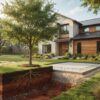
A tree that puts a foundation at risk isn’t always one with roots strong enough to crack concrete. In Houston, a larger concern is how a mature tree can draw moisture from expansive clay soil, contributing to uneven shrinking and settling. If you’re researching how to choose trees that won’t damage foundation, look beyond labels such as “foundation-friendly” and assess the tree, the planting site, and the home together.
It’s understandable to worry about roots and how close a new tree should be to your house. Thoughtful species selection and placement can reduce avoidable risks, but no tree is risk-free in every setting. Roots commonly take advantage of existing cracks or gaps; changes in soil moisture can also matter, particularly in Houston’s clay soils.
This guide explains how Houston’s soil and weather affect foundation risk, how to compare a tree’s mature size with your available space, and what to check before planting. Verdant Tree Farm offers Houston homeowners 3D landscape design and professional installation to help plan trees as part of the whole yard.
Key Takeaways
- Learn how to choose trees that won’t damage foundation by weighing mature size, site conditions, and planting location together.
- Compare smaller and larger Houston tree candidates without assuming any species is automatically foundation-proof.
- Use a practical checklist to account for your home, paving, utilities, drainage, and future canopy before planting.
- See how nursery selection, 3D landscape design, and professional installation can help shape a planting plan around your yard.
How to Choose Trees That Won’t Damage a Foundation in Houston
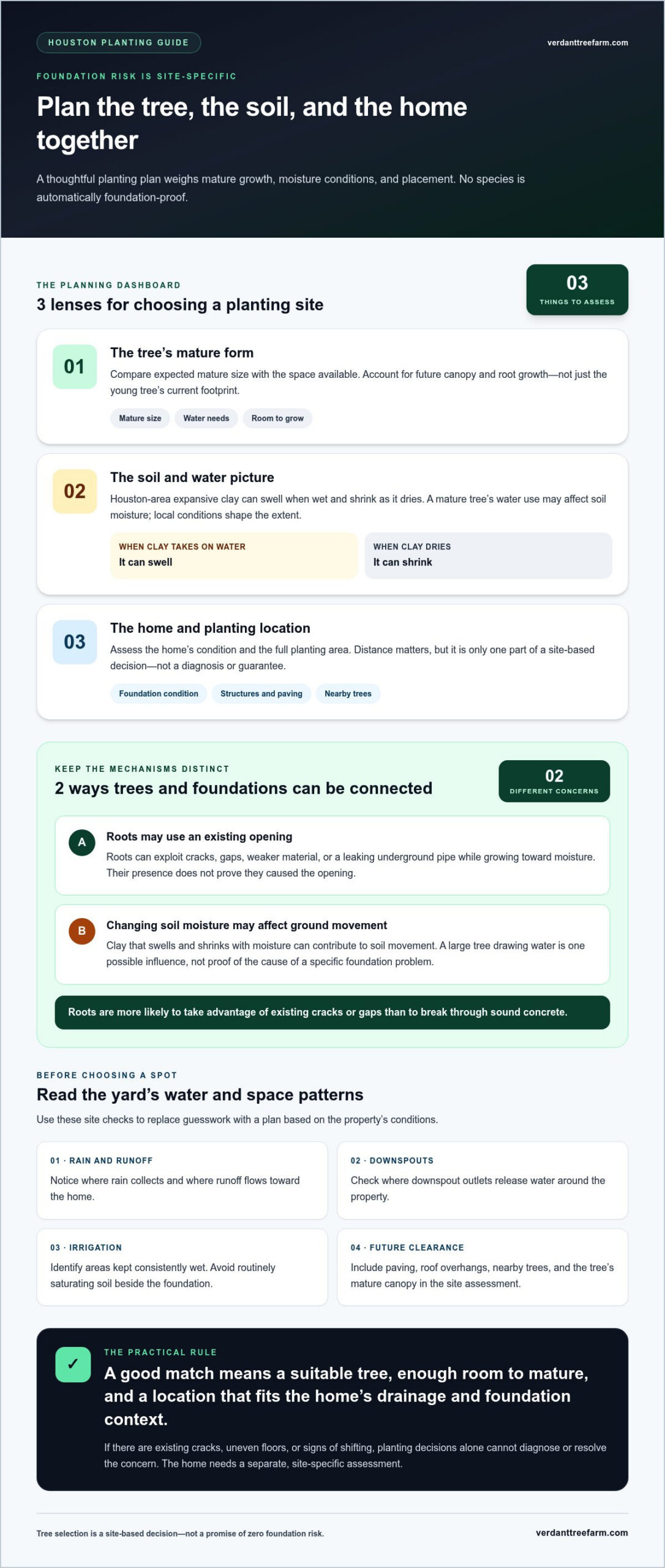
Choosing a tree near your home can feel like a high-stakes decision. You want shade and beauty without adding avoidable concerns about cracks or costly movement. Start by assessing the tree’s expected mature size, the soil and water conditions, and the distance from structures. No species can guarantee zero foundation risk, but a site-based plan can help prevent conflicts that are foreseeable.
Roots aren’t automatically a threat to a foundation. They grow where conditions provide water, air, and room, and are more likely to enter existing cracks or gaps than to break through sound concrete. The discussion of Root Invasion and Structural Damage describes how roots can affect built surfaces, including foundations. Normal root growth and structural damage are not the same thing.
Foundation risk depends on site conditions, tree growth, and placement together. That’s the useful starting point for how to choose trees that won’t damage foundation. Rather than searching for a species labeled “safe,” compare the actual planting area with the tree’s mature form and growing needs.
What “foundation-safe” really means for a Houston yard
In practice, “foundation-safe” means choosing and placing a tree to limit avoidable risk, not promising that a home will never experience foundation movement. Existing cracks, uneven floors, or signs of shifting need a separate, site-specific assessment. Planting decisions alone can’t diagnose or resolve a foundation concern, so base the tree plan on the home’s condition as well as the yard.
Why soil and water belong in the decision
Houston-area soils include expansive clay, often called “gumbo.” Clay can swell as it takes on water and shrink as it dries. Those changes may contribute to uneven soil movement beneath some foundations. Large trees can affect soil moisture as their roots draw water, but the extent depends on local conditions, including the tree’s size and location.
Before choosing a planting point, observe how water moves across the property. Note where rain collects, where runoff flows toward the home, and where irrigation keeps the ground consistently wet. Check the downspout outlets and the areas covered by irrigation, too. A planting plan should account for drainage and watering patterns, rather than placing a tree in the first open patch of lawn. Avoid irrigation that routinely saturates soil beside the foundation, and consider how a large tree’s water needs may affect soil moisture during dry periods.
Plan for more than the trunk’s position. A young tree may seem comfortably separated from the house, but its mature canopy and roots can occupy a much larger area. Include paving, roof overhangs, nearby trees, and future growth in your site assessment. These details help distinguish a workable location from one that could create conflicts later.
For Houston homeowners, the aim is a good match: a tree suited to the yard, enough room for it to mature, and a planting location that fits the home’s drainage and foundation context. This won’t remove every uncertainty, but it replaces guesswork with a plan based on the property’s actual conditions.
Do Tree Roots Damage Foundations? Understand the Houston-Specific Risks
A tree growing close to a home can look like the obvious cause of a crack, but proximity alone doesn’t prove that roots caused foundation damage. Separate two possible mechanisms: roots may enter an existing opening, while changes in soil moisture can contribute to ground movement beneath a structure. They are related concerns, but they are not the same process.
Direct root intrusion uses an existing weakness; soil-related foundation movement can occur as moisture conditions change around the structure. Keeping this distinction clear helps you plan a planting and avoid blaming a nearby tree without evidence.
How roots grow near homes and foundations
Tree roots grow through soil where conditions support them, including access to air, water, and nutrients. They don’t routinely break through sound concrete or deliberately target a foundation. As Purdue University’s guidance on tree roots and foundations explains, roots can exploit existing cracks or weaker material while growing toward moisture.
A small opening can change the situation. A crack in a foundation or a leaking underground pipe may provide a local source of water that attracts nearby roots. Root presence in a crack doesn’t establish what caused the crack. The opening may have existed first, or other conditions may be involved. Visible foundation movement needs an assessment specific to the home, rather than a conclusion based only on a tree’s distance.
Why Houston soil and drainage change the picture
Houston’s expansive clay soils can swell as they absorb water and shrink as they dry. Seasonal shifts between wet and dry conditions may change soil volume, and uneven moisture around a home can contribute to differential movement. A mature tree drawing water from one area is one possible influence, but it isn’t proof that a tree caused a particular foundation problem.
Consider the whole moisture picture. Poor drainage can leave some areas persistently wet, while a plumbing leak may keep a smaller patch damp. Uneven irrigation or prolonged dry weather can create different conditions elsewhere. These factors can overlap, so visible symptoms alone may not reveal the cause. Roots may also use a leaking pipe or pre-existing crack as a pathway, which is different from breaking through an intact foundation.
If you’re considering how to choose trees that won’t damage foundation, treat distance as one part of the decision, not a diagnosis or a guarantee. Note where water collects, where downspouts discharge, and how irrigation reaches the planting area. If a home already shows cracking or movement, have that condition evaluated separately before attributing it to a tree. Verdant Tree Farm’s 3D landscape design and tree planning can help bring the site’s drainage, planting locations, and landscape goals into one plan.
Compare Houston Trees by Mature Size, Root Traits, and Planting-Site Fit
A tree’s size in a nursery pot tells you little about how much room it will need years from now. Compare candidates by mature height and spread, growth habit, water needs, and the conditions in the exact planting spot. Roots can extend beyond the canopy, so the crown’s edge is not a dependable boundary for underground growth.
Use the following framework to compare options. Mature dimensions vary by species, cultivar, and growing conditions, so check a reliable horticultural reference for the specific tree before choosing its location.
Smaller ornamental candidates, such as Texas Redbud or crape myrtle: Consider these for a more modest-scale accent or where the planting area is limited. Check the selected tree’s mature dimensions and water needs, then compare them with nearby paving and structures.
Larger shade-tree candidates, such as Live Oak: Plan for more room and assess the mature canopy and root zone in relation to the home, driveways, utilities, and neighboring trees. A large shade tree may suit a spacious yard, but placement can be challenging on a tight site.
Any species on a challenging site: Check drainage, irrigation patterns, overhead clearance, and expected growth before settling on a spot. A suitable species can still be a poor fit if the site can’t accommodate its mature size.
Which tree traits matter most near a house?
Start with the space available, not the tree’s current height. Match its growth habit and water needs to the yard’s drainage and to your goals for shade, screening, or seasonal interest. Don’t infer a root system’s behavior from canopy width alone. Check species-specific claims about mature dimensions and root traits against reliable horticultural sources.
Distance guidelines are planning tools, not guarantees. General recommendations suggest placing many larger trees at least as far from a foundation as their expected mature height; smaller ornamental trees may sometimes fit closer, depending on the species and site. Use those guidelines as a starting point, then account for the specific tree, nearby infrastructure, and property conditions. The Michigan State University Extension guidance on reducing root damage also emphasizes considering species, proximity, and planting practices together.
How to compare smaller and larger tree options
When deciding how to choose trees that won’t damage foundation, compare each candidate against the same site facts instead of relying on a “safe tree” label. Texas Redbud and crape myrtle can be considered as ornamental options; Live Oak is a larger shade-tree candidate that calls for more space and careful placement. None is automatically foundation-proof. For more context on evergreen choices and landscape goals, explore the Houston evergreen tree guide.
Then picture the mature tree in place. Consider its canopy, the shade it will cast, its watering needs, and the space around structures. Matching those needs to the whole yard narrows the options before planting begins.
Use This Houston Planting Checklist to Reduce Foundation Risk
A good planting plan starts with the yard you have, not a generic distance rule. Homes can differ in foundation conditions, drainage, utility routes, and available space, so the right location depends on the tree and the site together. Use this checklist to work from measurements to a final planting point before digging.
Measure the site before choosing a tree
Record the available space and compare it with reliable information about the tree’s mature dimensions. Include the foundation, paving, overhead clearance, utilities, drainage, and irrigation in your plan. This helps you spot conflicts early, while you can still change the species or location.
- Map the planting area. Measure from the proposed trunk location to the foundation, paths, driveway, patios, and other structures. Note the planting area’s width and any narrow passages that could limit future growth or access.
- Look up, then below ground. Check overhead clearance near roofs, eaves, and service lines. Identify known underground utility locations and irrigation lines before choosing a final spot or beginning excavation. An open patch of lawn isn’t necessarily clear below the surface.
- Track how water moves. Observe where rainwater flows, collects, or drains slowly. Note downspout discharge points and areas reached by irrigation. If a spot stays unusually wet or dry, consider a different planting position or review the yard’s drainage plan.
- Compare space with mature size. Use verified horticultural information for the particular tree to check expected mature height and spread. Allow for canopy growth, and remember that roots may extend beyond the canopy. The tree’s current nursery size isn’t a reliable guide to how much room it will need later.
- Confirm the planting point. Compare the tree’s expected growth with the home, paving, access routes, utilities, and water patterns. Adjust the location if those needs compete. There isn’t one minimum distance that fits every species, foundation, and property.
Plan planting and care for the long term
Choose a spot where the tree can grow without crowding the foundation or blocking routine access. Plan for watering suited to the tree and site, while keeping drainage patterns in view. Even careful placement and maintenance can’t promise that a foundation will never move. If you already see cracking or movement, seek a site-specific assessment rather than assuming a nearby tree is the cause.
A practical approach to how to choose trees that won’t damage foundation is to measure first, compare mature growth, and check the location against the whole property. Houston landscaping design and installation services bring tree selection and site layout into one plan. Verdant Tree Farm can help with tree selection and placement as part of your yard’s landscape plan.
Plan Foundation-Conscious Tree Selection with Verdant Tree Farm
A thoughtful planting plan connects the tree you choose with the space it will occupy as it matures. Verdant Tree Farm combines Houston-area tree selection, 3D landscape design, and professional installation to help homeowners plan for the whole yard, not just the planting hole. No tree is guaranteed to be risk-free, but assessing the site and tree together supports a more informed decision.
Bring site conditions into the tree-selection conversation
Gather the details that will shape the decision: measurements from the proposed planting area to the house and paving, notes about drainage and irrigation, and known utility locations. Add your goals, such as shade, screening, or a focal point. This information helps frame which trees may suit the site and where they can fit as they grow.
Verdant’s inventory includes native Texas trees and species suited to regional conditions. Texas Redbud and Live Oak are examples of candidates to evaluate, not automatic solutions for every foundation or yard. Compare each tree’s verified mature dimensions and growth needs with the available space, the home’s position, and the site conditions.
Choose a practical next step for your yard
With 3D landscape design, you can consider the intended planting location as part of the broader layout before installation. This helps align tree selection with the yard’s space and goals, then carry the plan through to professional installation. Maintenance consultations can also help you plan for the ongoing care of new or existing trees and landscapes.
Bring photos or a simple sketch of the property, your measurements, and observations about standing water, dry areas, or existing foundation concerns. These details make the planning process more concrete. If the home shows visible movement or cracking, keep that issue separate from tree selection and seek a site-specific assessment rather than assuming the tree is responsible.
Learning how to choose trees that won’t damage foundation means making a reasoned match, not searching for a species with a blanket guarantee. Consider the tree’s mature size, the available planting space, and the way the yard’s conditions shape the plan. Verdant’s Houston nursery selection, design services, and installation can help connect candidate trees with the needs of your landscape.
Explore the Houston landscaping services guide for more on how planting design and installation fit together.
Make Your Next Tree Choice with Confidence
Start by gathering a few site measurements and noting where you want shade or screening. Those details give you a practical basis for deciding how to choose trees that won’t damage foundation, without expecting any species to eliminate every risk.
Verdant Tree Farm is a veteran-owned independent nursery serving Houston, with native Texas plants and trees suited to regional conditions. Its 3D landscape design, professional installation, and maintenance consultations can help connect your tree choice with the space and care your yard calls for. The goal is a plan suited to your property now and as the landscape matures.
Explore Verdant Tree Farm’s trees and landscape planning services to plan a thoughtful addition to your Houston yard.
Frequently Asked Questions
Can tree roots crack a concrete foundation?
Roots are unlikely to break through sound concrete, but they can grow into existing cracks or gaps. If a crack is near a tree, that alone doesn’t show which came first or what caused it. A leaking pipe or another source of moisture may also attract roots to a weak point. Have new or widening cracks assessed on their own merits instead of assuming the tree is responsible.
How far should I plant a tree from my house in Houston?
There isn’t one distance that suits every Houston home. General guidance often places large trees at least as far from a foundation as their expected mature height; other guidance suggests roughly 15 to 25 feet for many trees and 8 to 15 feet for some smaller ornamentals. Treat these as starting points, not guarantees. Species, mature dimensions, foundation conditions, utilities, and available yard space all affect placement.
Are there trees that are completely safe to plant near a foundation?
No tree can be called completely safe for every foundation and site. A smaller-growing tree may be easier to accommodate in a compact yard, but its fit still depends on drainage, soil, irrigation, and room to mature. To decide how to choose trees that won’t damage foundation, compare a specific tree’s mature size and growing needs with the actual planting space rather than relying on a blanket “safe” label.
Can removing a tree near a house cause foundation problems?
It can affect soil moisture, particularly where a large, established tree has been drawing water from clay soil. After removal, soil conditions may change as that water uptake stops, and the effect can vary with the site, weather, and foundation. Removal isn’t automatically the right response to a concern. Consider the tree, drainage, and existing foundation condition together before deciding what to do with a mature tree.
Can tree roots damage underground water or sewer pipes?
Roots can enter pipes through existing cracks, loose joints, or other openings, especially where moisture is escaping. That’s different from roots routinely puncturing a sound, intact pipe. Recurring wet patches, an unexplained drop in water pressure, or slow drains don’t identify the cause by themselves. Locate the affected line and address any leak or damage before choosing a tree nearby.
Does Houston clay soil make trees near foundations riskier?
Houston’s expansive clay can swell when wet and shrink as it dries, so changing moisture may contribute to soil movement around some foundations. Trees are one factor to consider alongside drainage, irrigation, leaks, and weather. Clay doesn’t mean every nearby tree will cause trouble, but it makes the site’s water patterns and the tree’s expected growth important parts of a careful planting decision.
Should I remove a mature tree if I see foundation cracks?
Don’t remove a mature tree based on cracks alone. The tree may be unrelated, and removing it can also change moisture conditions in the surrounding soil. First document where and when the cracks appear and have the foundation concern assessed independently. Then consider the tree’s condition and location alongside drainage and planting context. A clear assessment helps avoid treating removal as a guaranteed fix.