Waiting until the first bloom of spring to start your landscape is often the biggest mistake you can make in Southeast Texas. While most of the country follows a traditional schedule, knowing exactly when to plant trees in Houston is the difference between a thriving canopy and a dead trunk by July. We know the frustration of fighting heavy clay soil and watching a new investment wilt during a 20-day stretch of 100-degree heat. You deserve a lush, vibrant landscape that provides shade for decades, not a struggle for survival every summer.
At Verdant Tree Farm, Houston’s Premier Tree Farm, we’ve spent years perfecting the timing for our local environment. As a family-owned and operated business, we offer wholesale to the public prices along with the expert knowledge you need to succeed. This guide breaks down the ideal seasonal windows to ensure deep root establishment before the humidity peaks. You’ll discover the best months for planting, how to navigate our erratic freezes, and which specimen trees thrive best in our regional soil. We’re here to help you grow a legacy that lasts.
Key Takeaways
- Learn why mid-November through late February is the optimal window for when to plant trees in Houston to ensure strong root establishment before the summer heat hits.
- Understand how Houston’s unique soil and USDA Hardiness Zones impact tree survival and how to prepare your landscape for extreme weather events.
- Discover the essential timing exceptions for tropical palms versus native shade trees to ensure every specimen in your yard thrives.
- Master professional planting techniques, including the “Wide and Shallow” digging rule, to ensure your new investment grows lush and healthy for decades.
- See why choosing a “Wholesale to the Public” nursery provides a significant advantage in tree health and long-term property value.
The Optimal Window: The Best Time to Plant Trees in Houston
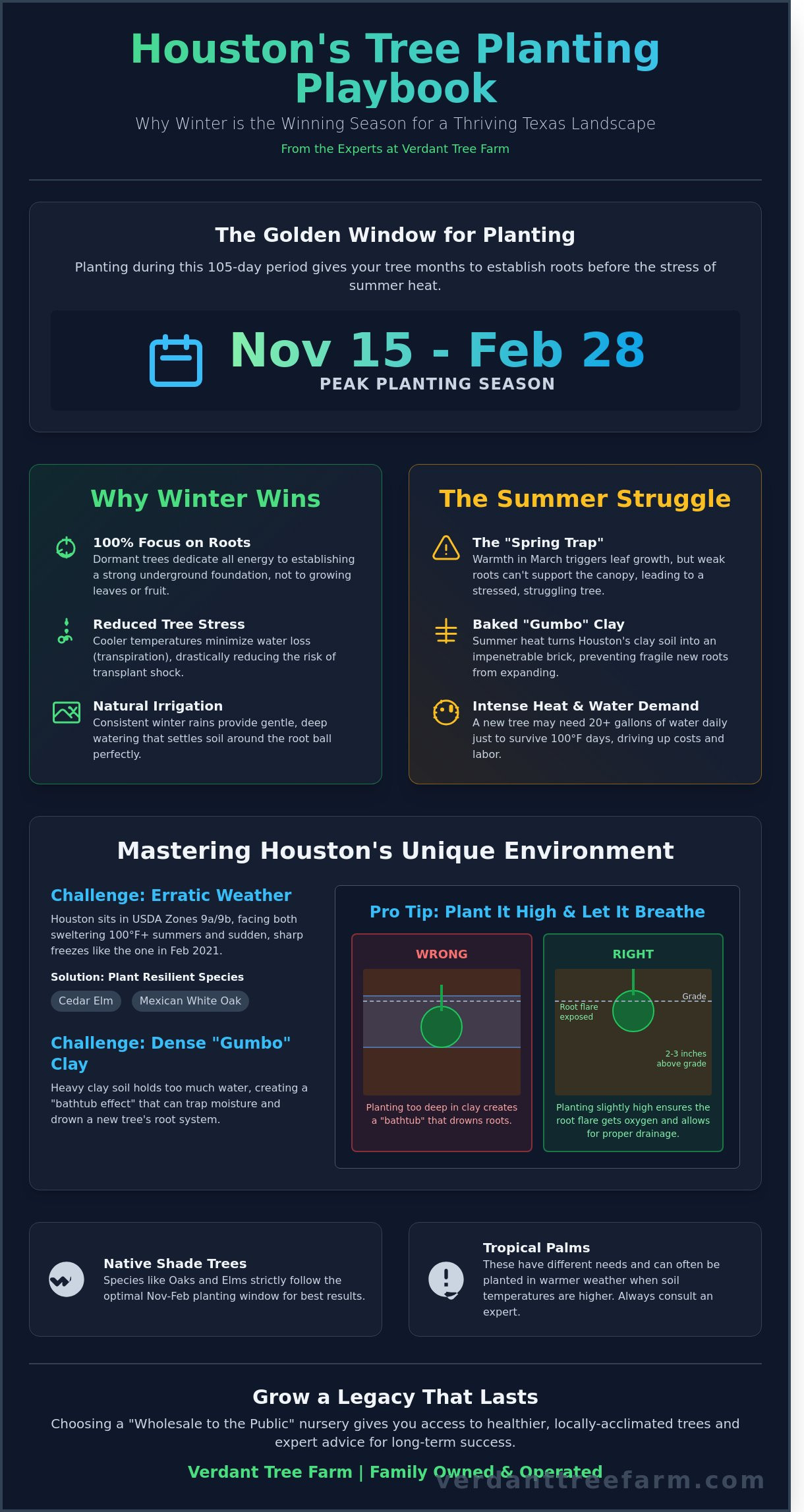
Success in Southeast Texas landscaping starts with timing. The primary window for when to plant trees in Houston runs from November 15th through February 28th. While northern states wait for the spring thaw, our local experts know that winter is the secret to a healthy canopy. Planting during these 105 days ensures your tree has months to establish itself before the first heat wave hits in May. As Houston’s Premier Tree Farm, we’ve seen how dormancy acts as a safety net for root systems. We are Family Owned & Operated, and we want your property to thrive for decades. That’s why we offer our specimen trees Wholesale to the Public during this peak season.
Many homeowners fall into the “Spring Trap” by waiting until March to visit a nursery. In Houston, March 1st often brings temperatures in the 80s, which signals the tree to begin leaf production. If the tree hasn’t established its roots yet, it will struggle to support that new growth. Soil temperature is the real driver of success. Even when the air is chilly, Houston’s soil remains warm enough for root activity. This allows the tree to build a foundation without the stress of supporting a full canopy of leaves.
Why Late Fall and Winter Win in Zone 9
In USDA Hardiness Zone 9, winter isn’t a time of total rest. It’s a period of underground productivity. Understanding Houston’s Unique Climate is vital because our ground rarely freezes. This allows roots to grow continuously throughout the cooler months. You’ll see several benefits by planting now:
- Trees focus 100% of their energy on root expansion instead of leaf or fruit production.
- Lower temperatures mean reduced transpiration rates, which keeps moisture inside the tree.
- Consistent winter rains provide gentle, natural irrigation that settles the soil around the root ball.
The Risks of Planting During a Houston Summer
Planting in July or August is a high-stakes gamble. The “Gumbo” clay soil common in Harris County bakes into a hard, impenetrable brick during the summer. This makes it nearly impossible for delicate new hair roots to penetrate the soil. You’ll also face the high cost of supplemental irrigation. A newly planted tree in July might require 20 gallons of water every single day to survive the 100-degree heat. Transplant shock occurs when a tree’s root system cannot absorb water fast enough to replace what’s lost through the leaves during a scorching Houston afternoon. Avoid the stress and stick to the winter window for a hassle-free experience.
Understanding Houston’s Unique Climate and Soil Challenges
Success in Southeast Texas landscaping starts with local knowledge. The Greater Houston area spans USDA Hardiness Zones 9a and 9b, meaning our plants must endure both sweltering heat and the occasional sharp frost. The February 2021 winter storm, which saw temperatures drop to 13 degrees in some areas, changed our industry forever. It taught us that resilience is just as important as beauty. When you decide when to plant trees in Houston, you’re timing your project to beat these environmental stressors. High humidity often helps specimen trees by slowing water loss through leaves, but it also means we must monitor for moisture-related diseases during the spring. We focus on providing trees that have already been acclimated to these local shifts.
Taming the Houston “Gumbo” Clay
Soil quality varies wildly across our region. While The Woodlands often enjoys sandy loam, neighborhoods in Cypress and Katy deal with heavy “gumbo” clay. This dense soil holds water like a sponge, creating the “bathtub effect.” If you dig a deep hole and drop a tree in, the clay walls trap water and drown the roots. We recommend planting your trees slightly high, usually 2 to 3 inches above the surrounding soil line. This technique ensures the root flare remains oxygenated. The Houston Area Urban Forestry Council Planting Guide provides additional technical insights on how proper mulching protects these exposed root balls from drying out during our intense summer months. Proper drainage is always more critical than nutrient density in these heavy clay pockets. Pairing your tree care with a solid lawn care Houston strategy that addresses the same compacted gumbo clay will help your entire landscape thrive together.
Preparing for Erratic Weather Patterns
Houston weather is rarely consistent. We experience long droughts followed by tropical deluges. To build a landscape that lasts, you need species that can handle these swings. Cedar Elms and Mexican White Oaks are excellent choices because they’ve proven their toughness in our local dirt. Beyond species selection, protection is key. If a sudden Gulf Coast freeze is forecasted, wrap the trunks of young trees to prevent bark splitting. Planning for these extremes is part of our commitment as Houston’s Premier Tree Farm. We offer trees Wholesale to the Public, ensuring you get high-quality specimens that are ready for our specific climate. If you want a landscape that thrives through every season, visit our Family Owned & Operated nursery to see our vibrant inventory. We make it easy to find the right tree for your specific neighborhood and soil type.
Species-Specific Timing: Shade Trees vs. Tropical Palms
Not every tree in our 20-acre inventory follows the same biological clock. Determining when to plant trees in Houston requires understanding the specific needs of the species you choose. At Verdant Tree Farm, we grow and acclimate our stock specifically for the Gulf Coast climate. This process ensures that whether you’re buying a 30-gallon sapling or a massive 200-gallon specimen, the tree is ready for local soil. Larger specimen trees often provide more planting flexibility because their established root balls retain moisture better than smaller, younger trees. However, the species still dictates the safest calendar window for long-term health.
When to Plant Native Shade and Ornamental Trees
For most Texas natives, the dormant season is the gold standard. We recommend planting shade and ornamental varieties during the cooler months to avoid transplant shock. This includes:
- Live Oaks and Shumard Oaks: Best planted between November 15 and February 15.
- Drummond Red Maples: Benefit from the 90-day root establishment window provided by winter planting.
- Texas Redbuds and Mexican Plums: These early bloomers should be in the ground by late January to ensure they have the energy for their March floral displays.
- Hollies and Magnolias: While these are resilient, they show a 25 percent faster establishment rate when installed during the cool autumn months.
Planting during these four months gives the tree a critical head start before August temperatures hit 100 degrees. Being Family Owned & Operated, we’ve seen that trees with a full winter of root growth handle the Texas summer with far less supplemental irrigation.
The Exception: The Best Time to Plant Palms in Houston
Palms are the significant exception to traditional planting rules. Unlike oaks, palms are monocots and behave more like giant grasses. They require warm soil, specifically 70 degrees or higher, to trigger new root initiation. For this reason, the ideal window for installing Sylvester, Medjool, or Pindo palms is from late April through early July.
Planting a palm in the dead of winter puts the tree at a 40 percent higher risk of failure. Cold, wet soil causes the roots to sit idle, making them susceptible to fungal pathogens and root rot. If you install your palms during the early summer peak, they can establish a solid foundation before the brief freezes of January arrive. As Houston’s Premier Tree Farm, we provide these “Wholesale to the Public” specimens with the specific care instructions needed for each season. Knowing exactly when to plant trees in Houston based on their species ensures your landscaping remains a vibrant, long-term investment.
A Step-by-Step Guide to Successful Houston Tree Planting
Choosing the right spot is your first priority. You need to look up for power lines and down for utility pipes. For large specimen trees like Live Oaks or Cedar Elms, stay at least 20 feet away from your home’s foundation to prevent future root interference. Understanding when to plant trees in Houston helps you avoid the stress of the July heat, but proper placement ensures the tree thrives for decades. Consider the sun’s path; a tree on the west side of your home provides essential relief from the 100-degree afternoon sun.
In Southeast Texas, our heavy gumbo clay acts like a ceramic pot. If you dig a deep, narrow hole, water collects at the bottom and rots the roots. We recommend the “Wide and Shallow” rule. Dig a hole only as deep as the root ball but two to three times as wide. This loose soil allows new roots to spread horizontally where oxygen is most plentiful. Don’t over-fill the hole with bagged potting soil. Using more than 20% soil amendments creates a “container effect” where roots refuse to grow into the surrounding native clay. Finish the job with a 3-inch layer of organic mulch to keep soil temperatures 10 to 15 degrees cooler during the summer. The same compacted clay that challenges your tree roots also affects your turf, so pairing your planting plan with proven lawn care Houston techniques for heat-defying yards will give your entire landscape the best chance of success.
Digging and Placing the Root Ball
Position the tree so the root flare, the area where the trunk widens at the base, sits slightly above the soil line. Burying this flare leads to trunk rot and eventual failure. Once the tree is level, backfill the hole with the native soil you removed. Tamping soil too hard in Houston clay collapses the vital air pockets that roots need to breathe, effectively suffocating the tree before it can establish. Use your hands or light water pressure to settle the dirt instead of your boots.
Watering and Aftercare in the First Year
Forget frequent, light sprinkling. Your new investment needs the “Slow Trickle” method. Use a hose at a low setting to saturate the root ball deeply twice a week during the winter. Build a 3-inch tall watering saucer out of mulch or soil around the edge of the hole to keep moisture where it belongs. As Houston transitions from a mild spring into a 95-degree June, increase your frequency to three or four times a week. Consistent moisture is the only way to survive the Texas heat.
Verdant Tree Farm: Houston’s Premier Source for Expert Planting
Choosing when to plant trees in Houston is only the first step toward a successful landscape. The quality of the tree itself determines if it will survive our intense summer humidity and heavy clay soils. At Verdant Tree Farm, we operate as a “Wholesale to the Public” nursery, which means we provide high-quality specimens directly to homeowners. This model ensures your trees don’t suffer from the stress of multiple transport moves or long stays in retail parking lots. You get fresher, healthier plants that are already acclimated to the local climate and ready to grow.
Our professional installation process removes the physical burden and technical guesswork from your project. Planting a large specimen tree requires precision, especially regarding hole depth and root placement. Our crews handle every step, from site delivery to the final application of mulch and initial watering. We stand behind our work with a three-month warranty on every tree we install. This guarantee provides peace of mind while your new investment establishes its root system in its new home. Our team understands that knowing when to plant trees in Houston is critical, but having a professional partner for the job is equally important.
Veteran-Owned Reliability and Local Expertise
We are a Family Owned & Operated business with a deep commitment to the communities of Cypress, Katy, and the Greater Houston area. Our team doesn’t just sell trees; we provide the knowledge needed to keep them alive for decades. We offer maintenance consultations that cover specific irrigation schedules and fertilization needs for new homeowners. If you’re struggling to visualize your project, our 3D design services allow you to see your landscape’s potential before planting begins. We focus on building long-term value for your property through expert horticultural practices and reliable service.
Visit the Largest Independent Tree Nursery in Houston
As Houston’s Premier Tree Farm, we maintain a massive inventory of specimen Oaks, Maples, and Palms across our expansive acreage. You can walk our rows to hand-select the exact tree that will shade your patio or provide privacy from neighbors. Our experts know the soil profiles of specific neighborhoods, from the sandy loams of North Houston to the heavy clays of the South. We invite you to visit our location to see the difference that local growing makes for plant health. Request a professional installation quote during your visit to ensure your trees are planted correctly the first time.
Start Growing Your Houston Legacy Today
Timing is everything when you’re building a vibrant outdoor space. Planting between November and February allows your new trees to establish strong root systems before the intense heat of July arrives. Whether you’re adding shade trees for energy efficiency or tropical palms for a backyard retreat, understanding when to plant trees in Houston is the first step toward success. Our local clay soils don’t have to be an obstacle when you have expert guidance and the right species for our climate.
Verdant Tree Farm is a veteran-owned and operated business that serves as the largest independent nursery in Houston. We provide wholesale prices directly to the public, offering a seamless experience where we grow, deliver, and install. Every professional installation comes with a 3-month warranty to protect your investment. As Houston’s Premier Tree Farm, we possess the inventory and the workforce to handle any residential or commercial project. We’re here to make your landscaping goals a reality.
Browse Houston’s Largest Tree Inventory at Verdant Tree Farm
We’re ready to help you plant a greener future for your property today.
Frequently Asked Questions
Can I plant trees in Houston during the summer?
You can plant trees in Houston during the summer, but it requires significantly more maintenance to prevent heat stress. While the peak season is November through February, our team at Verdant Tree Farm successfully installs specimen trees year-round. If you plant in July, you’ll need to water the root ball daily to combat 95-degree temperatures. It’s a labor-intensive process, but manageable with a dedicated irrigation schedule.
Is January too cold to plant a new tree in Texas?
January is the ideal time when to plant trees in Houston because the ground stays warm enough for root growth while the canopy remains dormant. Planting during the winter allows the root system to establish for 90 to 120 days before the first heat wave hits in May. As Houston’s Premier Tree Farm, we recommend this window to minimize stress. The cool soil temperatures promote root development without the demand for canopy hydration.
How often should I water a newly planted tree in Houston?
You should water your newly planted tree daily for the first 14 days after installation. After this initial period, transition to a deep soak 3 times per week for the next 90 days. Use a slow-release method like a 15-gallon watering bag or a trickling hose for 20 minutes. This ensures moisture reaches the bottom of the root ball where it’s needed most to survive the Gulf Coast heat.
Do I need to add fertilizer when planting a new tree?
Avoid using high-nitrogen fertilizers immediately after planting, as they can burn tender new roots. Instead, apply a root stimulator containing Vitamin B-1 or mycorrhizal fungi to encourage underground development. We suggest waiting at least 12 months before applying a standard granular fertilizer. This allows the tree to stabilize its nutrient intake naturally within the local clay soil. Our family-owned and operated nursery provides specific care guides for every purchase.
What are the best fast-growing shade trees for Houston?
The best fast-growing shade trees for our region include the Mexican Sycamore, Drummond Red Maple, and Nuttall Oak. A Mexican Sycamore can grow 2 to 3 feet per year, quickly reaching a height of 50 feet. These species are well-suited for the local climate and provide immediate relief from the sun. We offer these as premium specimen trees at wholesale prices to the public for homeowners seeking quick privacy screening.
How do I know if my tree has transplant shock?
You can identify transplant shock by looking for wilted leaves, yellowing foliage, or premature leaf drop within the first 30 days. If your tree loses more than 25 percent of its leaves, it’s likely struggling with the move. Check the soil moisture 4 inches below the surface to ensure it isn’t bone dry or waterlogged. Quick intervention with a consistent watering schedule usually resolves these issues for most native Texas species.
Should I stake my new tree during hurricane season?
You should definitely stake your new tree if it’s over 8 feet tall, especially during the Atlantic hurricane season from June to November. Use a 2-point or 3-point staking system with flexible straps to allow for slight trunk movement. This movement actually strengthens the tree’s structural integrity over time. We include professional installation and staking with our delivery services to protect your landscape from 50-mph wind gusts common in the Houston area.
Does Verdant Tree Farm offer a warranty on newly planted trees?
Verdant Tree Farm provides a comprehensive warranty on trees that we deliver and install for our customers. As a family-owned and operated business, we stand behind the quality of our Houston-grown inventory. Our goal is to ensure your long-term success, so we provide detailed care instructions to help your tree thrive. Contact our office for specific terms regarding our 90-day or 1-year coverage options for your new landscape investment.