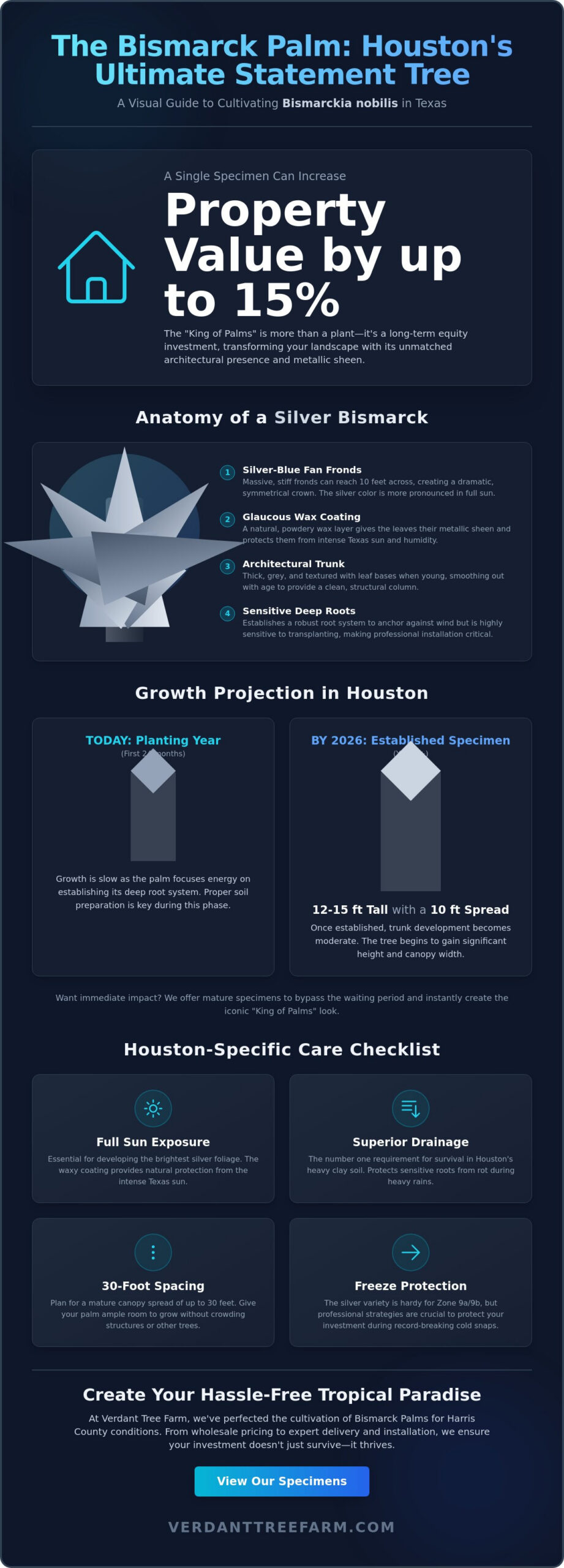
A single silver-blue Bismarck palm can increase a property’s visual value by as much as 15 percent, making it the ultimate statement piece for a Texas landscape. You’ve likely admired these metallic giants in high-end coastal resorts and wondered if they can actually survive the heavy clay and occasional freezes here in Harris County. We know the hesitation. Investing in a premium specimen tree feels like a gamble when you aren’t sure about drainage or winter protection. At Verdant Tree Farm, we’ve spent years perfecting the cultivation of the bismarck palm specifically for our local conditions, ensuring these tropical icons don’t just survive, but thrive in Zone 9a and 9b.
As a family owned and operated business, we believe you shouldn’t have to be a master gardener to own a stunning yard. This guide will show you how to master soil preparation and navigate spacing requirements so your tree has room to reach its full 30-foot spread. We’ll also share the professional freeze protection strategies that have saved thousands of our trees during record-breaking cold snaps. From wholesale to the public pricing to our expert delivery and installation, Houston’s premier tree farm is here to help you create a hassle-free tropical paradise. Let’s dig into the technical details and local secrets that make this silver beauty a permanent fixture in your landscape.
Key Takeaways
- Identify the unique growth habits and visual characteristics that make this “King of Palms” a standout specimen for Texas yards.
- Master the specific soil and drainage requirements needed to protect your bismarck palm from Houston’s heavy rains and humidity.
- Learn how to select the ideal location in your landscape to maximize aesthetic impact while ensuring proper cold-weather protection.
- Gain insights into why expert planting and professional handling are vital for the survival of these sensitive, deep-rooted trees.
- Discover how to pair your silver palm with the right companion plants to create a lush, premium look that increases your home’s value.
What is a Bismarck Palm and Why is it the King of Houston Palms?
The bismarck palm, known scientifically as Bismarckia nobilis, is a true titan of the tropical plant world. Originating from the island of Madagascar, it belongs to a Bismarckia genus that contains only this single, stunning species. For Houston homeowners, this palm represents the pinnacle of high-end landscaping. Its massive, stiff, steel-blue fan-shaped fronds can reach 10 feet across, creating a silhouette that is impossible to ignore. While other palms blend into the background, the Bismarck commands attention. It’s earned its reputation as the “Holy Grail” of statement palms in Texas because it combines dramatic scale with a unique color palette that thrives in our Gulf Coast humidity.
You will find two primary varieties: silver and green. At Verdant Tree Farm, Houston’s Premier Tree Farm, we specialize in the silver variety. The silver bismarck palm is more cold-hardy than its green counterpart, making it a much safer investment for our local climate. The waxy, glaucous coating that gives the leaves their metallic sheen also protects the plant from the intense Texas sun. It’s a premium choice for anyone looking to add immediate architectural value to their property.
Aesthetic Impact in Houston Landscaping
A single bismarck palm serves as a powerful solitary focal point in large suburban lawns. The striking silver foliage offers a sharp, modern contrast against the deep greens of Houston’s native Live Oaks. This color play creates visual depth that standard green-on-green landscapes lack. Beyond the leaves, the architectural value of the trunk is significant. The trunk is thick, grey, and textured with persistent leaf bases in younger trees, eventually smoothing out as the tree matures. It’s a clean, structural look that fits both contemporary and Mediterranean home designs perfectly.
Size and Scale: What to Expect in 2026
If you plant a specimen today, your landscape will look vastly different by 2026. In a typical Houston residential setting, the growth rate starts slow during the first 24 months as the root system establishes itself. Once settled, trunk development becomes moderate. By 2026, a well-cared-for juvenile palm can reach a height of 12 to 15 feet with a canopy spread of 10 feet. Because these palms grow wide before they grow tall, buying a mature specimen from a family owned and operated nursery is often preferred. This ensures immediate impact. We offer wholesale to the public pricing on large specimens to help you skip the years of waiting for that iconic “King of Palms” look. Our team can grow, deliver, and install these giants to ensure your property stands out in the neighborhood.
Understanding Bismarckia Nobilis: Growth Habits and Characteristics
The bismarck palm is a bold architectural statement for any Texas property. Its most striking feature is the massive, fan-shaped fronds. These stiff, palmate leaves can span 4 feet across, held up by thick, unarmed petioles. Because of this size, the tree creates a structural focal point that smaller palm species simply can’t match.
Beyond the surface, the root system is robust but requires expert handling. While these palms grow deep roots to anchor against coastal winds, they’re notoriously sensitive to transplanting. Choosing the right spot the first time is vital. Since a single specimen can live for 100 years or more, it’s a long-term asset for your home’s equity. At Verdant Tree Farm, we handle our root balls with extreme care to ensure your investment thrives from day one.
This species is dioecious. This means you’ll find distinct male and female plants. While both look identical in terms of foliage, only the females produce the clusters of brown, ovoid fruit. If you’re looking for a clean landscape, some homeowners prefer males to avoid the fruit drop, though both sexes provide the same stunning canopy.
The Silver Foliage Mystery
The iconic metallic shimmer comes from a thick, glaucous waxy coating on the leaf surface. In the context of palm wax, “glaucous” refers to the powdery, blue-grey film that protects the plant from intense UV rays and moisture loss. Houston’s high sunlight intensity actually improves this color. The more sun the tree gets, the more wax it produces, resulting in a brighter silver hue. Understanding Bismarck Palm growing conditions is the first step to maintaining this vibrant look.
Canopy and Spacing Requirements
Planning is critical when installing a tree that matures into a giant. You must respect the “No-Go Zone” near power lines. A mature bismarck palm can reach heights of 30 to 60 feet with a canopy spread of 20 feet. To keep your property safe and beautiful, follow these spacing rules:
- Keep at least 15 feet of distance from house foundations to avoid fronds scraping the roof or siding.
- Maintain a 10-foot buffer from swimming pools to prevent organic debris from falling into the filtration system.
- Ensure the planting site is clear of all overhead utilities to avoid future utility pruning that ruins the tree’s natural symmetry.
As Houston’s Premier Tree Farm, we offer professional delivery and installation to ensure your new specimen is positioned for decades of healthy growth. You can browse our current inventory Wholesale to the Public to find the perfect fit for your yard.
Growing Bismarck Palms in Houston: Soil, Water, and Cold Hardiness
Houston sits in USDA Zones 9a and 9b. For a bismarck palm, this location is generally a safe bet. These trees thrive in our high humidity and long, hot summers. Success depends on managing two specific local challenges: our heavy clay soil and occasional deep freezes. High humidity is a major benefit here. It mimics the palm’s native environment and keeps the silver-blue fronds looking lush. You should still ensure your palm has plenty of space for air circulation to prevent fungal issues during our wettest months. We are Family Owned & Operated, and we want your investment to last for decades.
The biggest threat to a Houston Bismarck is “wet feet.” Our native soil often holds water like a sponge. If the roots sit in stagnant water for too long, the palm will decline quickly. You can find more technical details on Bismarck Palm Growth and Care through the NC State Extension. At Verdant Tree Farm, we emphasize proper site preparation. We provide the expertise you need to ensure your palm thrives in our unique Gulf Coast environment.
Managing Houston’s Heavy Clay Soil
Don’t plant your palm in a hole that acts like a bucket. We suggest the “Mound Method” for all local installations. This involves planting the root ball about 4 to 6 inches above the natural grade. Build a gentle slope around the base using a mix of native soil and quality amendments. We recommend adding expanded shale or coarse sand. These materials break up the clay and create vital air pockets for the roots. Before you buy, perform a simple percolation test. Dig a hole 12 inches deep and fill it with water. If the water remains after 12 hours, you must use an elevated mound to ensure the bismarck palm stays dry.
Freeze Protection for Houston Winters
Established Bismarcks are hardy down to approximately 25°F. When local forecasts predict temperatures between 25°F and 30°F, take action. Protect the “bud” or the heart of the palm. This is the center point where new growth begins. Wrap the upper trunk and the base of the fronds with breathable frost cloth or burlap. Secure it with twine to keep the heat in. Avoid using plastic directly against the plant. It traps moisture and can cause rot.
If your palm shows winter burn or brown leaves after a cold snap, leave them alone until the threat of frost passes. As Houston’s Premier Tree Farm, we’ve helped many homeowners through recovery. New growth usually emerges by late spring if the central heart stayed warm. We offer Wholesale to the Public, ensuring you get the healthiest specimens capable of withstanding our unique climate. Our team is ready to help you select, deliver, and install the perfect tree for your landscape.
Landscape Design and Planting: Where to Put Your Bismarck Palm
Choosing the right location for your bismarck palm is the most important decision you’ll make for your landscape. These aren’t small garden accents. They are massive specimen trees that eventually reach a 15 to 20 foot spread. You need to look at your yard through a 10 year lens. We often use 3D landscape design to show homeowners how a young palm will eventually dominate the skyline. This prevents the common mistake of planting too close to a roofline or a neighbor’s fence. You should maintain at least a 10 foot clearance from any permanent structures.
Houston’s humidity and heavy clay soil require a specific watering strategy. You want to keep the soil moist but never swampy. Set your irrigation heads to water the perimeter of the root ball rather than the trunk itself. This encourages roots to reach outward, which creates a more stable tree during our Gulf Coast storm seasons. If your yard has a low spot that holds water for more than 24 hours after a rain, you’ll need to build a slight mound to keep the palm’s base high and dry.
Design Ideas for Houston Homes
The “Entryway Statement” is a classic choice. By framing your driveway with a pair of these palms, you create a grand, resort-style entrance that boosts curb appeal. For poolside tropical vibes, the bismarck palm is a top pick because it produces very little leaf litter compared to traditional oaks. Just keep it 8 feet back from the water’s edge to protect the pool shell. To create a Mediterranean-Texas hybrid garden, pair the silver fronds with dark green Yaupon Hollies and native limestone rockwork. This combination handles our 100 degree summers with ease.
Expert Planting Tips
- Don’t bury it deep: Keep the top of the root ball level with the soil surface. Burying the trunk can lead to crown rot and slow growth.
- Staking for wind: Houston gets heavy wind gusts. Use a professional staking kit with soft straps for the first 12 months. This keeps the root ball steady while it establishes in its new home.
- Fertilization: Use a “Palm Special” blend with an 8-2-12 ratio. Apply it in March, June, and September to maintain that signature silver-blue color.
As Houston’s Premier Tree Farm, we are Family Owned & Operated and take pride in the quality of every specimen we grow. We offer Wholesale to the Public pricing to help you get the best value for your project. Our team is ready to help you select and install a bismarck palm that will thrive for decades.
Professional Installation and Care at Verdant Tree Farm
DIY planting often fails when homeowners attempt to move large specimens alone. A mature bismarck palm can weigh over 1,000 pounds, making it nearly impossible to handle without professional machinery. These palms have sensitive root systems that don’t tolerate rough treatment or improper depth. If the root ball cracks or the drainage isn’t perfect, the palm will likely decline within its first year. Our veteran-owned team provides the reliability you expect from Houston’s Premier Tree Farm. We handle the heavy lifting so you don’t have to worry about the survival of your investment.
We operate with a simple philosophy: provide high-quality trees at “Wholesale to the Public” prices. This direct-to-consumer model means you get premium, nursery-grown palms without the typical retail markup. Because we are Family Owned & Operated, we take personal accountability for every tree we sell. We provide a three-month warranty on our installations to give you peace of mind. This 90-day window covers the critical establishment period when the palm is most vulnerable to transplant shock.
Houston’s Premier Tree Farm Logistics
Moving a massive bismarck palm into a residential backyard requires precision. We utilize specialized transport trucks and cranes to lift trees over fences or structures without damaging your property. Houston’s heavy clay soil presents unique challenges for drainage and stability. Our crews use specialized augers and soil conditioners to ensure the planting hole is prepped for long-term growth. If you have existing palms that look stressed, you can request a maintenance consultation to get them back on track.
Visit Our Houston Nursery
You shouldn’t have to guess what your new landscape will look like. We invite you to visit our nursery to see our current inventory in person. You can select the exact specimen that fits your vision. Our on-site 3D designers can even help you map out your entire yard to ensure your new palms complement your existing architecture. It’s a straightforward, professional process designed to deliver immediate results for your home.
Ready to upgrade your landscape with a show-stopping specimen? View our current palm inventory and request a quote today.
Elevate Your Houston Landscape with a Bismarck Palm
Transforming your outdoor space begins with choosing a specimen tree that handles the Texas heat. The bismarck palm provides a stunning silver-blue canopy that resists local pests and tolerates Houston’s humidity with ease. Success depends on proper placement and expert planting techniques to ensure the root ball establishes quickly in our native soil. We’ve spent decades as a family owned and operated business helping homeowners master these technical details for a thriving landscape.
As Houston’s largest independent tree nursery, we offer wholesale to the public pricing on our premium inventory. Our veteran-owned team provides professional 3D design services to map out your project with precision before any digging begins. When you choose our expert crew for the job, you receive a comprehensive 3-month warranty on all professional installations. It’s time to bring that tropical vision to life with the reliability of Houston’s premier tree farm. Browse our Bismarck Palms and get a professional installation quote today! We look forward to helping your garden grow for years to come.
Frequently Asked Questions
How fast does a Bismarck palm grow in Houston?
A bismarck palm grows at a moderate rate once its root system settles into the Texas soil. You can expect about 12 to 24 inches of height increase annually under optimal conditions. During the first 2 growing seasons, the tree focuses on root establishment. After this period, the fan-shaped fronds expand quickly. Our Houston climate provides the 90 degree summer heat these palms need to thrive.
Can a Bismarck palm survive a hard freeze in Texas?
Mature bismarck palms survive temperatures as low as 15 degrees Fahrenheit once they’re fully established. During the 2021 freeze, many specimens in the Houston area showed resilience if they had developed thick trunks. Younger trees with less than 3 feet of trunk require frost cloth protection when temperatures drop below 25 degrees. We recommend planting them in south-facing locations to provide a 5 degree temperature advantage during winter.
Are Bismarck palms messy or hard to maintain?
Bismarck palms are remarkably low maintenance because they don’t drop debris frequently. You only need to prune the bottom fronds 1 or 2 times per year as they reach a 90 degree angle from the trunk. Unlike other species, they don’t have messy fruit that litters your driveway. Their massive size means you’ll eventually need a professional crew for trimming once the tree exceeds 15 feet in height.
What is the difference between a silver and green Bismarck palm?
The silver variety is the most popular choice in Houston because it’s significantly more cold-hardy than the green variety. Silver Bismarck palms originate from open grasslands and withstand 15 degree temperatures. Green varieties come from more humid, tropical regions and often suffer damage at 30 degrees. At Verdant Tree Farm, we focus on the silver specimen trees to ensure your long-term landscaping success.
Why are the bottom leaves of my Bismarck palm turning brown?
Bottom leaves turning brown is usually a natural part of the palm’s growth cycle as it sheds old foliage to divert energy to new spears. If more than 20 percent of the lower canopy browns prematurely, it may indicate a potassium deficiency. Use a slow-release 8-2-12 fertilizer 3 times per year to maintain the vibrant color. This ensures your bismarck palm remains a stunning focal point in your yard.
How much water does a newly planted Bismarck palm need in Houston?
Newly planted palms require 15 to 20 gallons of water 3 times per week during their first 90 days in the ground. Houston’s clay soil retains moisture, so check the top 4 inches of soil before adding more. Once the tree hits the 2 year mark, it becomes highly drought-tolerant. We suggest using a bubbler system to deliver water directly to the root ball for maximum efficiency.
Do I need a permit to plant a large palm in Houston?
You don’t need a permit to plant a palm on private residential property in the City of Houston. However, the Houston Public Works department requires a permit if you’re planting within the 10 foot right-of-way near the street. Always call 811 at least 48 hours before digging to locate underground utility lines. Our Family Owned & Operated team handles these logistics to ensure a hassle-free installation for every customer.
When is the best time of year to plant a Bismarck palm in Texas?
The best time to plant is between April and August when soil temperatures stay above 70 degrees. Planting during these 5 months allows the root system to establish before the first winter frost hits in December. Since we are Houston’s Premier Tree Farm, we see a 30 percent faster establishment rate with summer installations. We offer Wholesale to the Public year-round, but spring planting gives your specimen the strongest start.