Last Saturday, a Houston homeowner finished planting a row of beautiful palms only to find a “cease and desist” letter in their mailbox on Monday morning. It’s a frustrating reality that many neighbors face when the Architectural Review Committee (ARC) feels left out of the loop. You likely moved into your community for its polished look, but now those same rules feel like a barrier to your own backyard vision. We understand that deciphering legal jargon in CC&Rs is the last thing you want to do on your day off. That’s why we’ve simplified the process of how to get HOA approval for landscaping into a clear, manageable strategy.
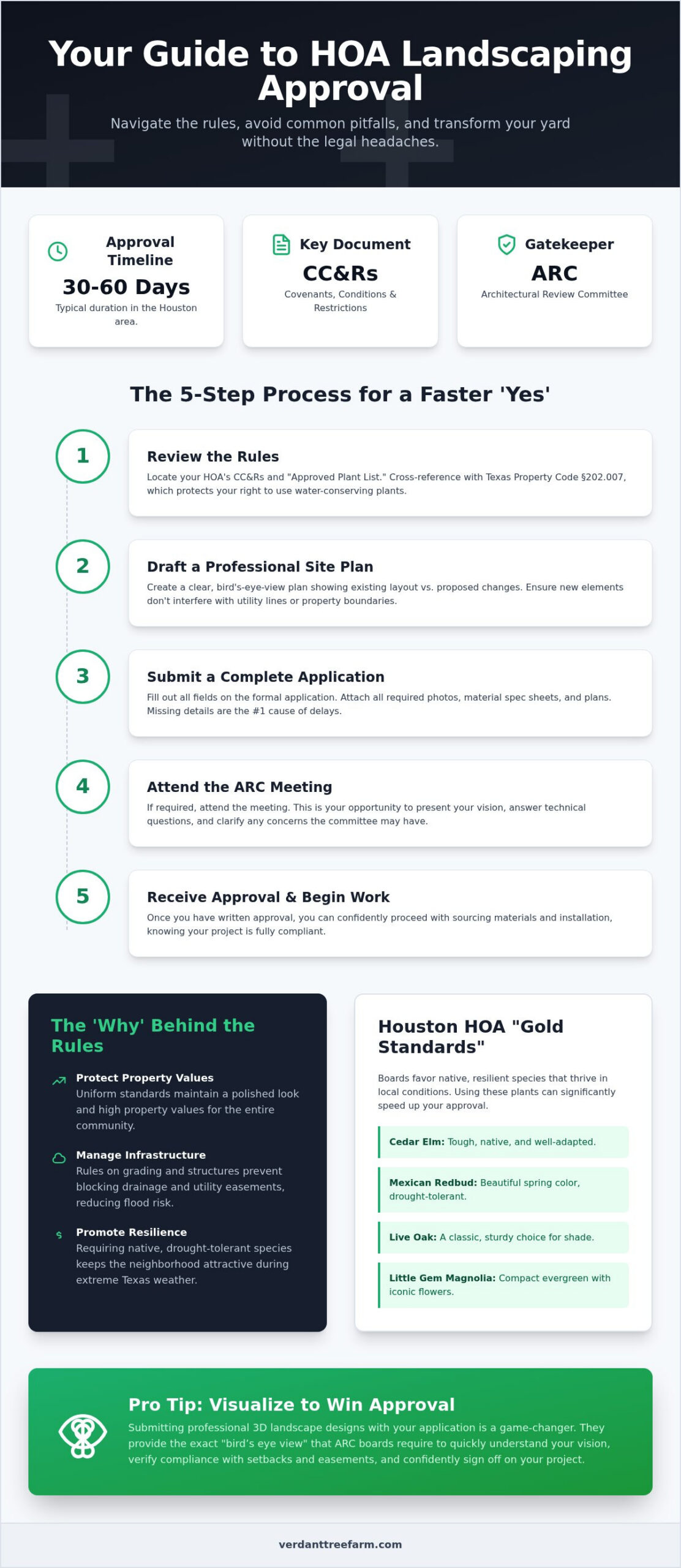
This guide helps you master the approval timeline, which typically runs between 30 and 60 days in our area. You’ll learn how to leverage professional 3D designs to help the board visualize your goals and how to select resilient, native species that meet Texas Property Code standards for water conservation. We’re covering everything from navigating ARC requirements to avoiding common planting mistakes in our heavy clay soil. By the end of this read, you’ll have the confidence to upgrade your property with expert precision and zero legal headaches.
Key Takeaways
- Learn how to locate and decode your HOA’s CC&Rs to avoid common compliance pitfalls before you start your project.
- Follow our proven five-step guide on how to get HOA approval for landscaping to move your project from a draft to a finished yard faster.
- Discover why native Texas varieties like the Cedar Elm or Mexican Redbud are the “gold standard” for quick approval in Houston neighborhoods.
- See how professional 3D landscape designs provide the exact “bird’s eye view” that boards require to sign off on your vision.
- Find out how nursery-direct sourcing and expert installation ensure your new landscape meets the high workmanship standards expected by your community.
Understanding Your HOA’s Landscaping Rules (CC&Rs)
Before you pick up a shovel or visit a nursery, you need to understand the legal framework governing your property. Most Houston communities operate under Understanding Your HOA’s Landscaping Rules (CC&Rs), which stands for Covenants, Conditions, and Restrictions. These documents act as a shared agreement between you and your neighbors to maintain a specific aesthetic standard. Knowing how to get HOA approval for landscaping starts with a deep dive into these fine-print details. They dictate everything from the height of your hedges to the specific type of mulch you can use in your flower beds.
You can usually find these bylaws tucked away in your home’s closing papers. If those aren’t handy, check your neighborhood’s online management portal or search county property records. Texas law now requires associations with 60 or more lots to maintain a website where these documents are easily accessible. Reviewing these early prevents you from falling in love with a design that the board will never permit.
The primary gatekeeper for your project is the Architectural Review Committee (ARC), sometimes called the Design Review Committee (DRC). These are the individuals who compare your proposed changes against the established community standards. Some homeowners consider “asking for forgiveness” after planting, but this is a high-risk strategy. Boards have the authority to issue daily fines or even force the removal of unapproved trees at your expense. It’s much cheaper to get it right the first time.
Common Landscaping Restrictions in Houston
Houston HOAs are specific about their visual identity. Most maintain an “approved plant palette” that features resilient species like Live Oaks or Little Gem Magnolias. Using plants outside this list often leads to immediate rejection. Hardscape rules are equally detailed. You’ll likely find limitations on the materials used for patios, the height of retaining walls, and the specific colors allowed for stone walkways. Even existing trees are protected; many CC&Rs require formal permission to remove any tree over a certain diameter to preserve the neighborhood canopy.
The ‘Why’ Behind the Rules
It’s helpful to view these restrictions as a tool for protecting your investment. Uniformity ensures that property values remain high across the entire street. Beyond looks, these rules manage critical infrastructure. In our region, improper grading or unapproved structures can block drainage and utility easements, leading to localized flooding during heavy rains. Finally, these standards promote neighborhood-wide resilience. By requiring native, drought-tolerant species, HOAs ensure the community stays attractive even during extreme weather. Mastering how to get HOA approval for landscaping ensures your yard contributes to this collective stability while enhancing your home’s curb appeal.
The 5-Step Process for HOA Landscaping Approval
Navigating how to get HOA approval for landscaping doesn’t have to be a guessing game. Following a clear, sequential checklist ensures you meet every administrative requirement before the first tree arrives at your curb. Most Houston boards aren’t trying to be difficult; they simply want to ensure that every project preserves the community’s standards and infrastructure.
Step 1: Review the “Approved Plant List” and local Houston ordinances. You should also verify your rights under Texas Property Code §202.007. This state law protects your ability to use drought-resistant plants and water-conserving turf, which can be a powerful tool if your HOA’s list feels overly restrictive for our climate.
Step 2: Draft a professional site plan. This document must show your existing lot layout compared to the proposed changes. A bird’s eye view is the industry standard. It helps the board see that your new Mexican White Oak won’t interfere with utility lines or your neighbor’s fence. Utilizing professional landscaping services Houston homeowners trust can provide the 3D renderings that make this step much easier.
Step 3: Submit the formal application with all required supporting documents. Don’t leave any fields blank. Attach every photo and spec sheet requested in your CC&Rs to prevent the committee from kicking the application back for more information. Missing details are the primary cause of project delays.
Step 4: Attend the ARC meeting if required. These meetings are usually brief and informative. They give you a chance to answer technical questions about drainage or plant spacing directly. Be ready to explain why you chose specific trees like a Shumard Oak or a Cedar Elm for their resilience.
Step 5: Secure your written approval letter before breaking ground. This is your insurance policy. Keep a digital and physical copy. If a future board member questions your landscaping, this letter serves as your permanent proof of compliance.
Gathering Your Documentation
A winning application is thorough. Include high-quality photos of the specific species you want, such as a Little Gem Magnolia or a Texas Redbud. Clearly list mature heights and quantities. This helps the board visualize the final canopy. If you’re hiring out the work, include your contractor’s license and insurance information. Professional landscaping services Houston residents rely on can simplify this by providing the technical drawings and plant specs that committees expect to see.
Managing the Timeline
Most Houston HOAs take 30 to 60 days to review an application. It’s a slow process, so plan your planting season accordingly. If you haven’t heard anything after three weeks, send a polite follow-up email to the property manager. Sometimes you’ll receive “Conditional Approval.” This means they’ve approved the project but want you to move a tree a few feet or swap a plant variety. Accept these small changes quickly to keep your project moving forward. Mastering how to get HOA approval for landscaping is all about patience and clear communication. If you feel overwhelmed by the paperwork, a quick design consultation can help you align your vision with your HOA’s rules.
Navigating Houston-Specific HOA Requirements
Houston’s climate has shifted the focus of local Architectural Review Committees. Following recent extreme weather events, committees now prioritize species that can survive both the intense summer heat and the occasional deep freeze. Understanding how to get HOA approval for landscaping in this environment requires selecting plants that look great but require minimal water once established. Boards are increasingly wary of tropical plants that might die during a cold snap, leaving the neighborhood with unsightly, dead foliage for months.
The “Native Advantage” is your best tool for a quick approval. Species like the Texas Redbud and Cedar Elm are indigenous to our region, making them easy sells to any board. Using these tells the committee you’re committed to a sustainable, low-maintenance yard that won’t strain local water resources during a drought. Most Houston HOAs have already added these to their pre-approved lists because of their proven resilience in our heavy “gumbo” clay soil.
You also need to check rules regarding freeze protection. Many HOAs allow temporary coverings but prohibit permanent wooden structures or unsightly plastic wraps for more than a few days. Drainage is another critical factor. Because our clay soil holds water so efficiently, your plan must demonstrate that new garden beds won’t redirect runoff onto a neighbor’s property. Partnering with Professionals for Guaranteed Compliance ensures your drainage plan meets the industry standards that local property managers expect to see.
HOA-Approved Trees for Houston Yards
For shade, you can’t go wrong with the Shumard Oak, Live Oak, or Mexican White Oak. These provide a massive canopy that can reduce summer cooling costs by up to 25%. If you want something smaller, the Texas Mountain Laurel and Vitex (Chaste Tree) offer beautiful blooms without overwhelming a front yard. Check out this guide on the best evergreen trees for Houston to find varieties that stay green all year, ensuring your home looks compliant even in the middle of January.
Palm Tree Approval Tips
Palms add a tropical flair, but they often come with specific height and placement rules. Sylvester and Pindo Palms are popular because they handle our cold snaps better than other tropical varieties. When looking for palm trees for sale in Houston, always choose freeze-resistant varieties to avoid having a “brown stick” in your yard after a hard frost. Be sure to measure the distance from your property lines; many HOAs require palms to be set back far enough so fronds don’t hang over fences. Mastering how to get HOA approval for landscaping means accounting for these small details before the board even asks.
How to Create a Winning Landscape Plan for Your Application
Most homeowners struggle with the drawing stage of their application. The Architectural Review Committee needs a “Bird’s Eye View” or a scaled property map to make an informed decision. This isn’t just a rough sketch; it’s a measurable document that shows exactly where your new October Glory Maple or Bald Cypress will sit. You must label distances from the house, fences, and property lines with precision. Clear measurements prove you aren’t infringing on utility easements or accidentally blocking sightlines for drivers on your street. Knowing how to get HOA approval for landscaping often comes down to the quality of this single document.
Precision extends to your plant list too. Don’t just write “oak tree” on your application. Use specific names like Shumard Oak or Mexican White Oak to avoid any confusion. Providing a detailed list with botanical names shows the board you’ve done your homework. It eliminates the risk of them assuming you’re planting a species that isn’t on their approved palette.
The Benefits of 3D Landscape Design
Static drawings often fail to capture the true scale of a project. 3D renderings allow the board to see how a mature Little Gem Magnolia will look five years from now. It proves the canopy won’t block a neighbor’s window or hang over a shared fence. You can even show how your yard changes through the seasons, from the spring blooms of a Mexican Redbud to the deep green of a Savannah Holly. Professional 3D design reduces application rejections by 40% by removing the guesswork for committee members.
Common Plan Mistakes to Avoid
Precision is your best friend when submitting a plan. Avoid vague labels like “large shrubs” or “privacy trees.” Instead, specify “Nellie R. Stevens Holly” and include the exact quantity. Many applications fail because they ignore the “mature spread” of the trees. A tree that looks small in a container today might grow 40 feet wide. If your plan shows it three feet from a fence, the board will likely reject it for future encroachment. Always mark your irrigation lines and existing utility easements on your map to show you won’t damage critical underground infrastructure. If you’re ready to visualize your project with professional accuracy, start your 3D landscape design today to ensure your plan is board-ready from day one.
Partnering with Professionals for Guaranteed Compliance
Once you understand the rules and have a vision for your yard, the final step is execution. A professional partnership removes the guesswork from how to get HOA approval for landscaping. Most committees are more likely to approve an application when they see it is backed by a reputable local expert. This gives the board confidence that the project will be completed to a high standard. It ensures your project won’t become an eyesore or a drainage liability for the neighborhood.
A nursery-direct approach ensures you get high-quality, approved stock from the start. When you source directly from our inventory of Shumard Oaks, Mexican White Oaks, or Medjool date palms, you’re getting trees acclimated to the local climate. Healthy, robust specimens pass final HOA inspections much more easily than struggling plants from big-box retailers. Professional installation ensures your new landscape meets the “workmanship” standards often cited in CC&Rs. In Houston’s heavy clay soil, technical details like “planting high” and proper staking are critical for long-term health and compliance.
Why Veteran-Owned Expertise Matters
We bring a veteran-owned “can-do” attitude to every project we handle. This means we respect your property, your timeline, and your HOA’s strict deadlines. Reliability and accountability are the foundations of our business in every Houston neighborhood. We don’t just provide plants; we provide a long-term investment in your home’s value. This local dedication is a primary factor when choosing a tree nursery in Houston. We understand the specific regional growth patterns and soil conditions that out-of-state contractors might miss.
Verdant’s End-to-End Approval Support
We support Houston homeowners from the initial design phase to the final planting. Our expert 3D landscape design services provide the exact “bird’s eye view” and professional renderings that ARC committees require. We provide the botanical names, mature heights, and specific quantities for every variety, whether it’s a Little Gem Magnolia or a Texas Mountain Laurel. This level of detail eliminates board uncertainty and speeds up the process. Every professional installation includes necessary soil amendments to help your trees thrive in “gumbo” clay. To ensure your investment is protected, we offer a three-month warranty on all professional installations. This end-to-end service model is designed to make how to get HOA approval for landscaping a stress-free experience for every homeowner we serve.
Transforming Your Houston Yard with Confidence
Success with an HOA is about merging community standards with professional documentation. You’ve learned that decoding CC&Rs and providing scaled plans are the foundations of a fast approval. By choosing native Texas varieties like the Shumard Oak or Cedar Elm, you aren’t just following rules; you’re ensuring your yard survives the local climate. Mastering how to get HOA approval for landscaping is much easier when you have the right technical support on your side.
As Houston’s largest independent tree nursery, we provide the expert 3D renderings that take the guesswork out of the application process. Our team handles everything from design to professional installation, backed by a three-month warranty for your peace of mind. We take pride in helping you build a landscape that serves as a long-term investment in your property. Request Your Professional 3D Landscape Design Today. Your dream landscape is within reach, and we’re here to help you cross the finish line with a yard that makes the whole neighborhood proud.
Frequently Asked Questions
Do I need HOA approval for small flower beds or just large trees?
Most Houston associations require approval for any project that changes the visible footprint of your yard. This includes new flower beds, permanent edging, or changing the soil grade. While rules vary by community, these changes can impact neighborhood drainage patterns or aesthetic uniformity. It is always safer to check your CC&Rs first. Small additions like seasonal flowers in existing beds often don’t need a permit, but any new permanent planting usually triggers the review process.
What happens if I landscape my front yard without HOA approval?
Proceeding without a permit often leads to “cease and desist” letters or daily fines until the issue is resolved. In extreme cases, the board can legally force you to remove unapproved trees or hardscaping at your own expense. This is why learning how to get HOA approval for landscaping before you plant is vital. It saves you from the stress of legal disputes and the high cost of tearing out a finished project after the work is done.
How long does the HOA landscaping approval process usually take in Houston?
You should expect the review process to take between 30 and 60 days in the Houston area. This timeline allows the Architectural Review Committee to evaluate your plans against community standards. If your application is missing details like plant specs or a site map, the board may send it back for more information, which resets the clock. Submitting professional 3D renderings early can help speed up their decision by providing a clear vision of the final result.
Can an HOA force me to remove a tree I just planted?
Yes, the association has the legal authority to mandate the removal of any unapproved structure or plant. If you plant a species that isn’t on the “approved palette” or place a tree in a utility easement, you’ll likely receive a violation notice. To avoid this, ensure every tree you buy from a nursery is on the board’s list. Our expert consultations help you select compliant species, like the Shumard Oak, that thrive in Houston’s specific climate.
What are the most common reasons an HOA rejects a landscaping plan?
Rejections typically happen due to vague site plans or selecting species that aren’t on the approved list. Boards also reject designs that interfere with neighborhood drainage or block visibility for drivers. If your plan doesn’t show the “mature spread” of a tree, the committee might worry about future encroachment on a neighbor’s property. Providing a scaled “bird’s eye view” with specific botanical names like Mexican Redbud usually prevents these common administrative issues.
Does my HOA have an approved list of plants for Houston’s climate?
Most established Houston communities maintain a specific list of approved trees and shrubs. These lists prioritize native varieties that handle our heavy clay soil and extreme heat. You can typically find this “plant palette” in your management portal or CC&R documents. If your list seems outdated, Texas law protects your right to use drought-resistant landscaping. You can often propose water-conserving alternatives, like a Texas Mountain Laurel, even if they aren’t explicitly listed.
Can I appeal an HOA landscaping rejection?
You have the right to appeal a rejection, but you must follow the formal process outlined in your bylaws. This usually involves requesting a hearing with the board of directors to discuss the committee’s decision. Bringing professional 3D designs or technical data about your chosen plants can help strengthen your case. Many rejections are simply requests for more information. Providing a more detailed application on the second try often leads to a much faster approval.
Do I need approval to replace a dead tree with the same species?
Even if you’re replacing a dead tree with the exact same species, you should still check with your board. Some HOAs require a “like-for-like” notification to ensure the new tree meets current size requirements. This is also a great time to evaluate if a different native species might be more resilient for that specific spot. Following the formal steps of how to get HOA approval for landscaping ensures your replacement is documented and fully compliant.