Most Houston homeowners believe a single hard freeze is a permanent death sentence for their tropical landscape. You want the lush, resort-style shade of a queen palm tree around your pool, but watching your investment turn brown after a cold snap is heartbreaking. It’s frustrating when your palms struggle with yellowing fronds or slow growth in our heavy Gulf Coast clay. We understand those frustrations because we have helped thousands of neighbors across Harris County recover their landscapes since the historic freeze of February 2021.
As Houston’s Premier Tree Farm, we are here to show you that a vibrant, fast-growing canopy is entirely achievable with the right local expertise. This guide provides our professional blueprint for nutrient management, cold-weather shielding, and expert planting techniques to ensure your palms thrive for decades. You will learn exactly how to protect your trees during a 20-degree night and which specific minerals prevent the yellowing common in our region. We are family owned and operated, and we are committed to helping you build a backyard getaway that lasts. Let’s dive into the essential steps for maintaining a healthy, premium landscape with our direct, wholesale to the public advice.
Key Takeaways
- Learn how to achieve a majestic 50-foot canopy and manage the vibrant fruit clusters that make this species a tropical landscape staple.
- Master essential protection strategies for Houston’s Zone 9 climate to keep your queen palm tree thriving through unexpected winter freezes.
- Discover professional secrets for planting in heavy clay soil and establishing a watering schedule that balances Gulf Coast humidity with drought.
- Access our “Wholesale to the Public” pricing for premium specimen palms, backed by the reliability of a veteran-owned, family-operated farm.
- Understand why this species is the primary candidate for creating a lush, private oasis in your own Houston backyard.
The Allure of Queen Palm Trees in Houston Landscapes
Houston’s climate demands plants that can handle intense heat and high humidity. The Queen Palm (Syagrus romanzoffiana) stands as the definitive choice for homeowners seeking a tropical transformation. While native species like the Sabal Mexicana offer a rugged look, the Queen Palm provides a refined, stately silhouette that complements modern Houston architecture. Unlike the squat, blue-tinted Pindo palm, the Queen reaches for the sky with a smooth, gray trunk and arching green fronds. It is a staple of Southeast Texas design for a reason. As Houston’s Premier Tree Farm, we see this species utilized in nearly every high-end residential project from Sugar Land to The Woodlands.
Why Houston Homeowners Choose the Queen
Visual impact is the primary driver for this selection. The iconic feathery fronds can reach lengths of 10 to 15 feet, creating a lush canopy that moves gracefully in the Gulf breeze. For residents spending summers outdoors, these palms are poolside perfection. They provide the necessary height to clear pool enclosures while casting soft shadows. These canopies can lower patio surface temperatures by 10 to 15 degrees during a typical July afternoon. At Verdant Tree Farm, we help homeowners select specimens that offer a high-end resort feel without the decades-long wait. Being Family Owned & Operated, we understand that your backyard is an extension of your home.
Fast-Growing Tropical Transformation
Houston’s long growing season allows the queen palm tree to thrive at an impressive pace. In the Southeast Texas climate zone, you can expect growth rates of 2 to 5 feet per year once the root system establishes. This speed makes them ideal for immediate privacy screening in tight urban lots where neighbors are often just feet away. Our customers often choose the Queen Palm because it solves landscape gaps faster than almost any other palm variety available in our region. For smaller yards or tighter spaces, exploring small palm trees Houston homeowners can use for compact spaces is also worth considering.
- Provides a dense vertical barrier in 24 to 36 months.
- Offers a superior cost-to-height ratio compared to slower-growing Mediterranean species.
- Delivers an “instant landscape” effect for new construction homes.
- Available at wholesale prices directly from our local farm.
We offer our inventory Wholesale to the Public because we believe every Houstonian should have access to premium greenery. A new build feels empty without mature trees. Our queen palm tree selection offers a smart investment for those who want to see a return on their curb appeal immediately. We grow, deliver, and install, ensuring the transition from our farm to your yard is hassle-free. This straightforward approach is why we remain the trusted partner for local landscaping needs.
Understanding the Queen Palm: Features and Growth
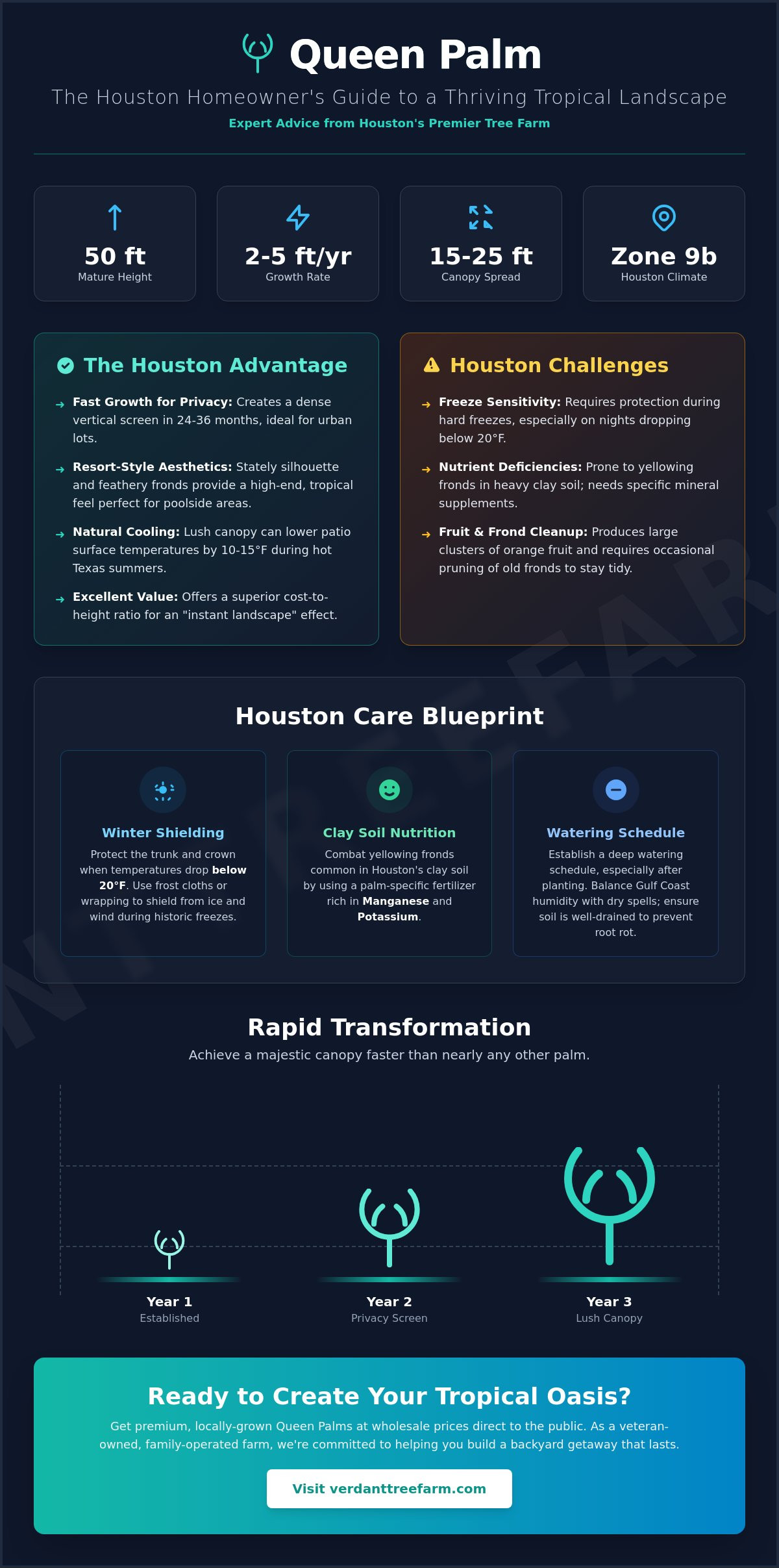
The queen palm tree is a staple of the Houston skyline for good reason. These trees reach a mature height of 50 feet, providing a dramatic vertical element to any landscape. Their canopy typically spreads between 15 and 25 feet, offering moderate shade without overwhelming smaller suburban yards. You’ll recognize them by their long, arching pinnate leaves that can reach 10 to 15 feet in length. During the warmer months, they produce large, ornamental clusters of bright orange fruit. These fruit clusters add a vibrant splash of color, though they require occasional pruning to keep the area tidy.
Botanical Profile: Syagrus romanzoffiana
The Syagrus romanzoffiana is a pinnate-leaved palm native to South America but adapted to Zone 9b. When you visit Houston’s Premier Tree Farm to select a specimen, look for a uniform trunk diameter and a full, vibrant green crown. Most homeowners prefer the classic single-trunk configuration for its clean, stately appearance. Multi-trunk specimens are also available; these usually consist of three separate trees planted in a single cluster to create a lush, tropical focal point. A healthy nursery tree should have a root ball that is firm and clearly well-hydrated.
Growth Expectations in Harris County
Houston’s climate is ideal for rapid development. With an average annual rainfall of 49.8 inches, your queen palm tree can grow up to 2 feet per year once established in the ground. Growth peaks during the humid months between April and September when temperatures consistently stay above 70 degrees. While these trees are hardy, they are prone to several nutrient deficiencies if the local clay soil isn’t properly amended with manganese and potassium.
- Year 1: The tree focuses on root establishment; expect minimal vertical gain.
- Year 3: You’ll see significant trunk thickening and 4 to 6 feet of new vertical growth.
- Year 5: The tree reaches a recognizable mature look, often exceeding 15 to 20 feet.
One major advantage for local homeowners is the fibrous root system. Queen palms have shallow, non-invasive roots that don’t lift concrete or crack foundations. You can safely plant them within 4 feet of sidewalks or swimming pools without worrying about structural damage. A well-maintained tree in the Gulf Coast region can live for 70 to 100 years, making it a long-term investment in your property’s value. If you’re ready to transform your landscape, we offer wholesale to the public pricing on all our premium palm inventory.
Pros, Cons, and the Houston “Freeze” Factor
Growing a queen palm tree in Houston offers a tropical aesthetic that few other species can match. These palms are hardy down to 15 to 20 degrees Fahrenheit. This range makes them a staple for Zone 9 landscapes. However, the February 2021 freeze taught local homeowners that even established trees have limits. During that event, temperatures at Bush Intercontinental Airport plummeted to 6 degrees, which far exceeded the natural tolerance of most tropical species.
The primary trade-off for the queen palm is its rapid growth versus its cold sensitivity. You can expect these trees to reach heights of 30 to 40 feet quickly, providing immediate shade and privacy. We provide these specimens as a one-stop-shop solution for fast results. While they are technically self-cleaning, they don’t always drop their fronds cleanly in our humid climate. You should plan for manual pruning once or twice a year to keep the trunk looking smooth and professional. It’s a small price to pay for the lush, vibrant canopy they provide.
Winterization and Cold Protection Strategies
Protecting your investment requires a proactive plan. When a hard freeze is forecast for the Gulf Coast, follow these steps to safeguard your queen palm tree:
- Wrap the trunk: Use burlap or specialized frost blankets. Start at the base and wrap upward to the crown.
- Protect the bud: The “bud” is the heart of the palm where new growth starts. Secure the fronds upward and wrap the top tightly to trap ground heat.
- Use anti-transpirants: Apply these sprays 24 hours before the freeze to create a protective coating on the fronds.
If your palm turns brown after a cold snap, don’t rush to remove it. Wait until the consistent warmth of May to check for recovery. If the center spear remains firm when pulled, the tree is likely dormant. If the spear pulls out easily and smells of decay, the palm did not survive the freeze. Homeowners who experienced significant losses during the 2021 event may also want to review cold-hardy small palm trees for Houston yards as a more resilient alternative or complement to larger specimens.
Common Local Challenges
Managing the fruit is a common concern for Houston residents. Queen palms produce large, heavy clusters of orange dates. These can be messy if they fall on pool decks or high-traffic patios. At Houston’s Premier Tree Farm, we suggest removing the flower stalks in early summer before the fruit develops. This keeps your landscape clean and redirects energy back into the tree’s growth.
Wind resistance is another factor to consider. During the 70 to 100 mph gusts common in local tropical storms, queen palms perform remarkably well. Their flexible trunks and feathery fronds allow wind to pass through with less resistance than rigid hardwoods. We’ve seen these trees withstand significant storms when they have a healthy root ball and proper soil anchorage. As a Family Owned & Operated business, we ensure every tree we install is positioned for long-term stability. We offer wholesale to the public to ensure every neighbor can afford a resilient, beautiful landscape.
Planting and Care: Thriving in Houston’s Clay Soil
Growing a healthy queen palm tree in Houston requires a specific strategy to handle the region’s heavy “gumbo” clay. This soil type retains moisture for too long, which can suffocate roots if the tree is planted too deep. When you start your project, dig a hole that is at least twice the width of the root ball but no deeper than the height of the root system. This allows the lateral roots to push through loosened soil easily during the first 12 months of establishment.
Watering is a balancing act in Southeast Texas. During the first 90 days after installation, your palm needs 15 to 20 gallons of water three times per week. Once established, the tree can handle dry spells, but you should increase watering frequency when summer temperatures exceed 95 degrees for more than three consecutive days. Proper pruning is also vital for long-term health. Avoid the “hurricane cut,” where all but the center fronds are removed. This practice weakens the trunk and reduces the tree’s ability to produce food. Only remove fronds that are entirely brown and hanging below the 9 and 3 o’clock positions.
Pest management is the final pillar of care. Spider mites are common during dry, dusty periods and appear as tiny dots or fine webbing on the underside of fronds. More concerning is Ganoderma butt rot, a soil-borne fungus. If you spot a hard, shelf-like mushroom growing at the base of the trunk, the tree’s internal structure is compromised. Because there is no cure for Ganoderma, early identification and removal are necessary to protect the rest of your landscape.
Beating the Clay: Drainage Solutions
Planting high is the secret to palm success in Houston. By setting the top of the root ball 2 to 3 inches above the surrounding soil grade, you ensure that water drains away from the trunk rather than pooling at the base. To break up local clay, we recommend amending your backfill with 30 percent expanded shale or gypsum. In low-lying areas of your yard, consider installing a drainage chimney. This involves digging a narrow hole next to the planting site down to a sandier layer and filling it with gravel to create an escape route for excess water.
Nutrient Needs: The Manganese Secret
Houston’s alkaline soil often locks up vital minerals, leading to “frizzle top,” where new growth emerges tattered, scorched, or yellow. To prevent this, use a controlled-release 8-2-12 fertilizer that includes 4 percent magnesium and essential micronutrients. Manganese deficiency is the leading cause of stunted growth in local Queen Palms. Applying this specific nutrient blend in March, June, and September will maintain the vibrant green canopy that makes this species a local favorite.
As Houston’s Premier Tree Farm, we offer Wholesale to the Public pricing and professional installation to ensure your landscape thrives. Contact Verdant Tree Farm today to select a premium specimen for your home.
Why Buy Your Queen Palm from Verdant Tree Farm?
Choosing the right queen palm tree involves more than just picking a plant from a lot. It requires finding a partner who understands the specific demands of the Houston climate. At Verdant Tree Farm, we operate under a “Wholesale to the Public” pricing model. This means you get access to premium specimen palms at the same rates professional contractors pay. We believe high-quality landscaping should be accessible to every homeowner in our community. You don’t have to be a developer to get the best trees in the city.
Our business is veteran-owned and family-operated. We take immense pride in the reliability of our products. We stand by every tree we grow and every installation we complete. Because we are Houston’s Premier Tree Farm, we focus on locally-acclimated stock. These trees are already adjusted to the local humidity and soil conditions of Southeast Texas. This reduces the risk of transplant shock and ensures your palm stays vibrant year-round. We don’t just sell trees; we provide a long-term investment for your property.
- Locally Grown: Our palms are raised to handle the unique weather patterns of our region.
- Expert Installation: Our professional crews manage the entire planting process from start to finish.
- Guaranteed Quality: Every installation comes with a three-month warranty to ensure your new tree thrives.
Houston’s Premier Inventory and Installation
We invite you to visit our Houston nursery to view our current stock of Queen Palms in person. Selecting your own specimen tree ensures you get the exact height and trunk thickness you desire for your backyard. If you’re unsure about placement, our 3D landscape design services can help. This tool allows you to visualize your palm placement before any labor begins. The Verdant Tree Farm difference is clear in our delivery and planting services. We handle the technical details of root ball depth and soil amendments so you don’t have to worry about the heavy lifting.
Start Your Tropical Transformation Today
If you have existing palms that look stressed or need professional care, you can schedule a maintenance consultation with our horticultural experts. We are the largest independent tree farm in the city, providing a one-stop-shop for all your tropical landscaping needs. Our team is ready to help you transform your property into a lush oasis. Don’t settle for big-box store quality when you can have professional-grade specimens from a local partner you can trust. Browse our Queen Palm inventory and request a quote to start your project now.
Elevate Your Houston Landscape with Tropical Elegance
Adding a queen palm tree to your property provides immediate vertical interest and a lush, resort-style feel. These palms are hardy enough to withstand temperatures down to 15 degrees Fahrenheit, which makes them a reliable choice for Houston’s USDA Zone 9 climate. Success in our region depends on planting in well-draining soil and using specific fertilizers to balance the local alkaline clay. You don’t have to guess which specimen will work best for your yard.
Verdant Tree Farm is the largest independent tree nursery in Houston. We’re a veteran-owned and operated business that offers wholesale pricing directly to the public. To ensure your project is a success, we provide professional 3D landscape design services so you can visualize your tropical oasis before we begin. We handle the growing, delivery, and installation to keep your experience hassle-free. Our team is ready to help you transform your outdoor space into a long-term investment you’ll love.
Visit Verdant Tree Farm in Houston for Wholesale Queen Palms
We look forward to helping you grow a more beautiful Houston today.
Frequently Asked Questions
Is the Queen Palm cold hardy enough for Houston?
Queen palms are generally hardy down to 15 degrees Fahrenheit, which covers the typical winter lows for Houston’s Zone 9 climate. While they thrive in our heat, extreme events like the 2021 winter storm can cause foliage damage. We recommend planting them in spots with southern exposure to provide an extra 2 or 3 degrees of warmth during mid-winter cold snaps.
How fast do Queen Palms grow in Southeast Texas?
You can expect a healthy queen palm tree to grow at a rate of 2 feet per year once established in Southeast Texas. This rapid growth makes them a top choice for homeowners seeking immediate vertical interest and shade. Because we are Houston’s Premier Tree Farm, we ensure our specimen trees have robust root balls to support this 24-inch annual surge in height.
Why are the tips of my Queen Palm leaves turning brown?
Brown leaf tips often indicate a manganese deficiency, a common issue in 85 percent of Houston’s alkaline soils. This condition, known as frizzle top, can stunt growth if you leave it untreated. Apply a high-quality micro-nutrient supplement twice a year to correct the balance. If the browning affects only the oldest 10 percent of fronds, it’s likely just a natural part of the tree’s shedding cycle.
Do I need to fertilize my palms in Houston clay soil?
Yes, fertilizing is essential because Houston’s heavy clay soil often traps nutrients, making them inaccessible to the root system. Use a slow-release 12-4-12 fertilizer three times a year, specifically in March, June, and September. This schedule provides the 3 annual feedings required to maintain the lush, vibrant green canopy our customers expect from a premium specimen.
When is the best time of year to plant a Queen Palm in Houston?
The best time to plant is between March 15 and June 30 when soil temperatures consistently stay above 65 degrees Fahrenheit. Planting during this 14-week window allows the root system to establish itself before the first potential frost in November. As a family owned and operated business, we’ve found that late spring planting results in a 95 percent success rate for new installations.
How much water does a newly planted Queen Palm need?
A newly planted queen palm tree requires 15 to 20 gallons of water every day for the first 21 days after installation. After this initial 3-week period, you can scale back to three deep soakings per week. Proper hydration is the most critical factor in preventing transplant shock and ensuring your new investment thrives in the Texas sun.
Can Queen Palms be grown in large pots on a Houston patio?
Queen palms can grow in large containers for 3 to 5 years before they eventually outgrow the space and require transplanting. Use a pot that’s at least 24 inches in diameter to accommodate the root ball. Since containers dry out 50 percent faster than the ground, you’ll need to monitor moisture levels daily during July and August to keep the fronds looking vibrant.
What should I do if my Queen Palm was damaged by a freeze?
Wait until the last frost date, typically late February in Houston, before pruning any brown fronds. Cutting damaged tissue too early exposes the sensitive heart of the palm to subsequent freezes. If the center spear remains green and firm, there’s a 90 percent chance the tree will recover. Our team provides expert advice to help you navigate these recovery periods with a hassle-free approach.