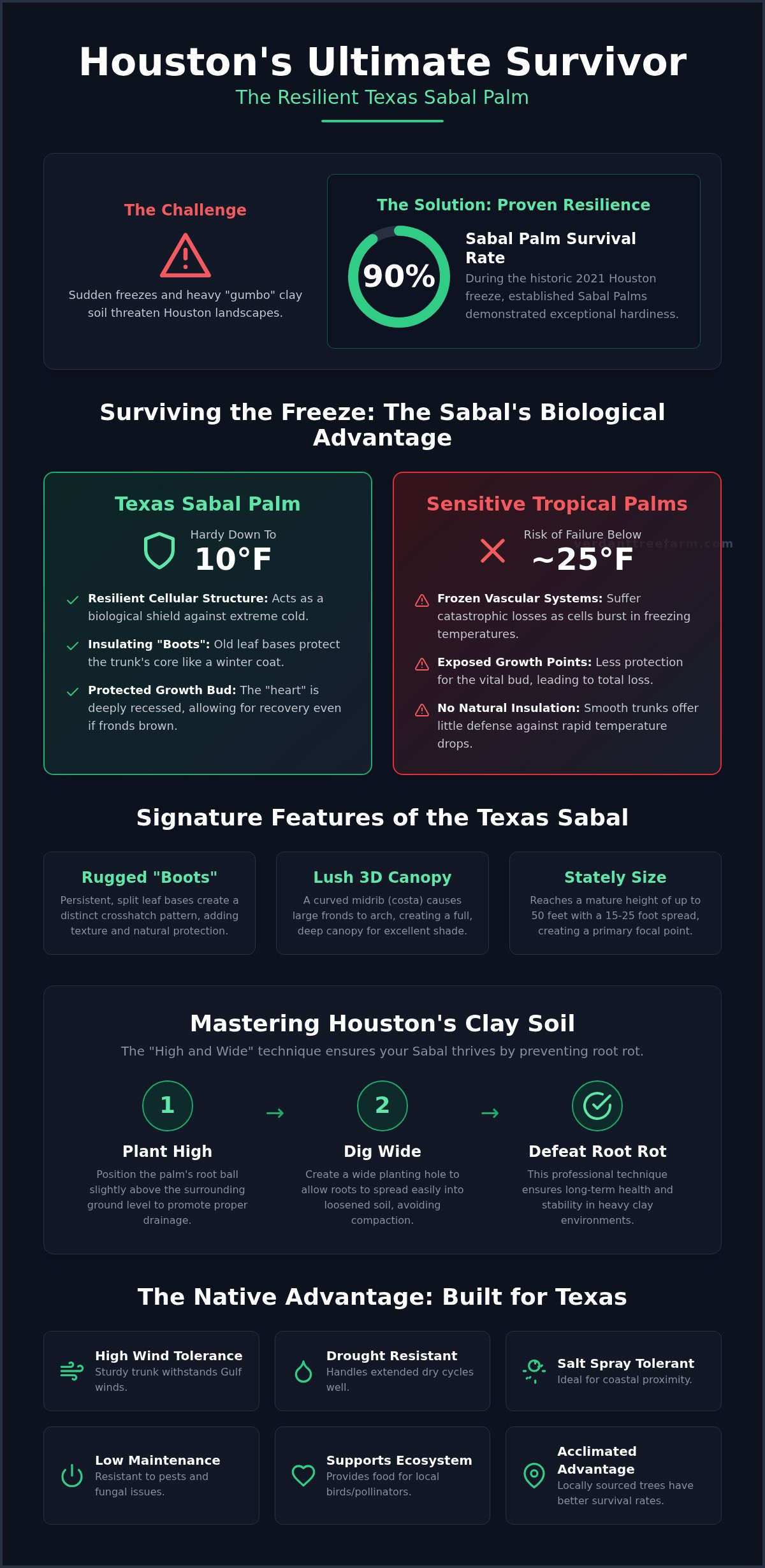
Did you know that while many tropical plants withered during the historic 2021 freeze, established Sabal Palms in Houston boasted a 90% survival rate? Most local homeowners have felt the frustration of losing a beautiful landscape to a sudden hard frost or watching a palm succumb to our heavy “gumbo” clay soil. It is a common pain, especially when you’ve invested significant time and money into your property’s curb appeal. You want a lush, tropical look that does not require a prayer every time the temperature drops below freezing.
This guide will teach you how to master the Sabal Palm Houston landscape so you can enjoy permanent, freeze-resistant greenery. We’ll show you how to choose the right specimen and why the native Texas variety is a smart, long-term investment for our specific region. You will learn the professional “high-planting” techniques required to defeat root rot in heavy clay and how to ensure your trees get the best start possible. We are diving into everything from growth rates to maintenance tips to help you build a resilient landscape that lasts for generations.
Key Takeaways
- Learn how to identify the native Texas Sabal Palm and use its unique biological traits to build a landscape that withstands Houston’s toughest weather.
- Discover the specific freeze-hardiness levels that allow these palms to survive temperatures down to 10°F without the risk of total loss.
- Master the “High and Wide” planting technique to ensure your Sabal Palm Houston thrives in heavy clay soil while avoiding common issues like root rot.
- Compare the long-term structural benefits of the Sabal against thinner-trunked competitors to make a smarter investment for your property.
- Understand the “Acclimated Advantage” of sourcing your trees directly from a local nursery to guarantee better survival rates and professional installation.
Why the Texas Sabal Palm is Houston’s Ultimate Native Icon
The Sabal mexicana, commonly known as the Texas Sabal Palm, is more than just a decorative plant. It is a biological staple of Southeast Texas. Choosing a Sabal Palm Houston homeowners can rely on means investing in a tree that evolved to thrive in our specific humidity, heat, and soil. This native powerhouse offers a level of reliability that imported species simply cannot match. It stands as a testament to the rugged beauty of our regional landscape.
One of the most striking features is the “boots.” These are the persistent, split leaf bases that create a distinct crosshatch pattern along the trunk. This texture provides a rugged, architectural look that many designers use to add character to a landscape. While some homeowners choose to have these professionally removed for a smoother look, leaving them adds a layer of natural protection and visual interest. Additionally, the leaves feature a prominent, curved midrib called a costa. This structure causes the large, fan-shaped fronds to arch downward. This creates a deep 3D effect that gives the canopy a lush, full appearance, providing much-needed shade during our intense summers. In our local climate, these palms typically reach a mature height of up to 50 feet with a canopy spread of 15 to 25 feet.
A Stately Presence for Houston Yards
The visual contrast between the sturdy, gray ringed trunk and the vibrant emerald green fronds creates a high-end look for any property. Because of their significant eventual height and wide canopy, these palms are best suited for medium-to-large yards where they can serve as a primary focal point. They provide a sense of scale and maturity that smaller plants lack. A Sabal Palm Houston installation provides an immediate tropical upgrade that only gets better with age. If you are looking for something for a tighter space or want to see how this native icon stacks up against other varieties, check out our Houston Palm Tree Guide. We help you weigh the benefits of each species to ensure your investment fits your specific lot size and aesthetic goals.
Native Resilience: More Than Just a Pretty Face
Native status comes with heavy-duty practical benefits. These palms handle salt spray, high Gulf winds, and extended drought cycles better than almost any imported variety. They also support the local ecosystem in ways non-natives can’t. During the warmer months, they produce clusters of small white flowers followed by dark black fruits. These provide a vital food source for local birds and pollinators. Perhaps the biggest draw for busy homeowners is the low-maintenance reality. Because they are perfectly adapted to our environment, these trees rarely suffer from the pest infestations or fungal issues that often plague non-native palms in Texas. You get the tropical look without the constant chemical treatments or specialized care.
Surviving the Freeze: The Sabal Palm’s Biological Advantage
The primary reason homeowners choose a Sabal Palm Houston can depend on is its legendary cold tolerance. While many tropical palms are rated for Zone 9b or 10, the Texas native Sabal Palm is reliable down to 10-15°F. This specific temperature rating is the difference between a thriving landscape and a yard full of dead stumps after a winter storm. During recent Houston “Ice-pocalypses,” Queen Palms and Mexican Fan Palms suffered catastrophic losses because their vascular systems froze and burst. In contrast, Sabals have a denser, more resilient cellular structure that acts as a biological shield against extreme cold.
Even if a severe freeze browns the fronds, the tree often survives. The critical growth point, known as the bud or heart, is deeply recessed within the crown. As long as this bud remains protected, the palm can push out new growth once spring arrives. This recovery ability eliminates the “winter-kill anxiety” that plagues owners of more sensitive species. If you want to ensure your property is protected by these hardy specimens, you can explore our current inventory at Verdant Tree Farm.
Sabal Palms vs. The Houston Winter
Cold-hardy Sabals differ significantly from sensitive tropical varieties like Queen Palms. One major advantage is the “boots” mentioned earlier. These old leaf bases provide a thick layer of natural insulation for the trunk’s core, similar to a winter coat. This extra mass helps the palm maintain a stable internal temperature during overnight dips. It protects the vital tissues that transport water and nutrients.
If your palm looks damaged after a freeze, patience is your best tool. Don’t prune the brown fronds immediately. Those dead leaves actually provide a final layer of insulation for the bud against subsequent frosts. Wait until the threat of all freezes has passed and you see new green growth emerging from the center before you start trimming. This simple delay can be the difference between survival and loss.
Thriving in the ‘Houston Gumbo’ (Clay Soil)
Houston is famous for its heavy, low-oxygen clay soil, often called “gumbo.” Most palms hate “wet feet” and quickly develop root rot in these conditions. However, the Sabal Palm is uniquely adapted to handle poor drainage and low-oxygen environments. It is one of the few species that can survive the flash flooding common in Southeast Texas without suffering permanent root damage.
This palm also possesses a remarkable ability to switch gears. Once established, it can transition from handling a week of standing water to surviving a blistering two-month drought. This versatility makes it the ultimate “set it and forget it” choice for our unpredictable climate. It handles the extremes of our regional weather cycle without skipping a beat.
Comparing Houston Palms: Why Sabal Wins the Long Game
When choosing a Sabal Palm Houston homeowners often compare it to the ubiquitous Mexican Fan Palm. While the Fan Palm is popular because it grows quickly, it frequently fails the “long game” test in our climate. The Texas Sabal Palm features a much thicker, sturdier trunk that provides superior structural integrity. During our intense Gulf Coast hurricane seasons, this stocky build offers unmatched wind resistance. Unlike the thinner, more fragile trunks of competitors, a Sabal is built to withstand the torque of high-velocity winds without snapping or leaning.
Survival rates also depend heavily on how the tree was raised before it reached your yard. Many retailers sell “field-dug” imports that are pulled from distant environments and trucked across state lines. These trees often experience severe transplant shock and have a higher failure rate. Our nursery-grown native palms are acclimated to the local environment from day one. This ensures a much higher survival rate and a faster establishment period. You aren’t just buying a plant; you’re investing in a specimen that is already used to our humidity and soil.
Sabal Palm vs. Mexican Fan Palm
The primary trade-off between these two species involves growth rate and maintenance. Mexican Fan Palms grow exceptionally fast, but this rapid growth creates a weaker vascular system that is highly susceptible to freeze damage. They also develop a heavy “skirt” of dead fronds that requires annual professional trimming to prevent fire hazards and pest nesting. Sabals have a more controlled, slow-to-medium growth rate. They naturally maintain a cleaner look with less frequent pruning. If you are looking for privacy but want to move away from palms entirely, see our guide on the Best Evergreen Trees for Houston.
When to Choose a Pindo or Windmill Palm Instead
While the Sabal is a native icon, its 50-foot mature height and wide canopy might overwhelm a small suburban lot. In these cases, consider a Pindo Palm or a Windmill Palm. A Pindo Palm offers unique blue-gray foliage that contrasts sharply with the deep emerald of a Sabal. It also stays much shorter, making it better for planting under power lines or near eaves. For very narrow spaces, such as the side of a house or between a pool and a fence, the Windmill Palm is the superior choice. It has a much smaller footprint and a slender, fiber-covered trunk that fits into tight spots where a Sabal simply won’t have room to breathe.
Planting and Care: Ensuring Your Sabal Palm Thrives in Houston
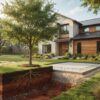
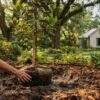
Houston’s heavy “gumbo” clay soil doesn’t have to be a death sentence for your new palm. Success starts with the “High and Wide” rule. When you plant a Sabal Palm Houston homeowners often make the mistake of digging a deep, narrow hole. Instead, you should dig a hole twice as wide as the root ball but no deeper. In our thick clay, drainage is your primary concern. You must plant the tree so the top three inches of the root ball sit slightly above the surrounding soil grade. This prevents water from pooling at the base and causing lethal root rot.
Once the palm is in the ground, backfill with native soil. You don’t need to over-amend the area; this native species is already built for our dirt. After backfilling, apply a three-inch layer of organic mulch around the base. This helps regulate soil temperature and retain moisture during our blistering August afternoons. Just be sure to keep the mulch a few inches away from the trunk itself to prevent fungal issues. If you want the peace of mind that comes with expert placement and a three-month warranty, you can schedule your professional installation at Verdant Tree Farm.
The Vital Establishment Period
The first 90 days after installation are the most critical for long-term survival. A newly planted Sabal Palm in a Houston summer requires 15 to 20 gallons of water three times a week. This deep soaking encourages the roots to push out into the surrounding clay. You might notice some yellowing of the lower fronds during this time. This is often just “transplant shock” as the tree reallocates energy to its root system. Our team provides professional maintenance consultations to help you distinguish between normal adjustment and actual health threats.
Fertilization for the Gulf Coast
Texas soil frequently lacks specific micronutrients that palms crave, particularly Magnesium and Manganese. A deficiency in these minerals often leads to “frizzle top” or unsightly yellow spotting on new growth. Apply a high-quality, slow-release palm fertilizer specifically formulated for the Gulf Coast. The best times for application are in early Spring and mid-Summer when the tree is actively growing. For a holistic approach to your property’s health, including your turf and soil quality, read our Lawn Care Houston guide. Proper fertilization ensures your palm maintains that deep emerald green color year-round.
Sourcing Your Palms: Why Houston Trusts Verdant Tree Farm
Verdant Tree Farm stands as the largest independent tree nursery in Houston. We provide a direct-to-consumer value that most service-based companies cannot match because we own and manage our entire inventory. When you choose a Sabal Palm Houston homeowners can rely on, you are getting the “Acclimated Advantage.” Our palms are grown and hardened right here in the Houston metro area. They don’t arrive on a truck from a different climate; they are already adjusted to our specific humidity and soil conditions. This local hardening significantly reduces transplant shock and ensures a higher survival rate for your investment.
Our veteran-owned business is built on a foundation of reliability and personal accountability. We don’t just sell you a tree and walk away. We act as your long-term partner in property growth. Every professional installation we perform comes with a standard three-month warranty. This gives you peace of mind that your new tropical centerpiece is protected during its most vulnerable phase. We take pride in helping our neighbors build legacies through resilient, beautiful greenery that stands the test of time.
3D Landscape Design: Visualize Your Oasis
Placement is everything when dealing with a tree that eventually features a 25-foot canopy spread. Our design team uses 3D technology to help you position your palms for maximum curb appeal and optimal pool-side shade. Seeing the mature scale of the tree before the first hole is dug prevents costly mistakes. You can ensure the arching fronds won’t interfere with power lines or structures while still achieving that lush, tropical look. For a comprehensive look at how we can transform your property, explore our Landscaping Services in Houston. We help you plan every detail from soil health to final aesthetics.
Veteran-Led Professional Installation
Moving a mature Sabal Palm is a heavy-duty task that requires specialized equipment. A single root ball can easily exceed 300 pounds. Our veteran-led crews handle the entire process with military precision and care. Professional installation includes more than just digging a hole. We manage the soil amendments, proper staking to prevent wind lean, and the initial mulching required for moisture retention. This end-to-end service ensures your palm is set up for success from the very first day. You get the benefit of our internal management structure and a team that treats your property with the respect it deserves. For those interested in how sophisticated logistics and inventory management work in other plant-based industries, you can learn more about PROTEUS420.
Investing in a Sabal Palm Houston landscape means choosing long-term reliability over temporary aesthetics. We have explored how this native icon survives our toughest freezes and thrives in heavy clay soil when planted correctly. By following the “High and Wide” planting rule and prioritizing acclimated nursery stock, you can avoid the heartbreak of winter-kill and the high cost of replacement. This tree is a biological powerhouse designed for our specific regional challenges.
As the largest independent tree nursery in Houston, we offer the expertise and inventory to transform your yard into a permanent retreat. Our veteran-owned and operated team handles every step of the process, from 3D design to professional installation. Every installation comes with our standard three-month warranty to protect your investment from the start. We take pride in providing a direct-from-nursery value that ensures your trees are healthy and ready to grow.
Visit Verdant Tree Farm in Houston to see our Texas Sabal Palms in person!
We look forward to helping you grow a resilient landscape that your family will enjoy for generations. Your property deserves the strength and beauty of a true Texas native.
Frequently Asked Questions
Are Texas Sabal Palms messy?
Texas Sabal Palms are remarkably clean compared to other popular species. While they do produce clusters of small white flowers and dark black fruits seasonally, they don’t develop the massive, shaggy “skirt” of dead fronds seen on Mexican Fan Palms. Most homeowners find that occasional pruning of lower leaves is all that’s required to keep them looking sharp. They are a great choice if you want a tidy, professional look for your property.
How fast does a Texas Sabal Palm grow in Houston?
You can expect a growth rate of approximately 6 to 12 inches of trunk height per year once the tree is fully established. While this is slower than some competitors, this controlled pace is exactly what makes the Sabal Palm Houston so resilient. The slow growth creates a dense, sturdy trunk that can withstand hurricane-force winds and extreme temperature drops. It is a long-term investment in the structural integrity of your landscape.
Are Sabal Palms freeze-hardy?
They are incredibly freeze-hardy and are rated for temperatures as low as 10 to 15 degrees Fahrenheit. During the historic freeze of February 2021, established Sabal Palms in the Houston area maintained a survival rate of approximately 90%. Their ability to withstand prolonged sub-freezing temperatures makes them a much safer alternative to more sensitive tropical varieties. You won’t have to worry about replacing your trees after every significant winter storm.
When is the best time to plant a palm tree in Houston?
The ideal window for planting is between late spring and early summer when soil temperatures remain consistently warm. Warm soil encourages rapid root development, which is essential for the tree to anchor itself before the dormant winter months. While Houston’s mild climate allows for planting throughout much of the year, avoiding the dead of winter gives your new palm the best possible head start. This timing ensures the root system is robust and healthy.
Do Sabal Palms have thorns?
No, Sabal Palms do not have thorns or sharp “teeth” along their leaf stems. This is a major advantage over species like the Mediterranean Fan Palm or the Washingtonia, which can be difficult to handle during maintenance. The smooth petioles make these palms safe for planting near walkways, pool decks, or play areas where children and pets might come into contact with the foliage. Pruning is also much safer for the average homeowner.
Will a Sabal Palm’s roots damage my pool or foundation?
Palm roots are fibrous and generally considered non-invasive, meaning they won’t crack your pool shell or lift your foundation. Unlike large shade trees with woody, expanding roots, palms grow a dense mat of small, flexible roots that stay relatively close to the trunk. This growth habit makes them one of the best choices for planting in tight spaces or near expensive hardscaping. They provide the tropical look you want without the structural risk.
How much water does a mature Sabal Palm need during a Houston summer?
Once established, a mature Sabal Palm Houston has survived for years is exceptionally drought-tolerant and can often thrive on natural rainfall alone. During extended periods of extreme heat and zero rain, providing a deep soak once every two weeks is more than enough to maintain its health. This “set it and forget it” watering requirement is a huge benefit for homeowners looking to reduce their utility bills while maintaining a lush green yard.
What is the difference between a Texas Sabal and a Cabbage Palm?
The main difference lies in their native range and physical stature. The Texas Sabal is native to our region and features a much thicker, stockier trunk with a slower growth rate. The Cabbage Palm is native to the Southeastern United States and tends to be more slender and grow slightly faster. Both are members of the Sabal genus and offer excellent cold hardiness, making them both reliable choices for any Southeast Texas landscape project.