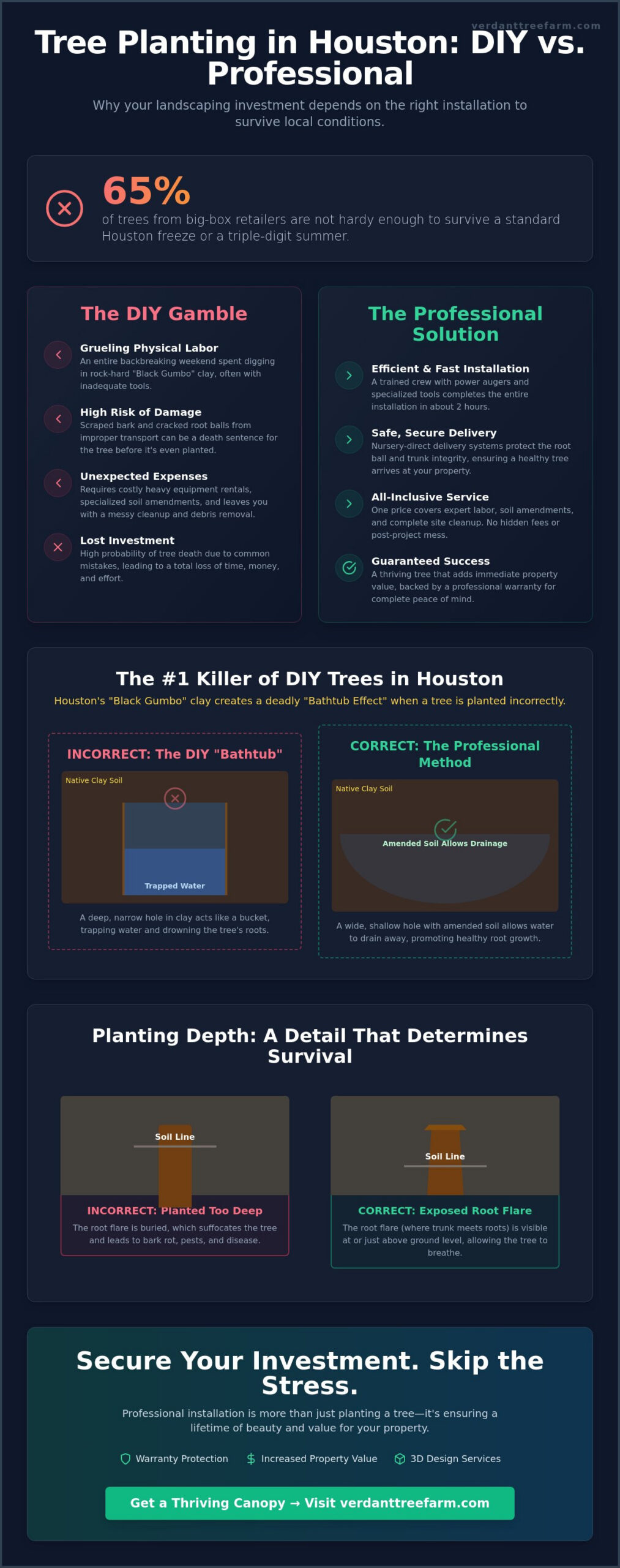
Did you know that 65% of trees sold at big-box retailers aren’t hardy enough to survive a standard Houston freeze or a triple-digit July drought? It’s a frustrating reality for local homeowners. You want a beautiful Cedar Elm or a Drummond Red Maple to shade your home; however, digging into stubborn Houston clay is backbreaking work. When weighing professional tree installation vs DIY, it’s easy to focus on the immediate cost. You must also consider the long-term risk of losing your investment to the elements.
We believe your landscaping should be a source of pride, not a source of stress. You deserve a thriving canopy that survives the next freeze and adds immediate value to your property. This guide explores whether professional installation is the right choice for your home. We will examine the difficulty of transporting heavy 30-gallon trees, the technical needs of our local soil, and the security of a professional warranty. Discover how to get the results you want without the physical exhaustion of a DIY project.
Key Takeaways
- Understand the physical scale of specimen trees and why a two-hour professional install saves you a grueling, backbreaking weekend.
- Learn how Houston’s “Black Gumbo” clay creates a deadly “bathtub effect” for roots when comparing professional tree installation vs DIY.
- Identify the hidden costs of self-planting, including heavy equipment rentals and the specialized soil amendments needed for local success.
- Discover the specific planting depths and staking requirements for Houston favorites like Live Oaks and Medjool date palms.
- Explore how professional maintenance consultations and 3D design services turn a simple plant purchase into a lasting property investment.
The True Scope of Tree Planting in Houston: DIY vs. Professional
Many homeowners walk through a nursery and see a beautiful 45-gallon Live Oak or a tall Drummond Red Maple and think they can manage the project with a standard pickup truck. However, understanding The True Scope of Tree Planting reveals that the logistical hurdles are often more than a single person can handle. When you analyze professional tree installation vs DIY, the physical reality of moving specimen trees is usually the first major roadblock. You aren’t just buying a plant; you’re moving a living organism that weighs hundreds of pounds and requires delicate handling.
Logistics and Heavy Lifting
The Time and Labor Factor
Digging in Houston’s compacted clay is a grueling task that many residents underestimate. Our local “Black Gumbo” soil is notorious for being rock-hard when dry and heavy as lead when wet. A professional crew equipped with power augers and specialized sharp-shooter shovels can complete a complex install in about two hours. For a novice, that same project often consumes an entire grueling weekend of physical exhaustion. You aren’t just digging a small hole; you’re excavating an area two to three times the width of the root ball to ensure the tree can actually establish itself in our tough environment.
There is also the matter of hidden labor. A DIY project leaves you with piles of heavy clay soil, large plastic containers, and shipping debris. Professionals manage the site cleanup and debris removal as a standard part of the service. You’re left with a pristine landscape and a healthy tree rather than a backache and a mess to clean up. Choosing expert help isn’t just about the planting; it’s about the efficiency and peace of mind that comes with a smart, direct, and uncomplicated purchase process.
Why Houston’s Clay Soil Makes DIY Planting Risky
Houston’s soil isn’t standard garden dirt. It’s “Black Gumbo” clay. This heavy, dense material expands when wet and contracts when dry, making it a nightmare for drainage. When you weigh the benefits of professional tree installation vs DIY, the technical understanding of this soil is often what determines if your tree lives or dies. Most homeowners dig a hole, drop the tree in, and hope for the best. Unfortunately, our local clay doesn’t work that way. It requires a specific approach to ensure roots can actually penetrate the ground and find oxygen.
The “bathtub effect” is the primary killer of DIY projects in the Gulf Coast. If you dig a hole in heavy clay and fill it with loose, rich soil, you’ve essentially built an underground bucket. Rainwater flows into the loose soil and sits there because it can’t penetrate the surrounding clay walls. The roots of your new October Glory Maple or Mexican White Oak will literally drown in standing water. Professional crews prevent this by digging wider, shallower holes. We also use professional-grade amendments like expanded shale or specific compost blends to break up the clay and create a sustainable environment for growth.
The Science of the Root Flare
Planting too deep is the most common mistake we see in residential yards. Many people think a deeper hole provides more stability; however, it actually suffocates the tree. The root flare is the transition zone between the trunk and the roots. If this area is buried, the bark stays constantly moist. This leads to fungal growth, pest infestations, and eventual rot. Our teams always identify the flare before backfilling to ensure the tree can breathe and thrive from day one. It’s a small detail that makes a massive difference in long-term health.
Drainage Solutions for the Gulf Coast
In low-lying areas, we often use “mounding” techniques. This involves planting the tree slightly above the existing grade and building up the soil around it. This keeps the root ball out of the standing water during our frequent heavy downpours. We also perform percolation tests to see how fast your yard actually drains before we ever start digging. It’s a level of detail that DIY projects rarely include. If you aren’t sure about your yard’s drainage capacity, a maintenance consultation can save you from a costly and frustrating mistake. We prioritize a smart, direct approach to ensure your investment survives the next rainy season.
Cost vs. Value: Breaking Down the Installation Investment
Deciding between professional tree installation vs DIY often comes down to the bottom line. It’s tempting to think that a shovel and a Saturday morning are all you need to save money. However, the true investment goes far beyond the price of the tree itself. You must account for specialized equipment, high-quality amendments, and the long-term value of a healthy specimen. A single mistake during a DIY install doesn’t just cost you time; it can result in the total loss of your financial investment. Professionally installed trees add immediate curb appeal and can increase property value by as much as 7% to 19%, according to various landscaping industry studies. When you choose expert help, you’re investing in a long-term asset that grows in value every year.
The “Hidden” Costs of DIY
The list of required materials for a successful planting is longer than most people realize. To do the job correctly in Houston, you’ll need more than a standard spade. Consider these often-overlooked expenses:
- Specialized Equipment: Renting a power auger or a heavy-duty tree dolly is essential for 30-gallon to 100-gallon trees.
- Stabilization Kits: High-quality wooden stakes, heavy-duty straps, and tension wires are required to keep a new canopy steady during Gulf Coast wind events.
- Soil Amendments: Buying enough expanded shale, professional-grade compost, and premium mulch to properly backfill a large hole can cost a significant amount at retail prices.
- Utility Risks: Striking an underground irrigation line or an internet cable is a common DIY disaster. Repairing these lines can cost hundreds of dollars, immediately erasing any savings from doing the labor yourself.
Warranty: The Ultimate Insurance Policy
The biggest financial risk of a DIY project is the lack of a safety net. Most retail nurseries sell trees “as-is” once they leave the lot. If a tree you planted yourself dies due to a sudden freeze, a drainage issue, or transplant shock, you’re responsible for the full replacement cost. This means paying for a second tree and the labor to remove the dead one. When comparing professional tree installation vs DIY, the warranty is often the smartest financial choice. A three-month warranty protects your investment during the most critical establishment phase. This peace of mind is invaluable during Houston’s unpredictable weather shifts. You aren’t just paying for labor; you’re securing a guarantee that your property’s new addition will thrive.
Installation Nuances for Houston’s Favorite Species
Every tree species has a unique biological blueprint. A Live Oak requires a different approach than a Medjool date palm. When you debate professional tree installation vs DIY, you must consider these technical requirements. A generic planting method often leads to stunted growth or early death. Our local expertise ensures that each variety gets the specific start it needs to thrive in our Gulf Coast climate. We don’t just dig holes; we create tailored environments for every specimen we install.
Planting Large Oaks and Elms
Large canopy trees like the Shumard Oak or Mexican White Oak present a unique structural challenge. Their heavy, broad canopies act like sails during a typical Houston thunderstorm. Professional crews use deep-set wooden stakes and heavy-duty straps to provide the necessary support while the roots establish. Without this, the tree can lean or even uproot before the first season is over. Drake Elms and Cedar Elms also require a rigorous watering schedule during their first summer. Our teams provide detailed maintenance plans to help these giants survive the 100-degree July heat. For more tips on selecting the right year-round canopy, explore our guide on the Best Evergreen Trees for Houston.
Specialized Care for Palms and Ornamentals
Palms are biologically different from hardwood trees. They don’t have traditional woody roots; instead, they have a fibrous root “boss.” In our heavy clay areas, palms like the Medjool date palm or Sylvester Palm require a specialized sandy-loam backfill. This ensures the drainage they need to prevent root rot. We also use specific professional-grade fertilizers during the initial install to jumpstart their growth.
Ornamental and flowering trees like the Texas Redbud or Mexican Redbud are particularly sensitive to transplant shock. Their thin bark and delicate root systems require gentle handling that DIY projects often lack. We prioritize species-specific depth and precise fertilization to ensure these color-producers bounce back quickly. Securing tall palms against Gulf winds is another area where professional expertise shines. We use a tripod staking method that provides 360-degree stability without damaging the trunk. This level of detail is the hallmark of a smart, direct, and uncomplicated purchase process.
Don’t leave the health of your new landscape to chance. Secure your investment by choosing professional installation for your next project.
Securing Your Investment with Verdant Tree Farm
Choosing where you buy your trees is just as important as how they are planted. When you look at professional tree installation vs DIY, the source of your inventory matters. Many landscaping companies are simple middle-men who buy from various wholesalers and mark up the price. We do things differently. As Houston’s largest independent nursery, we grow our own stock on over 20 acres of local land. This means our trees are already acclimated to our specific humidity and soil before they ever reach your driveway. You get direct-to-consumer value and the peace of mind that comes from a single point of accountability. Unlike third-party contractors, our nursery-backed warranty is supported by the very people who raised the tree from a sapling.
Our veteran-owned operation is built on reliability. We don’t just drop a tree in a hole and leave. We provide a comprehensive, end-to-end service that protects your property investment for years to come. From the initial selection of a 100-gallon Live Oak to the final mulch layer, our team manages every detail. This internal management structure ensures that the high standards we set in our fields are maintained during the installation on your property. By removing the guesswork of professional tree installation vs DIY, we allow you to focus on the beauty of your new landscape rather than the labor.
Nursery-Direct Landscaping Services
Utilizing landscaping services in Houston that are nursery-direct streamlines your entire property upgrade. You avoid the confusion of coordinating between a plant seller and a separate installation crew. We handle the 3D design, delivery, and planting with a cohesive strategy. Our team understands the biological history of every tree we sell, which allows us to provide superior care. We also offer maintenance consultations to ensure your new canopy stays healthy through our intense summer heat.
Expertise Rooted in Houston
Success in Zone 9 requires more than just a green thumb; it requires regional authority. Our 3D landscape design process allows you to visualize your project before the first shovel hits the ground. This planning ensures that your Drummond Red Maple or Medjool date palm is placed in the perfect spot for both aesthetics and drainage. We invite you to walk our 20-acre facility and hand-select the exact specimens for your home. You can see the quality for yourself and speak directly with the experts who grew them. Our team is equipped to handle projects of any scale with a can-do attitude that values your time and property.
Don’t settle for the risks and labor of a weekend project. Experience the difference of a professional partner who values legacy and regional growth. Visit Verdant Tree Farm to select your trees and book professional installation.
Grow Your Houston Legacy Today
Investing in your property’s canopy is a decision that lasts for generations. As we’ve explored, the choice between professional tree installation vs DIY involves more than just a shovel and a weekend. You must navigate the heavy logistics of specimen trees and the technical challenges of Houston’s “Black Gumbo” clay. A professional install ensures your tree is planted at the correct depth with the right drainage solutions to prevent root rot and transplant shock. By choosing expert help, you trade backbreaking labor for the security of a thriving, healthy landscape.
Verdant Tree Farm is a veteran-owned and operated local business dedicated to your success. We offer Houston’s largest independent tree nursery inventory, ensuring you find the perfect match for your yard. Every professional installation comes with a three-month warranty, providing a safety net that DIY projects simply can’t match. We take pride in being your dependable partner for long-term property growth and beauty. Take the first step toward a worry-free upgrade today.
Visit Verdant Tree Farm to browse Houston’s largest selection of trees and palms.
Frequently Asked Questions
What is the best time of year for professional tree installation in Houston?
The best time for professional tree installation in Houston is from late fall through early spring. Planting during this dormant period allows the root system to establish itself before the intense summer heat arrives. This timing reduces transplant shock and ensures the tree is resilient enough to handle the 100-degree days of July and August. While we plant year-round, these cooler months provide the most forgiving environment for new growth.
Can I plant a large palm tree myself without a tractor?
No, you cannot safely plant a large palm tree, such as a Medjool date palm or Sylvester Palm, without a tractor or specialized heavy equipment. These specimens are extremely heavy and top-heavy, making them dangerous to handle by hand. Attempting to move them without the right machinery often results in broken trunks or damaged root balls. Our professional crews use dedicated equipment to ensure these giants are placed safely and securely.
Does Verdant Tree Farm offer a warranty on DIY-planted trees?
Verdant Tree Farm does not offer a warranty on trees that are planted as a DIY project. Our three-month warranty is exclusive to professional installations because proper planting technique is the most significant factor in a tree’s survival. When you choose our team, we take full responsibility for the technical execution and the tree’s health during the critical establishment phase. This guarantee protects your investment from the start.
How much space should I leave between my house and a new Live Oak?
You should leave at least 15 to 20 feet of space between your home’s foundation and a new Live Oak. These trees have massive mature canopies and extensive root systems that can eventually interfere with structures or underground utilities. Proper spacing ensures your home remains safe while the tree has enough room to reach its full 50-foot spread over time. We help you determine the perfect placement during our initial site consultation.
Is it cheaper to buy a smaller tree and plant it myself?
Buying a smaller tree to plant yourself might seem cheaper initially, but it often carries a higher long-term cost. Small trees from big-box stores have a high failure rate in our local climate, and many fail to survive a standard Houston freeze. A larger, professionally installed specimen provides immediate property value and has a much higher survival rate. When evaluating professional tree installation vs DIY, consider the value of your time and the cost of replacing a failed tree.
What happens if a professionally installed tree dies during a Houston freeze?
If a professionally installed tree dies during our three-month warranty period, we stand by our commitment to your landscape. Our warranty covers the replacement of the tree if it fails due to health issues or transplant shock. This protection is a key benefit when comparing professional tree installation vs DIY, as it shields you from the financial loss of a dead investment. We prioritize local accountability and long-term customer satisfaction.
Do I need a permit for professional tree installation in Houston?
You generally don’t need a permit for professional tree installation on private residential property within Houston city limits. However, you must always check with your Homeowners Association (HOA) for their specific architectural guidelines. If you are removing a protected tree to make room for a new one, specific city ordinances regarding diameter and species may apply. We can help you navigate these local requirements during the planning phase.
How often should a professionally installed tree be watered in the first month?
A newly installed tree should typically be watered every day or every other day for the first month. In our heavy clay soil, it’s vital to deep-water the root ball without creating a “bathtub effect” that rots the roots. Our installation team provides a customized watering schedule based on the specific species and your yard’s drainage capacity. Consistent moisture is the most important factor for a healthy start in the Gulf Coast.