Did you know that 65% of trees sold in big-box stores might not have the hardiness to survive a typical Houston freeze? It’s a frustrating reality for many homeowners who spend their weekends digging through heavy clay only to see their investment wither during the next weather extreme. We understand the struggle of dealing with “Houston Gumbo” soil and the stress of rising utility bills when your yard lacks a cooling canopy. You deserve a landscape that provides lasting beauty and shade without the constant fear of the next deep freeze or summer heatwave.
This 2026 guide simplifies the process by teaching you how to choose the right tree for my Houston yard using our “Right Tree, Right Place” framework. We’ll show you how to navigate the region’s updated Zone 9b climate and select resilient species like the Shumard Oak, Cedar Elm, or Drummond Red Maple. You’ll learn how to evaluate your soil drainage, plan for mature growth heights, and pick the best planting window to ensure your new trees thrive for decades to come. Let’s turn your property into a local landmark with expert advice rooted in years of Houston experience.
Key Takeaways
- Master how to choose the right tree for my Houston yard by understanding the unique drainage challenges of “Houston Gumbo” clay and the updated Zone 9b climate standards.
- Identify the best placement for “Workhorse” shade trees to significantly lower your summer utility bills while avoiding foundation and utility line conflicts.
- Compare the resilience of top local species like the Mexican White Oak and Drummond Red Maple to ensure your landscape survives both extreme heat and deep freezes.
- Learn why the first 90 days are the most critical period for a new tree and how professional installation protects your long term investment.
- Discover the “15-Foot Rule” and other strategic planting techniques that prevent costly damage to your home’s structure and overhead power lines.
Understanding the Houston Ecosystem: Soil, Sun, and Hardiness
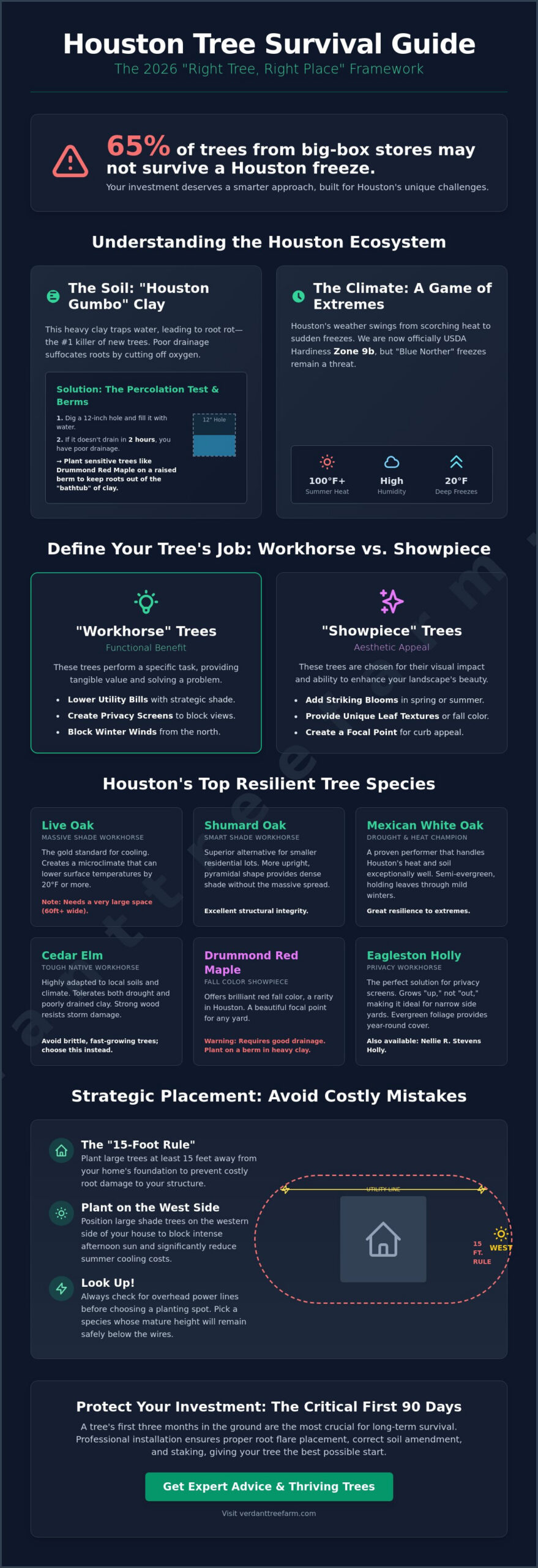
Houston isn’t just one climate. The late 2023 USDA update officially moved much of our region into Zone 9b. This shift reflects slightly warmer average winter lows, but it doesn’t mean we are safe from the “Blue Norther” freezes that define our winters. Learning how to choose the right tree for my Houston yard starts with respecting the local geography. You are planting in Houston’s Gulf Coastal Plain biome. This environment is characterized by flat topography and complex soil layers that dictate whether a sapling thrives or rots in the ground.
The Reality of Houston Clay Soil
“Houston Gumbo” is legendary for all the wrong reasons. This heavy clay soil acts like a sponge that never lets go. It traps water around root balls, effectively drowning trees by cutting off oxygen to the root system. Poor drainage is the leading cause of death for newly planted trees in Harris County. Before you buy, perform a simple percolation test. Dig a hole 12 inches deep, fill it with water, and time how long it takes to drain. If it hasn’t emptied in two hours, you have a drainage problem that needs addressing. For species like the Drummond Red Maple, we often recommend planting on a slight berm or a raised bed. This elevated position keeps the root flare above the “bathtub” of clay, ensuring the tree can breathe during our frequent heavy rains.
Houston’s Climate: From Humidity to Hard Freezes
Our weather is a game of extremes. We deal with 100°F summers and sudden 20°F winters. Urban neighborhoods often suffer from the “Heat Island” effect. Asphalt and concrete radiate heat long after the sun goes down, stressing trees that need a cool night to recover. Don’t assume “native” means “bulletproof” in a modern landscape. While native trees are adapted to our humidity, the specific microclimate of your yard matters more. High humidity can trigger fungal diseases in non-native species, making local expertise essential for a long-term landscape investment. Freeze-resilience is now a non-negotiable standard. After the record-breaking freezes of recent years, selecting trees that can handle both the swampy heat and the occasional deep chill is the only way to protect your property value. We focus on species that have proven their mettle in these exact conditions, ensuring your investment grows for decades.
Defining Your Purpose: Shade, Privacy, or Aesthetics?
Before you pick up a shovel, you need to decide what job your new tree will perform. We categorize trees into two main groups: “Workhorses” and “Showpieces.” A workhorse provides a functional benefit, such as lowering your cooling costs or blocking a neighbor’s second-story window. A showpiece focuses on curb appeal, offering striking blooms or unique leaf textures. Identifying your primary goal is the most critical step in learning how to choose the right tree for my Houston yard. If you try to make one tree do everything, you might end up with a species that grows too large for its space or fails to provide the specific benefit you need.
The Best Shade Trees for Energy Efficiency
In Houston, shade isn’t just a luxury; it’s a financial strategy. Planting a large canopy tree on the western side of your home can significantly reduce the heat load on your walls and windows. The Live Oak remains the gold standard for massive, spreading shade. Its broad reach creates a cooling microclimate that can lower surface temperatures by twenty degrees or more. However, not every yard can accommodate a tree that grows sixty feet wide. For smaller residential lots, the Shumard Oak is a superior alternative. It offers a more upright, pyramidal shape while still providing dense foliage. You can also use the Best Evergreen Trees for Houston to block biting winter winds from the north, creating a year-round buffer for your home. When you select a shade tree, prioritize structural integrity over growth speed. Avoid “brittle” fast-growers that might snap during a tropical storm. Instead, stick to proven performers like the Cedar Elm or Mexican White Oak.
Privacy Screens and Small-Space Solutions
Privacy is a top priority in our growing suburban neighborhoods. When space is tight, you need trees that grow “up” rather than “out.” Hollies are the workhorses of the privacy world. Species like the Eagleston Holly and Nellie R. Stevens Holly maintain their thick, green foliage all year. They fit perfectly into narrow side yards where a traditional fence isn’t enough. If you want a more ornamental look, the Little Gem Magnolia offers a compact evergreen solution with large, fragrant white flowers. It provides the classic Southern aesthetic without taking up the entire backyard. For those looking to create a layered landscape, the Texas Redbud is an excellent choice. As an understory tree, it thrives in the dappled light beneath larger oaks, providing a burst of purple color in early spring. If you aren’t sure which species fits your specific lot size, our team can provide professional maintenance consultations to help you map out a long-term plan.
Comparing Top Species: Which Houston Tree Wins?
Selecting the specific variety is where many homeowners feel overwhelmed. There are dozens of options available, but only a handful truly thrive in our local conditions over the long term. When you are researching how to choose the right tree for my Houston yard, you must look past the aesthetic appeal and check the resilience ratings. We have closely monitored which species stood tall after the historic 2021 freeze and the record droughts that followed. This real world data is the foundation of our recommendations.
Oaks and Elms: The Houston Backbone
The “Big Three” oaks are the foundation of our regional canopy. The Live Oak is our most famous resident; it offers a massive, spreading canopy that provides legacy shade for generations. If you want fall color and a more manageable, pyramidal shape, the Shumard Oak is a better fit for residential lots. It handles the alkaline pockets in our soil better than most other red oak varieties. For those who want privacy and shade quickly, the Mexican White Oak, also known as the Monterrey Oak, is a top contender. It grows significantly faster than the Live Oak and is highly resistant to common oak diseases.
Cedar Elms are the unsung heroes of Harris County. These trees are incredibly drought-tolerant and actually thrive in the heavy clay that often suffocates other species. If you want a more refined, semi-evergreen look, the Drake Elm offers a beautiful weeping shape and interesting bark texture. Both species are far superior to the brittle, fast-growing trees often sold at national retailers that tend to fail during tropical wind events.
Maples and Cypress for Varied Drainage
Maples provide stunning color but require careful selection based on your yard’s moisture levels. The Drummond Red Maple is a native star that loves “wet feet,” making it the perfect choice for the low-lying areas of your property that collect water after a storm. In contrast, the October Glory Maple provides intense red color but requires slightly better drainage to avoid root rot. If your yard has a persistent drainage issue or a deep ditch, consider a Bald Cypress or Montezuma Cypress. These trees are built for the Gulf Coast ecosystem and can handle standing water while providing a unique, feathery texture to your landscape.
Adding a Tropical Touch with Palms
You can still enjoy a tropical oasis without the fear of a total loss during a cold snap. Our curated selection of Palm Trees for Sale in Houston focuses exclusively on cold-hardy varieties that have proven their durability. The Medjool Date Palm is a majestic centerpiece with a thick trunk and striking blue-gray fronds. If you need a slightly smaller but equally hardy “showpiece” tree, the Sylvester Palm offers a beautiful diamond-cut trunk and dense canopy. For smaller tropical corners or pool-side planting, the Pindo Palm is a rugged, slow-growing option that handles our humidity and occasional hard freezes with ease.
Strategic Placement: Avoiding Foundation and Utility Issues
Picking a species is only half the battle. Strategic placement is the other half. When you are figuring out how to choose the right tree for my Houston yard, you have to look down at your foundation and up at the sky. The 15-Foot Rule is a non-negotiable standard for any large canopy tree. Planting an oak or maple closer than 15 feet to your home’s slab is asking for trouble. Houston’s expansive clay soil already puts stress on foundations. Thirsty tree roots can exacerbate this by pulling moisture away during a drought, causing the ground to shift and crack.
Don’t fall into the mature height trap. That six-foot sapling in a container today might reach forty or fifty feet in twenty years. If you plant it directly under CenterPoint power lines, you’ll eventually have to pay for aggressive pruning that ruins the tree’s natural shape. Always check the expected mature spread of your chosen species before you break ground. This foresight prevents costly maintenance and preserves the aesthetic value of your landscape.
Root Systems and Infrastructure
Planning for root spread is vital in suburban lots where space is at a premium. If you are planting near a sidewalk or driveway, you need species with less aggressive root profiles. For example, Eagleston Hollies or Little Gem Magnolias are excellent for tighter spaces. If you must plant a larger tree near a pool or expensive hardscaping, consider installing a professional root barrier. These physical shields redirect root growth downward rather than outward. Be especially careful with the Bald Cypress. While they are beautiful in wet areas, they develop knees that can lift pavers or trip guests if they don’t have enough breathing room.
Call Before You Dig: The 811 Process
In Houston, calling 811 is the mandatory first step for any digging project, no matter how small the tree. Hitting an underground gas or water line in Harris County can lead to massive repair bills and dangerous service interruptions for your entire neighborhood. Professional installation teams handle the utility marking process for you. They ensure every hole is dug safely and legally. If you want to skip the headache and ensure your trees are placed perfectly, you can schedule professional installation with our expert crew.
Professional Installation: Ensuring Your Investment Grows
You have done the hard work of researching species and measuring your lot. Now comes the most critical phase of the process. The first 90 days are the absolute make or break period for any new tree in the Texas climate. Even the most resilient species can fail if they aren’t transitioned properly from the nursery to your yard’s specific soil conditions. Learning how to choose the right tree for my Houston yard is only the first step; ensuring it survives the transplant shock is what protects your long term financial investment.
There is a significant difference between nursery direct purchasing and buying from a big box retailer. Large national chains often stock trees that were grown in different climates and shipped hundreds of miles. These trees arrive stressed and may not be hardened for our specific humidity or soil pathogens. By choosing a local source, you get a tree that has already spent its life acclimating to the local air and water. This local heritage results in a much higher survival rate once the tree is in the ground.
The Verdant Tree Farm Advantage
We take pride in being a veteran owned, independent Houston nursery. Our team understands that “planting” a tree involves more than just digging a hole. Professional installation with our crew includes specific soil amendments designed to break down the heavy clay we discussed earlier. We don’t just drop the root ball into the gumbo; we create a localized environment where roots can actually spread and breathe. To give you total peace of mind, we provide a three month warranty as a standard for our quality assurance. This ensures that your tree gets through that critical initial window with professional backing.
Visualizing Your Yard with 3D Design
One of the biggest challenges for homeowners is “buyer’s remorse” caused by poor spacing or mismatched aesthetics. Our Landscaping Services in Houston utilize advanced 3D design technology to remove this guesswork. You can see exactly how a Mexican White Oak or a grouping of Eagleston Hollies will look against your home’s architecture before the first shovel hits the dirt. This technology allows you to visualize the mature size of the canopy, ensuring you avoid the foundation and power line traps mentioned in previous sections.
Ready to transform your yard into a professional landscape? Schedule a professional 3D design consultation today and let our experts handle the heavy lifting. We are equipped to handle projects of any scale, from single legacy oaks to full property privacy screens. Let’s build a landscape that grows with your family for generations.
Build Your Houston Legacy with Confidence
Creating a landscape that thrives in the Texas elements requires more than just a green thumb. It demands a deep understanding of our updated Zone 9b climate and the unique drainage challenges of our heavy clay soil. By prioritizing freeze-resilient species and adhering to the 15-foot rule for foundation safety, you are making a smart, direct investment in your property’s future value. Mastering how to choose the right tree for my Houston yard is the first step toward lower utility bills and a more beautiful home environment.
As the largest independent nursery in Houston, we are here to ensure your vision becomes a reality. Our veteran-owned and operated team provides more than just inventory; we offer professional installation and a 3-month warranty for total peace of mind. We take pride in helping our neighbors grow a legacy that lasts for generations. It’s time to stop worrying about the next freeze and start enjoying the shade.
Browse Houston’s Largest Selection of Trees & Palms and start your transformation today. We’re ready to help you plant with confidence.
Common Questions About Houston Tree Selection
What is the best fast-growing shade tree for Houston?
Mexican White Oak is the best fast growing shade tree for our region. It outpaces the Live Oak while maintaining a strong branch structure that handles tropical winds. If you want fall color, the Shumard Oak is another excellent choice that grows quickly in well-drained spots. Both options avoid the brittle wood issues common in “fast-growing” trees sold at big-box retailers.
Can I plant a tree in Houston during the summer?
You can plant in the summer, but it requires rigorous watering discipline. The ideal window is mid-November through February, which allows roots to settle before the heat. If you plant in July or August, you must water daily to prevent transplant shock. Our professional installation includes specific soil amendments to help trees survive these harsh transitions during the hottest months.
How far should I plant an Oak tree from my house?
You should plant an Oak tree at least 15 feet away from your home’s foundation. This distance protects your slab from the pressure of expanding root systems and prevents branches from scraping your roof. For very large varieties like the Live Oak, 20 feet is even better. Proper spacing is a key part of how to choose the right tree for my Houston yard to avoid future repair costs.
What trees survived the 2021 Houston freeze best?
Live Oaks, Cedar Elms, and native Hollies like the Savanah Holly were the most resilient during the 2021 freeze. These species are naturally adapted to the “Blue Norther” temperature drops that define our winters. While many non-native tropicals were lost, these hardy trees bounced back quickly. We prioritize these survivors in our inventory to ensure your landscape remains a long-term investment.
Does Houston gumbo soil need to be replaced before planting?
You don’t need to replace Houston gumbo soil, but you must amend it during planting. Digging a hole twice as wide as the root ball and mixing in compost or expanded shale improves drainage. This prevents the “bathtub effect” where water sits and rots the roots. Planting on a slight berm is another effective way to manage the heavy clay without moving tons of dirt.
How much water does a newly planted tree need in Houston?
A newly planted tree typically needs 5 to 10 gallons of water per inch of trunk diameter, twice per week. During a typical Houston summer, you may need to increase this to three times per week. Using a soaker hose or a slow-release watering bag ensures the moisture reaches the deep roots. Consistent watering is just as important as knowing how to choose the right tree for my Houston yard.
Are native Texas trees always the best choice for my yard?
Native trees are excellent, but well-adapted species can also thrive in your yard. While the Texas Redbud is a native favorite, the Mexican White Oak and Drake Elm are “adapted” trees that handle our heat and soil perfectly. The goal is to find a tree that matches your specific yard function, whether it’s native or a proven regional performer that survives our updated Zone 9b climate.
What is the most low-maintenance tree for a small Houston lot?
The Little Gem Magnolia is the best low-maintenance choice for small lots. It stays compact, keeps its leaves year-round, and produces fragrant flowers without constant pruning. Eagleston Hollies are another great option if you need a narrow privacy screen. These trees provide high visual impact with very little effort, making them ideal for busy homeowners with limited outdoor space.