What if your lush, tropical backyard could withstand a 20-degree night without turning into a graveyard of brown fronds? Most Houstonians know the heartbreak of watching a beautiful landscape wither after a single freeze. It’s a costly cycle that leaves many homeowners wary of investing in new trees. If you’re looking for a reliable solution, the Windmill Palm Houston experts recommend is one of the toughest options available. These palms don’t just survive; they thrive even when our local weather turns volatile.
We understand the frustration of conflicting zone information and the fear of high replacement costs. You want a yard that reflects your style without the constant risk of winter damage. In this 2026 guide, you’ll discover which palm species can truly handle our shift into USDA Zone 9b and how to protect your tropical investment for the long haul. We’ll preview the best hardy varieties, explain why professional installation is the key to deep-root survival, and show you how a warranty-backed purchase ensures your landscape remains a permanent asset to your home.
Key Takeaways
- Identify your specific Houston sub-zone to select palm species that can withstand extreme 10-year freeze events rather than just average winter lows.
- Discover why the Windmill Palm Houston experts recommend remains the gold standard for homeowners seeking maximum cold hardiness and reliable growth.
- Learn how to balance luxury and risk when planting “zone pushers” like the Medjool and Sylvester Date Palms in your landscape.
- Master strategic siting and drainage techniques that leverage your home’s thermal mass to shield sensitive fronds from harsh north winds.
- Understand the long-term value of purchasing acclimated, nursery-direct stock backed by professional installation and a solid 3-month warranty.
Houston’s Microclimates: Why USDA Zone 9 Isn’t the Whole Story
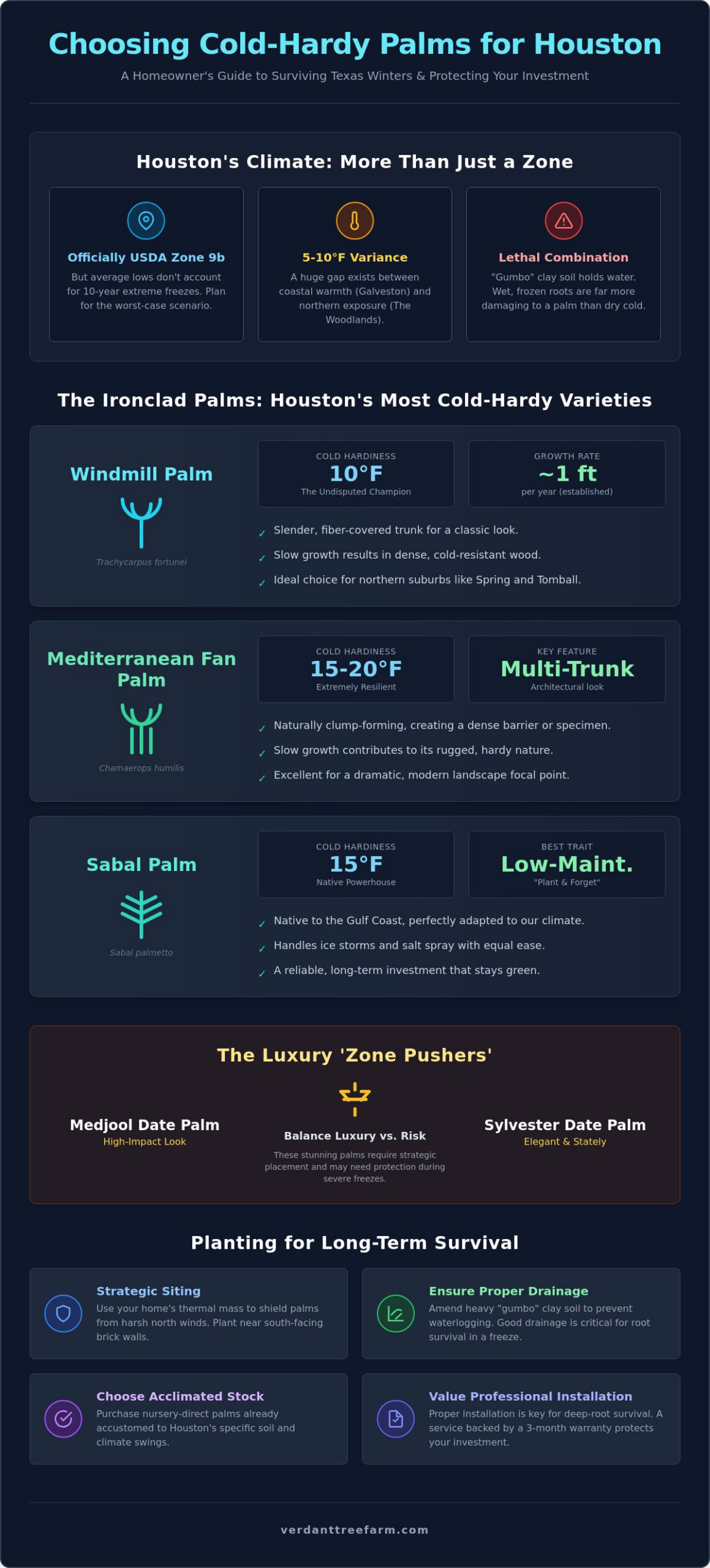
The official USDA Plant Hardiness Zone Map recently shifted much of Houston into Zone 9b. While this looks good on paper, local homeowners know that a single map color doesn’t tell the full story of our winter weather. There is a massive difference between the mild, coastal air of Pearland and the biting north winds that hit The Woodlands. Relying on average lows is a dangerous game for your landscaping budget. Average lows represent a typical year, but your palms need to survive the 10-year extreme events that send temperatures plummeting into the teens.
Humidity and soil moisture play a silent, critical role in how your trees handle the cold. In our “gumbo” clay soil, poor drainage often leads to wet roots during a freeze. This combination is far more lethal than dry cold, as it causes ice crystals to form more easily within the plant’s vascular system. When you choose a Windmill Palm (Trachycarpus fortunei), you’re selecting a species evolved to handle these damp, chilly conditions. Identifying your property’s specific microclimate is the first step toward success. A palm planted in a wind tunnel between two houses will struggle, while one placed near a brick wall benefits from stored thermal mass.
The North Houston vs. Galveston Gap
A palm that thrives in Clear Lake might fail in Conroe because of the 5-to-10-degree temperature variance during a cold front. Coastal areas benefit from the Gulf’s insulating warmth, while northern suburbs face unprotected exposure to Arctic air. Hardiness in Houston is the ability of a plant to withstand rapid temperature drops and prolonged freezing durations without sustaining permanent vascular damage. For those in the cooler northern reaches, the Windmill Palm Houston residents trust is often the only “ironclad” choice that doesn’t require a tarp every January.
Lessons from Winter Storm Uri
The record freeze of 2021 served as a brutal masterclass in palm survival. While many Queen Palms and Washingtonias perished, species like the Sabal and Windmill showed remarkable resilience. We learned that the duration of the cold is just as damaging as the minimum temperature reached. A palm might survive four hours at 18 degrees but succumb to forty-eight hours at 25 degrees. Urban “heat islands” in the Inner Loop provided just enough protection for some marginal varieties to pull through. If you live in a less dense area, you’ll need to rely on hardy species and professional planting techniques to ensure your investment survives the next big one.
The Ironclad Palms: Houston’s Most Cold-Hardy Varieties
Choosing the right species is the difference between a permanent landscape and a temporary one. While many palms look identical at a big-box store, their internal biology varies wildly. For homeowners in northern suburbs like Spring or Tomball, the Windmill Palm Houston residents rely on is the undisputed champion. It withstands temperatures as low as 10 degrees without significant damage. Because we are a veteran-owned operation, we prioritize stock that’s been locally acclimated to our specific “gumbo” soil conditions. This ensures your investment doesn’t just look good in the spring but survives the winter.
Research from the University of Florida identifies several cold-hardy palm species that can survive the erratic swings of the Upper Gulf Coast. Beyond the Windmill, the Mediterranean Fan Palm offers a rugged, multi-trunk look that provides an architectural focal point. For those closer to the coast, the native Sabal Palm is a powerhouse. It handles ice storms and salt spray with equal ease. These species represent a long-term investment in your property’s value. We back that investment with a 3-month warranty on all professional installations.
Fan Palms for Maximum Resilience
Windmill palms and Mediterranean Fan palms offer distinct visual profiles for modern Houston yards. The Windmill grows with a slender, fiber-covered trunk and a compact head of fronds. In contrast, the Mediterranean Fan Palm is naturally clump-forming. It creates a dense barrier or a dramatic specimen tree. Both are relatively slow growers. You can expect about 6 to 12 inches of trunk growth per year once established. This slow pace is actually a benefit. It results in denser wood and better cold resistance than fast-growing, “fleshy” species. If you want a low-maintenance option for a large property, the Sabal Palm is unmatched. It’s a “plant it and forget it” tree that stays green when others turn brown.
The Pindo Palm: Feather-Shaped Elegance
Many homeowners love the arching fronds of a Queen Palm but hate replacing them after every hard freeze. The Pindo Palm is the perfect alternative. It offers that classic “feather” look while surviving temperatures into the low teens. Its silver-blue foliage provides a high-contrast pop against standard green shrubbery. This makes it a favorite for designer landscapes in neighborhoods like River Oaks or Memorial. Its unique color creates an immediate focal point in any garden bed.
In these high-end outdoor spaces, the choice of durable structures and furnishings is just as important as the plants themselves; for those seeking a blend of style and resilience, Vansta Trädgård offers valuable insights into selecting exclusive garden features that withstand the elements beautifully.
Success with Pindo palms in Houston requires addressing our heavy clay soil. These trees need slightly better drainage than our native oaks. We recommend planting them in slightly elevated mounds to keep the root ball out of standing water. If you’re ready to upgrade your yard, you can view our current inventory of cold-hardy palms to find the perfect specimen for your microclimate. Our team handles everything from selection to deep-root installation, ensuring your new trees have the best possible start.
The Luxury ‘Zone Pushers’: Medjool and Sylvester Date Palms
While the Windmill Palm Houston homeowners often select provides the most security, some landscapes demand a grander, resort-style presence. This is where “Zone Pushers” like the Medjool and Sylvester Date Palms come into play. These trees are the gold standard for luxury properties in neighborhoods like River Oaks and The Heights. They offer a scale and architectural beauty that smaller, hardier species simply cannot match. However, planting them involves a calculated risk. According to the USDA Plant Hardiness Zone Map, Houston’s shift into Zone 9b makes these palms more viable than in decades past, but they still require expert placement and care.
Choosing these high-value specimens is an investment in your home’s curb appeal. Because these palms are massive and heavy, professional installation is non-negotiable. Our veteran-owned team uses specialized equipment to ensure deep-root placement, which is vital for winter survival. We don’t just drop a tree in a hole; we engineer the planting site for long-term health. This level of service is why we can offer a 3-month warranty on these premium palms, giving you peace of mind that your tropical investment is protected.
Protecting Your Medjool Investment
The Medjool Date Palm is the ultimate statement tree. It features a thick, rugged trunk and a massive canopy of blue-green fronds. For these palms, 20°F is the critical threshold. Once temperatures dip below this point, active freeze protection becomes necessary. The iconic “diamond cut” trunk, while beautiful, can increase cold sensitivity by exposing more of the plant’s surface area. We use professional 3D landscape design to identify “heat pockets” on your property. Placing these palms near south-facing brick walls or away from north-wind funnels can raise the ambient temperature just enough to prevent damage during a snap freeze.
Sylvester Palms: The Silver Standard
Sylvester Palms are rapidly becoming the preferred choice for Houston designers. They offer better cold tolerance than the Canary Island Date Palm but maintain a similar regal look. Their silver-green foliage provides a cool, sophisticated palette that works well with modern architecture. If you’re comparing options, you can read our detailed breakdown on Palm Trees for Sale in Houston: Your Guide to a Freeze-Resistant Oasis. This guide helps you weigh the visual impact against the maintenance requirements of each species. Whether you choose the ironclad safety of a Windmill Palm Houston trusts or the luxury of a Sylvester, we ensure your yard remains a lush, year-round retreat.
Planting for Survival: Strategic Siting and Winter Care
Strategic siting is your first line of defense. As a veteran-owned nursery, we’ve seen how proper placement saves homeowners thousands in replacement costs. Planting near a south-facing wall allows your home to act as a radiator. This thermal mass absorbs sunlight during the day and releases it at night. This small margin is frequently the difference between life and death for a Windmill Palm Houston residents plant to achieve that tropical look. Avoid north-facing corners where Arctic winds can whip around the house and strip moisture from the fronds. These wind tunnels can be significantly colder than the rest of your yard.
Soil preparation is just as vital as location. Houston’s heavy clay soil naturally holds water, which is a recipe for disaster during a hard freeze. Wet roots are significantly more susceptible to freeze damage because water conducts cold more efficiently than air pockets. If your yard has poor drainage, we recommend planting on a raised berm. This keeps the crown of the root system above the water line, protecting the plant’s vascular health when temperatures drop. Proper drainage is the foundation of our professional installation process, ensuring deep-root survival for every tree we sell.
The Professional Wrapping Technique
When a hard freeze is forecast, you need a plan. Use breathable materials like burlap or professional-grade frost blankets. Never use plastic directly against the foliage. Plastic traps moisture and can lead to fungal rot or even “cook” the plant if the sun comes out before you uncover it. Focus your efforts on protecting the “heart” or the central bud of the palm. This is the growth point; if it freezes, the tree dies. For particularly sensitive species, wrapping a strand of old-school C9 Christmas lights around the trunk before covering provides just enough supplemental heat to ward off frost.
Post-Freeze Recovery and Maintenance
Patience is the hardest part of palm care. After a freeze, many homeowners are quick to cut away brown fronds or declare a tree dead. We follow the “Wait and See” rule. It can take weeks or months for the true extent of damage to show. Perform a “spear tug test” by gently pulling on the newest, central frond. If it stays firm, there is hope. Avoid the temptation to fertilize a stressed tree in the winter. Feeding a palm too early forces new growth that is even more vulnerable to the next cold snap. If you want a landscape designed for long-term success, our Landscaping Services in Houston: The 2026 Guide to Nursery-Direct Design & Installation provides the expert planning you need to avoid these common pitfalls.
Our team is ready to help you protect your investment with professional advice and a 3-month warranty on all trees. Contact us today to schedule a maintenance consultation or visit our nursery to see our hardy stock in person.
Why Buying Nursery-Direct is the Safest Bet for Houstonians
We are the largest independent tree nursery in Houston. This scale allows us to offer a direct-to-consumer value that big-box retailers simply cannot match. Our veteran-owned team understands that a palm is an investment, not just a purchase. When you buy from us, you’re getting more than a tree; you’re getting years of local expertise and a 3-month warranty that provides ultimate peace of mind. We stand behind our stock because we know it’s prepared for the specific challenges of the Upper Gulf Coast.
Big-box stores often source their palms from Florida or Southern California. These trees have never experienced a 20-degree night or the heavy, alkaline “gumbo” clay unique to our region. They arrive stressed and ill-equipped for our erratic weather patterns. By choosing a Windmill Palm Houston grown or acclimated in our own nursery, you ensure the specimen has already survived local conditions. This local acclimation is the secret to long-term survival. We offer comprehensive services from 3D landscape design to professional installation, ensuring your trees are positioned for maximum protection and deep-root health.
The Largest Independent Inventory in Houston
Visiting our Houston farm allows you to hand-pick the exact specimen that will anchor your landscape. You don’t have to guess what your yard will look like based on a small pot or a grainy photo. Seeing the trunk thickness and frond health in person is vital for high-value palms. Many of our trees have already weathered a Houston winter in our care. This proven resilience makes them a much safer bet than freshly shipped stock. Our maintenance consultations also help you avoid common errors, such as improper mulching or over-watering in poorly drained soil.
Start Your Tropical Transformation Today
Visualizing your new backyard is easy with our professional 3D landscape design service. We can show you exactly how your palms will look against your home’s architecture before we ever break ground. This helps us identify the best “heat pockets” for sensitive species. Once you’ve selected your trees, our team handles the heavy lifting. Our professional installation service is essential for large palms, ensuring they are anchored correctly to withstand Gulf Coast winds. Don’t leave your landscape to chance. Visit Verdant Tree Farm or request a consultation today!
Build Your Freeze-Resistant Oasis Today
Creating a tropical paradise in Houston doesn’t have to be a seasonal gamble. By understanding your specific microclimate and choosing the right species, you can enjoy greenery that survives our harshest winters. Whether you opt for the ironclad Windmill Palm Houston families trust or a luxury Sylvester, success starts with strategic siting and professional installation. Avoiding big-box stock and choosing locally acclimated trees is the most effective way to protect your long-term investment.
At Verdant Tree Farm, we take pride in being Houston’s largest independent tree nursery. As a veteran-owned business, we prioritize reliability and direct-to-consumer value. We back every tree with a 3-month warranty, giving you peace of mind that your landscape is built to last. Our team is ready to help with everything from 3D design to deep-root planting. View Our Current Inventory of Cold-Hardy Palms and start your transformation with a team that knows Houston soil best. We look forward to helping you grow a yard you’ll love for decades.
Frequently Asked Questions
What is the most cold-hardy palm for Houston?
The Windmill Palm and Sabal Palm are the most cold-hardy options for our region. Specifically, the Windmill Palm Houston residents choose can handle temperatures down to 10°F. Sabal palms are also native powerhouses that withstand ice and snow with ease. These species are considered “ironclad” because they rarely require covering during a standard Texas winter. Choosing these acclimated varieties is the safest way to ensure your landscape remains lush year after year.
Can a Queen Palm survive a Houston freeze?
Queen Palms are marginal in Houston and often suffer severe damage or death when temperatures drop below 20°F for several hours. While they might survive a light frost, prolonged freezes like those seen in 2021 frequently kill them. We recommend hardier alternatives like the Pindo Palm if you want a similar feathery look with much better cold resistance. Investing in a more durable species prevents the high cost of frequent tree replacement.
How do I protect my palm trees when a freeze is coming?
Wrap the trunk and the central growth bud with breathable materials like burlap or frost blankets. Avoid using plastic directly against the plant because it traps moisture and causes rot. For sensitive specimens, you can wrap a strand of C9 Christmas lights around the trunk to provide a few degrees of warmth. Mulching the base with 3 to 4 inches of wood chips also helps insulate the roots against the cold ground temperatures.
Should I cut off brown fronds after a freeze?
No, you should wait until the spring to prune any brown or damaged fronds. Those dead fronds actually provide a layer of insulation for the palm’s heart during subsequent cold snaps. Cutting them too early exposes the vulnerable bud to more damage. Once you see new green growth in the center during the warm spring months, you can safely remove the unsightly brown foliage and resume your regular maintenance schedule.
Do I need to water my palms before a freeze?
Yes, watering your palms deeply 24 to 48 hours before a freeze is essential for survival. Moist soil acts as an insulator and stays warmer than dry soil. Hydrated plants also have better cellular strength to resist the desiccation caused by cold winds. However, ensure your soil has proper drainage so the roots don’t sit in stagnant water. Wet roots in heavy clay are far more susceptible to freeze damage than well-drained ones.
What is the difference between a fan palm and a feather palm?
The difference lies in the leaf structure. Fan palms, like the Windmill Palm Houston experts recommend, have fronds that radiate from a single point like a folding fan. Feather palms, such as the Pindo or Queen Palm, have long fronds with leaflets arranged along a central stalk. Generally, fan palms tend to be more cold-hardy in our regional climate. Understanding these structures helps you choose the right look for your specific microclimate and hardiness needs.
How much cold can a Medjool Date Palm handle?
Medjool Date Palms are generally hardy down to approximately 20°F. They are considered “zone pushers” in Houston, meaning they thrive in our typical weather but require active protection during extreme events. If a forecast predicts temperatures in the teens, you must wrap these high-value trees and protect the central bud to prevent terminal damage. Our professional installation ensures these large trees have the deep-root health necessary to withstand these occasional environmental stresses.