A tropical paradise in Southeast Texas shouldn’t be a disposable investment that you have to replace every two years. It’s exhausting to lose expensive plants to a sudden freeze or watch a premium specimen struggle because Houston’s heavy clay soil suffocated its roots. You deserve a lush, vibrant landscape that remains resilient through every season without the constant fear of the next winter storm hitting the coast.
As Houston’s premier tree farm, we understand that finding the right cold hardy palm trees Houston depends on more than just a generic tag at a big-box store. This 2026 guide provides the clarity you need to navigate the 2023 USDA Zone 9b update, where local temperatures now typically range between 25°F and 30°F. We’ll show you which species truly withstand our climate, how to manage the risks of Texas Phoenix Palm Decline, and the professional drainage secrets that prevent root rot. Whether you’re looking for wholesale to the public pricing or a family owned and operated team to handle the installation, we’ll ensure your tropical investment thrives for a lifetime.
Key Takeaways
- Learn how the recent USDA update to zones 9a and 9b changes your planting strategy and why local microclimates are the ultimate factor in survival.
- Identify the “Big 5” cold hardy palm trees Houston homeowners can rely on to withstand unpredictable freezes and maintain a vibrant landscape.
- Discover why Houston’s heavy clay soil is often deadlier than the cold and how to fix drainage issues that lead to winter root rot.
- Master the 35°F rule for proactive winterization to protect your tropical investment before the first frost arrives.
- Understand the advantages of buying direct from a family-owned farm, including wholesale pricing and professional guidance on specimen selection.
Understanding Houston’s Hardiness Zones for Palm Trees
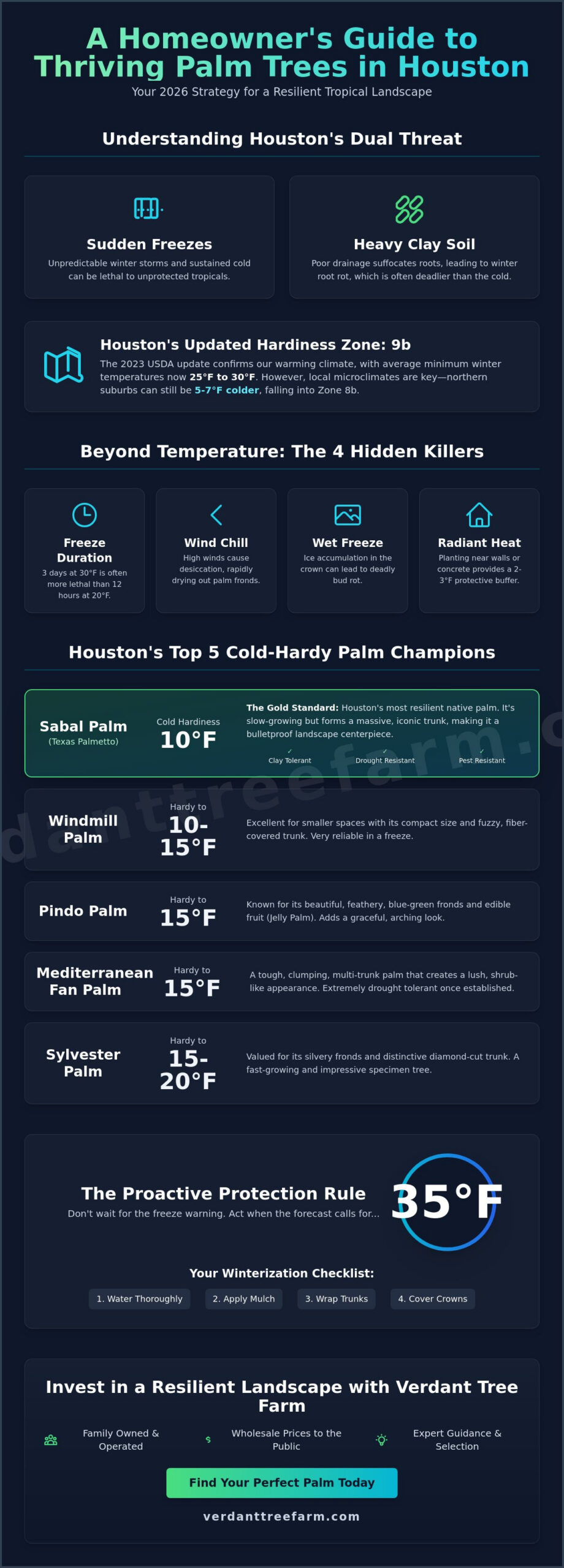
Houston’s landscape is not a monolith. You can’t treat a backyard in The Woodlands the same way you treat a patio in Clear Lake. While the 2023 USDA Plant Hardiness Zone Map update shifted most of Houston into Zone 9b, the reality on the ground is more complex. A distance of just five miles can be the difference between a palm that thrives and one that perishes. In the northern 8b corridor, temperatures frequently drop 5 to 7 degrees lower than the urban heat islands of Downtown or the coastal regions of South Houston. Successfully growing cold hardy palm trees Houston homeowners can be proud of starts with knowing exactly which micro-climate you inhabit.
The February 2021 freeze remains the ultimate benchmark for local resilience. It taught us that “cold hardy” is a spectrum rather than a simple binary label. Some species might survive a quick dip to 20°F but fail during a sustained three-day freeze. When planning your landscape, consulting a list of cold-hardy palm species provides a solid biological foundation, but local expertise determines the long-term success of your investment. At Verdant Tree Farm, we use our status as Houston’s Premier Tree Farm to test these varieties against real-world Texas conditions before they ever reach your yard.
Zone 8b vs. 9a: Where Does Your Yard Fall?
The northern suburbs, including Conroe, Spring, and Tomball, typically fall into the 8b corridor. These areas lack the concrete heat retention of the city center and face harsher north winds. Conversely, the coastal influence on South Houston and Galveston keeps those areas firmly in the 9a and 9b categories. To protect your property, you should check your specific zip code against historical weather data from 1991 to 2020. This data helps identify if your lot is prone to “frost pockets” where cold air settles, making it significantly colder than the official airport readings.
Why Temperature Isn’t the Only Killer
Temperature is only one part of the survival equation. The duration of the cold is often more lethal than the lowest number on the thermometer. A palm might handle 12 hours at 20°F but succumb to three days at 30°F because the trunk’s core temperature never has a chance to recover. Other factors include:
- Wind Chill: High winds cause desiccation, which is the rapid drying out of palm fronds.
- Humidity: A “wet freeze” in Houston is common. Ice accumulation in the crown of a palm can lead to bud rot more quickly than dry cold.
- Radiant Heat: Planting near brick walls or concrete pools can provide a 2 to 3-degree buffer that saves a marginal species.
As a family owned and operated business, we prioritize these technical details to ensure your purchase is a smart one. We offer our inventory wholesale to the public, giving you access to the same professional-grade specimens used by the city’s top contractors.
Top 5 Cold-Hardy Palm Species for Houston Landscapes
Selecting the right varieties makes the difference between a thriving oasis and a graveyard of dead fronds. We’ve identified five species that consistently survived the historic 2021 freeze and subsequent winter events. These “Big 5” provide the best balance of cold tolerance, aesthetic appeal, and resistance to local diseases like Lethal Bronzing. At Verdant Tree Farm, we recommend investing in larger specimen trees. Their thicker trunks and established root balls provide the thermal mass needed to endure a freeze that would kill a younger, smaller plant. Our inventory of cold hardy palm trees Houston is available wholesale to the public, ensuring you get premium quality without the retail markup.
As Houston’s Premier Tree Farm, we’ve watched these species thrive across the region. According to the USDA Plant Hardiness Zone Map, our shift into Zone 9b means we have more options than ever. However, we still prioritize the most resilient plants to protect your investment from unpredictable Texas weather shifts. Being a family owned and operated business, we only sell what we know will last in our local soil.
The Sabal Palm (Texas Palmetto)
The Sabal Palm is the gold standard for Texas hardiness. It can withstand temperatures as low as 10°F, making it nearly bulletproof in the Houston area. Because it’s a native species, it handles our heavy clay and periodic droughts with ease. It grows slowly but develops a massive, iconic trunk that serves as a perfect focal point for any luxury landscape. Its resistance to common pests makes it a low-maintenance favorite for busy homeowners.
Windmill and Pindo Palms
The Windmill Palm is a top choice for homeowners in North Houston or those with limited space. It’s compact and extremely cold-tolerant. If you want a more dramatic look, the Pindo Palm offers unique blue-gray, recurved fronds. While Windmills are “fan” palms with circular leaves, Pindos are “feather” palms with long, arching fronds. Both species are incredibly reliable and rarely suffer damage during a standard Houston winter. You can view our palm inventory to see which aesthetic fits your yard best.
Mediterranean Fan Palm and Mule Palm
For a multi-trunk, shrub-style look, the Mediterranean Fan Palm is unmatched. It stays relatively low and works beautifully as an accent or privacy screen. If you desire the tropical look of a Coconut Palm but need the grit of a Pindo, the Mule Palm is your answer. This rare hybrid combines the best of both worlds. It’s sterile, fast-growing, and handles the frost that would kill a true tropical palm. Both require minimal maintenance once established, though the Mule Palm benefits from slightly more frequent fertilization to maintain its vibrant green color.
Beyond the Freeze: Soil, Drainage, and Palm Longevity
Many homeowners believe a sudden drop in temperature is the only threat to their tropical landscape. The reality in Southeast Texas is more nuanced. While we prioritize cold hardy palm trees Houston families can rely on, the silent killer is often winter rain rather than the frost itself. Houston’s notorious “gumbo” clay soil acts like a structural bucket, trapping cold moisture around the root ball for days or weeks. This condition, known as “wet feet,” leads to root rot that weakens the tree’s internal defenses. A palm struggling with rot is far more likely to succumb to a 25°F night than a healthy, well-drained specimen.
We often hear the objection that palms are supposed to be low maintenance. While they are resilient once established, they require a professional foundation to survive Houston’s unique environment. Our team at Verdant Tree Farm always recommends the “10% rule.” This means planting the palm so that the top 10% of the root ball sits slightly above the surrounding grade. This simple adjustment ensures that excess surface water flows away from the trunk rather than pooling at the base. As Houston’s Premier Tree Farm, we’ve found that this technique is the single most effective way to prevent crown and root issues during our wet winters.
Amending Houston Clay for Palm Success
Success starts with what you put back into the hole. You should never use standard potting soil for a large landscape palm because it retains too much moisture and lacks structural integrity. We recommend a custom blend of sharp sand, organic compost, and expanded shale to break up the heavy clay. This mixture provides the necessary root aeration and allows for faster drainage. Because we are family owned and operated, we take the time to guide you through these technical requirements. We offer these professional-grade soil amendments wholesale to the public so your investment has the best start possible.
The Vital Role of Drainage
Before you purchase a $2,000 specimen tree, you must test your yard’s drainage capacity. Dig a hole 18 inches deep, fill it with water, and see how long it takes to empty. If it takes longer than 12 hours, you have a drainage problem that needs addressing. For sensitive species like the Sylvester Palm, you might need to install French drains or create raised planting beds. Proper drainage can actually increase a palm’s cold tolerance by 5 to 10 degrees. A dry root system stays warmer and more active than a waterlogged one, giving your cold hardy palm trees Houston a significant advantage when the next north wind blows through.
Winter Protection Strategies for Houston Tropicals
Survival in a Texas winter isn’t accidental. It’s the result of a proactive strategy that begins long before the first north wind hits. While we specialize in cold hardy palm trees Houston homeowners can trust, even the toughest specimens benefit from a little help when temperatures plummet. We recommend the 35°F rule. When the forecast predicts a dip to 35°F or lower, it’s time to trigger your protection plan for marginal or young trees. One of the best-kept secrets in professional landscaping is the use of anti-desiccant sprays. These products coat the fronds in a thin, waxy layer that helps them retain moisture during dry, freezing winds. This simple step prevents the “burn” that many palms suffer during a cold snap.
The most important action you can take happens 24 hours before the freeze. Give your palms a deep soak. Moist soil stays warmer than dry soil because water acts as a heat sink, radiating warmth back up toward the trunk. As Houston’s Premier Tree Farm, we’ve seen hydrated palms survive conditions that killed their drought-stressed neighbors. If you need supplies or advice on which specimens are toughest, you can browse our wholesale palm inventory to plan your next landscape upgrade.
How to Properly Wrap a Palm Tree
Wrapping is an art that requires the right materials. Never use plastic directly against your palm. Plastic traps moisture and creates a greenhouse effect that can lead to fungal rot or “cooked” fronds when the sun comes out. Instead, gather these items:
- Burlap or Frost Cloth: These breathable fabrics provide insulation while allowing air exchange.
- Heavy-Duty Twine: Use this to pull the fronds upward and secure the wrapping.
- Incandescent C9 Christmas Lights: These old-school bulbs generate actual heat. Wrap them around the trunk before covering with burlap for a 5 to 8-degree temperature boost.
The goal is to protect the “center bud” or the heart of the palm. If the heart stays alive, the tree can recover even if it loses every frond. Wrap the trunk and the base of the fronds securely, ensuring the insulation reaches all the way to the ground to trap rising earth heat.
Post-Freeze Recovery: Don’t Cut Those Fronds Yet!
Patience is your best friend in February and March. It’s tempting to prune away brown, crispy fronds as soon as the sun comes out, but those dead leaves actually provide a layer of insulation for the trunk against subsequent freezes. Wait until the threat of frost has completely passed, usually by late March, before you start pruning. To check if your tree is still alive, perform the “Tug Test.” Gently pull on the newest spear in the center of the crown. If it holds firm, your palm is likely still healthy. If it pulls out easily, the bud may have rotted. Even then, don’t give up. Many palms will push out new growth by June if you maintain a consistent fertilization schedule to jumpstart their spring recovery. Being family owned and operated, we take pride in helping our neighbors nurse their landscapes back to health after a tough season.
Why Buy from Houston’s Premier Tree Farm?
Selecting the right cold hardy palm trees Houston homeowners need is an investment in your property’s long-term value. You shouldn’t settle for the limited, unverified stock found at big-box retailers. As Houston’s Premier Tree Farm, we operate as the largest independent nursery in the region, providing a level of local expertise that national chains simply can’t match. We are a family owned and operated business with a veteran-owned foundation. This means we approach every project with a “can-do” attitude and a commitment to reliability that ensures your landscape succeeds. Our primary value proposition is simple: we offer our premium inventory wholesale to the public. You get the same high-quality specimen trees used by professional contractors at a fraction of the retail cost.
We stand behind our plants with a 3-month warranty, giving you peace of mind during those critical first weeks of establishment. Our team doesn’t just sell you a tree and send you on your way. We provide a comprehensive partnership that includes guidance on species selection, soil health, and long-term maintenance. When you buy from us, you’re investing in a legacy of local growth and professional-grade horticultural standards.
From Our Farm to Your Yard: Professional Installation
DIY palm planting in Southeast Texas often leads to failure because of the sheer weight of the specimens and the complexity of our soil. A mature palm can have a root ball weighing over 1,000 pounds. Attempting to move these without specialized equipment can damage the tree’s vascular system or cause personal injury. We utilize professional-grade cranes and trailers to handle heavy specimen palms safely. Our installation service isn’t just about digging a hole. It’s a complete process that includes professional soil amendments, proper staking to withstand Gulf Coast winds, and initial mulching to regulate root temperature. We ensure your tree is positioned correctly for both aesthetics and health from day one.
3D Design and Maintenance Consultations
It’s difficult to imagine how a massive palm will transform your backyard without seeing it first. Our 3D design services allow you to visualize your tropical oasis before we ever break ground. This technology helps us place trees strategically to maximize shade and privacy while ensuring they have the room to grow. Additionally, we offer expert on-site evaluations to check your existing tree health and irrigation needs. We’ll identify potential drainage issues or pest risks before they become expensive problems. If you’re ready to upgrade your landscape with trees that are built to last, visit our Houston nursery or request a consultation today!
Build a Resilient Tropical Paradise in Your Own Backyard
Creating a stunning, year-round landscape in Southeast Texas doesn’t have to be a gamble with the weather. By selecting the right cold hardy palm trees Houston homeowners can trust, and prioritizing proper drainage over simple aesthetics, you ensure your investment survives every unpredictable season. Success starts with the technical details we’ve discussed, from the 10% planting rule to the 35°F winter protection threshold. A beautiful yard is a long-term asset that should grow with your family rather than needing a replacement every two years.
At Verdant Tree Farm, we make this process easy. As a veteran-owned and operated business, we provide the heavy-duty equipment and horticultural expertise needed for a flawless installation. We offer professional 3D landscape design to help you visualize your goals and a 3-month warranty on all trees for your peace of mind. Don’t settle for retail markups when you can access our premium inventory at wholesale to the public rates.
Shop Houston’s Best Cold-Hardy Palms at Wholesale Prices and start your transformation today. Our team is ready to help you grow a legacy that lasts for generations.
Frequently Asked Questions
Which palm tree is the most cold hardy for North Houston?
The Sabal Palm, also known as the Texas Palmetto, is the most resilient choice for the North Houston 8b corridor. It withstands temperatures as low as 10°F without significant damage to the trunk or crown. Windmill Palms are also highly reliable for areas like Conroe or Spring, as they maintain their green foliage even when temperatures dip into the mid-teens. These varieties are the top cold hardy palm trees Houston homeowners choose for long-term durability.
Will a Queen Palm survive a Houston winter?
Queen Palms are marginal in Houston and typically suffer severe damage when temperatures drop below 25°F. During the historic February 2021 freeze, local arborists reported a mortality rate of approximately 90% for unprotected Queen Palms across Harris County. If you choose this species, you must be prepared to wrap the trunk and provide supplemental heat during every major cold snap to ensure its survival in Zone 9a or 9b.
How do I protect my palms during an Arctic Blast?
Protecting your palms requires a deep watering session 24 hours before the freeze to insulate the root system. Wrap the trunk and the center bud with breathable burlap or professional frost cloth, and secure it with heavy-duty twine. Adding a strand of incandescent C9 Christmas lights under the wrap can provide a 5 to 8-degree temperature boost that often saves the tree’s life. Avoid using plastic covers, as they trap moisture and lead to fungal bud rot.
When is the best time of year to plant palms in Houston?
The ideal window for planting palms in Southeast Texas is between April 1st and June 30th. Soil temperatures must be at least 65°F to trigger the active root growth necessary for establishment. Planting during these three months gives the tree a minimum of 150 days to develop a stable root system before the first potential frost in late November. This lead time is the most critical factor for the first-year survival of cold hardy palm trees Houston landscapes.
Do I need to fertilize my palms before winter?
You should stop all high-nitrogen fertilization by August 31st to prevent the growth of tender new fronds. Late-season growth is highly susceptible to freeze damage and can act as a gateway for disease into the heart of the palm. Instead, maintain a consistent schedule of potassium-rich fertilizer during the peak growing months of May through July. This builds cellular strength, which helps the tree naturally resist the desiccation caused by dry winter winds.
How much does a large specimen palm cost in Houston?
Costs for specimen palms are determined by the species, the overall trunk height, and the size of the root ball. While market prices fluctuate based on seasonal availability, buying wholesale to the public is the most cost-effective way to secure premium trees. Because we are family owned and operated, we provide direct pricing on varieties like the Sylvester and Pindo. For a specific quote based on your landscape design, we recommend an on-site evaluation of our current farm inventory.
What should I do if my palm tree’s center leaf pulls out?
If the center spear pulls out, it indicates the presence of bud rot, but it doesn’t always mean the tree is dead. Treat the open cavity immediately with a copper-based fungicide to stop the infection and prevent further decay. Research from local horticultural extensions suggests a 50% recovery rate if the treatment is applied quickly and the trunk remains firm. Be patient and wait until at least July 1st to see if the palm pushes out new, healthy growth.
Are there any palms that don’t need winter protection in Zone 9a?
Sabal Palms and Mediterranean Fan Palms generally don’t require protection once they’ve been established for two full growing seasons. These species have evolved to handle the 25°F lows typical of a Houston winter without the need for wrapping or supplemental heat. Their thick trunks and dense fiber provide natural insulation that protects the vital center bud. Choosing these varieties allows you to enjoy a tropical aesthetic without the labor-intensive maintenance required by more sensitive tropical species.