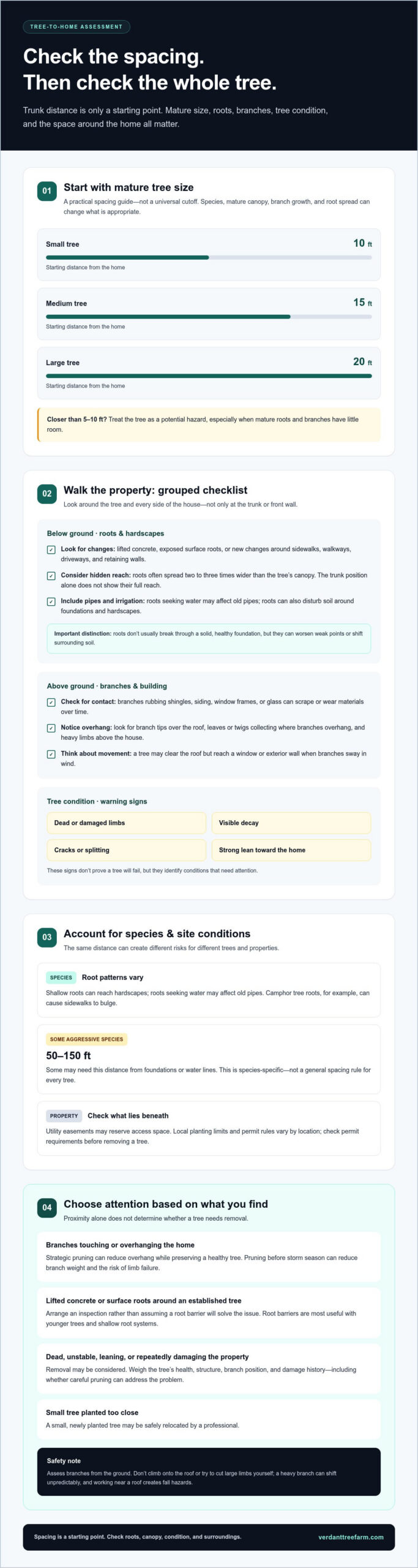
A tree can be too close long before it touches the house. There’s no single cutoff for the risks of planting a tree too close to a house, but a useful starting point is 10 feet for a small tree, 15 feet for a medium tree, and 20 feet for a large tree. The right distance depends on the species’ mature size, root spread, branch growth, and condition.
It’s understandable to focus on how close the trunk is to the wall, but what happens above and below ground matters just as much. Roots can affect soil and hardscapes, while overhanging or unhealthy limbs can threaten roofs, windows, and siding. A nearby tree doesn’t automatically need to be removed. Its condition and growing environment help determine what attention it needs.
Learn how to assess planting distance, what kinds of damage trees can cause, and which changes around a tree or home deserve a closer look. The same spacing may suit one tree but create risks for another, depending on its mature size and the space available.
Key Takeaways
- Use mature tree size as a starting point for spacing: plan for about 10 feet for a small tree, 15 feet for a medium tree, and 20 feet for a large tree.
- Look beyond the trunk’s distance from the house. Root growth can affect foundations, sidewalks, driveways, pipes, and other nearby features.
- Check for branches rubbing against the roof, windows, or siding, and note heavy limbs hanging over the house.
- Dead limbs, decay, cracks, splitting, and a lean toward the home are warning signs that deserve attention.
- A nearby tree doesn’t automatically need removal; its species, condition, growth pattern, and impact on the property all matter.
What Happens When a Tree Is Too Close to the House?
Roots can affect a foundation, sidewalk, driveway, or underground pipe as they grow. Trees planted 5 to 10 feet from a home should be treated as potential hazards, especially when mature roots and branches have little room.
Root Damage to Foundations and Hardscapes
Root damage occurs when growing roots disturb nearby soil or press against structures. Roots don’t usually break through a solid, healthy foundation, but they can worsen existing weak points or shift surrounding soil. That movement may contribute to cracks or changes around a home. Roots can also affect sidewalks, walkways, driveways, irrigation systems, and retaining walls as they grow beneath or alongside them.
Watch for lifted concrete, exposed surface roots, or new changes around hardscapes. These signs may indicate that roots are affecting the ground, even if the foundation looks unchanged. Roots often spread two to three times wider than a tree’s canopy, so the trunk’s position alone doesn’t reveal their full reach.
Root Growth Patterns by Tree Species
Root growth patterns vary by species, so the same planting distance can create different risks. Shallow roots can reach sidewalks and other hardscapes, while roots seeking water may affect old pipes. Camphor tree roots, for example, can cause sidewalks to bulge. Some aggressive species may need 50 to 150 feet from foundations or water lines.
Before planting, consider the tree’s mature canopy and likely root spread, not just its size as a young tree. Root barriers are most useful with younger trees and shallow root systems. For an established tree, lifted concrete or surface roots are reasons to arrange an inspection rather than assume a barrier will solve the problem.
Local Planting Limits and Repair Costs
Local planting limits and utility easements can affect where a tree fits on your property. Easements may reserve space for utility access, so planting directly over buried lines can create future conflicts. Local requirements vary, and permit rules differ by state and county. Before removing a tree, check whether a permit is required.
There’s no single repair cost for root damage to a foundation or sewer line. The work depends on what’s affected, the extent of the damage, and how accessible the area is. A shifted walkway calls for different repairs than a damaged pipe or foundation. Those distinctions matter when assessing the problem and planning the work.
A tree within 5 to 10 feet of a home can make later removal more difficult. Roots may extend beneath structures and hardscapes, while nearby branches can limit access. A small, newly planted tree that’s too close may be safely relocated by a professional. A tree’s proximity alone doesn’t mean removal is necessary, so consider its species, condition, and effects on the property.
Branches damaging roofs, windows, and siding
A branch touching the house can cause damage even without a major storm. As wind moves the canopy, twigs and limbs may scrape shingles, siding, window frames, or glass. Repeated contact wears roofing materials and can shorten a roof’s service life. A branch brushing siding can also leave marks or damage its finish.
Pay particular attention to branches near the roof. Limbs rubbing against shingles can gradually wear their surface, while leaves and small twigs can collect where branches overhang. Large branches shouldn’t hang directly over a house. If a heavy limb breaks in high winds, it can strike the roof and cause damage beyond the initial impact.
Windows and siding are exposed in different ways. A branch moving against a window can scratch or crack the glass; limbs dragged across siding can scrape or loosen exterior material. Check every side of the house, not just the front. A tree may clear the roof but still reach a bedroom window or exterior wall when its branches sway.
Wind can reveal weaknesses that are difficult to see in calm weather. A tree close to a home may fall during a storm and damage the house or a neighbor’s property. Dead or damaged limbs, visible decay, cracks, splitting, and a strong lean toward the structure are reasons for concern. These signs don’t prove a tree will fail, but they do identify conditions that need attention.
From the ground, note where the canopy overlaps the building. Look for branch tips over the roof, contact marks on shingles or siding, and limbs that reach windows. Consider how wind could move those branches toward the house. Don’t climb onto the roof or try to cut large limbs yourself. A heavy branch can shift unpredictably as it’s cut, and working near a roof creates fall hazards.
Strategic pruning can reduce overhang while preserving a healthy tree. Pruning before storm season can reduce branch weight and the risk of limb failure. The aim is to remove problem growth without damaging the tree’s structure through excessive cutting. Routine inspections can also catch new contact as branches grow, especially where a roofline, window, or siding sits within the canopy.
Removal may be considered if a tree is dead, unstable, leaning toward the house, or repeatedly causing property damage. Proximity alone doesn’t make removal necessary. The tree’s health, structure, branch position, and history of damage all matter. A sound decision weighs those factors and whether careful pruning can keep branches away from the roof, windows, and siding.
Recommended planting distances by tree size
There’s no universal distance that suits every tree, because species differ in mature height, branch spread, and root growth. As a starting guide, plant small trees about 10 feet from a home, medium trees about 15 feet away, and large trees about 20 feet away.
To reduce the risks of planting a tree too close to a house, choose a tree for its mature size and match its likely spread to the available space. Leave room between the tree, house, hardscapes, and fence lines.
Use mature height to make a practical first estimate. A small tree that won’t exceed 30 feet can start about 10 feet from the house. A medium tree under 70 feet can start about 15 feet away. For a large tree expected to reach 70 feet, allow about 20 feet.
- Small ornamental trees: Dogwoods and redbuds are generally planted 10 to 15 feet from a home.
- Medium deciduous trees: Maples and oaks are generally planted 15 to 25 feet away.
- Large shade trees: Elms and tulip poplars are generally planted 30 to 50 feet from the house.
These recommendations use different categories. A general guide of 15 to 30 feet from a house offers another broad planning range, while species-specific guidance accounts for mature growth. A young oak needs room for its eventual canopy and roots, not just the space its trunk occupies today.
The planting site matters, too. A tree beside a narrow walkway has less room for roots and branches than one in an open yard. Avoid planting directly on a fence line, where future growth may crowd the fence or neighboring space. Check the tree’s mature branch spread and root growth before choosing a spot.
Spacing matters beyond the house itself. Trees planted close together may compete for room as their canopies expand, while roots can affect nearby driveways or sidewalks. The risks of planting a tree too close to a house depend on species, mature size, root spread, and the space available. A 10-foot gap may suit a small ornamental tree, but it isn’t a universal guarantee of clearance.
Use these distances as planning benchmarks, then compare them with the specific tree’s mature characteristics. A small tree at 10 feet and a large shade tree at 30 feet can both fit the broad guidance, but the species and yard layout determine whether either placement leaves enough room.
Falling limbs and damage to siding or windows
A falling limb can damage more than a roof. It may strike a window, crack glass, dent siding, or damage an exterior frame. In high winds, a heavy branch can break and land on the house. If a nearby tree falls, it may also damage a neighbor’s home, especially where houses are close together.
Strong winds can expose structural weaknesses that aren’t obvious in calm weather. A tree may look steady on a quiet day but have dead limbs, visible decay, cracks, or splitting. A lean toward the house is another warning sign. These conditions can’t predict exactly when a branch might fail, but they help identify trees that need closer attention.
Inspect the tree from several places around the property. From the yard, note dead branches and cracks where limbs join the trunk. From inside, check whether large branches extend across windows or appear to reach the siding. Compare what you see after a storm. Newly fallen twigs or fresh damage can show how wind moves the canopy toward the building.
Impact and repeated contact leave different clues. A fallen branch may leave a dent, broken glass, or damaged shingles. A branch that brushes siding in ordinary wind can gradually scrape the surface. Look for fresh marks on siding and windows, and notice whether branches move against the house as the canopy sways. These details can help distinguish storm damage from ongoing contact.
Large limbs shouldn’t hang directly over a house. If one breaks, the roof, windows, or siding may be in its fall path. Overhanging branches also deserve attention before storm season, when pruning can reduce branch weight and the risk of failure. Strategic pruning can address hazardous growth while preserving a healthy tree.
Consider the tree’s overall condition, not just one low branch. Dead or declining growth, structural instability, a lean toward the home, or repeated property damage may affect whether pruning is enough. Proximity alone doesn’t automatically call for removal. The tree’s health, structure, location, and history of damage all help determine an appropriate response.
Don’t treat pruning a large tree beside a home as a routine do-it-yourself task. Cutting a limb can change how its weight is supported, and branches may fall toward the house as they’re removed. A professional arborist can assess the tree’s health and stability. If removal is warranted, professional removal may be the safer option for a large tree close to a home.
Warning signs of a tree too close to a house
A tree’s position is only one clue. Look for changes in the tree and the nearby property together: dead limbs, cracks, a lean toward the house, lifted concrete, and branches rubbing the roof. Several signs in the same area may show that the tree’s growth is affecting the home or that its structure needs attention.
Start with the canopy. Dead branches, visible decay, cracks, or splitting can point to structural problems, especially when limbs extend over a roof or window. A tree leaning toward the house also deserves attention. Strong winds may reveal weaknesses that aren’t obvious in calm weather, so compare the tree’s condition before and after a storm.
- In the canopy: Look for dead limbs, decay, cracks, splitting, or heavy branches over the home.
- At the trunk: Note a lean toward the house or visible damage to the trunk.
- On the property: Watch for lifted concrete, exposed roots, or new changes around walkways and driveways.
- On the house: Check for branches touching shingles, windows, or siding, plus leaves collecting in gutters.
Changes at ground level matter, too. Lifted concrete or surface roots can show that growth is affecting a sidewalk, walkway, driveway, or retaining wall. A nearby foundation may have weak points that are more vulnerable when surrounding soil moves. Roots often extend beyond the visible canopy, so damage may appear away from the trunk.
Include the roofline and gutters in your inspection. Branches over a roof can drop leaves into gutters, where debris may trap moisture, encourage moss growth, and give pests easier access. Branches rubbing shingles can wear roofing materials; contact with siding or windows can leave marks or cause damage. Notice whether wind moves branches against the house.
Take photos from several angles, including from inside the home. Capture the trunk, canopy, roofline, nearby hardscapes, and any visible damage. Comparing photos over time may reveal changes in a lean, branch contact, or concrete movement. Photos are useful records, but they can’t show hidden root spread or fully assess tree stability.
A nearby tree doesn’t automatically need removal. Removal may be considered if the tree is dead or declining, structurally unstable, leaning toward the home, repeatedly causing property concerns, or too large for its location. A professional arborist can assess the tree’s health, stability, and root spread, including conditions that aren’t visible from the ground.
If warning signs appear together, arrange a tree assessment and describe each change you’ve observed. For ongoing tree care planning, book a maintenance consultation.
Verdant Tree Farm: Live Oak
Verdant Tree Farm helps homeowners choose trees that suit their landscape plans and available space. When planning a new planting, consider the tree’s mature height, canopy spread, and clearance from the house. Options include Shumard Oak, Mexican White Oak, and Drummond Red Maple. The right choice depends on the room your yard provides and the tree’s expected growth, not just its size at planting.
Bring your planting location and spacing considerations into the decision. A thoughtful selection can help you plan for the tree’s future relationship with the house, walkways, and other features on your property. Visit Verdant Tree Farm to explore tree options or get in touch.
Plan a Landscape That Grows Well
The risks of planting a tree too close to a house are easier to manage when you plan for future growth. Think beyond filling an empty spot. Consider how the tree will fit your home’s long-term landscape, where it can develop freely, and how its canopy will complement the yard as it matures.
For a new planting, Verdant Tree Farm offers Live Oak, Shumard Oak, and Mexican White Oak. Let your available space and the tree’s mature characteristics guide your choice. A well-planned planting can add lasting character while respecting the room your home and landscape need.
Take the next step with a tree selection that suits your plans. Contact Verdant Tree Farm to discuss your landscape goals. With thoughtful placement and a suitable tree, you can build a yard that feels welcoming today and grows beautifully over time.
Frequently Asked Questions
How Close Is Too Close?
There’s no single cutoff because a tree’s mature size and growth pattern matter. Treat trees 5 to 10 feet from a home as potential hazards, then assess the species, canopy, roots, and condition. For example, a young tree may look clear of the eaves now but grow into the roofline later. In Houston, consider both the tree’s eventual spread and the space around the house.
What damage can tree roots cause to house foundations, sidewalks, and pipes?
Roots can disturb soil around a foundation, lift sections of sidewalk, and affect old pipes as they grow. A small crack or existing weakness may be more vulnerable to soil movement than an intact structure. For example, a raised walkway beside a mature tree may signal root pressure, while pipe trouble can occur underground without visible surface changes. Consider the tree’s location alongside any new changes to hardscapes or plumbing.
How close is too close to plant a tree near a house?
Use the tree’s expected mature size to set a starting distance: about 10 feet for small trees, 15 feet for medium trees, and 20 feet for large trees. These are general benchmarks, not one rule for every species. A tree beside a narrow side yard may need more careful planning than one in an open lawn, because walls, paving, and utility routes limit available growing space.
How do recommended planting distances vary by tree species and mature size?
Recommended spacing increases with expected height and spread, but species characteristics also shape placement. Small ornamental trees such as dogwoods and redbuds are generally set 10 to 15 feet from a home. Medium deciduous trees, including maples and oaks, are generally set 15 to 25 feet away. Large shade trees such as elms may need 30 to 50 feet. Compare mature form with the actual yard layout.
Can tree roots damage a foundation that is in good condition?
Healthy roots don’t usually break through a solid foundation. They can still affect surrounding soil, and movement may worsen existing weak points. For instance, a tree growing beside a home with an older crack could contribute to changing conditions around that area. Roots may also affect nearby paving or pipes first, so assess the full property rather than judging the foundation alone.
What are the risks of branches touching or falling onto a house?
Branches brushing a house can scrape siding, damage window surfaces, or wear shingles over time. A heavy limb may break in high winds and strike the roof, windows, or exterior walls. After a storm, look for fresh branch breaks, impact marks, or new contact with the house. Large limbs hanging over the roof deserve attention because their fall path may include the structure.
Can planting a tree near a house cause moisture, drainage, or mold problems?
Branches over a roof can drop leaves into gutters, where debris may trap moisture and encourage moss growth. Clogged gutters can also interfere with normal roof drainage. A nearby tree doesn’t automatically cause indoor mold. Pay attention to persistent dampness, water overflowing at the eaves, or moss near roof areas, and consider whether branches or leaf debris are contributing.
What signs show that a nearby tree is damaging a house?
Look for changes in both the tree and the property. Examples include new cracks or lifted concrete, exposed roots, fresh marks on siding, branches contacting windows, and leaves collecting in gutters. On the tree, note dead limbs, decay, splitting, or a lean toward the house. Photos taken from the yard and indoors can help document changing conditions between inspections or after a storm.