Did you know that strategically planting native deciduous trees like the Shumard Oak can slash your summer cooling costs by up to 25%? For many of us in the Bayou City, the last few years have been a wake-up call. We’ve seen expensive, non-native plants vanish in sudden freezes and struggle in our heavy gumbo clay soil. It’s exhausting to replant your yard every time the Texas weather shifts. Choosing the right native trees Houston homeowners can rely on is the ultimate insurance policy for your property value and your peace of mind.
At Verdant Tree Farm, we believe your landscape should be as resilient as the people who live here. This 2026 guide shows you how to select species that shrug off droughts, survive floods, and provide deep shade during triple-digit afternoons. We’ll walk you through the best local varieties, from the majestic Live Oak to the vibrant Texas Redbud. You’ll discover how to lower maintenance costs and build a yard that adds up to 15% to your home’s value. Let’s get started on growing a legacy that lasts for generations.
Key Takeaways
- Native species offer a natural defense against Houston’s extreme freezes and droughts, which significantly reduces your long-term maintenance and replacement costs.
- Discover the top-performing native trees Houston homeowners use for shade and privacy, including resilient varieties like the Live Oak and Cedar Elm.
- Learn how the “planting high” technique solves drainage issues caused by our local gumbo clay soil to prevent root rot and ensure healthy growth.
- Master the essential first-year watering schedule and professional installation steps that are critical for a tree’s survival in the Texas heat.
- Understand the benefit of choosing nursery-direct, locally acclimated stock from a veteran-owned supplier to guarantee your landscape’s long-term resilience.
Why Native Trees are the Best Investment for Houston Yards
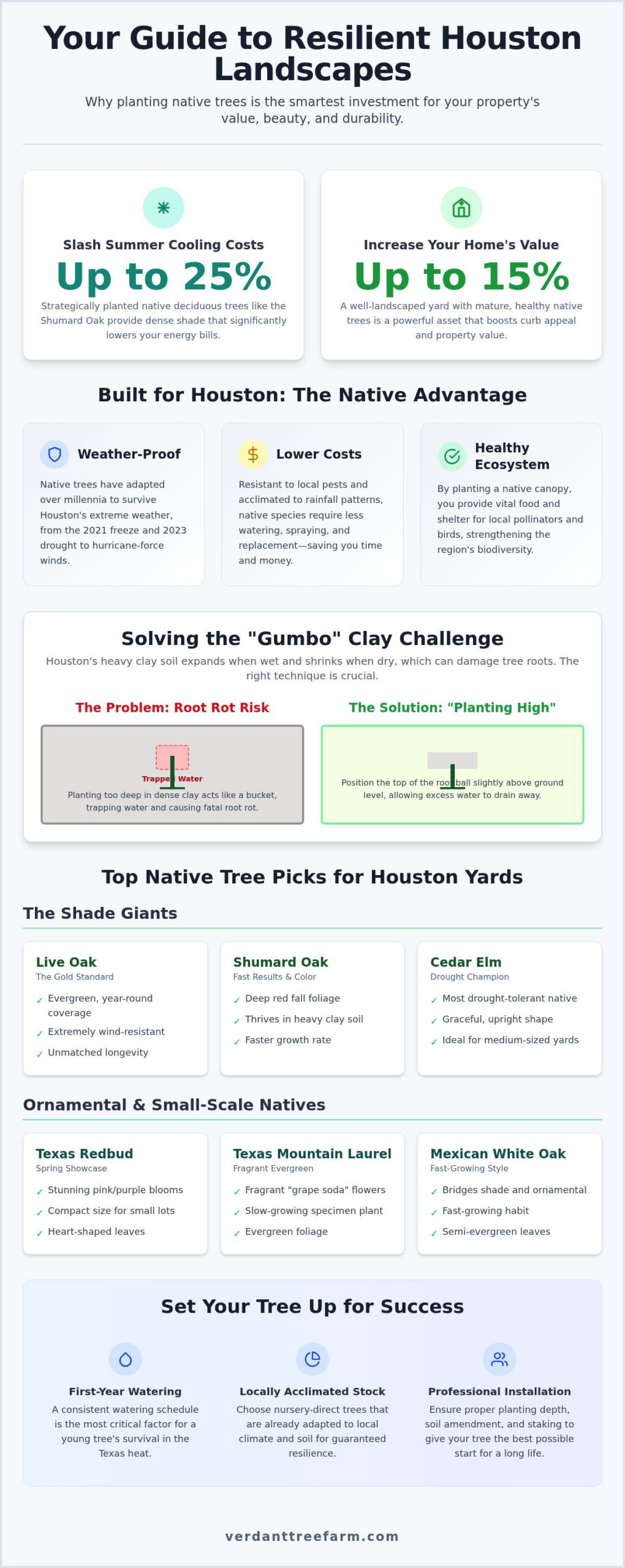
Investing in native trees Houston homeowners can trust isn’t just about curb appeal. It’s about biology. Houston sits at a crossroads of 10 unique ecoregions, ranging from coastal prairies to piney woods. This means the Flora of Texas in our region has spent thousands of years adapting to our specific challenges. These trees have an evolutionary advantage. They recognize local pests and diseases, which means they don’t need the constant chemical support that non-native ornamentals require. You’ll spend less on sprays and more time enjoying your yard.
Resilience Against Houston Weather Extremes
Our weather is unpredictable. We’ve seen the devastating 2021 freeze and the record-breaking 2023 drought. Data shows that native species had significantly higher survival rates during these events. Their root systems are built for “Gumbo” clay. This soil expands and contracts violently with moisture changes. Native roots are flexible and deep enough to handle that movement without snapping.
During hurricane season, these trees prove their worth again. Species like the Live Oak have a wind-resistant structure that stays standing when others fail. They also follow natural dormancy cycles. This protects them when Texas temperatures drop 40 degrees in a single afternoon. Because they aren’t tricked into blooming too early, they avoid the tissue damage that kills exotic species. Choosing native trees Houston weather can’t break is the best way to protect your landscape investment.
Boosting Local Biodiversity and Property Value
Native trees do more than just survive; they thrive as part of a local ecosystem. By planting a native canopy, you support the pollinators and birds that keep our environment healthy. A yard filled with mature, regional species creates a timeless aesthetic that fits the neighborhood perfectly.
The financial return is just as clear. A well-landscaped property with mature native trees can increase your home’s value by up to 15%. You also save money every month. Because these trees are acclimated to our rainfall patterns, they require far less irrigation once established. You’ll see the difference in your water bill during those long August stretches. It’s a smart, direct investment in your property’s future.
Top Native Tree Species for Houston Landscapes
Selecting the right variety for your yard starts with understanding your specific goals. Are you looking to block the blistering afternoon sun or add a pop of color to your front walk? Many homeowners feel overwhelmed by massive botanical lists. We focus on the Top Native Tree Species for Houston that actually perform in residential settings. These selections balance mature size with the constraints of modern urban lots, ensuring your tree doesn’t outgrow its welcome.
The Shade Giants: Oaks and Elms
If your goal is a cooler home and a lower energy bill, these large-canopy trees are your best bet. The Live Oak remains the gold standard for Houston shade tree needs. It’s an iconic evergreen that provides year-round coverage and massive limb spreads. While it grows at a moderate pace, its longevity is unmatched in the Gulf Coast region. It’s a legacy tree that your grandchildren will enjoy.
For those who want faster results and seasonal variety, the Shumard Oak is an excellent choice. It thrives in our heavy clay and rewards you with deep red fall foliage. If your yard has spots that get bone-dry in July, consider the Cedar Elm. It’s arguably the most drought-tolerant native we carry. It features small, textured leaves and a graceful, upright habit that fits well in medium-sized yards. These native trees Houston weather can’t quit are built for the long haul.
Ornamental and Small-Scale Natives
Not every lot has room for a 60-foot oak. Smaller native trees Houston residents love often serve as focal points or privacy screens. The Texas Redbud is a neighborhood favorite because of its stunning pinkish-purple blooms in early spring. It stays compact, which makes it perfect for planting near utility lines or smaller front entryways. Its heart-shaped leaves provide a soft, welcoming look all summer.
If you prefer a fragrance that fills the yard, the Texas Mountain Laurel is a must-have. Its drooping purple flower clusters smell remarkably like grape soda. It’s a slow-growing evergreen that works beautifully as a specimen plant. For a larger ornamental that bridges the gap between shade and style, look at the Mexican White Oak. It’s a fast-growing, semi-evergreen tree that is highly resistant to common pests. Finding the perfect fit for your specific soil and space is easier when you see these trees in person. You can browse our nursery inventory to find the right size and species for your next project.
Solving the Houston “Gumbo” Clay Challenge
Houston soil isn’t just dirt; it’s a living challenge. Most locals call it “gumbo” clay because of its thick, sticky consistency when wet and its rock-hard nature when dry. This soil holds water like a bathtub, which is a major problem for many non-native species. The secret to success with native trees Houston homeowners love is understanding the soil beneath their feet. While native species have spent centuries adapting to these conditions, they still need a little help during the initial planting phase to avoid common pitfalls.
In neighborhoods like Bellaire or Meyerland, drainage is a constant concern. If you dig a deep hole in heavy clay and drop a tree in, you’ve essentially created a “death bowl”. When it rains, that hole fills with water that can’t escape, leading to root rot and tree death within months. We always recommend “planting high”. Place the tree so the top of the root ball sits 2 to 3 inches above the surrounding soil line. This simple adjustment allows the roots to breathe even when the yard is saturated.
Drainage and Site Preparation
Before you break ground, perform a simple percolation test. Dig a hole about 12 inches deep and fill it with water. If it hasn’t drained within 24 hours, you have a serious drainage issue. You might need to install a French drain or create a raised berm for your tree. The good news is that native species require far fewer soil amendments than exotic trees. They don’t want a hole filled with store-bought potting soil; they want to grow in the local earth they were born for. If you’re dealing with standing water, we can help you choose the right spot during one of our maintenance consultations.
The Importance of Proper Mulching
Mulch is the finishing touch that protects your investment. In Houston’s high-humidity environment, a 2 to 3-inch layer of organic hardwood mulch helps regulate soil temperature and retain moisture during July heatwaves. It mimics the natural forest floor by breaking down over time and feeding the soil. However, you must avoid the “mulch volcano”. Never pile mulch against the trunk of the tree. This traps moisture against the bark and leads to fungal decay. Keep the mulch a few inches away from the trunk to let the root flare breathe. These native trees Houston yards require stay healthiest when their roots are cool and their trunks are dry.
Professional Installation and Long-Term Care
Buying the right tree is only half the battle. If you don’t get it in the ground correctly, even the toughest native trees Houston offers won’t survive their first summer. For larger specimens, professional installation isn’t just a convenience; it’s a necessity. Heavy root balls require specialized equipment to avoid trunk damage and ensure the tree is level. A professional team also provides a safety net for your investment. We offer a three-month warranty on all trees we install, which ensures your new landscape gets the start it deserves without the risk of an early loss.
The Planting Process: Step-by-Step
Success in Houston clay starts with the “goldilocks” zone of digging. Your hole should be at least twice as wide as the root ball but no deeper. As we discussed earlier, settling is common in our soil, so keeping the root flare slightly above the ground level is vital. Once the tree is in place, you must remove air pockets. We do this by slow-saturating the hole with water as we backfill with native soil. This process ensures the roots have immediate contact with the earth without being suffocated by over-compaction.
Staking is another critical step often overlooked by DIYers. Houston’s sudden wind gusts can rock a young tree, breaking the delicate new hair roots before they can grab hold. We use a flexible staking system that allows the trunk to move slightly, which actually helps the tree grow stronger over time. This stability is essential during our volatile spring and fall seasons.
Maintenance Consultations and Seasonal Care
Watering is the most important factor for long-term survival. For the first two years, you must maintain a consistent deep-watering schedule. During a typical Houston July, this often means slow-soaking the root zone two to three times a week. It’s much better to water deeply and less frequently than to give the tree a shallow sprinkle every day. If you’re unsure about your specific yard’s needs, our professional landscaping services in Houston include expert guidance on irrigation and soil health.
You also need to know when to leave the tree alone. Pruning should generally be done in late fall or winter. Specifically, avoid pruning any oaks from February through June to minimize the risk of oak wilt. Recognizing signs of stress is also key. If you see yellowing leaves or premature dropping, don’t panic. Sometimes it’s just a natural reaction to a temperature swing, but other times it’s a cry for more water. Our maintenance consultations help you decode these signals so your investment continues to grow. Ready to transform your yard? Contact us to schedule your professional installation and let our veteran-owned team handle the heavy lifting.
Sourcing Native Trees from Verdant Tree Farm
Choosing the right native trees Houston yards require is a significant investment in your property’s future. You don’t want to leave that investment to chance by buying from a big-box retailer that ships in stock from different climates. At Verdant Tree Farm, we’re proud to be Houston’s largest independent tree nursery. This independence allows us to maintain strict quality control over every specimen we sell. Because our trees are locally grown and acclimated to the Gulf Coast’s specific humidity and soil, they don’t experience the transplant shock common with trees brought in from out of state. They’re ready to hit the ground running the moment they’re installed.
We also understand that it’s hard to visualize how a 15-foot oak will look in your specific yard. That’s why we offer professional 3D design services. Our team helps you plan your landscape with precision, ensuring that your new native canopy provides the perfect amount of shade without interfering with your home’s foundation or power lines. As a veteran-owned and operated business, we bring a “can-do” attitude and a deep sense of accountability to every project, whether you’re a homeowner looking for a single focal point or a contractor managing a large-scale development.
Nursery-Direct Quality and Selection
There is no substitute for seeing a tree in person before it arrives at your home. When you visit our nursery, you can walk the rows and hand-select the exact specimen that speaks to you. Our inventory is extensive, featuring everything from the shade giants we’ve discussed to specialized evergreen trees for Houston that provide year-round privacy and wind protection. Buying nursery-direct means you get better pricing and higher quality because there’s no middleman. We offer both wholesale and retail options to fit the scale of any residential or commercial landscaping goal.
The Verdant Warranty and Installation Guarantee
We don’t just sell you a tree and walk away. We’re committed to the long-term success of your landscape. Every tree we install comes with a three-month warranty, which gives you peace of mind during that critical establishment phase. Our professional crews are trained specifically to handle Houston’s challenging gumbo clay. They know exactly how to implement the “planting high” technique and proper staking methods we’ve covered in this guide. We take pride in our work because we aren’t just building yards; we’re building a legacy for our community. Stop by our Houston location today to walk through our inventory, or contact us to book your 3D design consultation and start your journey toward a more resilient, beautiful landscape.
Build a Landscape That Stands the Test of Time
Your yard is an extension of your home, and investing in native trees Houston weather can’t break is the smartest way to protect it. We’ve explored how regional species like the Cedar Elm and Shumard Oak handle our unique gumbo clay while providing the deep shade necessary for Texas summers. By prioritizing resilience over ornamentation, you reduce maintenance costs and build a property that actually gains value as it matures. You’re not just planting a tree; you’re securing a legacy for your family and our community.
At Verdant Tree Farm, we make the process simple and direct. Our veteran-owned team provides everything you need to succeed, from professional 3D design and installation to a three-month warranty that protects your investment. We’re proud to be the city’s largest independent nursery, offering stock that’s already acclimated to our local humidity and soil. It’s time to stop fighting the local environment and start growing with it. Browse Houston’s Largest Selection of Native Trees today and take the first step toward a beautiful, storm-resilient yard that thrives for decades.
Frequently Asked Questions
What are the best native trees for small Houston yards?
Small-scale landscapes thrive with the addition of a Texas Redbud or Texas Mountain Laurel. These species stay compact and won’t overwhelm a standard residential lot or interfere with power lines. The Texas Redbud offers heart-shaped leaves and early spring blooms; the Mountain Laurel provides evergreen foliage and fragrant flowers. For those looking for a small-scale shade option, the Mexican Redbud is equally resilient and fits perfectly in modern Houston subdivisions.
How often should I water a newly planted native tree in Houston?
You should deep-soak your new tree two to three times per week during the first two years, especially during the summer. While native trees Houston homeowners choose are drought-tolerant once established, they need consistent moisture to develop a strong root system. We recommend a slow trickle at the base for 20 to 30 minutes rather than frequent, shallow sprays. Adjust your schedule based on rainfall to avoid over-saturating our local gumbo clay soil.
Which native Houston trees provide the best fall color?
If you want vibrant autumn aesthetics, the Shumard Oak and Drummond Red Maple are top performers in Southeast Texas. Shumard Oaks turn a deep, rich red as temperatures drop; the Drummond Red Maple provides early flashes of scarlet. If you want a more consistent display, the October Glory Maple is another reliable option that thrives in our climate. These trees prove that you don’t have to sacrifice seasonal beauty for the sake of regional resilience.
Are native trees more resistant to hurricanes?
Yes, native species have evolved structural characteristics to survive high-wind events along the Gulf Coast. Trees like the Live Oak and Bald Cypress have deep, sprawling root systems and flexible wood that can withstand heavy gusts better than many ornamental exotics. Their aerodynamic leaf structures also allow wind to pass through the canopy more easily. Proper pruning and professional installation further enhance this natural wind resistance, which helps your landscape stay standing after a storm.
When is the best time of year to plant native trees in Texas?
Late fall through early spring is the ideal planting window for most native species in our region. Planting during the dormant season, typically from November to February, allows the root system to establish itself before the intense summer heat arrives. This timing reduces transplant shock and ensures the tree has several months of cool-weather growth. However, because our nursery stock is locally acclimated, we can successfully install trees year-round with a proper watering plan.
Do native trees require fertilizer in Houston clay?
Native trees generally don’t require heavy fertilization because they are biologically adapted to our local soil mineral content. Instead of chemical fertilizers, we recommend using a high-quality organic hardwood mulch. As the mulch breaks down, it naturally enriches the soil and improves the structure of heavy clay. If your tree shows specific signs of nutrient deficiency, a professional maintenance consultation can help determine if a targeted, slow-release application is necessary for long-term health.
Which native trees are best for privacy screens in Houston?
The Savanah Holly and Eagleston Holly are premier choices for creating a thick, evergreen privacy barrier. These trees maintain dense foliage year-round and respond well to shaping. For a more ornamental screen, the Little Gem Magnolia offers glossy leaves and large white flowers while maintaining a narrow, upright habit. These native trees Houston residents prefer for screening provide a natural alternative to fencing while blocking noise and unwanted views from neighboring properties.
Can I plant a Live Oak near my house or foundation?
We recommend planting Live Oaks at least 20 to 30 feet away from your home’s foundation. While these trees are magnificent, their massive root systems and limb spreads need significant room to grow without causing structural issues. If you have a smaller lot, consider a Mexican White Oak or a Cedar Elm. Our 3D design services can help you visualize the mature size of any tree to ensure safe placement.