Most Houston homeowners assume that a lush, towering privacy screen takes decades to mature, but the Loblolly Pine proves them wrong by growing up to two feet every single year. It is a bold claim for a native tree, yet this speed-king evergreen is exactly what our regional landscape needs. You likely want a yard that feels established and private without the high-maintenance headaches or the fear of losing your investment during the next deep freeze. We understand that frustration because we have seen too many landscapes stall out in our heavy clay soils.
In this guide, you will discover why the Loblolly Pine Houston residents trust is the fastest-growing native evergreen and how to successfully establish one in your own landscape. As the largest independent nursery in the city, we have spent generations perfecting the care of these resilient giants. We will walk you through the essential steps for planting in local conditions, from managing drainage to professional installation techniques that ensure success. You are about to learn how to transform your property value with a low-maintenance, hardy tree that supports the city’s goal of planting 4.6 million native trees by 2030.
Key Takeaways
- Learn why the Loblolly Pine is the fastest-growing native evergreen in Southeast Texas, capable of adding two feet of height annually for rapid privacy.
- Discover the specific soil amendments and drainage strategies required to help this native species thrive in Houston’s heavy alkaline clay.
- Master strategic siting techniques for your Loblolly Pine Houston landscape to maximize afternoon shade and effectively reduce summer cooling costs.
- Understand the long-term value of buying direct from a local nursery and how professional installation ensures your tree survives the region’s periodic deep freezes.
Why Loblolly Pine is a Houston Landscape Favorite
The Loblolly Pine (Pinus taeda) is a native Texas powerhouse that defines our regional skyline. It is a towering evergreen known for its long, slender needles and impressive stature. While non-native pines often succumb to our intense humidity and heat, this species thrives in the Gulf Coast climate. It handles our heavy clay soils and periodic wet-and-dry cycles without missing a beat. A Loblolly Pine Houston project is a smart investment in a tree built for our specific environment.
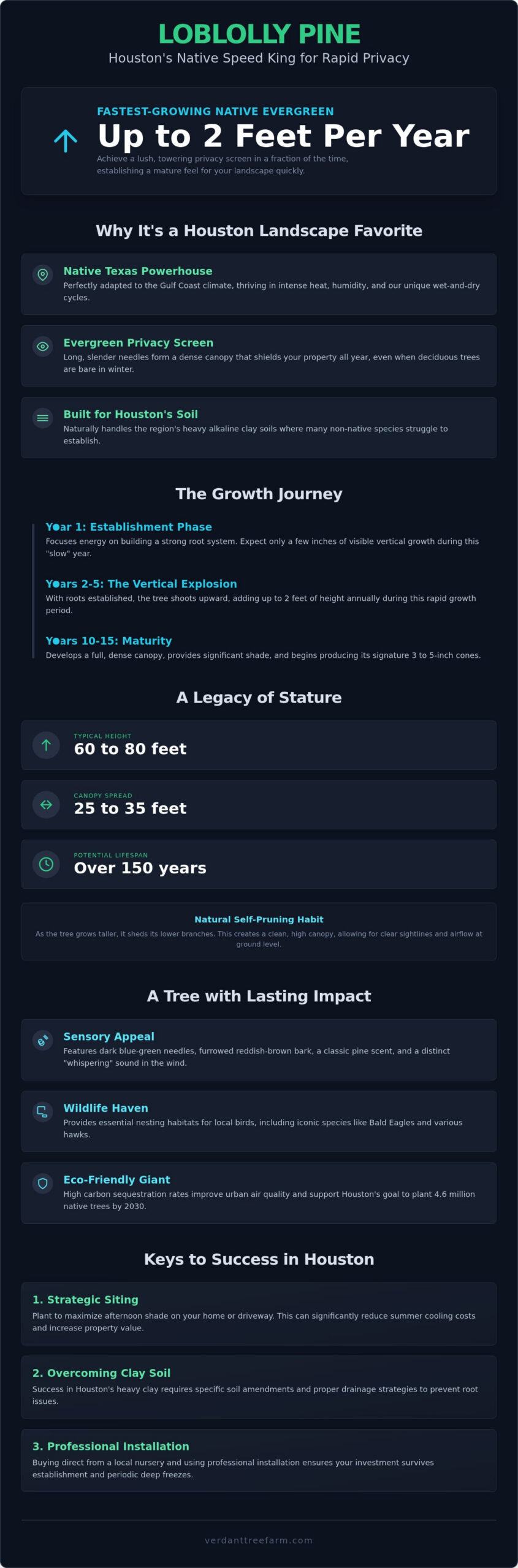
It is the undisputed “Speed King” of the South. Most evergreens require years of patience before they provide significant shade or privacy. The Loblolly Pine is different. It is capable of adding up to 2 feet of height every single year under the right conditions. This rapid growth makes it the ideal choice for homeowners who want to establish a tall, green barrier quickly. Because it is an evergreen, your property stays shielded and vibrant even when deciduous trees like oaks or maples are bare in the winter.
The Aesthetic Appeal of Pinus Taeda
The visual profile of this pine is striking. It features dark, blue-green foliage that forms a dense, rounded crown as it matures. The needles grow in bundles of three, creating a soft texture that catches the light. You will also notice the reddish-brown bark that develops deep furrows over time. This provides excellent winter interest and contrast. Beyond the looks, there is a sensory benefit. The needles produce a classic pine scent and a distinct “whispering” sound as the wind passes through the canopy.
Wildlife and Environmental Impact
Growth Rates and Mature Dimensions in Southeast Texas
While the Loblolly Pine can tower over 90 feet in the wild forests of East Texas, residential specimens in the Houston area typically reach a more manageable but still impressive height. You should plan for a mature height of 60 to 80 feet in a typical home landscape. This scale provides an incredible canopy, but it requires careful planning regarding your property lines and nearby structures. A Loblolly Pine Houston project is not just a quick fix for privacy; it’s a legacy investment that can live for over 150 years.
The canopy spread is just as important as the height. Expect your pine to develop a 25 to 35-foot wide crown at maturity. This broad footprint makes them excellent for shading large driveways or backyard play areas. Because these trees grow so large, they effectively increase property value by providing the kind of established, “old-growth” feel that new developments often lack. To safeguard the value of your home and its new landscape, consider reviewing your coverage options with Verdant Insurance. Proper spacing from the start ensures the tree has room to reach its full potential without interfering with your home’s foundation or roofline.
Loblolly Pines are famous for a process called self-pruning. As the tree grows taller and the upper canopy begins to shade the lower limbs, the tree naturally sheds those bottom branches. This creates a clean, high-canopy look that allows for clear sightlines and airflow at ground level. To maintain structural integrity, it is vital to protect the central leader, which is the main upward-growing trunk. If you are concerned about how a mature tree might interact with your specific lot, a maintenance consultation can help determine the safest placement away from power lines and structures.
Loblolly Pine Growth Milestones
The growth curve of this species is one of the most exciting things for a homeowner to watch. It follows a specific pattern as it adjusts to the local soil:
- Year 1: This is the establishment phase. The tree focuses almost entirely on its root system. You might only see a few inches of vertical growth during this “slow” year.
- Years 2-5: Once the roots are set, the “vertical explosion” begins. You can expect the tree to add up to 2 feet of height annually during this period.
- Maturity: By year 10 to 15, the tree will have a full, dense canopy and begin producing its signature 3 to 5-inch cones, providing both shade and habitat for local wildlife.
Houston Soil and Climate: Overcoming the Clay Challenge
Houston’s soil is famous for its “black gumbo” clay. While Loblolly Pines are native, they naturally prefer the acidic soils found just north and east of the city. Most residential lots in our area lean toward an alkaline pH. This environment can lock up essential nutrients, leading to yellowing needles or stunted growth. Successfully growing a Loblolly Pine Houston depends on bridging this gap between what the tree wants and what our soil provides.
Our regional climate presents another hurdle. We experience intense humidity, scorching summer heat, and the occasional deep freeze. While these pines are remarkably hardy, they are most vulnerable during their first two years. Establishing a resilient tree requires a combination of proper soil preparation and a strategic watering schedule that accounts for our unique weather patterns.
The ‘Black Gumbo’ Survival Guide
Testing your soil pH is the most important step before you dig. If your soil is too alkaline, you’ll need to lower the pH using elemental sulfur or iron sulfate. We recommend mixing in high-quality organic matter to break up the heavy clay. This improves aeration and drainage. If your yard holds water for days after a heavy rain, don’t plant the tree in a low spot. Instead, use a raised bed or a slight mound to keep the root flare above the water line. Young pines are highly susceptible to root rot if they have “wet feet” for too long.
Watering Requirements in the Houston Heat
Don’t rely on your lawn’s sprinkler system to keep your new pine alive. Sprinklers often only wet the top inch of soil, which is useless for a developing root system. You need deep-soaking techniques to encourage roots to dive deep into the cooler, wetter layers of earth. We suggest using a slow-trickle hose at the base of the tree for several hours once or twice a week during the summer.
Use the “Cake Test” to check moisture depth. Stick a long screwdriver or metal probe into the ground near the root ball. If it comes out clean and dry, it’s time to water. If it encounters resistance or comes out with wet clay, the soil is still sufficiently moist. This hands-on approach prevents overwatering, which is just as dangerous as drought in our heavy clay environments.
Siting and Landscape Design with Loblolly Pines
Designing with a tree that eventually reaches 80 feet requires more than just a shovel and a sunny spot. In many newer Houston developments, two-story homes often overlook neighboring yards, stripping away any sense of seclusion. A Loblolly Pine Houston installation offers a vertical solution that standard fences simply cannot match. Because of their towering height and dense upper canopy, these pines act as a living curtain for your upper-floor windows and balconies.
Strategic placement also serves a functional purpose beyond privacy. By positioning these trees on the western or southwestern side of your property, you create a massive shade shield against the brutal afternoon sun. This natural barrier can significantly lower your home’s cooling costs during our long summer months. When you plant a Loblolly Pine Houston residents often pair them with understory trees like the Texas Redbud or shrubs like the Savannah Holly. This layering creates a lush, multi-dimensional forest feel right in your backyard.
Privacy and Screening Strategies
Don’t plant your pines in a single, straight line. This “soldier row” approach can look unnatural and leaves gaps if a single tree grows slower than the others. Instead, use a staggered planting pattern. By creating two offset rows, you achieve a much denser privacy wall in half the time. You can also mix your pines with other evergreen trees Houston homeowners rely on for year-round color. This variety prevents a monoculture and protects your landscape’s health if a species-specific pest ever moves through the neighborhood.
Safe Planting Distances
Safety is the top priority during Houston’s notorious storm seasons. You must calculate the “fall zone” for your trees. While these pines are sturdy, it is best practice to plant them at a distance from your home that exceeds their expected mature height. Keep them at least 20 to 30 feet away from foundations, driveways, and septic lines to prevent root intrusion. Additionally, ensure the site receives at least 6 hours of direct sunlight. These trees are sun-lovers; planting them in the deep shade of a larger oak will lead to thin, spindly growth and a weak trunk.
Visualizing how an 80-foot tree will look on a standard residential lot can be difficult. We recommend using our professional 3D landscape design services to see exactly how your Loblolly Pines will mature alongside your home before you break ground.
Buying and Installing Your Loblolly Pine in Houston
Selecting a Loblolly Pine Houston homeowners can trust starts with finding a healthy specimen that is ready for our climate. Big-box retailers often stock trees that have been stressed by long shipping cycles or improper storage. When you buy direct from a local tree farm, you’re getting a tree that is already acclimated to the humidity and heat of Southeast Texas. This direct-to-consumer approach ensures you receive a more resilient plant while benefiting from nursery-direct pricing.
At the farm, look for a specimen with a strong, straight central leader and vibrant, dark-green needles. Avoid trees that show signs of circling roots at the surface or trunk damage. Selecting the right tree is only half the battle; the installation process is what determines long-term survival. We handle every step of the process with a level of precision that safeguards your property and your new investment.
The Professional Installation Advantage
Many DIY planting projects fail because the tree is placed too deep or the roots aren’t properly prepared for the heavy clay. Our professional installation team avoids these common pitfalls by following a rigorous protocol. We begin by coordinating 811 calls to mark all underground utility lines. When we dig, we ensure the hole is twice the width of the root ball to allow for easy lateral root expansion. We score the roots to prevent girdling and ensure the root flare remains slightly above the soil line.
Staking is another critical component. Houston’s windy seasons can easily lean a young pine if it isn’t secured. We use professional-grade staking systems that provide support without damaging the bark. Once the tree is set, we finish with a deep-soaking and a layer of premium mulch to retain moisture. You’ll receive a clear post-planting care guide to help you manage the tree through its first year of establishment.
Why Choose Houston’s Largest Independent Nursery?
Verdant Tree Farm is proud to be a veteran-owned and operated business. We operate as the largest independent tree nursery in the region; this gives us the ability to maintain a massive, high-quality inventory. Our customers enjoy access to wholesale-level stock combined with the approachable service of a family-run enterprise. We aren’t just a retail shop; we are a full-service partner for your property’s growth.
We provide expert landscaping services Houston residents rely on for professional results. Whether you need a single privacy screen or a complete 3D landscape redesign, our team has the equipment and expertise to handle projects of any scale. To ensure your success, we provide a three-month warranty on every tree we install. It’s our way of showing that we’re committed to the long-term health of your landscape and the value of your home.
Transform Your Landscape with Houston’s Native Evergreen
The Loblolly Pine is a fast-track solution for homeowners who want immediate privacy and long-term property value. By choosing a native species that grows up to two feet per year, you’re bypassing the decades-long wait times of slower-growing varieties. You now have the roadmap to manage Houston’s heavy clay and site your tree for maximum energy savings. Establishing a Loblolly Pine Houston landscape requires specific local knowledge, but the result is a resilient, evergreen canopy that thrives in our unique climate.
As the largest independent nursery in the city, we are ready to help you select and install the perfect specimen. Our veteran-owned and operated team handles every technical detail, from 3D design to professional planting. We stand behind our work with a three-month warranty on professional installations to ensure your new tree gets the best start possible. Visit Verdant Tree Farm today to see our Loblolly Pine inventory! We look forward to helping you grow a lasting legacy on your property.
Frequently Asked Questions
Are Loblolly Pines messy trees for a backyard?
Loblolly Pines produce a steady supply of needles and cones, which some homeowners find messy. These needles are actually beneficial because they create a natural, acidic mulch that suppresses weeds. If you have a pool or a manicured lawn, you’ll need to perform regular cleanup. However, for many, the trade-off for rapid privacy and a classic forest scent is well worth the occasional raking. Even the pollen, which often coats surfaces in spring, is a prized botanical resource used by companies like RAW Forest Foods to create specialized tinctures.
How fast do Loblolly Pines actually grow in Houston?
Once established, a Loblolly Pine Houston project can see vertical growth of up to 2 feet annually. This rate depends heavily on soil moisture and sun exposure. While the first year focuses on root development, you’ll see a significant vertical explosion starting in year two. Providing deep-soaking water during the summer months ensures the tree maintains this aggressive growth curve even during our hottest Texas droughts.
Can Loblolly Pines survive a Houston hurricane?
These trees are native to the Gulf Coast and possess a high tolerance for wind. Their deep taproots provide a strong anchor during Houston’s notorious storm seasons. However, their height makes them a potential risk if planted too close to structures. We recommend professional siting to ensure the tree has enough space to sway and stand firm against high-velocity winds without threatening your home’s roofline or foundation.
Do Loblolly Pines lose their needles in winter?
No, they are true evergreens and maintain their dark, blue-green foliage throughout the entire year. While they don’t go bare like oaks or maples, they do shed older needles as new ones grow. You might notice some brown needles toward the interior of the branches in the fall. This is a natural part of the tree’s life cycle and does not indicate that the tree is dying or unhealthy.
What is the best time of year to plant a Loblolly Pine in Texas?
Late fall through early spring is the ideal window for planting in Southeast Texas. This timing allows the root system to settle into the soil before the brutal July and August heat arrives. Planting during the cooler months reduces transplant shock and gives the tree a head start on its first vertical growth spurt. If you must plant in summer, professional installation is critical to manage the intense watering requirements.
How much space does a Loblolly Pine need from my house?
You should maintain a minimum distance of 20 to 30 feet from any permanent structures. This gap accounts for the tree’s mature canopy spread and protects your foundation from root expansion. It also ensures that if a limb fails during a severe storm, it’s less likely to impact your home. Giving the tree ample space allows it to receive the 6 hours of full sun it needs to thrive.
Do I need to fertilize my pine tree in Houston clay?
Standard fertilizers are rarely necessary in our nutrient-rich clay, but pH management is essential. Because Houston soils are often alkaline, your pine may struggle to absorb iron and other nutrients. Instead of a general-purpose fertilizer, focus on soil acidifiers like elemental sulfur. This adjustment helps the tree thrive in “black gumbo” by mimicking the acidic forest floors of East Texas. We can check your soil during a maintenance consultation.
Why are the bottom branches of my Loblolly Pine dying?
This is a natural process called self-pruning. As the tree grows taller, the upper canopy shades the lower limbs, causing them to die back and eventually fall off. This is how the Loblolly Pine develops its signature tall, straight trunk. It isn’t a sign of disease; it’s simply the tree’s way of focusing its energy on the new growth at the top where sunlight is most abundant.