Why do your trees seem to struggle during a drought while simultaneously drowning in a puddle after a typical Houston afternoon thunderstorm? If you’re living with the infamous “Gumbo” clay, you know exactly how unpredictable the ground beneath your feet can be. Many homeowners worry about tree root problems in clay soil Houston, especially when they see surface roots snaking toward the foundation or standing water that refuses to drain. It’s a common stressor in our community; however, it doesn’t have to mean choosing between a beautiful yard and a stable home.
This survival guide will teach you how to identify, prevent, and solve the most stubborn root issues caused by our region’s expansive soil. We’ll show you why the common “bathtub effect” kills young trees and how professional planting techniques can save your landscape. From selecting resilient species like the Mexican White Oak to mastering deep-watering schedules, you’ll gain the local expertise needed for a healthy, long-term investment in your property. We’ll explore how you can build a landscape that survives Houston’s weather cycles and protects your home’s value for years to come.
Key Takeaways
- Understand the science of “Gumbo” clay and why its expansive nature dictates the health of your trees.
- Identify the early warning signs of tree root problems in clay soil Houston, from surface roots to the silent threat of girdling.
- Select the right species for your property, focusing on clay-tolerant natives like the Bald Cypress and Cedar Elm.
- Learn the proper planting elevation techniques to avoid the “bathtub effect” and ensure your roots get the oxygen they need.
- Protect your investment with professional installation and a 3-month warranty that accounts for local soil challenges.
Houston’s ‘Gumbo’ Clay: Why Your Soil is a Challenge for Tree Roots
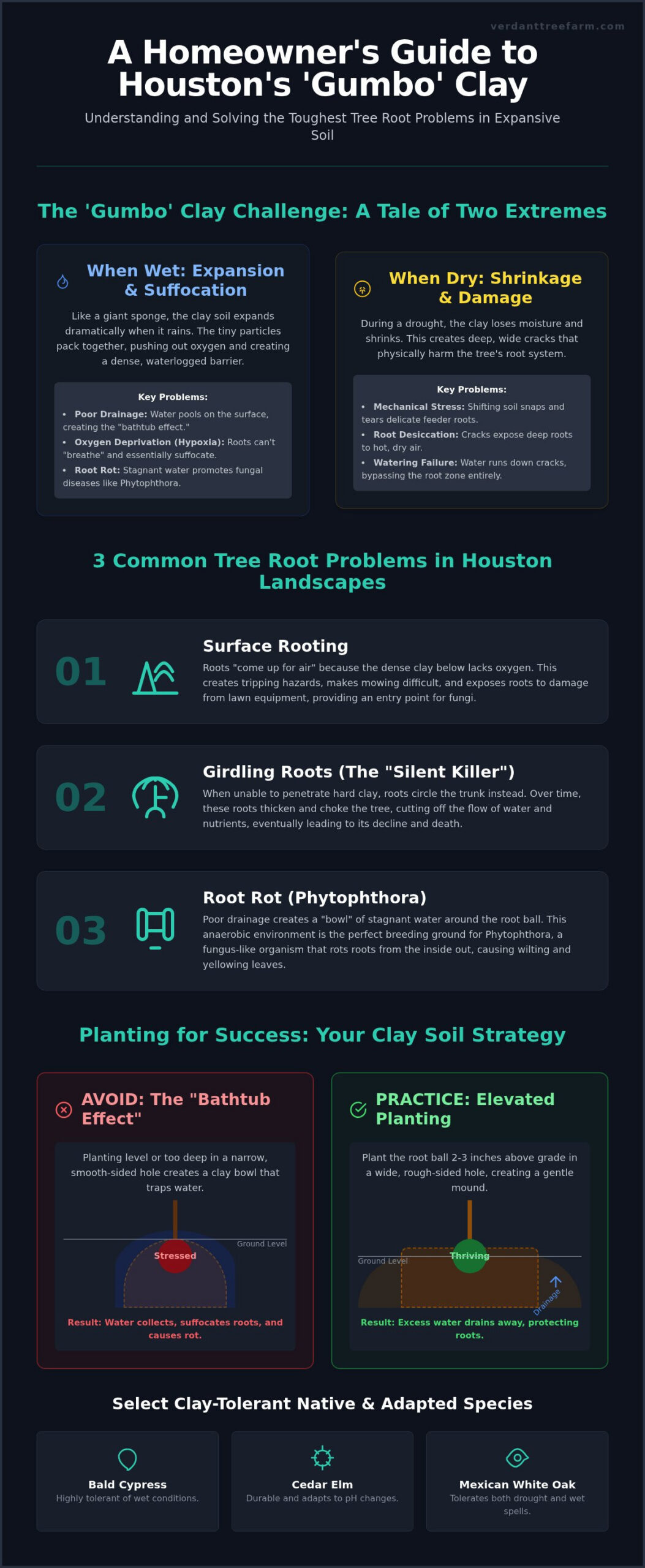
Houston sits on a massive deposit of Vertisols. This is the scientific name for the heavy, expansive clay that makes gardening here so unique. Locally, we call it “Gumbo” because of how it sticks to your shovel and boots when wet. Houston’s ‘Gumbo’ Clay acts like a giant sponge. It expands significantly when it rains and shrinks just as dramatically when it dries out. This constant movement is the primary driver of tree root problems in clay soil Houston. It’s a physical challenge that requires local expertise to manage effectively.
The Anatomy of Houston Clay
Our soil is rich in minerals but poor in pore space. The tiny particles in clay pack together tightly, leaving almost no room for water or air to move. This leads to poor percolation. Instead of soaking into the root zone where it’s needed, water often pools on the surface. This creates a soggy environment that promotes rot. Additionally, Houston clay often has an alkaline pH. This high alkalinity can lock up essential nutrients like iron. Your trees might starve for nutrients even if they’re present in the dirt simply because the chemistry is off.
How Soil Cracks Damage Root Systems
The shrink-swell cycle creates intense mechanical stress. During a Texas drought, the clay loses moisture and pulls away from itself. You’ll see deep, wide cracks opening up across your yard. These cracks don’t just look bad; they physically damage your landscape in several ways:
- Mechanical stress: Shifting soil pulls roots apart like a slow-motion earthquake, snapping delicate feeder roots.
- Air pockets: Large cracks expose deep roots to hot, dry air. This causes them to desiccate and die off.
- Watering failure: When you water a cracked yard, the liquid often runs straight down the fissures into the deep subsoil. It bypasses the root system entirely, leaving the tree thirsty despite your efforts.
Heavy clay also leads to hypoxia, or oxygen deprivation. Roots need to breathe to survive. When clay becomes saturated during our frequent floods, it pushes all the oxygen out of the soil pores. Traditional root systems essentially suffocate under these conditions. This is why you’ll often see surface roots snaking across the grass. They aren’t trying to ruin your lawn; they’re desperately searching for the oxygen that the dense clay below denies them. Managing tree root problems in clay soil Houston starts with acknowledging that your soil is a living, moving entity that needs specific care.
The 4 Most Common Tree Root Problems in Houston Landscapes
Identifying tree root problems in clay soil Houston requires a keen eye for how trees adapt to high-density earth. Because our clay is so compact, roots often take the path of least resistance. This leads to four distinct issues that can threaten your landscape’s health and your home’s structural integrity. Understanding these physical responses is the first step toward a long-term solution for your property.
1. Surface Rooting
In our dense “Gumbo,” oxygen and water often stay in the top few inches of soil. Trees like the Drummond Red Maple or October Glory Maple frequently develop surface roots as they “come up for air.” While this helps the tree breathe, it creates massive tripping hazards and makes mowing nearly impossible. Damaging these roots with a lawnmower blade provides an easy entry point for wood-rotting fungi. Strategic mulching is the best way to protect these systems without burying them too deep and suffocating them.
2. Girdling Roots
This is often called the “silent killer.” When a tree is planted in a hole that is too small or has slick, glazed sides from a shovel, the roots can’t penetrate the surrounding clay. Instead, they begin to circle the trunk. Over time, these roots choke the tree, cutting off the flow of nutrients. Ensuring you are Planting for Success by digging wide, rough-sided holes is the best way to prevent this circular growth pattern.
3. Root Rot (Phytophthora)
Standing water is a constant threat in Houston. When clay forms a “bowl” around the root system, water sits stagnant. This lack of drainage leads to Phytophthora, a fungal infection that rots the root system from the inside out. If your tree’s leaves are yellowing or wilting despite plenty of rain, you might be dealing with rot. Our team offers maintenance consultations to help diagnose these early signs of stress before the damage becomes irreversible.
4. Foundation Heave
Many homeowners fear that roots will “eat” their foundation. In reality, roots are opportunistic moisture seekers. They follow existing cracks where water is present rather than creating new ones. However, the way roots drink can cause the clay to shrink unevenly, leading to foundation movement. Distinguishing between simple soil movement and actual root interference is vital for any Houston homeowner; to ensure your property remains safe, you can visit True Tree Service for a professional assessment and eco-friendly care solutions.
The myth of aggressive roots often overshadows the fact that trees can actually stabilize soil moisture near a home. By drinking excess water during our wet seasons, they prevent the soil from over-expanding. In tight residential spaces, we often recommend root barriers. These physical shields redirect growth downward and away from the slab, allowing you to keep your shade without risking your foundation. Proper planning during the initial install is the most effective way to manage tree root problems in clay soil Houston.
Best Trees for Clay Soil: Species That Thrive in the Bayou City
Choosing the right species is the most effective way to prevent tree root problems in clay soil Houston. While some trees struggle to breathe in dense earth, others have evolved to thrive in these exact conditions. We select our inventory based on decades of local experience, ensuring every tree we sell is built for the Bayou City’s unique environment. Matching the right tree to your specific site conditions is a long-term investment in your property’s health.
The Bald Cypress is the undisputed king of wet clay. It actually thrives in swampy low spots where other trees would succumb to root rot. For homeowners dealing with the intense shrink-swell cycle of the Gulf Coast plains, the Cedar Elm is a native workhorse. It handles both heavy rain and extreme drought with ease. The iconic Live Oak remains a top choice because of its incredible adaptability to heavy clay, providing the deep shade Houstonians crave. If you’re looking for exceptional disease resistance in our humid climate, the Mexican White Oak, also known as the Monterrey Oak, is a standout performer that maintains a lush canopy even in tough soil.
Top Shade Trees for Clay Environments
For larger properties, the Shumard Oak is an excellent selection. Its high-volume root system is strong enough to penetrate deep clay layers, providing better stability during storm season. If your yard has “wet feet” or poor drainage, the Drummond Red Maple is a native choice specifically adapted to these conditions. Research on the Best Trees for Clay Soil confirms that these species are integral to Houston’s urban canopy. These are consistent favorites at our Houston tree nursery because they offer the best long-term results for our neighbors.
Resilient Ornamental and Privacy Trees
Not every clay-tolerant tree needs to be a giant. The Little Gem Magnolia offers the classic beauty of a Magnolia with compact roots that won’t disrupt nearby walkways or patios. For those needing year-round screening, the Nellie R. Stevens Holly is our go-to for privacy hedges. It establishes quickly in clay and maintains a dense, green wall. If you have a tight spot near a foundation, the Texas Mountain Laurel is a slow-growing, hardy option that won’t overwhelm your space. By matching the tree to the soil, you avoid the common tree root problems in clay soil Houston that plague so many local landscapes.
Planting for Success: How to Prevent Root Issues in Heavy Clay
Many homeowners think digging a deep, fertile hole is the kindest thing they can do for a new tree. In Houston, it’s often a death sentence. This creates the “bathtub effect.” Because our clay is so dense, a deep hole filled with loose soil acts like a drain. Rainwater and irrigation collect at the bottom and stay there, literally drowning the roots. To avoid tree root problems in clay soil Houston, you must change your approach to elevation and width. Success starts with working with the clay rather than fighting against it.
We recommend the 10% Rule. This means planting the root ball so that about 10% of it, roughly 1 to 2 inches, sits above the natural soil line. This ensures the root flare has access to oxygen even during our heavy rain cycles. Your hole should be twice as wide as the root ball but no deeper. We often use soil amendments like expanded shale during this process. Unlike organic compost which breaks down, expanded shale stays in the soil to permanently create tiny air pockets. This helps break up the “Gumbo” and improves drainage, which is a critical step in preventing tree root problems in clay soil Houston.
The Art of the Elevated Planting
Creating a slight mound around the tree helps water drain away from the trunk. This is a hallmark of professional installation. When mulching, always taper the material away from the bark. We call this avoiding “volcano mulching.” Piling mulch against the trunk traps moisture and causes rot. A flat, donut-shaped ring is much safer for the tree’s health. This simple adjustment allows the root system to establish itself without the risk of trunk-base fungal infections.
Long-Term Clay Soil Maintenance
Once your tree is in the ground, maintenance is your next priority. Liquid deep root fertilization is far superior to granular spikes in our region. It delivers nutrients directly to the root zone through the heavy clay. For watering, use a “low and slow” method. A slow drip over several hours allows moisture to penetrate the clay without running off into the street. If your existing trees look stressed or aren’t growing, our maintenance consultations can help you get back on track.
Ready to ensure your new investment thrives? Book a professional installation today to guarantee your trees are planted at the perfect height for Houston’s unique soil conditions.
Verdant Tree Farm: Expert Solutions for Houston’s Toughest Soil
Dealing with Houston’s “Gumbo” doesn’t have to be a solo struggle. At Verdant Tree Farm, we’ve built our reputation on being the largest independent nursery in the city. We provide veteran-owned reliability to every neighbor we serve. We don’t just hand you a tree and wish you luck. Instead, we offer a comprehensive service model that ensures your landscape thrives despite the local environment. Our expertise in tree root problems in clay soil Houston allows us to guide you through every stage of the process, from selection to long-term care. We view every tree as a long-term investment in your property’s value and safety; to see how professional tree safety and felling services are handled by specialized experts, you can discover Baumpflege Weserland GmbH.
Our team understands the specific tree root problems in clay soil Houston because we’ve spent years studying how local species interact with our unique environment. We take pride in being a dependable partner for our community. Whether you’re a first-time homeowner or a professional contractor, we have the scale and the expertise to handle projects of any size. You can trust that the trees you buy from us are the same hardy varieties we’d plant in our own backyards. We back this commitment with a 3-month warranty on every tree we plant, giving you the peace of mind you deserve.
When you visit us, you’re buying direct. There’s no middleman, which means you get nursery-direct pricing on high-quality specimens. Our on-site inventory is massive. You can hand-pick the exact Live Oak, Cedar Elm, or Bald Cypress that will anchor your yard. Once you’ve made your choice, our professional installation crews take over. They handle the grueling physical labor that Houston clay demands. They ensure every tree is planted at the correct elevation to prevent the root suffocation we’ve discussed. This professional touch is the best insurance you can buy for your new investment.
Start Your Landscape Transformation Today
We believe in planning before planting. Our 3D landscape design services allow you to visualize your yard before the first shovel hits the ground. This is especially helpful for planning drainage and ensuring roots have the space they need to grow safely. If you already have existing trees showing signs of stress, we offer maintenance consultations to diagnose the issue. We’ll look for surface roots or girdling and provide a clear path forward. Visit our Houston location today to see our clay-hardy inventory in person and start your transformation with a team that knows local soil best.
Secure Your Houston Landscape for the Future
Managing tree root problems in clay soil Houston requires a shift in how we think about our yards. Success starts with selecting the right species and ends with proper, elevated planting techniques. By avoiding the “bathtub effect” and choosing resilient natives like the Cedar Elm or Bald Cypress, you protect both your home’s foundation and your tree’s long-term health. It’s about working with our unique environment rather than fighting against it to ensure a landscape that thrives for generations.
As the largest independent tree nursery in Houston, we’re here to help you get it right the first time. Our veteran-owned and operated team provides the local expertise needed to navigate our tough “Gumbo” soil with confidence. Every tree planted by our professional crew comes with a 3-month warranty; this gives you the peace of mind that your investment is protected. We take pride in building resilient landscapes that stand the test of time and weather.
Browse our inventory of clay-hardy trees and request a professional installation quote today! Your dream landscape is possible even in the toughest clay conditions. Let’s work together to build a greener, more beautiful Houston for your family.
Frequently Asked Questions
How do I know if my tree roots are damaging my foundation?
Look for stair-step cracks in your exterior brickwork or sticking doors inside your home. Roots rarely “punch” through solid concrete. Instead, they follow moisture into existing fissures. If the soil shrinks unevenly because a tree is drinking near the slab, the foundation settles. It’s often soil movement rather than direct root force. Professional maintenance consultations help determine if a root barrier is needed to protect your home’s structure.
Can I plant a tree in heavy clay soil without digging it all out?
Yes, you don’t need to replace all the “Gumbo” to have a healthy landscape. Focus on digging a hole twice as wide as the root ball to allow lateral growth. Use the 10% rule by keeping the root flare slightly above the grade. This prevents the “bathtub effect.” Choosing clay-hardy species like the Mexican White Oak ensures the plant has the genetic strength to penetrate dense Houston earth.
What is expanded shale and does it help with Houston clay?
Expanded shale is a ceramic-like mineral fired at high temperatures. It’s a permanent soil amendment that creates tiny air pockets in heavy clay. Unlike compost, it doesn’t break down over time. It helps solve tree root problems in clay soil Houston by improving drainage and aeration. We often recommend mixing it into the backfill during professional installation to give young roots a better start in our compacted environment.
Why are my tree roots growing on top of the grass?
Roots grow where the oxygen and water are located. In compacted Houston clay, the lower levels are often anaerobic and waterlogged. Roots stay near the surface to breathe. This is very common with species like the Drummond Red Maple. Don’t bury these roots with heavy dirt, as this can suffocate the tree. Instead, apply a thin layer of organic mulch to protect them from mower damage and heat.
How often should I water a newly planted tree in clay soil?
Use a “low and slow” approach rather than frequent light sprinkling. Clay holds moisture for a long time, so you want to avoid keeping the root ball constantly soggy. Water deeply twice a week during the first growing season. Adjust this based on rainfall and heat. Check the soil moisture three inches down; if it’s still damp, wait another day. Overwatering in clay is a leading cause of root rot.
Is it safe to cut surface roots that are lifting my sidewalk?
Cutting large structural roots can be dangerous for the tree’s stability and health. If you remove a major root, the tree may lean or die from the shock. It also creates an entry point for disease. It’s better to bridge over the roots with a reinforced sidewalk or use a root barrier during the initial planting. If you must cut, consult an expert first to ensure the tree won’t become a fall hazard.
What happens if I plant a tree too deep in clay?
Planting too deep is a major cause of tree root problems in clay soil Houston. When the root flare is buried, the bark stays moist and begins to rot. Additionally, the roots are pushed into the low-oxygen “Gumbo” layer where they can’t breathe. This leads to a slow decline, yellowing leaves, and eventual death. Always aim for the top of the root ball to be an inch or two above the surrounding ground.
Does Verdant Tree Farm offer a warranty on trees planted in clay?
Yes, we provide a 3-month warranty on all trees we install. As Houston’s largest independent nursery, we stand behind our inventory and our veteran-owned expertise. We know our “Gumbo” soil is a challenge, so we ensure every specimen is planted correctly to survive. This warranty gives homeowners peace of mind that their new investment is protected while it establishes its root system in the local environment.