Can a single tree really transform a standard suburban backyard into a five-star Caribbean resort? You’ve likely seen the towering, diamond-cut trunks of a Medjool date palm Houston residents admire and wondered if that same luxury is possible for your own home. It’s a common dream, but many homeowners hesitate. You might worry about our heavy “black gumbo” clay soil or that one inevitable winter freeze that could ruin a significant investment. We understand that concern because we’ve seen how the Gulf Coast climate tests even the hardiest landscapes.
The good news is that with the right expertise, these iconic palms don’t just survive in Texas; they thrive. This guide will show you exactly how to successfully integrate, plant, and maintain the Medjool date palm to create a lasting legacy on your property. We’ll clear up the confusion between species like the Sylvester and the Medjool, explain how to handle drainage issues, and provide the expert confirmation you need on winter hardiness. From nursery-direct value to professional installation tips, you’re about to discover how to build a resort-style oasis with total peace of mind.
Key Takeaways
- Learn why the Medjool is the gold standard for luxury landscapes and how to achieve a resort-style aesthetic in your own backyard.
- Understand Houston’s specific climate zones and the exact temperature thresholds your palm can handle before needing protection.
- Discover the professional secrets to planting a Medjool date palm Houston clay soil won’t kill, including how to prevent the dreaded “bathtub effect.”
- Get a breakdown of the “diamond cut” maintenance technique and the seasonal pruning schedule required to keep your palm looking pristine.
- Explore the benefits of nursery-direct value and why a professional installation warranty is essential for protecting your long-term investment.
The Medjool Date Palm: Houston’s Ultimate Luxury Landscape Statement
The Phoenix dactylifera, commonly known as the Medjool date palm, carries a legacy that stretches back to ancient Mesopotamia. It’s not just a tree; it’s a piece of living history that brings a regal, timeless presence to your property. In our local market, the Medjool date palm Houston residents choose for their estates represents the pinnacle of resort-style design. While other palms offer height, the Medjool provides unparalleled substance. Its massive trunk diameter and lush, silvery-green fronds create a architectural focal point that smaller species simply cannot match. You’ll recognize these specimens by their distinct silhouette and the iconic diamond pattern carved into the trunk. The Medjool is a cold-hardy, drought-tolerant palm that thrives in full Texas sun.
Medjool vs. Sylvester Palm: Which is Right for You?
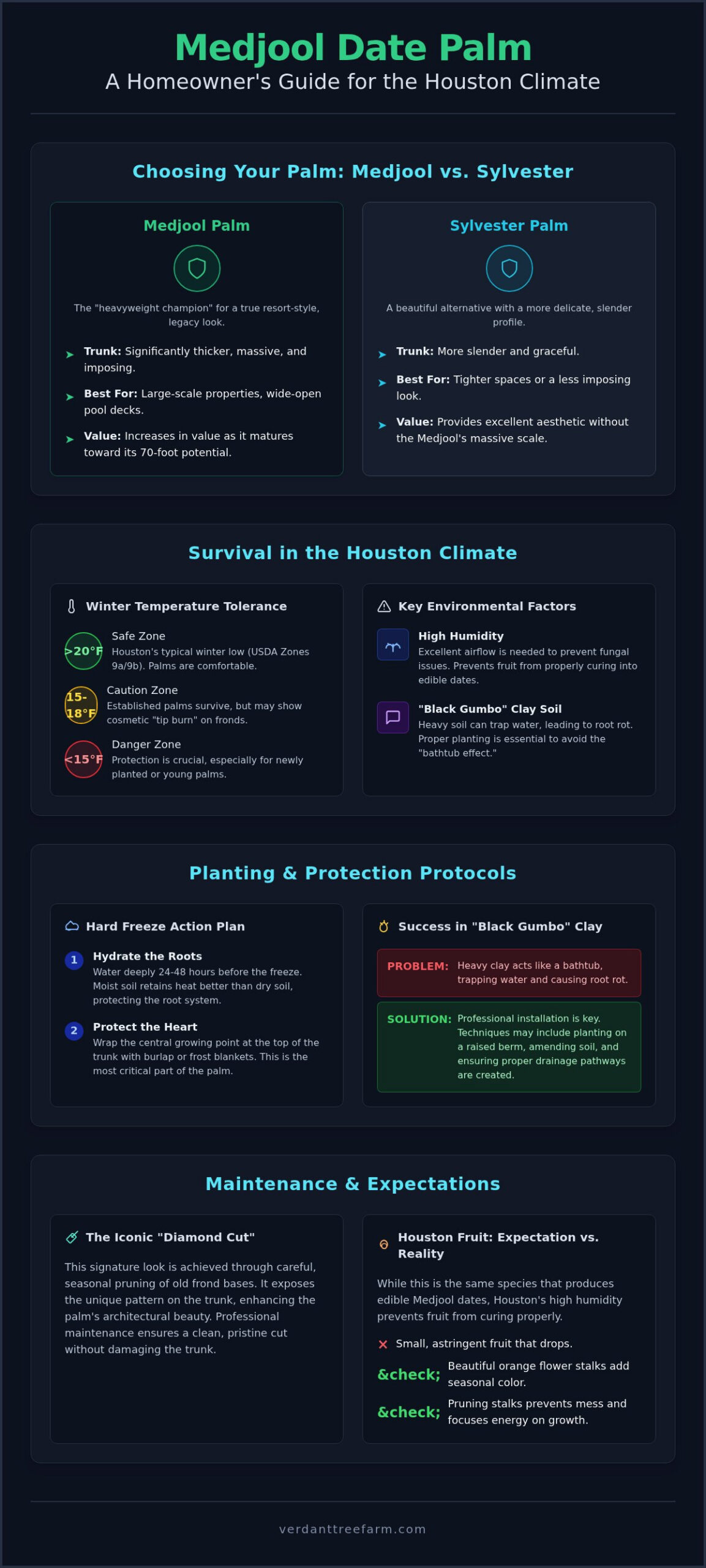
Choosing between a Medjool and a Sylvester palm often comes down to the “visual weight” you want in your landscape. The Medjool is the heavyweight champion. Its trunk is significantly thicker and more imposing, making it the perfect choice for large-scale homes or wide-open pool decks. In contrast, the Sylvester palm offers a more slender, delicate profile that fits well in tighter spaces. Both species are favorites for the Houston climate because they handle our Zone 9 winters with impressive resilience. While the Sylvester is a beautiful tree, it lacks the massive, ancient character that defines the Medjool. For a true “legacy” look that increases in value as the tree matures toward its potential 70-foot height, the Medjool remains the gold standard.
The Myth of Houston Dates: Expectation vs. Reality
It’s a common question: will my Medjool palm produce edible fruit? While these trees are technically the source of the world’s most famous dates, Houston’s climate tells a different story. Our high humidity levels prevent the fruit from properly curing on the tree. Instead of sweet, dried dates, you’ll likely see small, astringent fruit that drops before it’s useful. We encourage homeowners to focus on the ornamental value rather than agricultural output. When the tree attempts to flower, it produces large, orange-hued stalks that add a splash of color to the canopy. Most professional maintenance schedules involve removing these stalks early to prevent “fruit drop” on your pool deck or patio. This keeps your luxury landscape clean while allowing the tree to focus its energy on frond production and trunk growth.
Survival Guide: Medjool Palms and the Houston Climate
Houston’s weather is a mix of tropical humidity and sudden arctic blasts. Most of the metro area sits in USDA Zones 9a and 9b. This means we usually stay above 20 degrees, but history shows we can drop much lower. A Medjool date palm Houston residents plant needs to be ready for these swings. Established palms can survive temperatures down to 15 or 18 degrees, though they might suffer cosmetic foliage damage. This “tip burn” looks scary, but the tree typically pushes out fresh green fronds as soon as the spring sun hits. Newly planted palms don’t have the same starch reserves as mature ones, so they require more attention during their first few winters.
Humidity and heavy rainfall are the silent challenges in Southeast Texas. While these trees love the sun, they need excellent airflow to prevent fungal issues in our muggy summers. Understanding Date palm cultivation requirements is essential for local success. You aren’t just planting a tree; you’re managing an ecosystem. If you’re unsure about your specific neighborhood’s microclimate, you can always ask for maintenance consultations to ensure your palm is positioned for maximum survival.
Freeze Protection Strategies for Houston Winters
When the forecast calls for a hard freeze, it’s time to act. The most critical part of the palm is the “heart,” which is the central growing point at the top of the trunk. Wrap this area with several layers of burlap or specialized frost blankets. Avoid using plastic wraps directly against the fronds, as this can trap moisture and cause rot. A pro tip is to water your palms deeply 24 to 48 hours before the freeze hits. Moist soil stays warmer than dry soil, providing a small but vital buffer of latent heat for the root system.
Drought Tolerance and Summer Heat
Once the summer heat kicks in, the Medjool really shines. These trees thrive in 100-degree weather and high light intensity. They develop a deep taproot that allows them to tap into moisture deep below the surface. This makes them incredibly resilient once they’ve settled into their new home. While drought-tolerant, consistent irrigation is vital for the first two years. This initial period is when the tree builds the foundation it needs to survive a Texas summer without constant help. After that, they become one of the most water-efficient luxury plants in your yard.
Planting for Success in Houston’s ‘Black Gumbo’ Clay
Houston is famous for “black gumbo” clay. It’s thick, sticky, and holds water like a sponge. When you plant a Medjool date palm Houston clay becomes your biggest obstacle. Most homeowners dig a hole, drop the tree in, and fill it with loose potting soil. This mistake creates the “bathtub effect.” The loose soil in the hole collects all the runoff from the yard, but the heavy clay walls won’t let it drain. The roots end up sitting in standing water and eventually rot. You need a strategy that accounts for this drainage challenge from day one.
The secret to success in Southeast Texas is planting “high.” This means the top of the root ball should sit three to four inches above the surrounding ground level. You then build a gentle mound of soil up to the root ball to cover any exposed edges. This technique allows excess water to shed away from the base of the palm during heavy rains. We recommend amending your backfill with high-quality compost or leaf mold. These amendments create an ideal rhizosphere, giving the roots a nutrient-rich environment to expand into before they tackle the native clay.
Professional Installation vs. DIY Planting
A mature Medjool is not a standard weekend garden project. These specimens often weigh over 5,000 pounds. Moving one into a residential backyard requires heavy machinery and a skilled crew. You can’t simply roll these into place; they require a crane or a specialized tree spade to avoid damaging the root structure. Proper staking and bracing are also non-negotiable for the first 12 months. Without it, a strong Gulf Coast wind can lean or even topple a newly planted palm before the roots take hold. Our team uses specialized equipment and veteran-led precision to handle these logistics through the landscaping services Houston homeowners rely on for high-value specimens.
Irrigation and Drainage Solutions
Water management is a delicate balancing act. New palms need consistent moisture to establish, but they can’t survive in a swamp. We suggest setting up a dedicated bubbler system rather than relying on standard lawn sprinklers. This delivers water directly to the root zone without keeping the trunk or fronds constantly wet. After a typical Houston thunderstorm, check the area around the base of the tree. If you see standing water for more than a few hours, you might need to install a French drain or a raised berm. These solutions ensure that even during our wettest months, your investment stays protected from the threat of root rot.
Maintenance and the Iconic ‘Diamond Cut’ Aesthetic
Maintaining a Medjool date palm Houston homeowners can be proud of requires more than just consistent watering. It is a commitment to the tree’s structural beauty and long-term health. The most recognizable feature of a high-end specimen is the “diamond cut.” This isn’t a natural growth habit. It’s a meticulous manual process where the leaf bases, known as petioles, are trimmed away to reveal a clean, geometric pattern on the trunk. Without this specialized care, the trunk remains shaggy and loses that polished, resort-style appeal that defines luxury landscaping. Professional pruning ensures the tree remains a focal point rather than an overgrown eyesore.
Beyond the shears, you must stay vigilant against local threats. Spider Mites and Palmetto Weevils are common in Southeast Texas and can quickly damage an expensive investment. Weevils are particularly dangerous because they tunnel into the heart of the tree, often causing irreversible damage before it’s noticed. Regular inspections are your best defense. Since Houston’s heavy soils often lock away vital minerals, you can’t use generic lawn food. Palms require specialized fertilizer blends high in Magnesium and Potassium to prevent fronds from frizzling or turning an unappealing yellow at the tips.
Achieving and Maintaining the Diamond Pattern
Creating the perfect diamond look requires precision tools like sharp linoleum knives or specialized saws. It is truly an art form that requires a steady hand and an eye for symmetry. Most homeowners find that they need a refresh every 1 to 2 years as the tree grows and older fronds are removed. Safety is a major factor as the tree matures. As these palms reach significant heights, the maintenance work happens far off the ground. We always advise leaving the climbing and cutting to professionals who have the proper rigging and experience. If your palm needs a professional touch to restore its regal look, you can book maintenance consultations with our expert team today.
Nutrient Management for Vibrant Fronds
Texas clay is often alkaline, which frequently leads to Magnesium and Potassium deficiencies. You will see this manifest as yellowing or spotting on the older, lower fronds first. The best time to apply a slow-release granular palm fertilizer is during the early spring and again in late summer. This schedule aligns with the tree’s peak growth periods in our region. If you notice rapid yellowing in the upper canopy, a micronutrient spray can provide a quick “booster shot” to restore that deep, silvery-green color. Consistent feeding keeps the canopy lush and provides the tree with the strength it needs to recover from any winter stress.
Buying Your Medjool Date Palm from Verdant Tree Farm
Verdant Tree Farm stands as the largest independent nursery in the region. We offer a massive, hand-selected inventory of Grade A specimens. When you choose a Medjool date palm Houston residents can trust, you are buying into a legacy of quality. Our “Nursery Direct” model means you get superior value without the typical middleman markup. These trees are already acclimated to our specific Gulf Coast humidity and soil conditions. As a veteran-owned and operated business, we prioritize transparency and personal accountability. We handle everything from the initial selection to the final professional installation. Our team is equipped for projects of any scale, ensuring your property receives the expert care it deserves.
Visualize Your Oasis with 3D Landscape Design
Placing a massive, mature palm requires careful planning. You don’t want to guess where a tree of this size should go. We offer professional 3D landscape design services to take the guesswork out of the process. Our designers model your property to show exactly how your Medjool will look next to your pool or patio. This technology helps you avoid future problems like foundation interference or blocked views. You can see how your new palm pairs with other flowering trees for Houston, such as Vitex or Crape Myrtles. We help you create a balanced, layered look that maximizes your property’s curb appeal. This proactive approach ensures your resort-style backyard is functional and beautiful for decades to come.
The Verdant Warranty: Protecting Your Investment
A luxury landscape is a significant investment in your home’s value. We protect that investment with a comprehensive three-month warranty on every tree we install. This provides a vital safety net while your palm establishes its root system in its new home. Our customers trust us as the premier tree nursery in Houston because we stand behind our products. We invite you to visit our farm in person to see our operation first-hand. You can walk the rows, inspect the trunks, and tag the exact tree you want for your yard. Our veteran-led installation crews arrive on time and treat your property with the highest level of respect. We don’t just sell trees; we provide long-term solutions for homeowners who value quality and reliability. Visit us today to start your transformation.
Build Your Legacy Landscape Today
A thriving Medjool date palm Houston residents admire is the result of careful planning and expert execution. You now know that success in our climate requires overcoming “black gumbo” clay by planting high and ensuring proper drainage. You also understand that the iconic diamond-cut aesthetic isn’t just about looks; it’s a professional maintenance standard that preserves the health and value of your investment. Whether you’re designing around a new pool or refreshing an estate entrance, these palms offer a regal presence that few other trees can match.
Verdant Tree Farm makes the process simple and secure. As the largest independent tree nursery in Houston, we provide high-quality specimens directly to you. Our veteran-owned team stands behind every project with a three-month warranty for your peace of mind. We are ready to help you visualize your dream backyard before the first hole is ever dug. Browse our Medjool Date Palm inventory and request a 3D design consultation today! Your tropical oasis is closer than you think, and we’re honored to be your partner in growing a beautiful Texas landscape.
Frequently Asked Questions
Will a Medjool Date Palm survive a freeze in Houston?
Yes, an established Medjool date palm Houston specimen can survive temperatures as low as 15 to 18 degrees Fahrenheit. While they may experience some foliage burn during extreme arctic blasts, the central heart typically remains protected. We recommend wrapping the trunk and crown during hard freezes to ensure the tree’s long-term health and prevent cosmetic damage that takes a full season to grow out.
How fast do Medjool Date Palms grow in Southeast Texas?
Medjool palms generally grow at a slow to moderate rate of 6 to 12 inches of trunk height per year in Southeast Texas. This pace depends heavily on soil quality, drainage, and consistent fertilization. Because they aren’t rapid growers, many homeowners choose to purchase mature specimens from our nursery to achieve an immediate, high-impact resort look without waiting decades for the tree to reach its full potential.
Do Medjool palms produce edible dates in the Houston area?
While these trees are the source of the world-famous Medjool date, they rarely produce edible fruit in the Houston area. Our high humidity levels prevent the fruit from drying and curing properly on the tree. You’ll likely see the fruit form and turn orange, but it usually drops or rots before it becomes sweet. Most local owners treat them purely as ornamental luxury landscape statements.
How much space does a Medjool Date Palm need in a backyard?
You should plan for at least a 20-foot diameter clearance to accommodate the full spread of the mature fronds. While the trunk is massive and sturdy, the canopy needs ample room to breathe without hitting roofs, fences, or power lines. We recommend a minimum 10-foot setback from pool edges and home foundations to prevent any future structural interference or debris issues as the palm matures.
What is the difference between a Medjool and a Sylvester palm?
The Medjool is significantly larger and more robust than the popular Sylvester palm. A Medjool features a much thicker trunk diameter and a wider canopy with silvery-green fronds. Sylvester palms offer a more slender profile and are known for the deep orange color revealed in their trunk cuts. For a truly imposing, legacy-scale landscape focal point, the Medjool is the superior choice for Houston estates.
How often should I water my newly planted Medjool palm?
Newly planted palms require daily deep watering for the first three to four weeks to settle the soil and hydrate the root system. After this initial month, you can transition to a schedule of three times per week. It’s vital to ensure the water reaches the deep root ball directly. Avoid overwatering in heavy clay areas where drainage might be slow to prevent root rot issues.
Does Verdant Tree Farm offer a warranty on palm trees?
Yes, Verdant Tree Farm provides a three-month warranty on all trees we sell and professionally install. This coverage offers you critical protection during the initial establishment phase when the tree is most vulnerable. We stand behind our Grade A specimens because we’re committed to the long-term success of your property. Our veteran-owned team ensures every installation meets the highest professional standards for local reliability.
When is the best time of year to plant a palm tree in Houston?
The best time to plant a palm tree in Houston is between late spring and early summer, specifically March through July. This warm window allows the tree to establish a vigorous root system before the first winter cold arrives. While you can plant later in the year, early season planting gives the specimen the maximum amount of time to acclimate to its new environment and soil.