Did you know that past extreme droughts in Texas have claimed over five million urban shade trees in a single season? In Houston, the urban heat island effect can make some neighborhoods 14 degrees hotter than others, putting your mature landscaping on the front lines of a relentless survival battle. It’s painful to watch a prize Live Oak or Drummond Red Maple struggle as the mid-summer heat turns a lush canopy into a collection of brown, curling leaves. You’ve likely felt that spike of anxiety while looking at the deep cracks forming in our notorious Houston clay soil, wondering if your current watering routine is actually reaching the roots.
This guide will help you confidently identify the early signs of underwatered trees in Texas before the damage becomes permanent. We’ll show you how to move beyond wasteful surface sprinkling to master the “low and slow” deep-soaking techniques that keep root systems resilient during 100-degree stretches. We’ll break down exactly how to read your trees’ distress signals, establish a reliable watering schedule for our local climate, and protect your property’s long-term value without wasting a drop of water.
Key Takeaways
- Identify the early signs of underwatered trees in Texas, including “crispy” leaf edges and survival-driven leaf drop, to act before your landscape is at risk.
- Master the “low and slow” deep-watering method to ensure hydration reaches the root zone through Houston’s dense clay soil.
- Discover how to adjust your watering schedule based on tree species, from high-transpiration Maples to drought-hardy native Oaks.
- Learn the “donut, not a volcano” mulching rule to lower soil temperatures by up to 10 degrees while protecting the trunk from rot.
- Perform a simple “scratch test” to distinguish between summer dormancy and a dead tree, helping you decide when to seek professional maintenance consultations.
Common Signs of Underwatered Trees in Texas
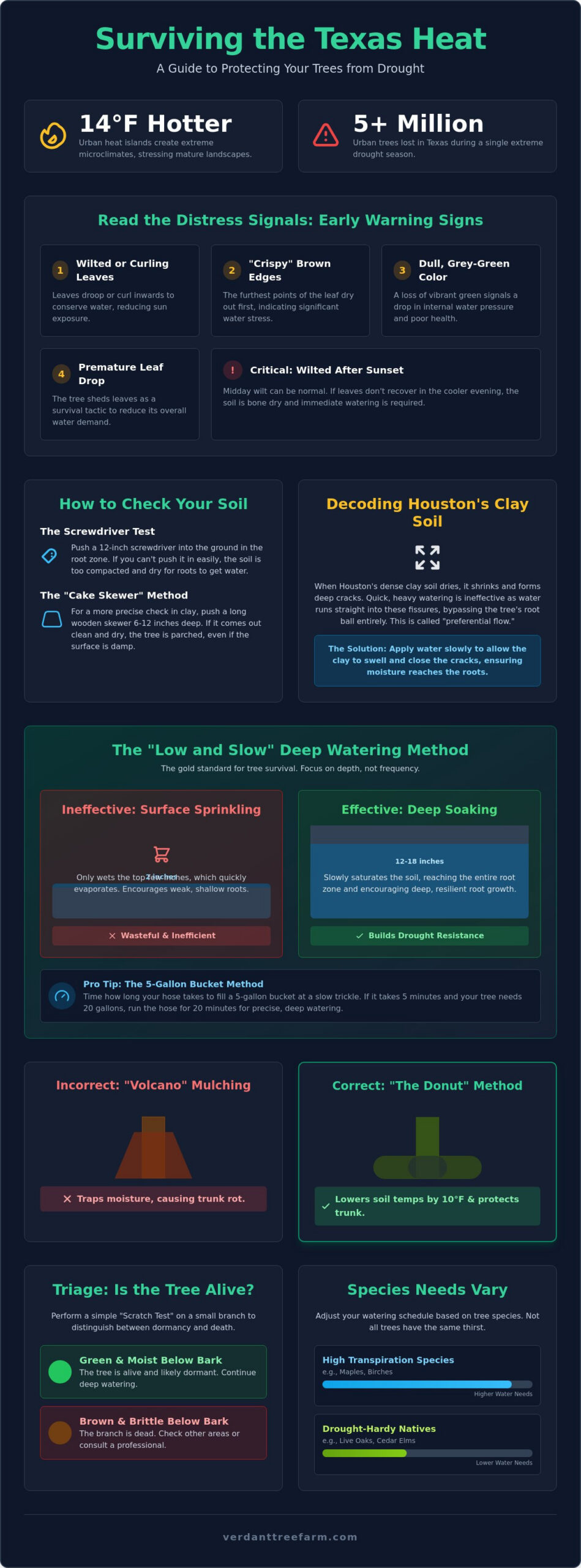
July 2026 has brought some relief to our region, but roughly 32% of the state remains under active drought conditions. In the Houston heat, your landscape can go from thriving to thirsty in a matter of days. Recognizing the signs of underwatered trees in Texas is the first step toward saving a valuable investment. Look for visual cues like wilted or curling leaves. When leaf edges become “crispy” and brown, the tree is already in a state of immediate distress.
Trees often change color before they drop foliage. A stressed tree, such as a Mexican White Oak or a Drummond Red Maple, will lose its deep green shine. It takes on a dull, grey-green hue that signals a drop in internal water pressure. If you notice a sparse canopy during the peak of summer, your tree is likely using a survival mechanism. It sheds leaves early to reduce the amount of water it needs to stay alive. This is common in species like the Cedar Elm when the soil moisture is depleted.
Timing is everything when observing wilt. Midday wilt is a natural response to extreme Texas sun; the tree is simply transpiring faster than it can hydrate. But don’t ignore evening wilt. If the leaves are still drooping after the sun goes down, the soil is likely bone dry. This is a critical warning sign that requires immediate action. Your tree is no longer recovering during the cooler night hours.
The ‘Screwdriver Test’ and Soil Moisture Checks
Don’t rely on how the surface looks. Use a 12-inch screwdriver to gauge soil compaction. If you can’t easily push the tool into the ground, the soil is too dry for roots to function. For a more precise check in our heavy Houston clay, try the “cake skewer” method. Push a long skewer 6 to 12 inches deep into the root zone. If it comes out clean and dry, your tree is parched. Surface dampness from a light rain or a quick lawn sprinkle rarely reaches the deep root system where it’s needed most.
Decoding Houston’s Clay Soil Cracks
Houston’s clay soil behaves differently than sandy or loamy soils. When it dries out, it shrinks and forms deep cracks. These fissures can lead to “preferential flow,” where water bypasses the roots and drains straight into the subsoil. This makes it hard to re-hydrate hydrophobic clay. If you apply water too quickly, it will just run off into the cracks or the street. You must use a slow application to swell the clay back together. This ensures the water actually saturates the root ball instead of disappearing deep into the ground fissures.
The ‘Low and Slow’ Method: Deep Watering Techniques for Houston
Lawn sprinklers are designed for grass, not trees. They typically only wet the top two inches of soil, which quickly evaporates in the intense Texas sun. This is the primary reason many homeowners overlook the early signs of underwatered trees in Texas. Your lawn might look lush and green, but the deeper root systems of your trees could be bone dry. To save a tree, you have to change your approach from surface sprinkling to deep hydration.
The “Low and Slow” method is the gold standard for tree survival. It focuses on volume and depth rather than frequency. Instead of a quick daily spray, you want a slow, steady application that allows water to soak 12 to 18 inches deep into the soil. This encourages roots to grow downward, away from the scorching surface heat. Setting up a soaker hose is the most efficient way to achieve this. Spiral the hose around the base of the tree, starting about a foot from the trunk and extending out to the edge of the canopy.
Precision matters when you’re trying to beat the heat. You can measure your delivery exactly using the 5-gallon bucket method. Simply time how long it takes to fill a 5-gallon bucket with your hose at a low trickle. If it takes five minutes to fill, and your tree requires 20 gallons, you know you need to run that hose for exactly 20 minutes. Implementing these deep watering techniques ensures that every drop counts toward the long-term health of your landscape.
Watering Newly Planted Trees (0-2 Years)
Young trees are in a high-stakes establishment phase. Their root systems are still small and haven’t spread far beyond the original planting hole. In July and August, daily soil checks are mandatory. If the ground feels dry two inches down, it’s time to water. Tree watering bags, often called Gator bags, are perfect for this. They provide a slow-release delivery over several hours, ensuring the root ball stays moist. If you’re planning a new project, our landscaping services in Houston can help you select and install species that are grown to handle our local climate cycles.
Maintaining Mature, Established Trees
For mature trees, follow the “Drip Line Rule.” The most active feeder roots live at the outer edge of the canopy, not right against the trunk. Target this area with your water. A reliable formula is to provide 10 gallons of water for every inch of trunk diameter. If you have a Shumard Oak with a 6-inch trunk, it needs 60 gallons per session. During 100-degree stretches, perform this deep soak every 7 to 10 days. This frequency helps prevent the common signs of underwatered trees in Texas from appearing in your older, more valuable specimens. If you’re worried about a specific tree, a professional maintenance consultation can help you create a custom hydration plan.
Species-Specific Hydration: From Native Oaks to Tropical Palms
Every tree in your yard has a unique metabolic rate. This is largely dictated by leaf surface area and transpiration, which is essentially how much a tree “sweats.” A tree with large, broad leaves, like a Drummond Red Maple or a Little Gem Magnolia, loses moisture much faster than a fine-leaved Cedar Elm. This “Hydration Gap” means you can’t treat every trunk in your landscape with a one-size-fits-all approach. If you apply the same amount of water to a high-transpiration Maple as you do to a drought-hardy Oak, one will thrive while the other shows clear signs of underwatered trees in Texas.
Micro-climates also play a massive role in Houston. A 2024 study highlighted a 14-degree temperature difference between various Houston neighborhoods due to the urban heat island effect. A tree planted near a concrete driveway or a brick wall faces much higher thermal stress than one in an open, grassy area. You should customize your irrigation zones to account for these “hot spots.” Trees in full afternoon sun or near heat-reflecting structures will always require more supplemental water to maintain their internal pressure.
Shade Tree Care: Live Oaks and Cedar Elms
Live Oaks are famous for their resilience. Their deep taproots are designed to find moisture far below the surface. However, in urban Houston, these roots often encounter compacted clay or foundation barriers that limit their reach. Even these hardy natives will drop leaves early if they aren’t getting enough deep hydration during a 100-degree stretch. Cedar Elms are also champions of drought tolerance, but they’ll sacrifice their canopy to protect their core. Don’t confuse thirst with overwatering; if the soil is mushy and interior leaves are turning yellow, you might be drowning the roots instead of helping them.
Palm Tree Needs: Medjool and Sylvester Palms
Palm trees require a delicate balance. While they love the heat, they need consistent moisture to maintain their tropical vigor. When looking at palm trees for sale in Houston, it’s vital to plan for drainage. Medjool and Sylvester palms are particularly sensitive to “the clay pot effect.” This happens when a hole is dug in heavy clay and acts like a bowl, holding stagnant water around the roots. Palms need deep, infrequent soaking that fully saturates the root ball but allows the “ankles” of the tree to dry out between sessions. If you see the lower fronds of your Sylvester palm turning brown and brittle, it’s a clear signal that the hydration isn’t reaching the deep roots through the heavy soil.
Soil Armor: Using Mulch and Clay Management to Retain Moisture
Soil armor is your tree’s best defense against the brutal Houston sun. Think of mulch as a thermal blanket. A three-inch layer of organic material can reduce soil temperatures by up to 10 degrees. This cooler environment allows roots to function properly even when the Texas heat is at its peak. If you let the soil sit bare, it develops a hard “clay crust” that acts like a shield. This crust causes water to run off into the street rather than soaking down to the roots. When this happens, you’ll soon notice the telltale signs of underwatered trees in Texas despite your best efforts with the hose.
You must follow the “Donut, Not a Volcano” rule for proper application. Many homeowners pile mulch directly against the trunk, which is a significant mistake. It traps moisture against the bark and leads to rot or fungal infections. Instead, leave a few inches of space around the base of the tree. Spread the mulch wide, ideally reaching out to the drip line of the canopy. For long-term clay management, consider mixing in organic compost or expanded shale. These amendments break up heavy Houston clay and improve water retention for years to come.
The Best Mulch for Houston’s Humidity
Hardwood mulch is generally the superior choice for our local humidity. It’s heavier than other types and stays in place during our sudden Gulf Coast downpours. As of July 2026, brown hardwood mulch in the Houston market is priced around $30.99 per cubic yard. Pine bark mulch is excellent for adding acidity but it’s lighter and tends to float away; it currently runs about $49.99 per cubic yard. Avoid dyed mulches like red or black during the peak of summer. These dyes can absorb more heat and may contain chemicals that aren’t ideal for stressed root systems. It’s best to refresh your armor in late May or early June before the first major heat spike hits.
Coordinating Tree Care with Your Lawn
Competition for moisture is a real threat in residential yards. Standard lawn care in Houston often focuses on keeping St. Augustine grass green, but grass is a greedy neighbor. Turf roots are shallow and incredibly efficient at soaking up light rain or sprinkler water before it ever reaches the tree’s deeper root zone. If you’re watering your lawn daily for only 10 minutes, you’re likely starving your trees. Adjust your sprinkler run times to deliver deeper, less frequent cycles that benefit both turf and timber. If your landscape feels like a battlefield, our team can provide professional maintenance consultations to help you balance the needs of your entire property.
Triage and Professional Support: Saving Your Stressed Landscape
If you’ve noticed the signs of underwatered trees in Texas, don’t panic. Many trees have built-in defenses to survive our brutal summers. Before you decide a tree is lost, perform the “Scratch Test.” Use your fingernail or a small pocketknife to gently scrape a tiny bit of bark off a young twig. If the tissue underneath is green and moist, the branch is still alive. If it’s brown and brittle throughout the canopy, the tree is in severe trouble. Some species, like the Cedar Elm, may enter “Summer Dormancy.” They drop leaves to conserve energy, which can look like death but is actually a sophisticated survival tactic.
A weakened tree is a target for invaders. Drought stress lowers a tree’s natural defenses, making it a magnet for pests like aphids and spider mites. These insects suck the remaining moisture out of the foliage, accelerating the decline. If you see sticky residue on the leaves or fine webbing, you’re likely dealing with a secondary infestation. In these cases, a maintenance consultation is the best way to evaluate root health and develop a recovery plan. We can help you determine if the tree is salvageable or if the structural integrity has been compromised by the heat.
Emergency Recovery Steps
When a tree is severely wilted, start an “Emergency Soak.” Place a hose at the base of the tree at a heavy drip and leave it for several hours. You need to swell the clay and get moisture to the core of the root ball immediately. Never fertilize a drought-stressed tree in the heat of summer. Fertilizer encourages new growth, which requires even more water that the tree simply doesn’t have. Similarly, avoid heavy pruning. Leaves provide vital shade for the bark; removing them can lead to sunscald. Wait until the cooler fall temperatures arrive before making any major structural cuts.
Investing in a Resilient Future
The best way to avoid future heartache is to start with high-quality, locally grown stock. Choosing the right tree nursery in Houston ensures your trees are already acclimated to our specific soil and heat cycles. At Verdant Tree Farm, we take pride in our inventory. We offer a 3-month warranty on installations because we believe in the strength of our Texas-grown trees. Our veteran-owned team is here to help you build a landscape that lasts for generations. Contact us today to schedule an on-site evaluation and protect your property’s most valuable natural assets.
Protect Your Houston Landscape Investment
Saving your trees from the relentless Texas heat is a marathon, not a sprint. You now have the essential tools to spot the early signs of underwatered trees in Texas before the damage becomes permanent. By mastering the “low and slow” watering method and applying proper “soil armor” through mulching, you’re giving your trees the best chance to survive 100-degree days. These practical steps ensure that moisture reaches deep into our heavy clay soil where it matters most.
As Houston’s largest independent tree nursery, we provide veteran-owned local expertise to help your property thrive. We understand the unique stress our climate puts on everything from native Oaks to tropical Palms. If you’re still concerned about canopy loss or root health, don’t wait for the next heatwave. We stand behind our work with a 3-month warranty on professional installations; this ensures your investment is protected from the start.
Book a Professional Maintenance Consultation with Verdant Tree Farm today to secure a custom hydration plan for your yard. Your mature trees are a legacy that adds value and beauty to your home. Let’s work together to keep your Houston landscape green, resilient, and healthy for years to come.
Frequently Asked Questions
How many gallons of water does a tree need in the Texas summer?
Provide about 10 gallons of water for every inch of trunk diameter during each deep-watering session. If your Shumard Oak has a 6-inch trunk, it needs 60 gallons of water. In 100-degree weather, perform this soak every 7 to 10 days. This volume ensures moisture reaches the feeder roots 12 to 18 inches below the surface. Measuring with a 5-gallon bucket helps you stay accurate and avoid wasting water.
Can you overwater a tree in 100-degree heat?
You can absolutely overwater a tree, even during a Texas summer, due to Houston’s heavy clay soil. Clay holds moisture for a long time, creating a “clay pot effect” that can drown roots if they stay saturated. Signs of overwatering include yellowing interior leaves and soil that feels mushy or smells sour. Always check the soil moisture 6 inches deep with a skewer before adding more water to prevent root rot.
Is it better to water trees with a sprinkler or a hose?
A hose is significantly better than a sprinkler for tree health. Sprinklers are designed for turf and rarely penetrate more than two inches into the soil. This shallow watering encourages weak, surface-level roots that can’t handle the heat. Using a soaker hose or a slow-dripping garden hose delivers water directly to the root zone. This “low and slow” approach is the most effective way to prevent the signs of underwatered trees in Texas.
Why are the leaves on my Live Oak turning brown in July?
Brown leaves on a Live Oak in July usually indicate drought stress or leaf scorch. When the tree loses moisture through its leaves faster than the roots can replace it, the edges turn brown and “crispy.” This often happens when a tree is only receiving shallow water from a lawn irrigation system. Ensure you’re targeting the drip line of the canopy with deep soaking to help the tree maintain its internal water pressure.
How do I know if my tree is dead or just dormant from the heat?
Perform the “scratch test” on a small twig to see if your tree is dead or just dormant. Use your thumbnail to scrape a tiny bit of bark away. If you see green, moist tissue underneath, the tree is still alive and likely in summer dormancy. If the twig is brittle and brown all the way through, that specific branch is dead. Cedar Elms are particularly known for dropping leaves early to survive extreme heat.
Do I need to water my trees during a Houston drought if there are water restrictions?
You should prioritize watering your trees even during droughts, as they are the most expensive part of your landscaping. As of July 2026, the City of Houston has no mandatory water restrictions in place. If restrictions are ever reinstated, most ordinances allow for the use of hand-held hoses or soaker hoses during specific hours. These methods are efficient and keep your mature trees alive while still complying with local conservation efforts.
What is the best way to water a newly planted tree in Houston?
The best method for a newly planted tree is slow, consistent delivery through a tree watering bag. These bags zip around the trunk and release water over several hours, ensuring the root ball stays moist without runoff. Check the soil daily during the first two summers. A young tree hasn’t established a wide root system yet, so it relies entirely on the water you provide within its original planting hole.
Does mulch really help trees stay hydrated in Texas?
Mulch is essential for moisture retention in our climate. A three-inch layer of hardwood mulch acts as a thermal blanket, reducing soil temperatures by up to 10 degrees. This prevents the sun from baking the ground into a hard “clay crust” that repels water. By keeping the soil cool and porous, mulch helps you avoid the common signs of underwatered trees in Texas and reduces the frequency of supplemental watering sessions.