During the record-breaking freeze of February 2021, thousands of Houston homeowners watched their tropical hedges turn into brittle, brown sticks overnight. You want a backyard that feels like a private retreat, but our local “gumbo” clay soil and unpredictable weather make it difficult to maintain a cherry laurel or any other consistent screen. It is frustrating to spend your weekend replanting only to have the next heatwave or cold snap reset your progress. At Verdant Tree Farm, Houston’s Premier Tree Farm, we know that a long-term investment in your property requires plants that are as tough as they are beautiful.
We are here to help you discover how to select, plant, and maintain these hardy evergreens for our specific Gulf Coast climate. This plant offers the dense privacy screening you need without the high-maintenance headaches of more delicate species. As a family owned and operated nursery, we bring wholesale to the public to ensure every neighbor can access premium specimen trees. This guide provides a clear roadmap for conquering heavy clay drainage and building a lush, green wall that increases your property value for years to come.
Key Takeaways
- Discover why these lush evergreens are the gold standard for Houston privacy screening and how to select the perfect variety for your specific square footage.
- Learn the essential drainage secrets for planting in “Houston Gumbo” to prevent the most common cause of hedge failure in clay soil.
- Master professional watering schedules and maintenance tips to keep your cherry laurel vibrant and healthy through the intense Zone 9 heat.
- Unlock wholesale-to-the-public pricing on premium specimen trees grown specifically for the Bayou City climate by Houston’s premier tree farm.
What is a Cherry Laurel? Houston’s Top Choice for Evergreen Privacy
The cherry laurel stands as the gold standard for privacy screening across the Greater Houston area. These versatile evergreen shrubs, which can also be trained into small specimen trees, provide a lush wall of foliage that remains vibrant through every season. Whether you’re shielding a backyard in River Oaks or creating a sound barrier in Katy, these plants deliver consistent results. They are prized for their thick, glossy leaves and elegant white spring blooms. Beyond the aesthetic appeal, they produce small berries that serve as a vital food source for local bird populations during the winter months.
As Houston’s Premier Tree Farm, we see homeowners constantly searching for a solution that balances speed of growth with long-term health. The cherry laurel fills this gap perfectly. It isn’t just a plant; it’s a structural investment in your property’s value. These evergreens can reach heights of 15 to 20 feet, effectively blocking out two-story views and noisy street traffic. Because we are Family Owned & Operated, we prioritize varieties that we know will survive the specific soil conditions found in Harris County.
English Laurel vs. Texas Cherry Laurel
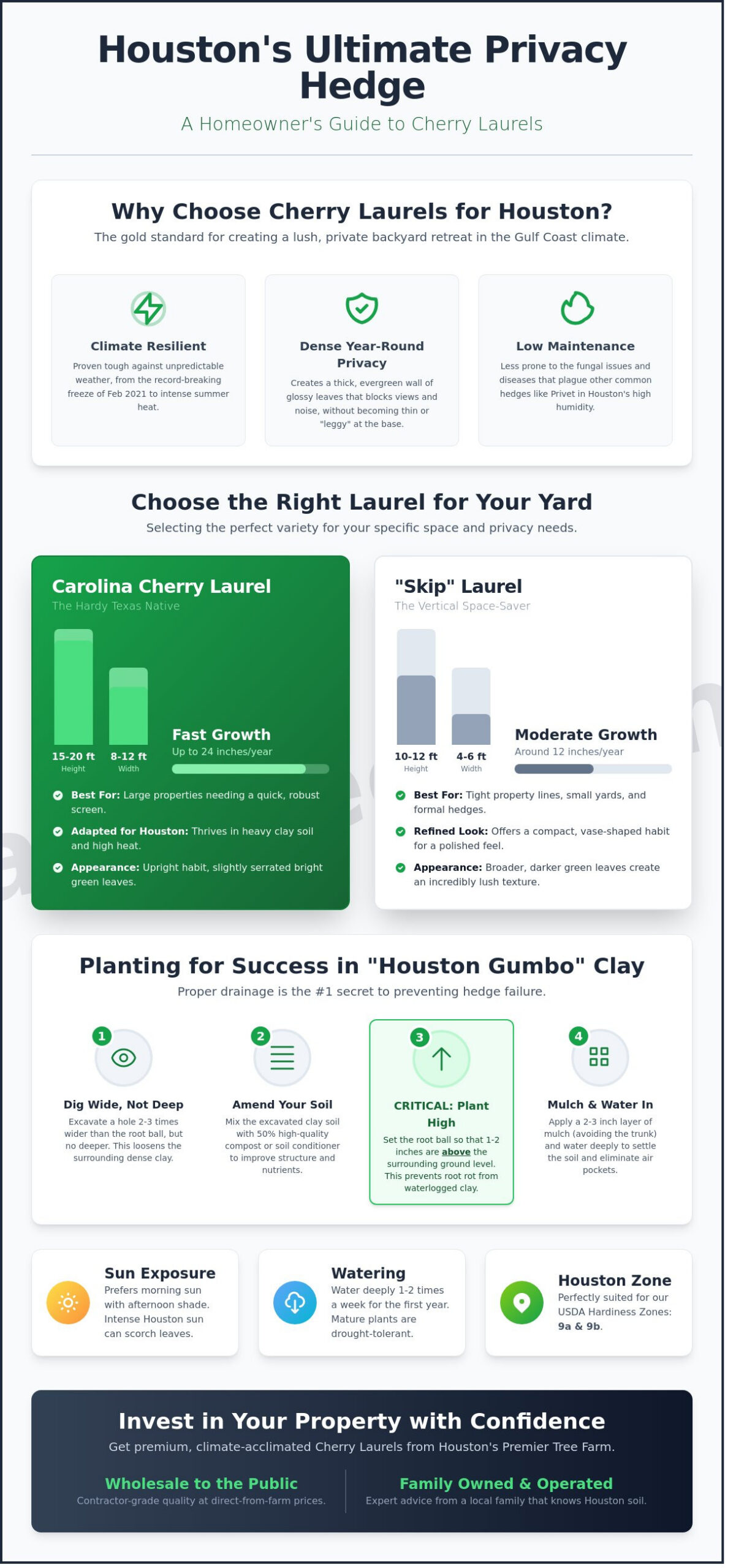
Choosing between varieties often comes down to your specific microclimate. The Carolina Cherry Laurel is a true Texas native. It thrives from the 4th Ward to the suburban stretches of Cypress because it has evolved to handle our heat and heavy clay. Native varieties are typically more drought-tolerant once established and show better resistance to local pests. In contrast, English Laurel varieties like “Skip” or “Otto Luyken” offer a more refined, compact look. These are excellent choices for smaller garden beds or areas with filtered afternoon shade. The Texas native version features a more upright growth habit and slightly serrated leaf edges, while the English types provide a broader, darker green leaf texture that feels incredibly lush in a landscape design.
Why Houston Landscapers Prefer Laurels Over Privet
Professional landscapers often steer clients away from Privet in favor of laurels for several technical reasons. While Privet grows fast, it often lacks the longevity and disease resistance required for Houston’s 90 percent humidity levels. Cherry laurels are less prone to the thinning and fungal issues that plague other hedge plants. They maintain a dense, year-round visual barrier that doesn’t become “leggy” or transparent at the bottom. We provide these premium specimens Wholesale to the Public, ensuring you get contractor-grade quality at a fair price. This direct-from-the-farm advantage allows you to install a mature, dense screen immediately rather than waiting years for a thin hedge to fill in. It’s a hassle-free way to secure your perimeter with a plant that actually belongs in a Texas landscape.
Choosing the Right Cherry Laurel Variety for Your Houston Landscape
Selecting a cherry laurel for your property requires more than just picking a green bush. Houston sits in USDA Zone 9a and 9b, where 100-degree summer days and high humidity dictate which plants thrive and which struggle. Growth rates vary significantly between cultivars. Some varieties add 24 inches of height per year, while dwarf versions grow at a modest 6 to 10 inches annually. If you need a visual barrier by next season, speed matters. If you have a small patio in West University, a slower, controlled growth rate prevents the plant from overtaking your living space.
Sun exposure is your second biggest factor. While these plants are adaptable, the intense afternoon sun in the Bayou City can scorch leaves. Most varieties prefer filtered light or morning sun with afternoon shade. For a detailed look at cultivar differences and potential issues like shot hole disease, this Clemson Extension guide to laurels provides excellent technical background for southern growers. We recommend assessing your yard’s square footage before buying. A variety that matures to 12 feet wide will quickly crowd out a narrow side yard.
The “Skip” Laurel (Schipkaensis): The Vertical Champion
The Skip laurel is the ultimate solution for tight property lines in neighborhoods like The Heights or Montrose. It features a naturally narrow, vase-shaped growth habit, reaching heights of 10 to 12 feet while staying only 4 to 6 feet wide. This verticality provides a dense privacy screen without stealing valuable yard space. It’s also incredibly hardy. During the historic February 2021 winter storm, Skip laurels across Houston showed remarkable resilience compared to more tropical alternatives. It’s a reliable, tough choice for homeowners who want a classic look that survives local weather extremes.
The “Otto Luyken”: The Compact Foundation Solution
If you need a cherry laurel that stays low, the Otto Luyken is the dwarf variety of choice. It typically matures at 3 to 4 feet tall but can spread 6 feet wide, making it perfect for planting under windows or along walkways. In professional Houston 3D landscape designs, we often use this variety to create layered textures. To keep your Otto Luyken healthy, ensure it has plenty of airflow. Its dense foliage can trap moisture in our humid climate, so periodic thinning helps prevent fungal issues. You can view our current inventory to see how these compact specimens look in person.
Native Carolina Cherry Laurel: The “Bright ‘n Tight” Choice
The “Bright ‘n Tight” cultivar is a refined version of the native Carolina species. It’s a local favorite because it’s already adapted to the Texas Gulf Coast. This variety is exceptionally drought-tolerant once established, meaning it won’t drive up your water bill during a dry Houston July. It features smaller, glossier leaves than the European varieties and produces black berries that are a vital food source for local bird populations. As a Family Owned & Operated business, we appreciate plants that give back to the local ecosystem while providing the “Wholesale to the Public” value our customers expect from Houston’s Premier Tree Farm.
Planting Cherry Laurels in Houston: Overcoming Clay Soil and Drainage
Houston soil is famous for “Gumbo,” a heavy, expansive clay that holds water like a sponge. This density is the primary cause of root rot for a new cherry laurel. At Verdant Tree Farm, we see many homeowners struggle with drainage issues that are unique to the Gulf Coast. Without proper site preparation, your investment can suffer from “wet feet” within 14 days of heavy rain. To ensure a dense privacy screen, space your plants 3 to 5 feet apart from center to center. For a standalone specimen tree, provide at least 12 feet of clearance from other structures. Dig your hole twice as wide as the root ball but only as deep as the root flare. This allows roots to spread horizontally into loosened soil. As Houston’s Premier Tree Farm, we recommend amending our native alkaline clay with 30% organic compost and 20% expanded shale to improve aeration and soil structure.
Pre-Planting: The Percolation Test
Don’t guess about your drainage. Dig a hole 12 inches deep and fill it with water. If the water remains in the hole after 24 hours, your site has poor drainage. In these scenarios, we suggest planting on a berm or in a raised bed. Raising the root ball 6 to 8 inches above the surrounding grade prevents water from pooling around the trunk. Our professional installation team often utilizes this technique in neighborhoods with high clay content to ensure long-term survival. Consulting with an expert helps you avoid common pitfalls of the Carolina Cherry Laurel, which requires well-drained conditions to maintain its vibrant green canopy.
The Planting Process: Root Balls and Soil Mixes
Handling large specimen trees requires physical care and technical precision. We are Family Owned & Operated, and we treat every tree with the respect a living investment deserves. Never lift a cherry laurel by the trunk. Always support the weight of the root ball to prevent internal root damage. Mix your native soil with high-quality compost before backfilling the hole. This blend creates a necessary transition zone for new feeder roots. After planting, apply a 3-inch layer of shredded hardwood mulch. Keep the mulch 2 inches away from the trunk base to prevent bark decay. This setup retains essential moisture during 100-degree Texas summers while preventing soil compaction. We offer these professional-grade materials Wholesale to the Public to ensure your landscaping project succeeds from day one.
Caring for Your Laurels: Managing Houston Heat, Pests, and Pruning
Maintaining a healthy cherry laurel in the Houston area requires a strategy tailored to Zone 9 conditions. Our local climate presents unique challenges, from 100 degree summer afternoons to the high humidity levels that characterize the Bayou City. Success starts with a consistent maintenance routine that prioritizes root health and air circulation. As Houston’s Premier Tree Farm, we’ve seen that a proactive approach saves homeowners time and protects their landscape investment.
Summer Survival: Irrigation and Heat Stress
Establishing a new hedge requires a strict watering schedule. For the first 90 days after installation, water your laurels three times per week. Use the Deep Soak method rather than light daily misting. Light watering only reaches the top 2 inches of soil, which evaporates quickly in the Texas sun. Instead, run a soaker hose for 30 to 45 minutes to ensure moisture reaches the entire root ball. Once established, you can reduce this to once or twice a week depending on rainfall.
Distinguishing between heat stress and fungal issues is vital. Heat stress typically shows as drooping leaves during the hottest part of the day, which usually recover by sunset. If leaves turn yellow or develop brown spots that don’t go away, it’s often a sign of overwatering or poor drainage. Our team at Verdant Tree Farm offers maintenance consultations to help homeowners diagnose these issues before they compromise the entire hedge.
Pest Control and Fungal Prevention
The most common issue for Houston laurels is Shot-Hole disease. This fungus thrives in our 80% humidity levels and creates small, circular holes in the foliage, making the leaves look like they were hit by birdshot. To prevent this, improve air circulation by spacing plants at least 3 to 5 feet apart. Don’t use overhead irrigation, as wet leaves are breeding grounds for spores. Keeping the foliage dry is the secret to disease-free laurels.
For pests like scale and aphids, we recommend an integrated approach:
- Organic Options: Apply neem oil or insecticidal soap during the cooler evening hours to avoid leaf burn.
- Chemical Treatments: Use systemic insecticides in early spring for long-term protection against heavy infestations.
- Manual Care: Prune away heavily infested branches to stop the spread immediately.
Prune your cherry laurel in late winter or early spring before new growth begins. Trimming the top and sides encourages the plant to push out lateral branches, creating the thick, dense wall needed for privacy. Fertilize twice a year, once in March and again in early September, using a balanced 10-10-10 slow-release formula. This schedule provides nutrients without the risk of nitrogen burn during the peak of summer heat.
Why Buy Cherry Laurels from Houston’s Premier Tree Farm?
Choosing the right cherry laurel involves more than just a trip to a big-box store. It requires a partner who understands the unique demands of the Gulf Coast climate. At Verdant Tree Farm, we provide a “grown for Houston, by Houstonians” approach that ensures every tree is acclimated to our local heat and soil conditions. As Houston’s Premier Tree Farm, we operate at a scale that allows us to offer wholesale to the public. This means you receive premium specimen trees at an unbeatable value, bypassing the retail markups found elsewhere.
Our veteran-owned status drives our commitment to quality and personal accountability. We don’t just sell products; we provide a complete, turn-key service. Our team manages every step of your landscaping project, including:
- Custom 3D landscape designs to visualize your new privacy hedge.
- Professional delivery and precision planting by experienced crews.
- Direct access to horticultural experts who know Houston’s neighborhoods.
We take pride in our work and our community. We aren’t just a nursery; we’re a dependable partner for your home’s long-term growth.
The 3-Month Warranty and Peace of Mind
Investing in large privacy hedges is a significant commitment to your property’s value. We protect that investment with a comprehensive 3-month warranty on our trees. This 90-day window is essential for ensuring your cherry laurel successfully transitions to its new environment. Our “can-do” attitude means we handle the complex logistics of delivery and planting, taking the stress off your shoulders. When you work with us, you’re supporting a family-owned and operated local business that prioritizes long-term relationships over quick sales.
Visit Our Houston Nursery Today
You can’t fully appreciate the scale of our inventory until you walk through Houston’s largest independent nursery. Spanning over 20 acres, our facility allows you to hand-select the exact specimen trees that will frame your home. Our on-site experts are ready to provide personalized advice tailored to your specific neighborhood, whether you’re dealing with the clay soils of Katy or the shaded lots of Memorial. We make the process simple, professional, and successful.
Ready to transform your backyard into a private sanctuary? View our current inventory of Cherry Laurels and Privacy Shrubs and see why we’re the trusted choice for Houston homeowners.
Start Your Houston Privacy Project Today
Creating a lush, evergreen sanctuary in your backyard requires a plan tailored to the Bayou City’s unique environment. You now understand how to choose the right variety for your space and how to navigate the heavy clay soil that defines many local landscapes. Success depends on managing the intense Texas heat and ensuring your drainage is set up for long-term health. A healthy cherry laurel hedge offers a premium, vibrant screen that blocks out noise and neighbors alike. At Verdant Tree Farm, we make this transformation simple. As Houston’s largest independent tree nursery, we provide high-quality specimen trees directly to the public at wholesale prices. Our veteran-owned and operated team is ready to grow, deliver, and install your new landscape with professional precision.
Every tree we install includes a 3-month warranty, giving you peace of mind that your investment is protected. Our experts ensure every plant is hardy enough for the specific heat zones found throughout Southeast Texas. Stop dreaming about a private backyard and start building one with the help of our local experts. Get a Free Landscaping Quote & 3D Design Consultation today to see how we can elevate your property. Your perfect outdoor retreat is just one phone call away.
Frequently Asked Questions
Are Cherry Laurels toxic to dogs and cats in Houston?
Yes, the ASPCA confirms that these plants are toxic to dogs, cats, and horses. Every part of the shrub contains cyanogenic glycosides, which release cyanide when chewed or swallowed. Symptoms include dilated pupils and difficulty breathing. We suggest keeping pets away from the foliage. Our team can help you select pet-safe alternatives if your backyard is a dedicated play area for animals.
How fast do Cherry Laurels grow in the Texas climate?
In our local soil, these shrubs grow 12 to 24 inches every year. This rapid pace helps homeowners establish a 15-foot privacy screen in just a few seasons. As Houston’s Premier Tree Farm, we see these plants reach their full potential quickly when provided with consistent irrigation and mulch. They’re one of the most efficient options for fast-growing evergreen coverage.
Can Cherry Laurels survive a hard freeze in Houston?
They absolutely survive our winters, as they’re cold-hardy down to 0 degrees Fahrenheit. During the historic 2021 freeze, these evergreens proved their resilience across Southeast Texas while other tropical hedges failed. They’re rated for USDA Zones 7 through 9. This makes them a reliable, long-term investment for your property that won’t require replacement after a typical cold snap.
What is the best time of year to plant a Cherry Laurel in Houston?
The best time to plant is from October through February. Planting during these cooler months allows the root system to establish before Houston’s 90-degree summer temperatures arrive. It’s the most effective way to reduce transplant shock. At Verdant Tree Farm, we offer professional delivery and installation during this peak window to ensure your new hedge thrives from day one.
How far apart should I space Cherry Laurels for a privacy hedge?
Space your plants 3 to 5 feet apart from the center of each root ball to create a thick wall. Choosing a 3-foot gap creates a seamless barrier within 24 months. As a family owned and operated business, we provide the cherry laurel at wholesale prices so you can afford the high-density planting required for total backyard seclusion.
Do Cherry Laurels need full sun to grow in Houston?
These shrubs are versatile and grow well in full sun or partial shade. They require at least 4 to 6 hours of direct light to maintain dense foliage. In the intense heat of July and August, afternoon shade helps prevent leaf scorch. This flexibility makes them a top choice for Houston landscapes that have a mix of open areas and canopy trees.
How do I stop my Cherry Laurel leaves from getting holes in them?
Holes in leaves are usually caused by shothole disease, a common fungal or bacterial issue in humid climates. You can stop this by applying a copper-based fungicide during the wet spring months. Ensure you don’t use overhead sprinklers, as wet leaves spread the spores. Pruning out affected branches also improves airflow and keeps your hedge looking vibrant and healthy.
What is the difference between a Cherry Laurel and a Texas Mountain Laurel?
The main difference is growth rate and appearance. A cherry laurel is a vigorous grower used for screening, while the Texas Mountain Laurel grows less than 6 inches annually and produces purple, grape-scented flowers. One provides immediate privacy, while the other serves as a slow-growing specimen tree. We offer both varieties wholesale to the public to suit your specific goals.