What if your backyard could smell exactly like a fresh bottle of grape soda every spring while requiring almost no water? Finding a Texas Mountain Laurel Houston homeowners can rely on for year-round privacy and stunning purple blooms is a common goal, but the path to a healthy specimen often feels daunting. You likely already know these trees are legendary for their fragrance and drought tolerance. However, you might also feel stuck worrying about their notoriously slow growth rates or those frustrating Genista broom moth caterpillars that can strip a young tree overnight.
We understand that you want a landscape that adds value and beauty without becoming a high-maintenance chore. It’s a smart investment for your property, especially with Houston’s Natural Area Ordinance now supporting native habitats. This guide simplifies the entire process. You’ll discover how to navigate local clay soils to ensure your tree survives its first critical years. We also address seed toxicity concerns and provide professional tips on where to buy the healthiest stock. From expert planting advice to long-term care strategies, you’re about to learn how to turn this legacy tree into the centerpiece of your garden.
Key Takeaways
- Discover why the iconic grape-soda fragrance and evergreen foliage make this tree a top choice for year-round structure.
- Learn how to manage the slow growth rate of the Texas Mountain Laurel Houston homeowners often find challenging.
- Identify the specific pests and drainage signs that can threaten your tree and learn how to stop them before they start.
- Master the professional technique of “planting high” to ensure your tree survives the heavy clay soil common in our region.
- Find out how buying nursery-direct with professional installation provides a long-term investment backed by local expertise.
Why Texas Mountain Laurel is a Houston Landscape Essential
Houston landscapes require plants that work as hard as the homeowners who maintain them. The Texas Mountain Laurel (Dermatophyllum secundiflorum) is a standout choice because it thrives in our intense humidity and heat without demanding constant attention. It isn’t just a tough native plant; it’s a structural powerhouse. For anyone looking for a Texas Mountain Laurel Houston nursery can provide, understanding its role as a multi-functional evergreen is the first step toward a successful garden.
Native plants are the backbone of a sustainable local garden. This species has evolved to handle the feast-or-famine rainfall cycles of Texas. Once established, it requires very little supplemental water, which is a major relief during our long, dry summers. It’s a “set-and-forget” option that looks like a high-maintenance luxury tree but acts like a rugged survivor. This resilience is why it’s a staple for both professional landscapers and weekend gardeners who value longevity over temporary fixes.
The “Grape Soda” Tree: A Sensory Experience
Evergreen Beauty for Year-Round Privacy
While the flowers get the headlines, the foliage does the heavy lifting. The leaves are thick, leathery, and glossy. They stay deep green through the scorching August heat and our occasional winter freezes. This makes the tree an excellent candidate for a specimen plant or a dense privacy screen. It provides a consistent backdrop that complements other flowering trees for Houston like Redbuds or Desert Willows. It offers a permanent green wall that doesn’t disappear when the temperature drops.
Because it’s a slow-grower with a mature height usually between 15 and 25 feet, it fits perfectly in modern, smaller suburban lots. You won’t have to worry about it overgrowing its space or interfering with power lines. It provides the privacy you need without the aggressive root systems of larger oaks. Whether you’re a contractor looking for a reliable anchor for a new build or a homeowner refreshing an old bed, this tree offers the perfect balance of aesthetic appeal and functional design.
Growth and Characteristics in the Houston Climate
Understanding the growth patterns of a Texas Mountain Laurel Houston homeowners choose is essential for proper landscape planning. Unlike the rapid growth seen in some shade trees, this species is a slow to moderate grower. It typically adds only a few inches of height each year. While this requires patience, the result is a dense, sturdy wood structure that resists wind damage and heavy storms. This measured pace makes it a stable, long-term investment that won’t outgrow its designated space in a few seasons.
Sunlight is the primary driver for a healthy bloom cycle. While these trees tolerate partial shade in our region, full sun is best for maximizing those purple flower clusters. In the Houston climate, some afternoon shade can actually help protect the foliage during record-breaking 100-degree days. However, too much shade will lead to a leggy appearance and fewer flowers. According to the Texas Mountain Laurel plant profile, the species is highly adaptable to various soil types, though it naturally prefers the well-drained conditions found in its native range.
Size and Structure Expectations
In the Gulf Coast region, you can expect a mature height of 15 to 25 feet. This makes it an ideal small tree for suburban yards. When shopping, you’ll often find two distinct forms: multi-trunk and single-trunk. Multi-trunk specimens offer a more natural, shrub-like appearance that works well for privacy screens. Single-trunk versions are pruned to look like traditional miniature trees, perfect for focal points near entryways. Because it takes a decade or more to reach full maturity, many people prefer starting with a larger specimen from a local tree nursery to get an immediate impact.
Hardiness and Resilience
Houston sits in USDA Zones 8b and 9a, which is the “sweet spot” for this plant. It’s remarkably hardy. During recent historic freezes that damaged many non-native tropicals, established Mountain Laurels generally performed well. They are built for temperature swings. Additionally, they possess a surprising level of salt tolerance. This makes them a viable option for properties in South Houston or even closer to the coast near Galveston. They handle the salty air and occasional wind spray better than many other flowering ornamentals.
Safety is a final consideration regarding the “Mescal Bean” seeds. The tree produces woody pods containing bright red, hard seeds. These seeds are highly toxic if ingested. If you have small children or curious pets, simply snip the seed pods off after the blooming season. This not only keeps your family safe but also directs the plant’s energy back into new foliage growth rather than seed production.
Overcoming Houston-Specific Growing Challenges
Growing a healthy Texas Mountain Laurel Houston gardeners can be proud of isn’t just about planting; it’s about active defense. While this native species is incredibly hardy, our local environment presents two specific hurdles: heavy clay and a very hungry caterpillar. Success depends on recognizing these issues early and resisting the urge to over-manage. This tree thrives on a “less is more” philosophy, provided the foundation is correct.
One common myth is that this tree only grows in the rocky, limestone soil of the Hill Country. While it certainly loves those conditions, it’s remarkably adaptable to our coastal plains. The secret isn’t changing the soil chemistry entirely but managing how water moves through it. Most failures in our area come from “wet feet” rather than poor soil quality. If you see yellowing leaves or a sudden drop in foliage, it’s often a sign that the roots are suffocating in standing water.
Managing the Genista Broom Moth Caterpillar
Late spring brings the most significant threat to your tree’s foliage. The Genista broom moth caterpillar is the primary pest for this species in our region. These small, greenish-yellow larvae can defoliate a young tree in a matter of days. You’ll first notice tell-tale silk webbing on the branch tips, similar to what you might see with webworms. Catching them early is vital for maintaining the tree’s aesthetic appeal.
For organic control, Bacillus thuringiensis (Bt) is highly effective if applied while the caterpillars are still small. If the infestation is more advanced, Spinosad-based products provide a stronger knockdown. We recommend a weekly inspection starting in April. Simply look for the webbing or “shotholes” in the new leaves. A proactive monitoring schedule ensures your tree stays lush and full throughout the growing season.
Addressing the Houston Clay Challenge
Our heavy “gumbo” clay is the biggest killer of Texas Mountain Laurels. In a typical Houston yard, clay acts like a bowl that traps water around the root ball. This leads to root rot, which is often mistaken for dehydration. Before you reach for the hose, check the soil moisture a few inches down. For homeowners struggling with established trees in low-lying areas, professional maintenance consultations can help identify drainage solutions like French drains or raised berms.
Remember that as a native legume, this tree is a “nitrogen fixer.” It works with soil bacteria to create its own nutrients. Heavy fertilizing often backfires by producing weak, succulent growth that caterpillars love. This Texas Mountain Laurel growing guide highlights that a simple layer of organic mulch is usually enough to keep the soil healthy. Avoid high-nitrogen lawn fertilizers near the base of the tree to ensure it grows at a natural, sturdy pace.
How to Plant Texas Mountain Laurel in Houston Clay
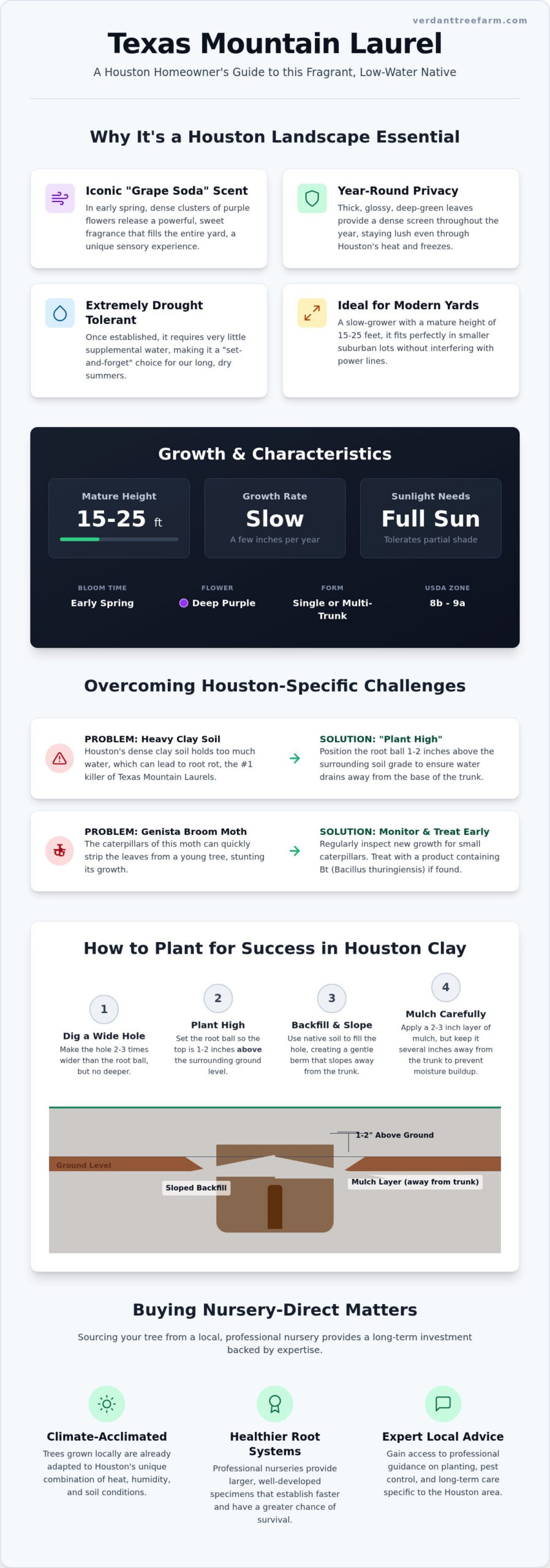
Success with a Texas Mountain Laurel Houston project starts with the hole you dig. In our heavy gumbo clay, traditional planting methods often lead to failure because the soil holds too much moisture. You must treat the planting site as a drainage project rather than just a gardening task. Because these trees are slow growers, giving them the best possible start is a long-term investment in your property’s value. Choosing a professional installation ensures that the technical details of soil elevation and drainage are handled correctly from day one.
The “Mound” Method for Better Drainage
The “mound” method involves planting the tree slightly above the surrounding grade to prevent the root ball from sitting in a pool of water during heavy rains. You should aim to have the top third of the root ball resting above the natural ground level. Build a wide, sloping mound around this exposed area using a mix of native soil and high-quality amendments. We recommend blending in expanded shale or coarse compost to break up the dense clay particles and create air pockets for the roots. This mound should be at least two to three times the width of the root ball to allow for lateral root expansion.
Establishment and First-Year Care
Your watering schedule is the most critical factor during the first 90 days. For the first two weeks, water the tree every other day to settle the soil and keep the roots hydrated. From week three through the end of the first three months, transition to twice a week, depending on rainfall. Once the first year passes, the tree becomes significantly more drought-tolerant. However, you must avoid over-mulching the trunk. Don’t pile mulch against the bark in a “volcano” shape, as this traps moisture and invites fungal rot. Instead, keep mulch a few inches away from the base of the tree.
Houston’s spring weather often brings high winds that can lean a newly planted tree. Use a basic staking kit for the first six to twelve months to keep the tree upright while it anchors itself into the clay. If you’re unsure about the proper depth or soil mix for your specific lot, the team at Verdant Tree Farm is ready to help you get it right. Proper placement and professional technique are the keys to ensuring your “Grape Soda Tree” survives and thrives for decades to come.
Buying Nursery-Direct: Why Sourcing Locally Matters
When you’re ready to invest in a Texas Mountain Laurel Houston homeowners often worry about whether the plant has been properly acclimated to our local humidity and clay. Sourcing your tree from a massive, multi-state retailer often means getting stock that was grown in a completely different climate. Buying nursery-direct ensures your tree was raised with the specific challenges of the Gulf Coast in mind. It’s the difference between a plant that struggles to survive and one that thrives from the moment it hits the ground.
Selecting a tree that has been cared for by local experts is a smart, direct way to ensure success. Our regional market leadership isn’t just about size; it’s about the deep connection we have to the Houston soil. We know exactly what it takes to get a native species through its first summer. This local expertise translates into a more reliable product for your home or job site.
The Verdant Tree Farm Advantage
Choosing the largest independent tree nursery in Houston gives you access to a massive inventory that smaller retail centers simply can’t match. You can walk the rows and hand-select the exact specimen that fits your vision. As a veteran-owned and operated enterprise, we take personal accountability for every tree we sell. We eliminate middleman markups to provide direct-to-consumer value that makes your landscaping budget go further.
This isn’t just a transaction; it’s a long-term investment in your property. To back that up, we provide a three-month warranty on our trees. This guarantee provides the peace of mind you need when adding a slow-growing legacy tree to your yard. Our staff understands the technical anatomy of native Texas varieties and can guide you through the selection process with ease.
Visualize Your Landscape with 3D Design
One of the biggest hurdles in landscaping is knowing where to put a tree for the best visual impact. Our 3D landscape design services allow you to see your project before the first shovel hits the dirt. This digital visualization helps prevent costly planting mistakes, like placing a sun-loving Laurel in a future shade pocket. You can see how to pair your new addition with other evergreen trees in Houston to create a layered, professional look that provides year-round privacy.
We encourage you to visit the farm in person to see mature examples of the Texas Mountain Laurel. Seeing the scale and smelling the fragrance for yourself makes the decision process straightforward and uncomplicated. We’re proud to be a dependable partner for our neighbors, helping you grow a regional legacy that lasts for generations. Our team is equipped to handle projects of any scale, ensuring your landscape remains a point of pride for years to come.
Start Growing Your Houston Legacy Today
Investing in a Texas Mountain Laurel Houston is a commitment to a more fragrant, low-maintenance future for your yard. By mastering the mound planting method and keeping a watchful eye for spring caterpillars, you ensure this iconic tree thrives for decades. It’s a structural anchor that provides year-round privacy and that unmistakable grape-soda scent every spring. You don’t have to navigate the complexities of Houston soil alone; we’re here to provide the expertise and stock you need.
As Houston’s largest independent tree nursery, we make it easy to select the perfect specimen for your specific property. Our veteran-owned and operated team understands the local climate better than anyone. We stand behind our work with a three-month warranty on all trees we install, giving you total confidence in your investment. Whether you’re a homeowner looking for a new focal point or a professional contractor needing reliable inventory, we have the capacity to handle your project.
Browse our Texas Mountain Laurel inventory and request a quote today! We look forward to seeing you at the farm and helping you build a landscape that lasts.
Frequently Asked Questions
Are Texas Mountain Laurel seeds poisonous to dogs and children?
Yes, every part of the tree is toxic, especially the bright red seeds. These “mescal beans” contain cystisine, which can be fatal if ingested by pets or children. Because the seeds are hard and red, they often attract curious hands and mouths. We recommend snipping off the seed pods after the flowering season ends to eliminate this risk. This simple maintenance step keeps your family safe while helping the tree focus its energy on new foliage growth.
How fast does a Texas Mountain Laurel grow in Houston?
Growth rates for the Texas Mountain Laurel Houston homeowners plant are notoriously slow. You can typically expect only a few inches of new height each year, though younger trees may grow slightly faster under ideal conditions. This slow pace is exactly why many people choose to buy larger, more mature specimens from a nursery. While it requires patience, the result is a dense, strong wood structure that withstands local storms and high winds much better than fast-growing alternatives.
Can Texas Mountain Laurel grow in full shade?
No, these trees won’t thrive in full shade and often become leggy or sparse. They require at least six hours of direct sunlight to produce their iconic purple flower clusters and maintain a dense, evergreen shape. While they can tolerate some partial afternoon shade in the intense Houston heat, too much shade prevents blooming and weakens the plant. For the best results, place your tree in an open area with plenty of southern or western exposure.
What is the best time of year to plant a Texas Mountain Laurel in Houston?
Fall and early spring are the ideal planting windows to avoid the stress of summer heat. Planting between October and March allows the root system to establish itself before the ground temperatures soar. However, because we provide professional installation and specialized soil amendments, we can successfully plant these trees year-round. If you plant during the summer, you must be extremely diligent with your initial watering schedule to ensure the root ball doesn’t dry out in the clay.
Why are the leaves on my Texas Mountain Laurel turning yellow?
Yellowing leaves are almost always a sign of poor drainage or overwatering. In our heavy Houston clay, water often pools at the bottom of the planting hole, leading to root rot. This suffocates the tree and prevents it from taking up nutrients. If you notice yellowing, check the soil moisture levels several inches down. You may need to adjust your irrigation or consult with a professional to improve the drainage around the base of the tree.
How do I get rid of caterpillars on my Texas Mountain Laurel?
The Genista broom moth caterpillar is the most common pest you’ll face. These larvae create silk webbing and can quickly eat through new growth. To control them, apply an organic spray containing Bacillus thuringiensis (Bt) as soon as you see the first signs of webbing. For larger infestations, Spinosad-based products are a reliable alternative. Regular monitoring during the spring and summer months is the best way to catch these pests before they cause significant aesthetic damage.
Does Texas Mountain Laurel need a lot of water once established?
No, this is one of the most drought-tolerant trees available for our region. Once the root system is fully established, usually after the first year, it requires very little supplemental water. It’s designed to survive on natural rainfall alone, even during dry Texas summers. Overwatering is actually a bigger threat than underwatering. Only provide extra water during extreme, prolonged droughts when you notice the leaves beginning to curl or lose their usual glossy sheen.
How big do Texas Mountain Laurels get in the Houston area?
You can expect a mature height of 15 to 25 feet with a similar spread. This small to medium stature makes the Texas Mountain Laurel Houston residents’ favorite choice for small suburban lots and narrow privacy screens. While they can occasionally grow larger in their native limestone habitats, our local soil and humidity levels generally keep them within this manageable range. They’re easily pruned to maintain a specific height or to encourage a more tree-like, single-trunk form.