What if the secret to a thriving tropical paradise in your backyard isn’t the Texas sun, but how you manage our notorious “gumbo” clay? Many homeowners plant these majestic trees only to face the heartbreak of yellowing, “frizzled” top leaves or the anxiety of a sudden winter freeze. You want a landscape that adds real property value, not a list of maintenance headaches. We understand that frustration because we’ve spent generations helping Houstonians navigate these exact regional challenges.
Effective Queen Palm care Houston requires a specialized approach to overcome our area’s naturally alkaline soil. Approximately 85% of Texas soils have a high pH that blocks essential nutrients, leading to the common issue of frizzle top. This guide provides the expert blueprint you need to master the essentials of growing lush, healthy palms in our unique climate. You’ll learn how to improve drainage in heavy clay through proper mounding, select the right slow-release fertilizers, and implement proven winter protection techniques. We’re here to simplify the technical side of horticulture so you can enjoy vibrant green fronds year-round with total confidence.
Key Takeaways
- Learn how to conquer “Houston Gumbo” clay by using proper mounding and wide-hole digging techniques to prevent root rot and ensure drainage.
- Identify the early signs of Manganese deficiency to stop “frizzle top” before it damages your palm’s feathery aesthetic.
- Master a tiered winter protection strategy that builds resilience against unpredictable freezes through strategic mulching and trunk wrapping.
- Discover why professional installation and local acclimation are the foundations of successful Queen Palm care Houston for long-term property value.
- Understand the benefits of sourcing trees directly from a local, veteran-owned nursery to ensure your landscape starts with healthy, acclimated specimens.
Why Queen Palms (Syagrus romanzoffiana) are Houston Favorites
The Queen Palm, botanically known as Syagrus romanzoffiana, has earned its place as a staple in Southeast Texas landscapes. Its appeal starts with a classic silhouette: feathery, arching fronds and a smooth, stately grey trunk. For homeowners in new Houston developments, the primary draw is often the growth rate. These palms are the fastest-growing variety in our area. Under ideal conditions, they can add 12 to 18 inches of trunk height annually. This makes them a perfect solution for creating quick privacy or a lush canopy in a short timeframe. They offer a sophisticated look that instantly elevates the curb appeal of any property.
While they are technically tropical, these palms require a specific management plan to survive long-term in our region. They aren’t “set it and forget it” plants. Success requires a partnership between the homeowner and the environment. You get the beauty of the tropics, but you must provide the specific nutrients and drainage that our local geography lacks. We see them as a high-reward investment for those willing to follow a few straightforward maintenance steps.
The Tropical Aesthetic in a Coastal Prairie
While our native oaks provide excellent shade, they don’t capture the “resort look” that many homeowners crave. Queen Palms deliver that high-end vacation feel instantly. Because of their tall, slender profile, they are ideal for adding vertical interest in narrow side yards where wider trees won’t fit. We often recommend pairing them with shorter, texture-rich species like Mediterranean Fan Palms to create a layered, multi-dimensional garden. This combination balances the tall canopy of the Queen with dense, low-level greenery, making even a small backyard feel like a private escape.
Queen Palms vs. The Houston Climate
Houston sits firmly in USDA Zone 9. This means our high heat and heavy humidity actually benefit the Queen Palm’s growth. However, our local environment presents a unique paradox. While the air is perfect, the ground is often a challenge. Success with Queen Palm care Houston depends on understanding the 20°F threshold. Mature specimens can typically handle these temperatures, but young palms need extra help. Implementing a proactive strategy for Queen Palm care Houston ensures your landscape remains a long-term asset rather than a temporary fixture.
The heavy clay in our region is the biggest obstacle. It holds water too long and lacks the acidity these palms prefer. To ensure your investment survives, it’s vital to source acclimated stock from a reputable tree nursery Houston. Locally grown palms are already adjusted to our specific light cycles and humidity levels. This gives them a significant head start over trees shipped in from different climates. Proper care isn’t just about planting; it’s about active intervention to manage the soil and protect the tree’s core during the winter months.
Planting for Success in Houston Clay Soil
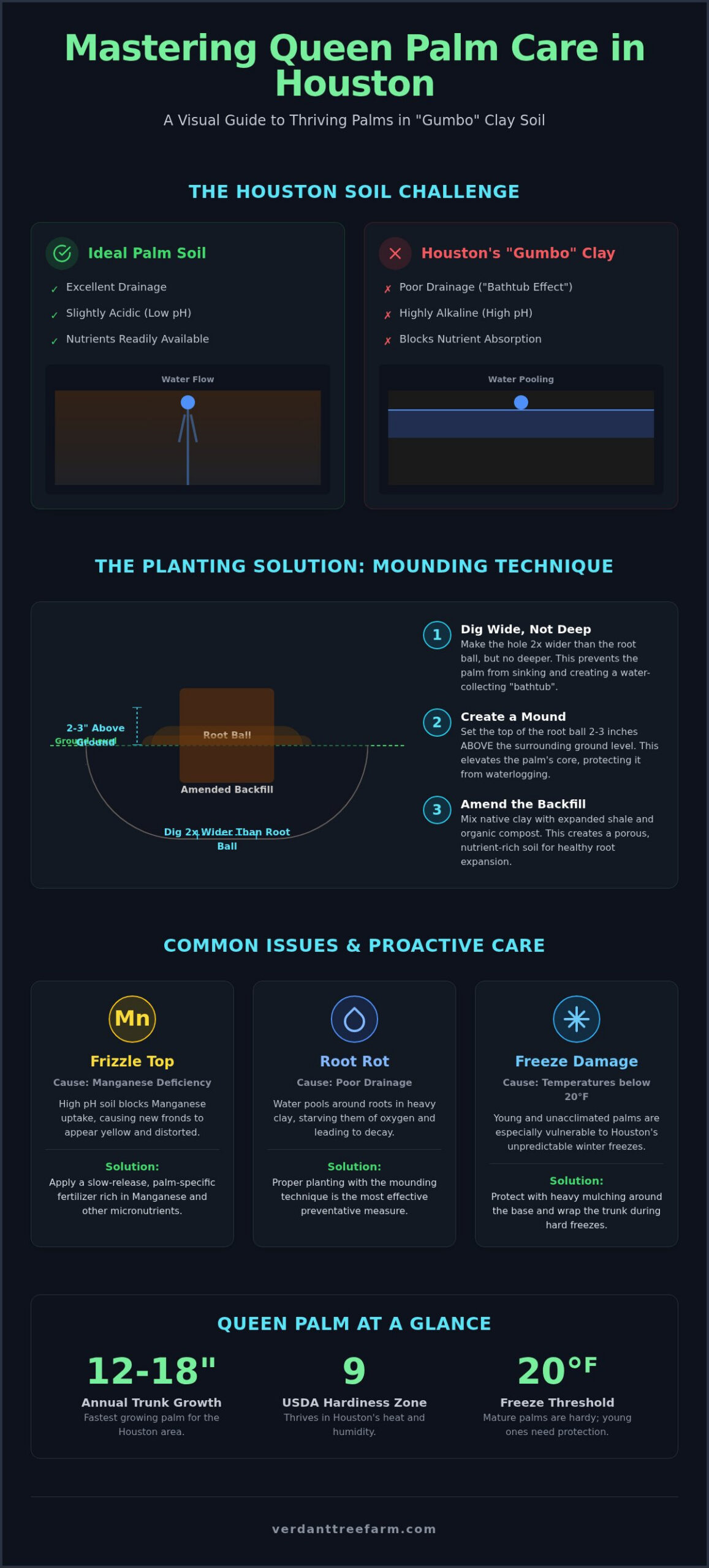
Houston’s “black gumbo” clay is the single greatest hurdle for new trees. It’s thick, poorly aerated, and holds moisture like a sponge. For successful Queen Palm care Houston, you must change how you think about planting. Most generic guides suggest digging a hole and dropping the plant in. In our region, that creates a “bathtub effect” where water collects around the roots and cannot escape. This lack of oxygen is the primary reason young palms fail within their first year.
Follow these three steps to give your palm a fighting chance in our heavy soil:
- Step 1: Dig Wide, Not Deep. Your hole should be at least twice as wide as the root ball to allow roots to push through loosened soil. However, never dig deeper than the root ball itself. If the palm settles too low, water will pool at the base and drown the plant.
- Step 2: The Mounding Technique. Instead of planting flush with the ground, set the palm so the top of the root ball is 2 to 3 inches above the surrounding grade. Build a gentle mound of soil up to this height. This elevation ensures the heart of the palm stays above the water line during our frequent heavy rains.
- Step 3: Break Up the Clay. Don’t just put the heavy clay back in. Mix your backfill with expanded shale for permanent aeration and organic compost to introduce nutrients. This creates a porous environment where roots can actually breathe and expand.
The Importance of Proper Drainage
Before you even buy a tree, run a “perc test” on your site. Dig a hole 12 inches deep, fill it with water, and see how long it takes to empty. If it takes more than 24 hours, you have a drainage crisis that needs addressing. Standing water in winter is actually more dangerous than the cold itself because it freezes the root zone more effectively. ‘Wet feet’ occurs when a palm’s root system sits in saturated soil for extended periods, leading to oxygen deprivation and rot. If you’re concerned about your site’s health, you might consider a maintenance consultation to evaluate your soil profile.
Soil Amendments for Houston Palms
In alkaline neighborhoods like West University or Bellaire, the soil pH is often too high for palms to absorb minerals. Adding elemental sulfur during planting helps lower this pH over time. We also recommend adding mycorrhizal fungi to the root zone. These beneficial organisms form a symbiotic relationship with the roots, significantly increasing their ability to absorb water and nutrients. Because of the technical nature of soil prep in our region, professional installation is the safest bet for large specimens. It ensures the mounding is precise and the amendments are balanced for long-term health in Queen Palm care Houston.
Watering and Feeding: Preventing ‘Frizzle Top’
Hydration and nutrition are the twin pillars of successful Queen Palm care Houston. For the first 30 days after planting, your palm needs daily watering to settle the soil and keep the root ball hydrated. Once the tree is established, shift to a schedule of deep soaking twice a week. It is vital to monitor local updates regarding City of Houston 2026 water restrictions. These typically prohibit outdoor watering between 10 a.m. and 8 p.m. to conserve resources. Deep watering is better than light, frequent sprays because it encourages roots to grow downward into the cooler clay layers.
Houston’s tap water and soil are naturally alkaline, often hitting a pH between 7.5 and 8.5. This high alkalinity creates a chemical lock that prevents palms from absorbing Manganese, even if it is present in the soil. The result is “Frizzle Top,” a condition where new fronds emerge stunted, yellowed, and looking scorched. Don’t confuse this with Nitrogen deficiency, which usually causes a uniform yellowing of the older, lower leaves. To maintain a lush canopy, your palm requires a steady supply of Nitrogen, Potassium, and Magnesium.
The Queen Palm Feeding Schedule
Timing is everything when it comes to fertilization. We recommend feeding your palms three times a year: Early Spring, Mid-Summer, and Early Fall. Use a slow-release 8-2-12 + 4Mg palm special fertilizer. This specific formulation ensures the tree gets a steady stream of nutrients without the risk of “flash” growth that can be weak and prone to disease. Always apply the fertilizer at the drip line, which is the area directly under the outer edge of the fronds. Never place fertilizer directly against the trunk; this can cause chemical burns and invite pests.
Solving Yellowing and Stunted Fronds
You need to know the difference between old leaf shed and nutrient stress. It’s normal for the bottom-most fronds to turn brown and droop as the tree grows. However, if the newest growth at the top looks “frizzled” or pale, you have an emergency. Manganese Sulfate spikes can provide a quick “green-up” by delivering a concentrated dose of the mineral directly to the root zone. If your palm doesn’t respond to these interventions, or if the stunted growth persists, it’s wise to schedule a maintenance consultation. Professional diagnostics can help determine if the soil pH needs more aggressive adjustment to unlock those essential nutrients.
Winterizing Queen Palms: A Houston Survival Guide
Houston winters have become increasingly unpredictable. While Queen Palms thrive in our summer humidity, they face a real challenge when the temperature drops. Effective Queen Palm care Houston involves a tiered response based on the severity of the forecast. You don’t need to panic every time the thermometer hits 32°F, but you do need a plan. By following a structured protection strategy, you can build resilience into your landscape and protect your investment from the “Northward blasts” that occasionally hit our region.
- Tier 1 (32°F to 25°F): At this level, focus on ground-level protection. Apply a heavy layer of mulch, about 3 to 4 inches deep, around the base. Water your palms deeply 24 hours before the front arrives. Moist soil acts as a heat sink, radiating warmth upward during the night.
- Tier 2 (25°F to 20°F): This is the danger zone for foliage. Wrap the trunk and the “bud,” which is the top center where new fronds emerge, with frost cloth or burlap. Avoid using plastic directly against the plant, as it traps moisture and can cause burn.
- Tier 3 (Below 20°F): For extreme events, you need active heat. String old-fashioned C9 incandescent holiday lights around the trunk and under your wrap. These bulbs emit enough heat to keep the internal temperature just a few degrees warmer, which is often the difference between survival and loss.
After the freeze passes, resist the urge to prune. Those brown, “fried” fronds actually serve as a natural insulation layer for the heart of the palm against any follow-up freezes. Wait until the threat of frost has completely passed in late spring before cleaning up the canopy. If you’re unsure about your tree’s recovery, you can schedule maintenance consultations to get an expert assessment of the damage.
Protecting the Growing Point (The Bud)
The “heart” of the palm is its only growing point. If this central bud survives, the tree can grow an entirely new canopy even if every existing frond turns brown. Water freezing in the bud causes cellular collapse that often leads to fatal heart rot. To prevent secondary infections in damaged tissue, apply a copper fungicide spray into the center of the bud once temperatures rise. This helps stop opportunistic fungi from attacking the weakened core while the tree is in recovery mode.
The Role of Hydration in Cold Hardiness
A thirsty palm is a vulnerable palm. When soil is dry, cold air can penetrate deep into the root zone, potentially killing the shallow roots that Queen Palms rely on for stability and nutrient uptake. Moist soil retains significantly more heat than dry soil. By ensuring your palms are well-hydrated before a freeze, you create a thermal buffer. Combine this with a wide ring of organic mulch to insulate the root system. If you want to ensure your palms are positioned for maximum resilience, our team provides professional installation that includes proper mounding and initial mulching to safeguard your new trees.
Nursery-Direct Queen Palms: The Verdant Advantage
Selecting the right specimen is the foundation of successful Queen Palm care Houston. As the city’s largest independent nursery, we maintain a massive inventory that bypasses the middleman. This direct-to-consumer model ensures you get better value and healthier trees. Our Queen Palms are fully acclimated to local conditions, meaning they’ve already survived our heat and humidity before they reach your yard. Because we’re a veteran-owned business, we take immense pride in our hand-selected inventory and rigorous quality control. We treat every tree as a long-term investment in your home’s legacy. To give you total peace of mind, we back our work with a three-month warranty on every professional installation. If you’re unsure where a palm looks best, our 3D design services help you visualize the finished tropical oasis before we ever break ground.
Expert Installation and Warranty
Our installation teams handle the heavy lifting and technical soil requirements that Queen Palms demand. They don’t just dig a hole; they implement the mounding and amendment strategies necessary to defeat Houston’s heavy clay. We also prioritize stability. During our intense thunderstorm seasons, young palms are vulnerable to shifting. Our crews use professional-grade staking to ensure your trees stay straight and secure while their roots establish. You can view our current selection of palm trees for sale Houston to see the variety of sizes we have ready for immediate delivery.
Beyond the Queen Palm
A great landscape doesn’t stop at one species. To create a balanced and resilient backyard, we recommend pairing your palms with other local favorites. You can add year-round privacy and structure by incorporating evergreen trees Houston. For seasonal interest, we offer a wide variety of flowery trees Houston that provide vibrant blooms against the stately grey trunks of your palms. This comprehensive approach ensures your property maintains its value through every season. If you’re ready to transform your landscape, the best first step is a professional consultation. Our experts will walk your property, test your drainage, and help you build a plan that works for your specific soil type and aesthetic goals.
Build Your Tropical Houston Legacy Today
Mastering Queen Palm care Houston comes down to two critical factors: managing our heavy clay soil and staying ahead of nutrient deficiencies. By implementing the mounding technique and a disciplined fertilization schedule, you can prevent “frizzle top” and ensure your palms thrive for years to come. Remember that winter protection is about building resilience, not just luck. Proper hydration and strategic wrapping during our coldest nights will safeguard the heart of your trees. You don’t have to navigate these technical challenges alone.
As the largest independent tree farm in Houston, we provide the acclimated inventory and local expertise you need to succeed. We’re a veteran-owned and operated team that stands behind our work with a three-month warranty on all professional installations. We’re here to help you design a landscape that increases your property value while providing that sought-after resort aesthetic. Shop Our Acclimated Queen Palms & Get Expert Installation to start your project with a partner you can trust. Let’s work together to grow a lush, vibrant canopy that stands the test of time in our unique Texas climate.
Frequently Asked Questions
How fast do Queen Palms grow in Houston?
Queen Palms are the fastest-growing variety for our local climate. Under ideal conditions with proper Queen Palm care Houston, these trees can add 12 to 18 inches of trunk height annually. This rapid development makes them a favorite for homeowners seeking quick privacy or an immediate tropical canopy in new developments. To sustain this pace, ensure the palm is planted in well-drained soil and fed with appropriate nutrients throughout the growing season.
Why are the tips of my Queen Palm leaves turning brown and crispy?
Brown, crispy tips usually indicate salt buildup from tap water or a lack of deep hydration. Houston’s heavy clay soil can trap salts around the roots, leading to tip burn. You should transition from light surface watering to deep soaking sessions that flush the root zone. However, if the browning is accompanied by distorted new growth, it may be a nutrient deficiency rather than a simple watering issue that requires attention.
Can a Queen Palm survive a Houston freeze?
Mature Queen Palms typically survive temperatures down to 20°F if they are properly winterized. While they are less cold-hardy than Windmill or Pindo palms, they can withstand most Houston winters with proactive protection. You should wrap the trunk and the central bud with frost cloth when a hard freeze is forecast. Providing supplemental heat with C9 lights under the wrap is a proven way to help young trees survive extreme weather events.
What is the best fertilizer for Queen Palms in Texas?
The most effective choice is a slow-release 8-2-12 fertilizer that includes at least 4% Magnesium. This specific ratio addresses the nutritional gaps common in alkaline Texas soils. Because our local ground often locks out essential minerals, using a palm-specific blend is better than a general-purpose lawn fertilizer. Following a schedule for Queen Palm care Houston involves applying these granules at the drip line three times a year during the spring, summer, and early fall.
How often should I water a newly planted Queen Palm?
A newly installed palm requires daily watering for the first 30 days to help the roots establish in the new soil. After this initial period, you can shift to deep soaking two to three times per week. It’s important to monitor City of Houston water restrictions during the summer months to ensure you’re compliant while still providing enough moisture. Always check the soil moisture levels 2 to 3 inches deep before watering to avoid saturating the clay.
When is the best time of year to plant palms in Houston?
Late spring and early summer are the ideal windows for planting palms in Southeast Texas. This timing allows the tree to take advantage of the warm soil temperatures, which are necessary for root growth. Planting during this period gives the palm several months to establish a strong root system before the first winter cold fronts arrive. Avoid planting in late fall, as the tree won’t have enough time to acclimate before the growing season ends.
Should I cut off yellow fronds from my Queen Palm?
You should only remove fronds that are completely brown and dead. Yellowing fronds are often still providing the tree with essential nutrients like potassium and magnesium. If you prune them too early, the tree will simply pull nutrients from the next healthy fronds, accelerating the yellowing process. Additionally, keeping damaged fronds intact during the winter provides an extra layer of insulation for the central bud against frost damage. Only prune when the green has completely vanished.
How do I fix ‘Frizzle Top’ on my palm tree?
Fixing “Frizzle Top” requires a two-step approach involving soil pH adjustment and mineral supplementation. This condition is caused by a manganese deficiency that is common in Houston’s alkaline soil. You can apply manganese sulfate spikes for a quick boost, but you must also lower the soil pH with elemental sulfur to ensure the tree can absorb the mineral long-term. If the new growth remains stunted and distorted, a professional maintenance consultation can help diagnose deeper soil issues.