Your wooden fence is already rotting, and those nosey neighbors aren’t going anywhere. It’s a common Houston headache. You want a real barrier that doesn’t crumble after a few humid seasons or die during a surprise February freeze. The Nellie R Stevens Holly privacy hedge is the heavy-duty, evergreen solution that actually thrives in our heavy clay soil and punishing summer heat. We know how frustrating it is to invest in a landscape only to watch it struggle when the temperature hits triple digits.
You’re about to discover why this specific holly is Houston’s top privacy solution and exactly how to plant it for maximum growth. We’ll walk you through the essential steps to achieve a dense screen, including the best spacing strategies and how to handle our local soil. You’ll learn the professional secrets to helping these plants reach their 25-foot potential while gaining 2 to 3 feet of height every single year. It’s time to trade that decaying wood for a living wall that adds value and peace to your property.
Key Takeaways
- Learn why this vigorous evergreen hybrid is the gold standard for Houston homeowners seeking a permanent, living fence that outperforms traditional wood.
- Get the facts on local growth rates and mature size expectations to ensure your privacy screen fits your property’s dimensions perfectly.
- Master the 5-6 foot spacing rule to establish a dense Nellie R Stevens Holly privacy hedge that effectively blocks out noise and intrusive views.
- Discover how to conquer Houston’s “Black Gumbo” clay soil using specific amendments like expanded shale to ensure proper drainage and plant health.
- Understand the logistical benefits of professional installation, including the use of specialized machinery to handle our heavy local terrain.
What is a Nellie R Stevens Holly Privacy Hedge?
The Nellie R. Stevens Holly is a vigorous evergreen hybrid created from a cross between English Holly and Chinese Holly. This specific cultivar was discovered in the early 1900s and has since become the gold standard for creating a living privacy wall in Southeast Texas. Unlike many other hollies, this variety is remarkably self-sufficient. It’s often self-pollinating, which means you’ll enjoy a heavy crop of bright red winter berries without needing a separate male plant nearby. Its deep green, waxy leaves stay lustrous even in our intense sun, creating a thick texture that remains vibrant through every season. For Houston homeowners, a Nellie R Stevens Holly privacy hedge represents a permanent, growing solution to property boundaries.
The ‘Living Fence’ Advantage Over Wood
Standard wooden fences in Houston face a constant battle against moisture and rot. Our local humidity and heavy rains often lead to warped boards and failing posts within a decade. A living hedge is a long-term investment that actually improves with age. While a traditional fence begins to depreciate the moment it’s installed, these hollies grow thicker and more valuable as they mature. They provide excellent acoustic benefits too. The dense, multi-layered foliage acts as a natural sound buffer, dampening the drone of street traffic or the noise from a neighbor’s pool pump. Professionally installed landscaping like this offers a much higher return on investment than hardscaping. It enhances curb appeal and provides a permanent, beautiful solution that won’t require staining or board replacements every few years.
Evergreen Reliability in Southeast Texas
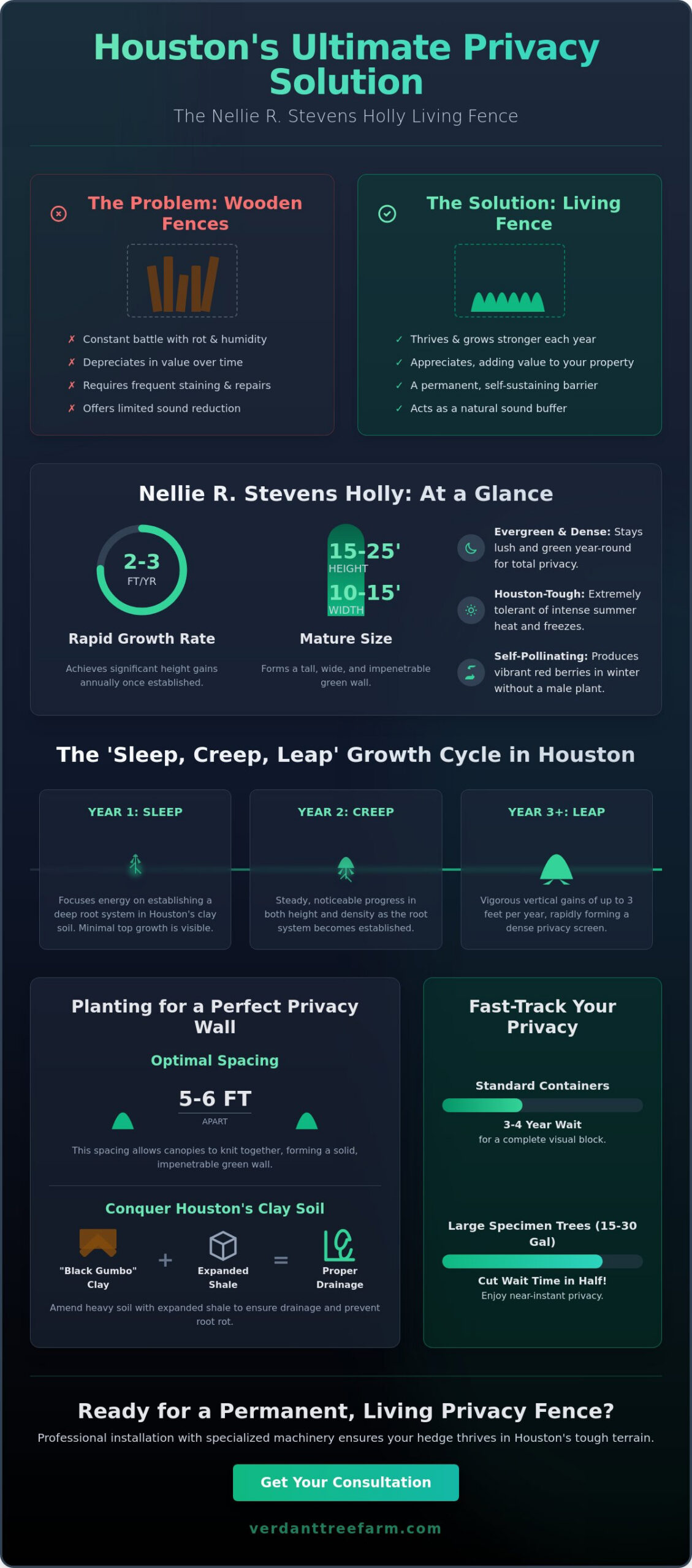
Our climate in USDA Zone 9 is demanding. Plants must survive 100-degree August afternoons and the occasional deep freeze that catches the Gulf Coast off guard. The Nellie R. Stevens is remarkably heat tolerant. It won’t suffer from leaf scorch during a typical Houston summer like more sensitive species. It maintains its density during the winter, unlike deciduous hedges that leave you exposed for months at a time. During the colder months, the plant produces a massive crop of red berries. These provide essential winter interest for your landscape and a vital habitat for local birds. Because it’s a fast-growing variety, typically gaining 2 to 3 feet of height per year, you won’t have to wait a decade for your privacy. Once it reaches its mature height of 15 to 25 feet with a width of 10 to 15 feet, it forms an impenetrable green wall that keeps your backyard truly private.
Growth Rate and Size Expectations in Houston
How fast will your new screen actually grow? You’ve likely seen national websites promise three feet of growth every single year. While that’s achievable, it isn’t a guarantee without the right local approach. In Houston, your Nellie R Stevens Holly privacy hedge follows a specific biological rhythm often called the ‘Sleep, Creep, Leap’ cycle. During the first year, the plant ‘sleeps’ as it focuses energy on establishing a deep root system in our local gumbo. Growth might only be a few inches. By the second year, it ‘creeps’ with steady progress. In the third year, once established, it ‘leaps’ with vigorous vertical gains that can reach that famous three-foot mark.
A mature Nellie R. Stevens typically hits 15 to 25 feet in height. Its width usually spans 8 to 12 feet, though this varies based on how closely you plant them. One major advantage for our region is that this variety tolerates a range of soil types including heavy clay, which is essential for Houston’s landscape. If you’re looking to fast-track this process, starting with larger 15-gallon or 30-gallon nursery stock gives you an immediate head start on height. You can also boost growth with a nitrogen-rich, slow-release fertilizer applied in early March before the spring flush begins.
Calculating Your Privacy Timeline
Your timeline depends heavily on your starting point. If you install smaller containers, expect a three to four-year wait for a complete visual block. Starting with our larger specimen trees can cut that wait time in half. By the third year, the canopy usually knits together to form a solid, impenetrable wall. If you aren’t sure which size fits your goals, our team can provide maintenance consultations to help you plan the perfect installation schedule. This ensures you aren’t waiting years for the privacy you need today.
Managing Size in Smaller Urban Lots
Not every Houston backyard can accommodate a 25-foot tree. If you’re working with a tight side-yard in the Heights or a compact patio in Rice Village, you’ll need a pruning plan. These hollies respond exceptionally well to shearing. You can maintain a formal ‘boxed’ look at a fixed 10-foot height with annual trimming. For a more relaxed feel, allow them to keep their natural pyramidal shape. Spacing is your best tool for size management; keeping them on 5-foot centers ensures they grow together quickly without overcrowding the root systems in confined spaces.
Nellie R Stevens Holly Spacing for Maximum Privacy
Spacing is the critical factor that transforms a row of individual trees into a true Nellie R Stevens Holly privacy hedge. Most Houston homeowners find success with the 5 to 6 foot rule. This measurement is always calculated “on-center,” which means you measure from the center of one trunk to the center of the next. Planting on 5-foot centers creates a dense, interlocking wall much faster than wider spacing. If you choose 6-foot centers, you’ll provide the plants with more airflow, but you’ll wait an extra year or two for the canopy to knit together completely. Because the Nellie Stevens holly is a popular evergreen shrub known for its 10 to 12 foot mature width, you must give the root systems enough room to support that massive top growth.
Single Row vs. Double Staggered Row
A single row is the most common choice for narrow side yards or compact backyards in neighborhoods like the Heights. It provides a clean, streamlined look while still offering a solid barrier. If you have more depth to work with and want 100% visual blockage immediately, the double staggered row is superior. This “Zig-Zag” pattern involves planting two parallel rows where the trees in the second row are offset to fill the gaps of the first. This technique is especially effective for creating a windbreak or dampening heavy street noise. To figure out how many trees you need, divide your total linear footage by your chosen spacing. A 50-foot property line at 5-foot spacing requires 10 trees for a single row, while a double staggered row would require roughly 18 to 20 specimen trees to achieve that layered effect.
Distance from Structures and Utilities
Don’t make the mistake of planting too close to your property line or house foundation. We recommend keeping the center of the trunk at least 4 to 5 feet away from fences. This prevents the branches from growing through your neighbor’s fence or hanging over their lawn, which saves you from future maintenance disputes. While these hollies don’t have aggressive, invasive roots that threaten foundations, they still need space to expand. Keep them at least 6 feet away from pool equipment and house walls to ensure you have room for future repairs or painting. Always look up before you plant. Since these trees can reach 25 feet, avoid placing them directly under low-hanging power lines to prevent the utility company from topping your beautiful hedge in a few years.
Planting and Care in Houston’s Clay Soil
Houston’s “Black Gumbo” is notorious for holding water like a bathtub. This drainage issue is the primary reason many landscape projects fail. While national retailers claim these plants are adaptable, they often fail to mention that stagnant water leads to root rot in a Nellie R Stevens Holly privacy hedge. To give your hedge a fighting chance, you must physically change the soil structure. We recommend mixing expanded shale into your backfill to create permanent air pockets in the clay. Adding organic compost provides the necessary nutrients to help the roots push through the heavy ground during the first growing season.
How you set the plant in the ground matters just as much as the soil itself. Use the “High Planting” technique by digging a hole twice as wide as the root ball but slightly shallower. The top of the root ball should sit exactly 2 inches above the surrounding grade. This allows excess water to shed away from the trunk instead of pooling at the base. Once in the ground, your irrigation schedule is critical for the first 12 months. In the peak of a Houston summer, your hedge needs deep watering three times a week. A soaker hose is the most efficient tool for this task because it delivers moisture directly to the root zone without losing water to evaporation or runoff.
Surviving the Houston ‘Freeze’ and ‘Fry’
Our local weather moves from one extreme to another. The record-breaking winter storms of 2021 and 2022 proved that even hardy evergreens have limits. To protect your investment, apply a 3-inch layer of hardwood mulch around the base of your trees. This mulch regulates soil temperature during a July heatwave and provides a thermal blanket during a February freeze. If you notice the deep green leaves turning dull or beginning to curl, the plant is likely experiencing drought stress. Deep, slow watering is the only way to recover from these “fry” periods. Need expert eyes on your landscape? You can book one of our Maintenance Consultations to ensure your hedge stays healthy through every season.
Pests and Disease in High Humidity
High humidity in Southeast Texas can invite specific pests like scale and leaf miners. Scale insects appear as small, stationary bumps on the stems, while leaf miners leave distinct silver trails inside the foliage. Maintaining proper spacing, as discussed in the previous section, ensures the airflow needed to prevent fungal outbreaks. Sooty mold is a black, soot-like fungus that grows on the sticky honeydew excreted by aphids or scale insects. If you spot this black coating, treat the underlying insect problem first to stop the mold from spreading across your dense privacy screen.
Professional Installation vs. DIY: The Verdant Advantage
Digging a trench for a 50-foot Nellie R Stevens Holly privacy hedge sounds like a simple weekend project until you hit the first six inches of Houston clay. This soil is incredibly dense and unforgiving. Hand-digging often leads to shallow holes and physical exhaustion, which results in poor planting depth. We use specialized machinery to ensure every hole is uniform and deep enough for proper root development. This mechanical precision guarantees that your root balls sit at the exact height needed for drainage, preventing the “Black Gumbo” rot issues discussed earlier. When you’re dealing with dozens of heavy specimen trees, the right equipment isn’t just a luxury; it’s a necessity for the plant’s survival.
Buying direct from our nursery also secures a higher standard of plant health compared to big-box retailers. We manage the growth of our inventory from day one in local conditions. You aren’t getting a plant that’s been stressed by long-distance shipping or sitting on a concrete parking lot for weeks. We back our professional, large-scale privacy installations with a 3-month warranty. If a plant fails to thrive due to installation factors, we take responsibility. This level of accountability provides a safety net that DIY projects simply can’t match. It’s an investment in your property’s long-term value and your own peace of mind.
3D Design: Visualize Your Privacy Before You Plant
Most homeowners struggle to imagine how their yard will look once the trees actually mature. Our 3D Landscape Design service removes the guesswork entirely. We create digital models that show your Nellie R Stevens Holly privacy hedge at the 5-year and 10-year marks. This prevents expensive spacing mistakes before the first shovel hits the ground. We can also show you how to layer your hollies with other local favorites like the Texas Redbud or Natchez Crape Myrtle to create a beautiful, multi-dimensional screen. This design phase is also the perfect time to plan for integrated irrigation and landscape lighting to showcase your new living wall.
Expert Installation in Houston
Our installation process is comprehensive and site-specific. We don’t just drop a tree in a hole and move on. We handle professional site preparation, including the specific soil amendments like expanded shale and organic compost required for our region. As a veteran-owned business, we pride ourselves on reliability and clear, direct communication. Whether you’re shielding a small suburban patio or a massive commercial estate, we have the equipment and the expertise to handle the job correctly the first time. Ready for a greener view? Schedule your 3D design consultation today.
Transform Your Backyard into a Private Sanctuary
You’ve seen how a Nellie R Stevens Holly privacy hedge provides a permanent, living solution to noise and prying eyes. It’s the most reliable way to build a wall that actually thrives in Houston’s heavy clay and survives our unpredictable weather cycles. By following the proper spacing rules and amending your soil, you’re investing in a landscape that grows more valuable and beautiful every single year.
We’re ready to help you finish the job. As the largest independent nursery in Houston, we keep a massive inventory of specimen hollies ready for your property. We’re a veteran-owned and operated team that understands the local climate better than anyone else in the region. We even provide a 3-month warranty on all professional installations to ensure your new screen gets the best possible start. It’s a direct, uncomplicated process designed to give you the privacy you deserve.
Visit Houston’s Largest Tree Nursery to Pick Your Hollies today. Your perfect backyard view is just one planting season away.
Frequently Asked Questions
How fast do Nellie R Stevens Hollies grow in Houston?
Nellie R. Stevens Hollies typically grow 2 to 3 feet per year once they’re established in your yard. During the first year, they focus on root development in our local soil, so don’t be alarmed if you don’t see immediate vertical height. By the third year, they enter a vigorous growth phase that quickly fills in gaps to form a solid wall.
How far apart should I plant Nellie R Stevens for a privacy hedge?
You should plant them 5 to 6 feet apart on-center to create a dense Nellie R Stevens Holly privacy hedge. This spacing ensures the branches interlock within a few seasons without overcrowding the root systems. If you have more space and want a thicker barrier, a double staggered row with 8-foot spacing between rows is an excellent alternative.
Do Nellie R Stevens Hollies need a male pollinator for berries?
No, these hollies don’t require a male pollinator to produce their signature red berries. They are parthenocarpic, which means they can set fruit without cross-pollination from a separate plant. You can plant a single tree or a whole row and still enjoy a heavy crop of berries every winter to attract local birds and provide seasonal color.
Are Nellie R Stevens Hollies deer resistant?
These hollies are considered highly deer resistant because of their thick, leathery, and prickly leaves. Deer usually avoid them in favor of softer foliage, though no plant is completely deer-proof if food is extremely scarce. In most Houston area neighborhoods, they are a safe, reliable bet for a maintenance-free living barrier.
Can Nellie R Stevens Hollies grow in full shade in Texas?
Nellie R. Stevens Hollies won’t thrive in full, deep shade. They prefer full sun to partial shade to maintain their dense foliage and produce a heavy berry crop. If planted in too much shade, the hedge will become thin and leggy. This reduces its effectiveness as a privacy screen and makes the plant more susceptible to pests.
What is the best fertilizer for Nellie R Stevens Holly in Houston?
The best fertilizer for these hollies in Houston is a balanced, slow-release formula applied in early spring. Look for a nitrogen-rich blend that encourages lush, green leaf growth before the summer heat arrives. Avoid fertilizing in late fall. Late-season feeding can stimulate new growth that is easily damaged by a sudden winter freeze.
Will Nellie R Stevens Holly survive a Houston freeze?
Yes, this variety is incredibly hardy and survived the historic Texas freezes of 2021 and 2022 with minimal damage. While they might lose a few leaves during extreme ice events, they typically bounce back quickly in the spring. Applying a thick layer of hardwood mulch helps protect the root system from these temperature extremes.
When is the best time of year to plant a holly hedge in Houston?
Fall and early spring are the ideal times to plant a holly hedge in Houston. Planting between October and March allows the root system to establish itself before the intense summer heat hits. If you must plant during the summer months, you’ll need to follow a strict, deep-watering schedule to prevent heat shock and ensure survival.