A Medjool date palm can grow in a Houston landscape without producing ripe fruit. Understanding the Medjool date palm growth stages means separating steady leaf and trunk development from the distinct process of flowering, pollination, and fruit ripening.
This guide follows the palm from early vegetative growth through flowering and the fruit’s progression from green Kimri to ripe Tamar. It also explains why a palm grown from seed may develop differently from one grown from an offshoot, which generally preserves the parent plant’s characteristics and can affect expectations for fruit.
Houston’s heat can support palm growth, while humidity, rainfall, and occasional freezes can affect development and make fruiting less predictable. Learn what to observe at each stage and why drainage, airflow, and cold protection deserve attention when planning a Medjool date palm as a long-term landscape feature.
Key Takeaways
- Use the Medjool date palm growth stages to distinguish root establishment and leaf development from flowering and fruit production.
- Propagation method matters: seed-grown palms may differ from offshoot-grown palms, so a young palm’s progress won’t follow one universal timeline.
- Fruit production depends on successful pollination between male and female flowers. Flowering alone doesn’t mean dates will develop.
- Watch for signs of water stress. Waterlogged soil can hinder establishment, while prolonged dryness may show in leaf condition.
- Record new leaves, crown condition, planting date, and weather events to track gradual progress and spot emerging stress.
What Are the Growth Stages of a Medjool Date Palm?
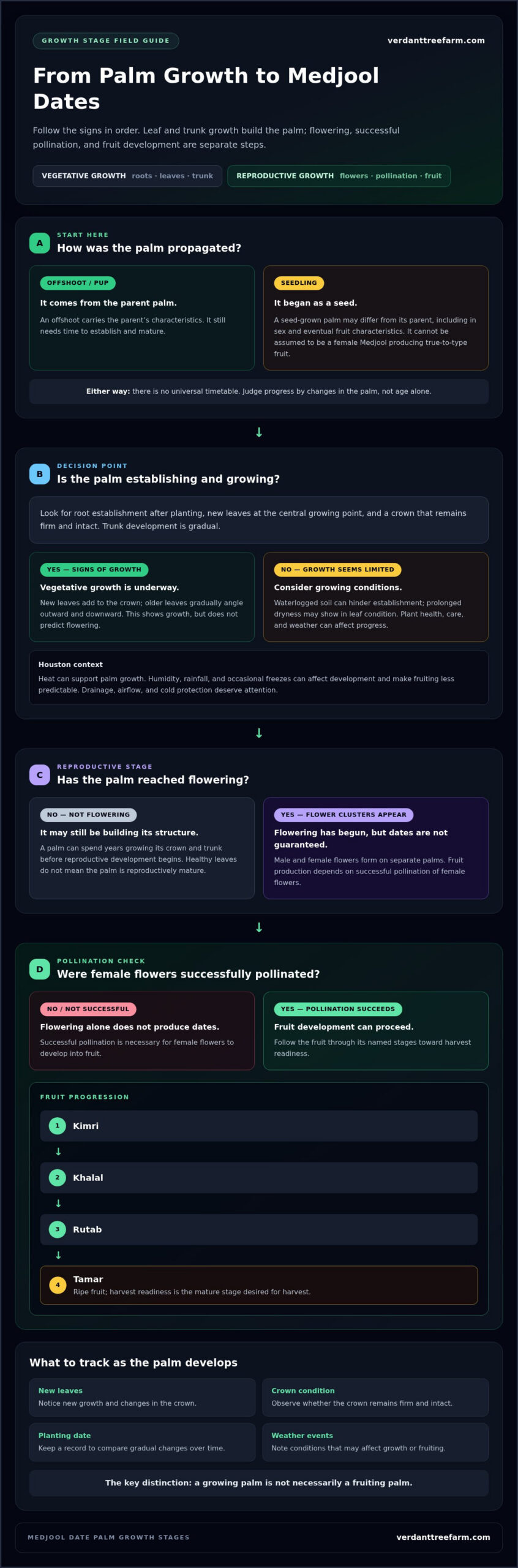
A growth stage is a recognizable phase in a palm’s development, such as root establishment, new leaf production, flowering, or fruit ripening. The Medjool date palm growth stages follow a broad sequence, but not a fixed calendar. A palm may spend years building its crown and trunk before reproductive development begins.
A Medjool date palm establishes roots, grows leaves and trunk, reaches reproductive maturity, flowers, develops fruit, and eventually produces dates ready for harvest. This overview helps distinguish a growing landscape palm from one that has begun the separate process of producing fruit. For a general reference on date palm development, see the Date palm life cycle.
The life-cycle sequence at a glance
Think of development in two broad parts: vegetative growth, when the palm builds its structure, and reproductive growth, when it flowers and may produce fruit. The sequence is:
- Establishment: Roots adapt and develop after planting.
- Vegetative growth: New leaves emerge, the crown expands, and the trunk develops gradually.
- Maturity: The palm becomes capable of flowering, though it may not flower immediately.
- Flowering and pollination: Male and female flowers form on separate palms. Fruit production requires successful pollination of female flowers.
- Fruit development: Pollinated fruit progresses through the Kimri, Khalal, Rutab, and Tamar stages.
- Harvest readiness: Fruit reaches the mature stage desired for harvest.
These steps aren’t interchangeable. A palm can produce healthy new leaves and continue growing without being reproductively mature. Flowering alone doesn’t confirm that fruit will develop, because pollination is necessary for the transition from flowers to dates.
Why growth-stage timing varies
Starting material makes a difference. A seed-grown palm begins from a seed and may not share all the characteristics of its parent. An offshoot is a shoot taken from the parent palm, so it offers a different starting point and can preserve the parent’s characteristics. In either case, treat a general timeline as a guide, not a promise for an individual palm.
Progress also depends on growing conditions and the palm’s health. Establishment, ongoing care, weather, and genetic background can all influence development. A palm under stress may not show the same steady leaf and crown growth as one that has established well. Watch changes in the palm over time rather than judging progress by age alone.
This sequence offers a practical framework for observing a Medjool date palm. Next, look at how establishment and vegetative growth appear on a young palm.
From Seedling or Offshoot to a Mature Medjool Date Palm
A young Medjool palm’s first task is to establish itself. After planting, roots adapt to the soil and begin supporting the palm. Above ground, growth may look modest at first. Watch the central growing point and look for new leaves rather than expecting the trunk to increase in size immediately.
Once established, the palm enters a longer period of vegetative growth. Each new leaf adds to the crown, while older leaves gradually angle outward and downward. The trunk develops slowly as the palm matures. These changes show progress, but they don’t predict when the palm will flower.
What happens during the seedling stage?
A seedling begins when a date seed germinates and sends out an initial root and shoot. Its first leaves are simple and narrow. As it grows, it develops the characteristic divided leaves of a mature date palm. This early phase builds the plant’s structure, but a seedling’s appearance doesn’t guarantee it will match the parent palm.
Seed-grown palms can vary in traits, including sex and eventual fruit characteristics. A palm raised from a Medjool date seed can’t be assumed to be a female Medjool that will produce true-to-type fruit. A seedling can still be interesting to grow as a landscape palm, but its reproductive outcome is less predictable.
How an offshoot establishes and grows
An offshoot, sometimes called a pup, is a vegetative shoot that grows from the parent palm. Because it comes from the parent rather than developing from a seed, it carries the parent’s characteristics. Propagation method is therefore important when setting expectations, although an offshoot still needs time to establish and mature.
After planting, look for continued growth, such as healthy new leaves and a crown that remains firm and intact. Careful planting and suitable aftercare support root establishment, but they can’t offset unsuitable conditions or challenging weather. Growth varies with the palm’s health, planting environment, and ongoing care.
Propagation method changes maturity expectations because an offshoot carries the parent palm’s traits, while a seedling may differ in both its characteristics and reproductive outcome. Neither starting point comes with a universal timetable. A healthy palm can spend an extended period producing leaves and building its structure before flowering maturity. Houston growing conditions can also influence its progress.
For a Houston landscape, consider the planting location and long-term care alongside the palm’s life stage. Verdant Tree Farm offers professional installation and maintenance consultations to help plan for a young palm. Explore Medjool date palms for Houston landscapes as you consider the next step.
Flowering, Pollination, and the Medjool Date Fruit Stages
Flower clusters mark reproductive development, but flowers alone don’t mean a Medjool palm will produce dates. Date palms are dioecious: male and female flowers grow on separate palms. Pollen must reach the female flowers for fruit to set. Without successful pollination, a female palm won’t develop a normal crop. Flowering is only one step in the process.
The fruit that sets then develops through four named stages. The Medjool date palm growth stages describe the palm’s overall development, while Kimri, Khalal, Rutab, and Tamar describe how its fruit progresses.
Flowering and pollination before fruit develops
Flower clusters emerge from the crown. After pollination, the fertilized female flowers can develop into small fruits. In commercial date production, pollination is often managed by hand. For a homeowner, the key point is that a female palm needs pollen from a male palm for fruit to form. Flowers don’t prove that pollination occurred or that a harvest will follow.
From green dates to ripe Medjool fruit
Once fruit sets, observe changes in color and firmness rather than relying on the calendar alone. The traditional stages mark a gradual shift from hard, immature fruit to fully ripe dates:
- Kimri: Early development. Dates are green, firm, and generally bitter as they grow toward full size.
- Khalal: Fruit reaches full size and shifts from green toward yellow or red, depending on the variety. It remains firm and crisp, with less sweetness than at later stages.
- Rutab: Ripening advances, and the fruit begins to soften and turn brown. Changes may appear unevenly across a cluster.
- Tamar: Fruit reaches its final mature, ripe stage. Medjool dates are commonly eaten at this stage, when they’re soft and sweet.
Kimri is the green, firm growth stage; Khalal is full-sized and crisp; Rutab is softening and browning; Tamar is fully mature and ripe. These terms describe fruit development, not a guaranteed harvest date. Weather, pollination, and growing conditions affect whether fruit develops and how it ripens. A Houston palm may flower without setting fruit, and high humidity or rain can complicate ripening and increase the risk of fruit problems. Treat each stage as an observation, not a promise of a crop or a specific eating quality.
For a homeowner, the sequence is straightforward: look for flowers, then fruit set, then changes in color and texture. If fruit is present, compare dates in the cluster over time, since they may not ripen evenly. This helps identify what’s happening without assuming every flowering palm will reach Tamar.
How Houston Weather and Care Can Affect Each Growth Stage
Houston conditions can change what you see from one season to the next. Warm weather may support active leaf growth, while cooler periods can slow visible development. Humidity and rainfall matter too: soil that stays saturated can stress developing roots, while prolonged dry conditions can affect leaf condition. Read growth in context instead of expecting each stage to arrive on a fixed schedule.
Reading seasonal growth in the Houston area
During warmer stretches, look for new leaves and gradual changes in the crown. Cooler weather may bring slower growth, so a pause in visible activity isn’t automatically a sign that the palm has stopped developing. Houston’s humidity and rainfall can also make fruit ripening more challenging than in arid date-growing regions. Focus on the palm’s condition and stage rather than assuming it will produce a crop.
Occasional freezes deserve attention, especially after a period of steady growth. Cold can damage foliage or interrupt growth, but damaged leaves alone don’t establish that the entire palm has died. Observe the crown and watch for later changes before drawing conclusions. Don’t judge recovery from a single leaf or an inspection immediately after severe weather.
Care observations that support steady development
Newly planted palms need appropriate watering as they establish, but the soil should drain rather than remain waterlogged. Check moisture near the root zone before watering again, and account for recent rainfall. During prolonged dry weather, monitor the soil and foliage for changes. Respond to site conditions rather than following the same watering routine in every weather pattern.
Keep a simple record of new leaves, crown condition, soil moisture, rainfall, and freeze events. Compare observations over time. New growth after a quiet period may mean the palm was developing slowly. A pattern of worsening foliage or crown changes deserves closer attention. Don’t diagnose a problem from one symptom alone, since weather, water, and the palm’s stage can all affect its appearance.
For locally relevant planting and care information, consult Texas A&M AgriLife Extension guidance and consider how recommendations apply to your site. A sunny, exposed location and a sheltered spot can experience different conditions, as can well-drained soil and a low area where water collects. These differences can affect establishment and the signs you should monitor.
Use a practical routine: check soil moisture, note weather changes, and track new growth instead of relying on a rigid calendar. Verdant Tree Farm provides Medjool palm installation and maintenance consultations for Houston landscapes. Explore Medjool palm installation and maintenance to plan for your site.
How to Track a Medjool Date Palm’s Progress and Plan Its Next Stage
A simple record makes the Medjool date palm growth stages easier to recognize. Rather than relying on memory or expecting a change by a particular date, track what the palm is doing and the weather it has experienced. Comparing observations across seasons can reveal gradual progress and patterns that may need closer attention.
A simple way to record growth over time
Take a dated photo from the same viewpoint each season. Keep the crown centered so you can compare new leaves, overall shape, and changes after weather events. Add brief notes to a log, such as:
- Planting: Record the planting date and whether the palm was seed-grown or an offshoot, if known.
- New growth: Note emerging leaves and changes in the crown’s appearance.
- Care: Record significant watering changes and whether the surrounding soil drains or stays wet.
- Weather: Note periods of unusual heat, heavy rainfall, or freezing conditions.
Look for patterns, not a single snapshot. Limited visible growth during one season doesn’t prove that a palm is unhealthy. A stable crown followed by new leaves may indicate a pause rather than a lasting setback. By contrast, continuing decline in crown condition or repeated leaf changes alongside persistently wet or dry soil gives useful context for seeking guidance. Avoid treating one leaf or event as a diagnosis.
Turning growth knowledge into a landscape plan
Use the palm’s current stage to plan ahead. A young palm may fit neatly into a space now, but placement should account for its eventual size and its role in the landscape. Consider overhead and surrounding clearance, site conditions, drainage, and how the palm will relate to nearby structures and planting areas. Choose a location that works for establishment and as the crown develops.
Professional planting support can help turn those site considerations into a practical plan. Verdant Tree Farm offers Medjool date palms, professional installation, and maintenance consultations for Houston residential and commercial landscapes. For broader placement and project planning, its Houston landscaping design and installation information can help connect a palm’s needs with the overall landscape.
Keep your log as the palm grows, especially after a change in care or severe weather. Your notes provide a clearer starting point for planning the next stage. Explore palm trees for sale in Houston to consider a Medjool date palm for your landscape.
Plan for the Palm You Want to Grow
Let the Medjool date palm growth stages inform your landscape plan, starting with the role you want the palm to play. Is your priority its architectural presence, the shade and structure it may add over time, or the possibility of fruit? Keeping that goal clear helps you make thoughtful choices about placement and care without relying on a particular growth or harvest timeline.
A palm is a long-term part of a property. Consider how its space, surroundings, and care needs will fit your landscape as it develops, not only how it looks on planting day. Planning ahead helps you make a confident choice for a residential or commercial setting.
Verdant Tree Farm offers Medjool date palms, professional installation, and maintenance consultations. Explore Medjool date palms and landscape support at Verdant Tree Farm and start planning for your Houston landscape.
Frequently Asked Questions
How can you tell a male and female date palm apart?
You generally can’t reliably identify a date palm’s sex from its leaves or trunk. The distinction becomes apparent when it flowers: male and female palms produce different flower clusters, and only female flowers can develop into dates after pollination. If a young palm hasn’t flowered, its sex may not be obvious from appearance alone. This is one reason a seed-grown palm’s future fruiting potential can be uncertain.
Can a Medjool date palm produce fruit without pollination?
No, normal fruit development requires pollination of female flowers. A female palm may flower without setting a usable crop if pollen doesn’t reach those flowers. In a landscape, don’t treat blooms as proof that dates will follow. Note whether small fruit begins to form after flowering, then monitor its development. In Houston, even successful pollination doesn’t guarantee ripe fruit because local weather can affect the crop.
Are Medjool dates ripe when they are yellow?
Usually not. Yellow fruit is generally at the Khalal stage: it may be full-sized and firm, but it hasn’t reached the soft, fully ripe Tamar stage associated with Medjool dates. Color can vary as fruit develops, so check texture as well as appearance. If dates remain crisp, they’re at an earlier stage; softening and browning indicate further ripening, though not a guaranteed harvest date.
How often should you water a newly planted Medjool date palm?
There isn’t one reliable schedule for every Houston planting site. Check the soil around the root zone and water when it begins to dry, adjusting for rainfall, drainage, and heat. Newly planted palms need consistent moisture as roots establish, but soil that stays saturated can cause problems. A low spot after heavy rain may need less supplemental watering than a well-drained site during a dry, hot stretch.
What does cold damage look like on a date palm?
Cold injury may appear as discolored, browned, or drooping leaves after a freeze, and damage can become clearer as affected foliage dries. Don’t conclude from one damaged frond that the whole palm is dead. Check whether the central crown remains intact and watch for new growth as conditions warm. If decline continues or the crown appears affected, seek a professional assessment rather than relying on leaf color alone.
Can you grow a Medjool date palm from a grocery-store date pit?
Yes, a pit may germinate if it’s viable, but the resulting seedling isn’t guaranteed to be a true-to-type Medjool palm. Seed-grown palms can vary in traits, including sex, so a seedling may not produce Medjool fruit or the fruit you expect. If you’re experimenting, label the pot with the planting date and track germination and leaf growth. Treat it as a growing project, not a predictable fruit crop.