What if you could drop your attic temperature by 20 degrees without touching your thermostat? In our region, the quickest path to a cooler home and a greener lawn isn’t a mechanical fix. It’s investing in the right fast growing shade trees Houston homeowners can rely on for both speed and structural integrity. We all understand the frustration of watching a lawn turn brown under the relentless Texas sun while cooling costs skyrocket every July.
It’s common to feel like you’re stuck choosing between a decade of waiting or planting a brittle tree that won’t survive a Gulf Coast storm. You don’t have to compromise. You can achieve a 15 to 20 foot canopy within just a few years by selecting resilient, smart-growing species like the Shumard Oak or the Drummond Red Maple. These varieties thrive in our heavy clay soil and offer the deep root stability needed for hurricane season. This guide highlights the best rapid-growth options to increase your property value and provide the immediate relief your landscape needs.
Key Takeaways
- Define “fast-growing” for our Zone 9a climate and see how rapid canopy expansion combats the local Urban Heat Island effect.
- Discover the top five fast growing shade trees Houston homeowners trust for maximum shade and hurricane-ready strength.
- Identify the “trash trees” that grow fast but pose a major safety risk to your roof during high-wind events.
- Master the “twice as wide” planting rule to help your new investment thrive in Houston’s notorious heavy clay soil.
- Learn why professional installation is the most reliable way to ensure your trees reach their full growth potential quickly.
Why Fast-Growing Shade Trees are Essential for Houston Homes
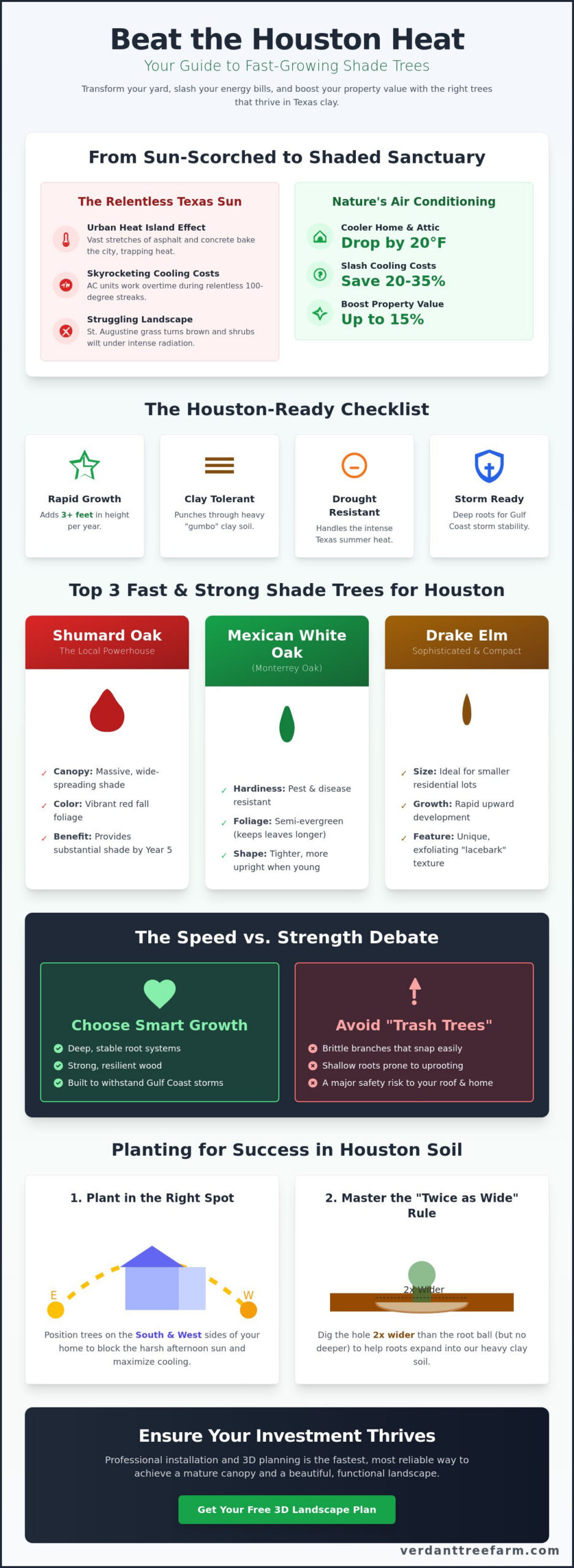
In the context of Houston’s humid subtropical Zone 9a climate, we define “fast-growing” as a tree capable of adding three feet or more to its height every single year. This rapid development isn’t just a luxury; it’s a necessity for local homeowners. Houston faces a significant Urban Heat Island effect. This phenomenon occurs when our vast stretches of asphalt and concrete absorb solar radiation, causing city temperatures to remain significantly higher than nearby rural areas. By planting fast growing shade trees Houston residents can effectively create “nature’s air conditioning” right in their own backyards.
Strategic planting does more than provide a visual break. According to the USDA Forest Service, mature shade trees can reduce annual cooling costs by 20% to 35%. Beyond the wallet, these trees serve as critical infrastructure in our flood-prone region. Large canopies intercept rainfall before it hits the ground, while deep root systems help manage stormwater runoff. Every leaf works to sequester carbon and improve our local air quality, making your property a functional part of the city’s environmental solution.
The Reality of the Houston Heat Index
Houston summers aren’t just warm; they’re characterized by brutal 100-degree streaks that can last for weeks. This intense radiation doesn’t just bake your house. It kills your St. Augustine grass and wilts your ornamental shrubs. A well-placed canopy creates a cooling microclimate. This protective layer lowers the ambient temperature of your soil, helping your understory landscape survive the August heat. There’s also a clear psychological shift when you step from a sun-scorched driveway into a lush, green backyard. It turns a hostile environment into a functional living space where your family can actually spend time outdoors, or even set up an indoor workout area with equipment from Gym Pros to stay active in a climate-controlled environment.
Energy Savings and Property Value
To maximize your return on investment, focus your planting on the western and southern sides of your home. These areas receive the most intense afternoon sun. Blocking these rays before they hit your windows or siding prevents heat gain, which keeps your AC unit from working overtime. While the iconic Southern Live Oak is a regional favorite for long-term value, choosing faster-maturing species allows you to see these benefits in half the time. A healthy, mature-looking landscape can increase property value by as much as 10% to 15%. Starting now ensures you aren’t just buying a plant, but rather securing a permanent upgrade for your home’s efficiency and aesthetic appeal.
Top 5 Fast-Growing Shade Trees for the Houston Area
Selecting the right species involves more than just looking at a nursery tag. For a tree to succeed in a local backyard, it must meet three strict criteria: a growth rate of at least 3 feet per year, the ability to punch through heavy “gumbo” clay, and high drought tolerance. These are the fast growing shade trees Houston families need to transform a scorched lot into a cool sanctuary. We focus on trees that balance this speed with structural integrity so they remain assets rather than liabilities during storm season.
The Shumard Oak is a local powerhouse. It produces a massive, spreading canopy quickly and is widely considered one of the most reliable oaks for our region. If you want a classic look with vibrant red fall color, this is your best bet. For those who prefer a tree that stays green longer, the Mexican White Oak (also known as the Monterrey Oak) offers incredible speed and high resistance to pests and diseases common in East Texas. It is a rugged, semi-evergreen option that handles our unpredictable weather with ease.
The Oaks: Shumard vs. Mexican White Oak
In the first five years, both of these oaks are sprint champions. You can expect a Shumard Oak to establish its root system quickly and then push significant vertical growth. By year five, a well-maintained specimen often provides substantial shade for a single-story home. The Mexican White Oak is equally aggressive but keeps a tighter, more upright shape during its youth. Both species excel in Houston’s heavy clay because they are evolved to handle the “wet-dry” cycle of the Gulf Coast. While the Shumard gives you that iconic autumn flare, the Mexican White Oak stays semi-evergreen, dropping leaves only briefly in late winter before pushing new growth. You can find more details on these species in the Texas A&M Forest Service Tree Planting Guide.
The Resilient Alternatives: Drake Elm and Montezuma Cypress
If you have a smaller residential lot, the Drake Elm is a sophisticated choice. It grows rapidly upward and develops a unique, exfoliating “lacebark” texture that provides winter interest. It’s tough enough for street-side planting but elegant enough to serve as a backyard focal point. For larger properties with plenty of room to spread, the Montezuma Cypress is a game-changer. Unlike the Bald Cypress, which often requires swampy ground, the Montezuma Cypress is exceptionally drought-hardy and doesn’t produce the “knees” that make mowing difficult. It stays green longer into the season and grows with surprising speed. If you’re ready to see these varieties in person, our team at Verdant Tree Farm can help you select the perfect specimen for your specific soil type.
The Speed vs. Strength Debate: Avoiding ‘Trash Trees’
A common myth in the landscaping world suggests that any tree that grows quickly is destined to be brittle. While this is true for certain species, it isn’t a universal law of nature. The key is distinguishing between “smart growers” and “trash trees.” In our region, a trash tree is defined by its tendency to prioritize height over structural integrity. Species like the Silver Maple and the Arizona Ash are notorious for this. They may provide a quick canopy, but they often split or drop heavy limbs during their first encounter with a standard Gulf Coast thunderstorm. Choosing fast growing shade trees Houston homeowners can rely on requires a focus on wood density and branch architecture.
Speed should never come at the cost of safety. To find resilient options, many professionals consult the Lady Bird Johnson Wildflower Center’s native plant database to verify which species have evolved to handle our specific environmental stressors. Beyond species selection, the first three years of a tree’s life are critical. We recommend structural pruning during this window to establish a strong central leader and remove competing branches. This simple maintenance step ensures your fast-growing investment doesn’t become a hazard to your roofline a decade down the road.
Why Some Fast-Growers Fail in Storms
The science behind “weak” wood often comes down to cell expansion. When a tree grows too rapidly without proper local hardening, its wood cells are often larger and thinner-walled. This creates a softer internal structure that lacks the flexural strength to survive high winds. Another major failure point is the “narrow crotch angle.” This occurs when branches grow too closely to the main trunk, creating a V-shape rather than a strong U-shape. These tight joints collect moisture and debris, leading to internal rot and eventual snapping. Big-box nurseries often sell trees that haven’t been pruned for these issues, which is why sourcing from a local expert is your best insurance policy.
Selecting for Houston’s Wind Loads
You can have both speed and strength if you choose species like the Shumard Oak or the Drummond Red Maple. These trees maintain higher wood density even during periods of rapid growth. Root structure is just as important as the branches above. In our heavy “gumbo” clay, trees must develop extensive lateral root systems to act as anchors. While a taproot provides some stability, it’s the wide-reaching network of lateral roots that keeps a tree upright during a tropical depression. Buying from a local grower ensures your tree was raised in our soil and wind conditions, making it “hardened” and ready for the specific challenges of a Houston backyard.
Planting for Success in Houston’s Heavy Clay Soil
Houston’s “gumbo” soil presents a unique challenge for any landscaping project. This heavy clay expands when wet and contracts into concrete-like cracks when dry. To ensure your fast growing shade trees Houston reach their full potential, you must work with the soil rather than against it. Most planting failures in our area stem from poor drainage rather than a lack of water. Proper preparation ensures your new investment doesn’t just survive but thrives in our local environment.
The first step is correct hole preparation. Digging a hole that is twice as wide, but not twice as deep, is the golden rule of local arboriculture. You want the root ball to sit on firm, undisturbed soil so it doesn’t sink over time. If the root flare, which is where the trunk meets the roots, becomes buried, the tree will slowly suffocate. Use the native soil you removed for backfilling. Avoid the temptation to fill the entire hole with rich, black garden soil. This creates a pocket of loose material that holds too much moisture against the trunk while the surrounding clay remains impenetrable.
Correcting the ‘Bathtub Effect’
In areas with exceptionally poor drainage, digging a deep hole in clay creates a “bathtub.” Water collects in the hole and has nowhere to go, effectively drowning the root system. We often recommend a “mound planting” technique to combat this. This involves placing the root ball slightly above the surrounding grade and building a gentle slope of soil up to it. This keeps the upper roots out of standing water during our frequent monsoon-style rain events. To test your yard’s drainage, dig a 12-inch hole and fill it with water. If it hasn’t drained within 24 hours, you have a drainage issue that requires this elevated planting approach.
Watering Your New Tree: Year One
Successful establishment depends on a “Deep Soak” method. Rather than a five-minute spray every day, leave a hose on a slow trickle at the base of the tree for 30 to 45 minutes twice a week. This encourages roots to grow deep into the clay where moisture levels are more stable. Adjust your schedule based on the season. During a dry July, you may need a third soak. In a rainy May, you should skip watering entirely to prevent root rot. Once the tree has survived its first full year, you can typically stop supplemental watering except during extreme droughts. If you aren’t sure about your soil quality, our team at Verdant Tree Farm offers professional installation to handle the heavy lifting and ensure your tree is positioned for long-term health.
Professional Installation and 3D Planning with Verdant Tree Farm
Choosing the right species is only half the battle. To truly maximize the benefits of fast growing shade trees Houston homeowners need a partner who understands the local landscape from the ground up. Professional installation acts as your primary insurance policy. It ensures your tree is planted at the correct depth, oriented for the best sun exposure, and secured against our unpredictable Gulf Coast winds. At Verdant Tree Farm, we bring a balance of veteran-owned reliability and multi-generational expertise to every project. We handle the heavy lifting so you can focus on enjoying your new outdoor sanctuary.
Our team doesn’t just drop a tree in a hole. We use advanced 3D landscape design to take the guesswork out of your property’s future. This technology allows you to see exactly where the shade will fall on your roof at 10 AM versus 4 PM before a single shovel hits the dirt. This level of precision is essential for maximizing energy savings and protecting your home’s structural integrity. By investing in fast growing shade trees Houston residents can depend on, you are making a long-term commitment to your property value. We support that commitment with a three-month warranty to give you total peace of mind during the critical establishment phase.
Visualize Before You Dig
Our 3D design service is a game-changer for urban and suburban lots. It prevents the costly mistake of planting a rapid-grower too close to power lines or your home’s foundation. We plan for the mature size of your tree today so you don’t face expensive removal costs ten years from now. This process also helps us integrate your new shade trees with existing palms or shrubs like the Little Gem Magnolia or Savannah Holly. The result is a cohesive, multi-layered landscape that looks established from day one.
The Installation Process
When our professional crew arrives, we bring the right equipment to handle even the largest specimens with care. We manage the entire process from site preparation to final mulching. Once the tree is in the ground, we don’t just walk away. We provide maintenance consultations to walk you through the specific watering and pruning needs of your new tree. This personalized guidance ensures your landscape remains healthy and vibrant through every Texas season. Ready to transform your backyard? Schedule your 3D landscape consultation today!
Start Building Your Cooler Future Today
Achieving a lush, temperature-controlled landscape doesn’t have to take a lifetime. By selecting the right fast growing shade trees Houston residents can secure immediate energy savings and long-term property value. We’ve explored how prioritizing structural integrity over mere speed protects your home from storm damage, while specialized planting techniques ensure your investment survives our notorious heavy clay. Every choice you make today contributes to a more resilient and comfortable environment for your family.
You don’t have to navigate these technical details alone. As a veteran-owned and operated business, we provide the local expertise and end-to-end service you need to succeed. We offer Houston’s largest independent selection of resilient species and back our professional installation with a 3-month tree warranty for your total peace of mind. Our team is ready to help you plan, select, and install the perfect canopy for your specific lot.
Visit Houston’s Largest Independent Tree Nursery & Start Growing Your Shade Today!
Your journey toward a more beautiful and energy-efficient outdoor space starts with a single well-placed tree. We look forward to helping you beat the heat and enhance your home’s legacy.
Frequently Asked Questions
What is the absolute fastest growing shade tree for Houston?
The Mexican White Oak and the Montezuma Cypress are among the absolute fastest growers for our region, often adding more than three feet of height annually. These species thrive in our local climate and establish their canopy much faster than traditional varieties. Selecting these “smart growers” ensures you get shade quickly without the structural risks associated with inferior, brittle species.
Will fast-growing trees damage my foundation or plumbing?
Trees don’t actively seek out foundations to break them, but their roots will follow moisture into existing cracks. We recommend planting large shade trees at least 15 to 20 feet away from your home’s foundation or main sewer lines. This distance provides ample room for root expansion while protecting your underground infrastructure from the natural pressure of a maturing root system.
When is the best time of year to plant shade trees in Houston?
Late fall through early spring is the ideal window for planting fast growing shade trees Houston homeowners want to establish successfully. Planting between October and March allows the root system to settle into the soil before the brutal summer heat arrives. This head start is crucial for the tree’s survival and ensures it has the energy to push significant new growth during its first spring season.
How much water does a new shade tree need in the Houston summer?
A newly planted tree typically requires about 15 to 20 gallons of water per inch of trunk diameter each week during a standard Houston summer. It’s best to deliver this through two deep-soak sessions rather than daily light sprinkles. This method encourages roots to grow deeper into the clay soil, which provides better stability and drought resistance as the tree matures.
Do I need a permit to plant a tree in my Houston parkway or front yard?
You generally need a permit from the City of Houston to plant any tree in the public right-of-way or parkway area. For your own private front yard, city permits aren’t usually required for planting, but you must consult your Homeowners Association (HOA) guidelines first. HOA rules in our area are often stricter than city ordinances and may dictate specific species or placement requirements.
How do I protect my fast-growing tree during a hurricane?
The best hurricane protection starts with choosing wind-resistant species and performing regular structural pruning. Removing dead wood and thinning the canopy allows wind to pass through the tree more easily, which reduces the “sail effect” that causes uprooting. If a storm is imminent, ensure your mulch is refreshed to protect the root ball, but avoid staking mature trees as they need to flex to build strength.
What should I do if my tree’s leaves turn yellow in Houston clay?
Yellowing leaves, or chlorosis, often indicate that your tree is struggling to absorb nutrients from our alkaline clay soil. This can also be a sign of “wet feet” caused by poor drainage. We suggest testing your soil’s pH and checking the moisture levels at the root ball. Adding a high-quality chelated iron supplement or improving the local drainage can often restore the vibrant green color to your canopy.
Can I plant a shade tree near my pool?
You can plant shade trees near a pool, but you should prioritize species with minimal leaf and fruit litter. Varieties like the Little Gem Magnolia or certain hollies are excellent choices because they are evergreen and don’t drop large amounts of debris into your filtration system. Always consider the mature spread of the canopy to ensure you aren’t creating a constant cleaning chore for yourself.