In Houston, the DIY vs. Pro debate isn’t just about labor; it’s about surviving the soil and climate variables that kill 40% of DIY projects. Deciding between DIY landscaping vs professional Houston services is a major choice for your property value and your own sanity. We’ve all seen it happen. You spend a weekend hauling mulch and planting a beautiful Drummond Red Maple, only to watch it struggle when the August humidity hits or the next big freeze arrives. It’s frustrating to watch your hard-earned money and back-breaking effort disappear into the heavy clay soil.
You deserve a yard that thrives without needing a constant rescue. This guide reveals the real costs, risks, and rewards of going solo versus hiring local experts. We’ll look at the impact of professional labor rates and design fees so you can invest in your home with confidence. You’ll discover how to achieve a drought-resistant landscape that adds lasting value and survives whatever the Gulf Coast throws at it next.
Key Takeaways
- Understand why “Houston-Hardy” selection is a technical necessity for navigating our unique regional climate and heavy soil conditions.
- Analyze the 2026 cost-benefit breakdown between DIY landscaping vs professional Houston services, accounting for hidden expenses like tool rentals and labor timelines.
- Determine which tasks are low-risk for homeowners and which projects, such as complex drainage grading or large tree planting, demand professional equipment.
- Explore the “hybrid solution” of buying direct from a local nursery to maximize your investment while utilizing expert installation for long-term property growth.
- Learn how professional soil audits and 3D design tools prevent expensive mistakes by mapping out your property’s specific needs before any work begins.
The Reality of Landscaping in Houston: Why Local Context Matters
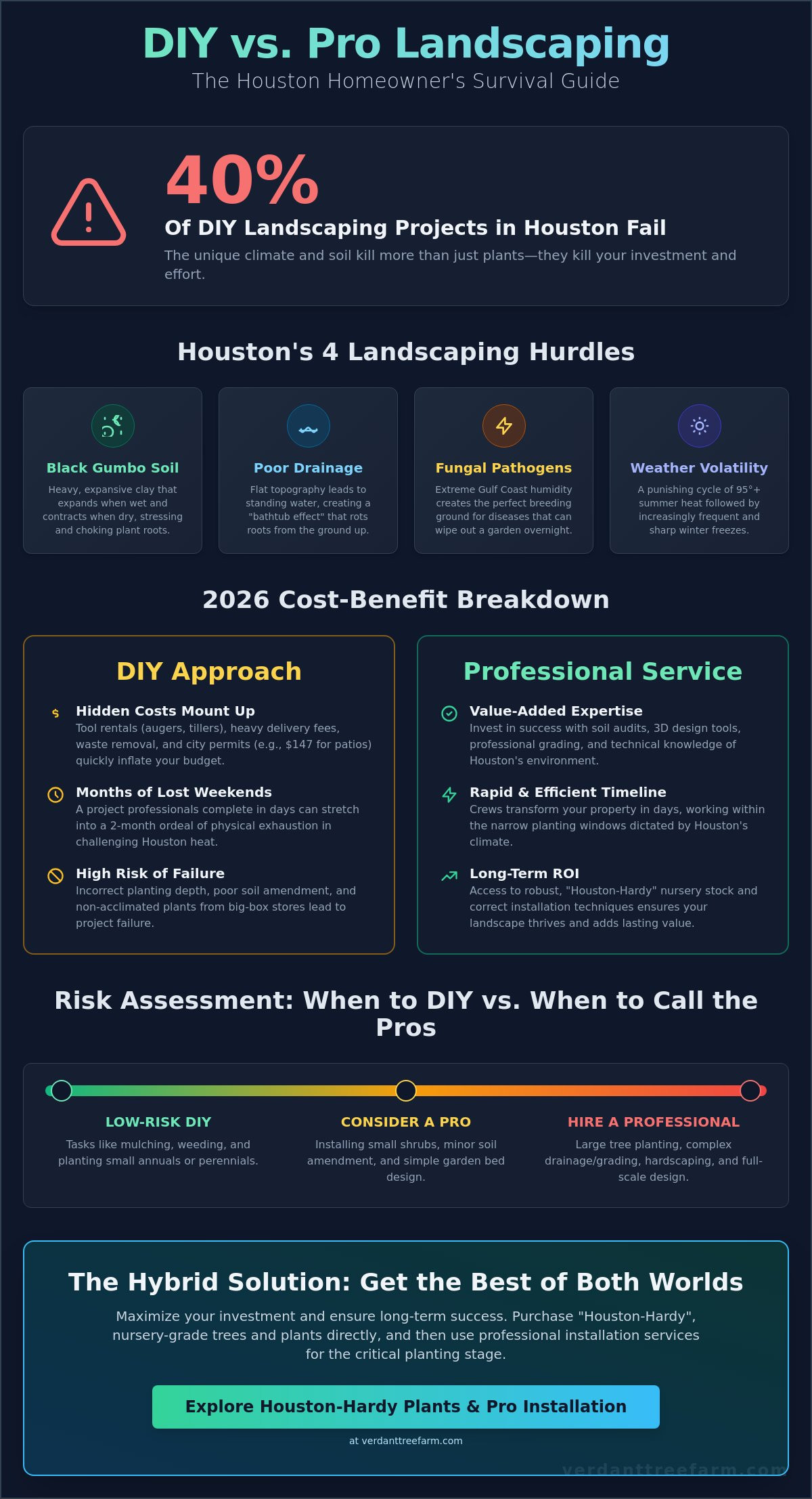
Successful yards in Southeast Texas aren’t built on aesthetics alone; they are built on survival. When weighing the choice between DIY landscaping vs professional Houston services, you have to look deeper than the price tag of a shovel. You need to understand the environmental pressures that define our region. What is Landscaping? In the broadest sense, it’s the modification of land, but in Houston, it’s a battle against the elements. We call it “Houston-Hardy” landscaping. This isn’t an optional style choice. It’s a technical requirement for any plant that hopes to survive our 95-degree humidity and the sudden, sharp freezes that have become more frequent in recent years. The humidity in Houston acts as a breeding ground for pests and pathogens that can wipe out a new garden overnight. This volatility is the primary reason the DIY landscaping vs professional Houston debate usually ends with a call to the experts.
Our local environment presents four main challenges to any landscape project:
- Black Gumbo Soil: Heavy clay that expands and contracts, stressing root systems.
- Poor Drainage: Flat topography that causes water to pool around plant bases.
- Fungal Pathogens: High humidity levels that encourage rapid disease spread.
- Weather Volatility: A cycle of extreme summer heat followed by unpredictable winter freezes.
The “Black Gumbo” Challenge
Black Gumbo is the local term for the heavy, expansive clay soil that covers much of the Bayou City. It presents a unique hurdle for homeowners. DIYers often fail to dig deep enough or use the correct soil amendments. This leads to “the bathtub effect” where water sits around the roots and rots the plant. Soil compaction occurs when clay particles are pressed together so tightly that there’s no room for air or water to move; this effectively chokes the plant by preventing root respiration. Because most Houston lots are remarkably flat, professional grading is often the only way to prevent standing water from destroying your investment.
Microclimates in Your Own Backyard
Your backyard is its own ecosystem. Sun exposure in a Texas July is far more intense than what a plant experiences in a northern climate. This is why species selection is critical. We recommend focusing on native or well-adapted varieties like the Live Oak, Cedar Elm, or Drummond Red Maple. These trees have evolved to handle our specific cycle of drought and deluge. Plants from “big box” retailers often aren’t acclimated to our thick humidity, which leads to rapid fungal growth and disease shortly after planting. Selecting the right species ensures your landscape survives the next big freeze or summer dry spell.
DIY vs. Professional Landscaping: The 2026 Cost-Benefit Breakdown
Evaluating the financial impact of DIY landscaping vs professional Houston services requires looking beyond the initial receipt. Most homeowners focus on the immediate savings of doing the work themselves. However, a true cost-benefit analysis of landscaping must include the price of your time, specialized tool rentals, and the high cost of potential failure. While a professional crew might transform a property in three days, a solo DIY project often stretches into a two-month ordeal of lost weekends and physical exhaustion. This timeline matters in Houston, where our planting windows are narrow and dictated by the looming summer heat.
The DIY Expense Sheet
The hidden costs of DIY add up fast. You’ll need to rent heavy equipment like power augers for deep holes and tillers to break through the Black Gumbo. Hauling a 500lb Sabal Palm or a large-caliper Live Oak isn’t a job for a standard pickup truck. You have to factor in delivery fees, waste removal for old sod, and even city permit fees, like the $147.38 required for certain patio projects. Working in the 95-degree humidity isn’t just uncomfortable; it’s a safety risk that often leads to rushed work and poor planting techniques.
Professional Value-Adds
Hiring a pro gives you access to robust nursery stock that isn’t available at big-box retailers. Professional installation ensures that species like the Drummond Red Maple or Drake Elm are planted at the correct depth with proper root flare exposure. This technical precision prevents the tree from drowning in clay soil or failing to establish a stable root system. A landscape that is designed and installed correctly the first time offers a far better ROI than a DIY yard that needs a total overhaul after the first freeze. For those unsure where to start, professional maintenance consultations can help protect your long-term investment.
Consider the “Cost of Failure.” If a large tree dies because it was root-bound or planted too deep, you don’t just lose the money spent on the tree. You lose the years of growth and shade that tree would have provided. Utilizing 3D design services allows you to visualize the mature size of an October Glory Maple before it’s in the ground. This prevents expensive mistakes like planting too close to your home’s foundation or encroaching on underground utility lines. Investing in professional expertise ensures your yard becomes an asset rather than a recurring expense.
Risk Assessment: When to DIY and When to Call the Pros
When deciding between DIY landscaping vs professional Houston services, the first step is a realistic risk assessment. Not every project carries the same weight. Spreading mulch or refreshing a small flower bed with seasonal color is a low-risk way to spend a Saturday. However, as the scale of the project grows, so do the technical requirements. High-risk tasks include installing large-caliper trees like the Live Oak or Drummond Red Maple, as well as complex drainage grading. One wrong move with a shovel can lead to a broken irrigation line or a drowned root system.
A common homeowner objection is, “I can just dig a hole.” In our local Black Gumbo clay, digging the hole is only 10% of the job. You have to account for the root flare, soil amendments, and proper backfilling to prevent air pockets. Professional contractors who prioritize personal accountability, such as veteran-owned operations, bring a level of reliability that ensures these technical details aren’t overlooked. You can find excellent research-based guidance through Texas A&M AgriLife Extension landscaping resources, but translating that data into manual labor requires specialized experience and equipment.
The Weight of the Matter
The physical danger of moving large trees is often underestimated. A specimen like a Sylvester Palm or a Medjool date palm can weigh several tons. Moving these requires heavy machinery and a crew that knows how to secure the root ball without damaging the trunk. Beyond the physical strain, there’s the risk of hitting underground utilities. DIYers often forget that even shallow digging can interfere with gas, water, or fiber optic lines. Professionals handle the “Call Before You Dig” logistics and carry the necessary insurance to protect your property from accidental damage during the process.
Warranty and Peace of Mind
The biggest differentiator in the DIY landscaping vs professional Houston debate is what happens after the plant is in the ground. Big-box retailers typically offer a “no-return” policy once a tree is planted, or they provide a limited exchange that doesn’t cover the labor of replanting. Professional installation usually includes a 3-month warranty. This coverage is vital because it protects your investment during the critical first season when the plant is most vulnerable to transplant shock. Ongoing maintenance consultations further ensure that your new Eagleston Holly or Little Gem Magnolia receives the correct nutrients and hydration to thrive for decades.
The Houston Landscape Success Framework: 5 Steps to a Perfect Yard
Achieving a resilient yard in the Bayou City requires more than just good intentions. It demands a structured approach that accounts for our specific environmental pressures. When comparing DIY landscaping vs professional Houston results, the difference usually lies in the planning phase. Most homeowners start at the nursery, but the pros start with the dirt. Following a proven framework ensures your investment grows in value rather than becoming a seasonal expense.
Our five-step framework for local success includes:
- Step 1: Professional Soil and Drainage Audit. We analyze the composition of your Black Gumbo and identify pooling areas that need grading.
- Step 2: 3D Design and Visualization. We map out the mature size of every plant to ensure the layout remains functional for decades.
- Step 3: Houston-Hardy Species Selection. We choose trees and shrubs, such as the Shumard Oak or Savannah Holly, that are acclimated to our humidity.
- Step 4: Technical Installation. We execute professional planting using specific amendments to break up heavy clay and encourage root growth.
- Step 5: Maintenance and Irrigation Calibration. We establish a schedule that accounts for the narrow margins of error in Houston’s climate.
Phase 1: Design and Visualization
Visualizing the end result is the best way to prevent “over-planting,” a common mistake where homeowners buy too many plants for a small space. Utilizing 3D Landscape Design Services allows you to see how a Live Oak or October Glory Maple will look ten years from now. It helps you balance evergreen privacy from Eagleston Hollies with the seasonal color of Natchez Crape Myrtles. This digital blueprint prevents you from wasting money on materials that will eventually crowd your foundation or block your windows.
Phase 2: Execution and Care
Once the design is set, the focus shifts to technical execution. Proper staking is vital for young trees like the Cedar Elm or Loblolly Pine to withstand Gulf Coast winds during hurricane season. Irrigation is equally critical. In our heavy clay soil, over-watering is just as lethal as a drought because the water has nowhere to go. You must also pay close attention to the root flare. The root flare is the transition zone where the trunk expands into the root system; burying this area too deep is a leading cause of tree death because it prevents necessary gas exchange. Professional installation ensures these technical details are handled correctly the first time. Ready to start your project with expert guidance? Schedule one of our Maintenance Consultations to evaluate your property’s unique needs.
Verdant Tree Farm: The “Hybrid Solution” for Houston Homeowners
When homeowners weigh DIY landscaping vs professional Houston services, they often feel forced to choose between the high cost of a full-service design firm or the physical grind of doing it themselves. Verdant Tree Farm offers a “hybrid solution” that bridges this gap perfectly. We are the largest independently owned tree farm in the region. By buying direct from the source, you eliminate the middleman markup found at big-box retailers. This approach gives you the financial benefit of a direct purchase with the technical security of professional execution. It’s the smartest way to ensure your property grows in value without the stress of managing multiple vendors.
Our one-stop-shop model simplifies a complex process. We handle everything in-house, including:
- Direct Sales: Access to high-quality trees and palms grown specifically for our climate.
- Expert Design: 3D visualization that takes the guesswork out of your layout.
- Professional Installation: A dedicated team that manages the heavy machinery and technical planting.
- Maintenance Consultations: Expert advice to keep your landscape thriving long after the initial planting.
Nursery-Direct Value
Buying direct means your trees haven’t spent weeks on a hot transport truck from another state. Our specimens, from the sturdy Live Oak to the vibrant October Glory Maple, are grown and acclimated to local soil and humidity. This regional hardiness is the key to long-term survival. We encourage you to visit our farm to hand-select your specific trees. You can walk the rows and pick the exact shape and size that fits your vision. If you’re looking for a tropical touch for your pool area, feel free to browse our current inventory of Houston palms to see the quality we maintain on-site.
Professional Installation You Can Trust
The hybrid model succeeds because we don’t just sell you a tree; we ensure it thrives. Our professional installation process handles the heavy lifting that makes DIY landscaping vs professional Houston projects so risky. We use specialized equipment to plant everything from a 15-gallon Vitex to a massive Medjool date palm. Our veteran-owned team brings a level of accountability and precision to every job site. We don’t leave your yard’s future to chance. After planting, our maintenance consultations provide you with the specific knowledge needed to protect your investment through every season. Stop managing the logistics between retailers and contractors. Request a Landscaping Consultation today and see the difference that nursery-direct expertise makes for your home.
Build a Landscape That Lasts for Generations
Your property is one of your most significant investments. Choosing between DIY landscaping vs professional Houston services shouldn’t feel like a gamble. By understanding the technical demands of our regional climate and the specific challenges of Black Gumbo soil, you can make an informed decision that saves money and prevents future headaches. Focus on high-impact species selection and professional installation to ensure your yard thrives through summer heat and sudden freezes. A well-planned landscape increases your home’s value and provides a functional space for your family to enjoy for decades.
As the largest independent nursery in Houston, we’re proud to offer a veteran-owned commitment to quality and accountability. Our professional installations come with a 3-month warranty to give you absolute peace of mind during the critical establishment phase. We’re here to simplify the process and provide you with the direct-to-consumer value you deserve. You can achieve the beautiful, resilient yard you’ve always wanted without the back-breaking labor or the risk of failed plantings.
Explore Houston’s Largest Tree Inventory & Professional Services today. Let’s work together to transform your outdoor space into a lasting asset for your home.
Frequently Asked Questions
Is it cheaper to DIY my landscaping in Houston?
Initial material costs are lower for DIY projects, but long-term expenses often exceed professional rates due to plant replacement and equipment rentals. Homeowners pay retail prices for plants and must rent specialized tools like power augers or tillers. Professionals access wholesale inventory and use expert techniques to ensure survival. When you factor in the value of your time and the risk of a project failing, hiring an expert is often the more cost-effective choice.
What are the best low-maintenance trees for Houston yards?
Native species like the Live Oak, Cedar Elm, and Shumard Oak are the most resilient options for our regional climate. These trees are acclimated to the high humidity and heavy clay soil found throughout Southeast Texas. Other hardy choices include the Little Gem Magnolia and various Crape Myrtles. Selecting “Houston-Hardy” plants ensures your landscape thrives with minimal intervention while standing up to summer droughts and winter freezes.
Do I need a permit for professional landscaping in Houston?
Most standard residential planting projects don’t require a permit, but structural additions like decks, patios, or fences do. For example, a building permit for a patio or deck currently costs $147.38 in Houston. Fences over 100 linear feet require a $73.85 permit. It’s also important to note that new single-family constructions must comply with the city’s Tree and Shrub Ordinance regarding landscape buffers and plant preservation.
How much does professional tree installation cost compared to DIY?
The average labor cost to professionally plant a tree in Houston is approximately $325, not including the price of the tree itself. A DIY installation costs the price of the sapling plus your time and any tool rentals. While DIY seems cheaper, professional installation ensures the root flare is correctly positioned and the tree is stabilized. This technical precision is vital for the tree to survive the high winds and poor drainage common in our area.
What happens if my DIY-planted tree dies within the first year?
Most retail nurseries and big-box stores don’t offer a warranty on plants once a homeowner installs them. If your DIY project fails, you’re responsible for the full cost of removing the dead specimen and purchasing a replacement. Professional installations typically include a 3-month warranty. This coverage protects your investment during the critical first season when young trees are most vulnerable to transplant shock and environmental stress.
Can I do my own 3D landscape design?
Consumer-grade design software is available, but it often lacks the specific horticultural data needed for Houston’s growth patterns. Professional 3D design accounts for the mature canopy spread and root systems of species like the October Glory Maple. This prevents expensive mistakes like planting too close to a foundation. Expert designers visualize the final result while ensuring the layout remains functional and sustainable as the plants grow over the next decade.
Why is Houston clay soil so difficult for DIY landscaping?
Our local “Black Gumbo” clay is difficult because it expands when wet and shrinks during droughts, which stresses root systems. This soil is dense and lacks the oxygen pockets needed for root respiration. DIYers often struggle to dig deep enough or use the correct amendments to break up the compaction. Without professional-grade equipment and soil knowledge, plants in clay soil often suffer from “the bathtub effect” where water pools and rots the roots.
How do I know if I need a professional drainage solution?
If water stands in your yard for more than 24 hours after a typical rainstorm, you likely need a professional grading or drainage audit. Standing water drowns root systems and creates breeding grounds for pests. In the DIY landscaping vs professional Houston debate, drainage is the most technical area where expert intervention is mandatory. Professionals use specialized equipment to ensure water flows away from your home’s foundation and into proper runoff channels.