A deer-resistant planting can reduce browsing, but it won’t make a Houston landscape deer-proof. Deer may eat plants they usually avoid when food is scarce. Choosing a mix of less-palatable trees and shrubs is a practical way to limit damage while creating a hedge or screen.
It’s frustrating to want privacy only to see fresh growth disappear. This guide explains how deer-resistant foliage can help, which trees and shrubs may work for screening, and how to balance evergreen coverage, seasonal interest, and growth habits in a Houston yard. You’ll find ideas for layered hedges and varied foliage, too. The right choices depend on your site, including its light, moisture, and available space, as well as how dense you want the screen to be. The goal is a landscape suited to your property that may be less appealing to browsing deer, with realistic expectations about what plant selection can and can’t do.
Key Takeaways
- Use a diverse mix of plants to help reduce browsing, since deer may still eat less-preferred foliage when food is scarce.
- Plan screening around seasonal foliage and the density you want, not just a plant’s resistance to browsing.
- Choose hedge and shrub varieties that suit your yard’s sunlight and desired landscape texture.
- Compare tree options such as Live Oak, Shumard Oak, Mexican White Oak, and Drummond Red Maple when planning your Houston landscape.
1. How deer-resistant plants can reduce browsing damage
Deer-resistant plants can reduce browsing because their foliage, scent, or texture may be less appealing. They aren’t deer-proof: hungry deer may still browse plants they usually avoid, especially when food is scarce. For Houston landscapes, Bald Cypress, Cedar Elm, and magnolias are listed as resistant options, but no single tree guarantees protection. Deer-resistant trees and shrubs for Houston gardens work best as part of a varied planting plan.
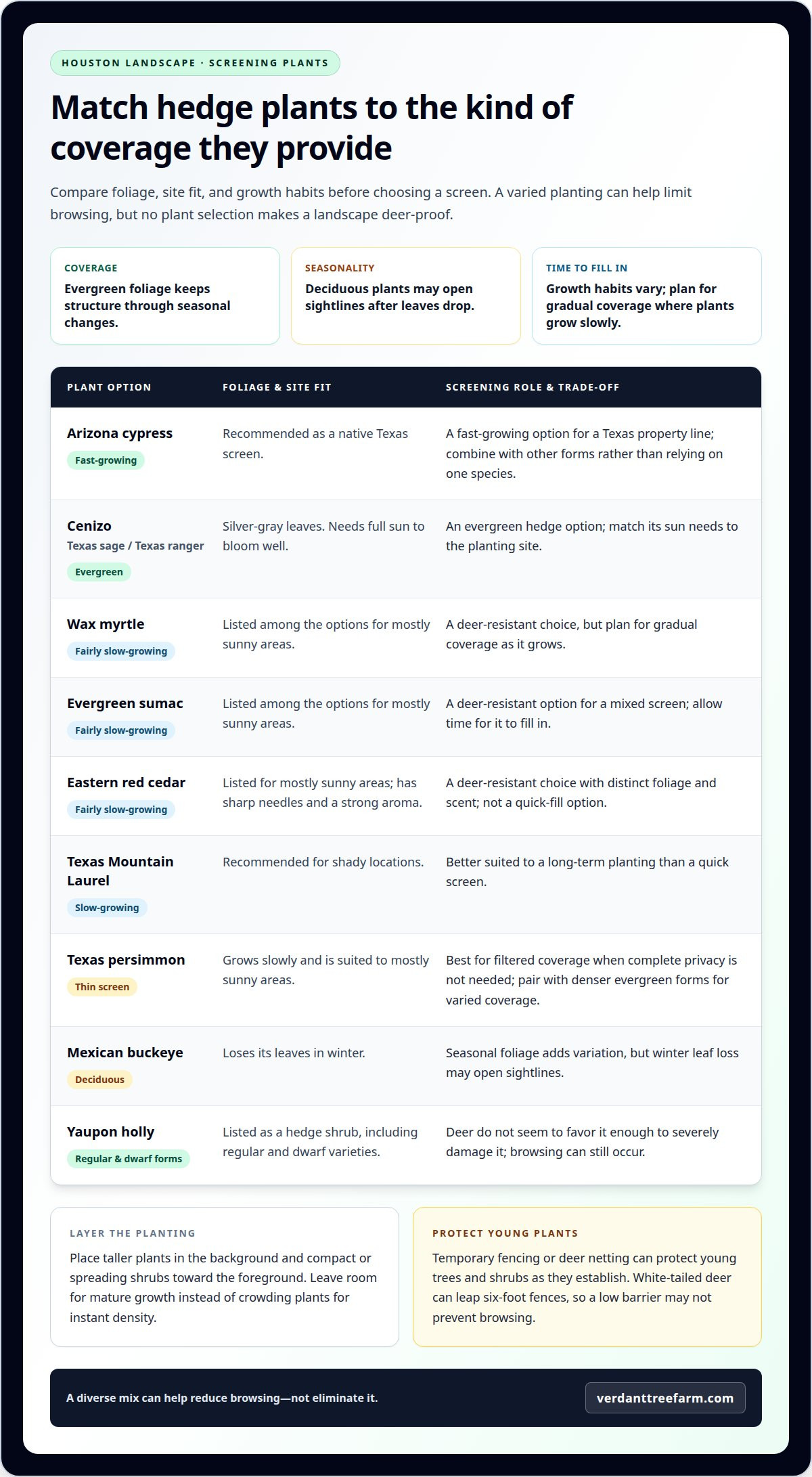
Texas-suited options include Cedar Elm, Bald Cypress, yaupon holly, and cenizo, also called Texas sage. Texas Mountain Laurel is another choice for shade, though it grows slowly. For a screen on rocky, shallow soil, consider available rooting space and drainage. Texas persimmon grows slowly and provides a thin screen. Tough or leathery leaves, dense growth, sharp foliage, and strong aromas may also discourage browsing.
Strongly scented plants can add another layer around vulnerable garden areas. Garlic, lavender, rosemary, and thyme are sometimes used as natural repellents, but they work as companion plants, not dependable barriers. Rosemary is also noted as not needing supplemental water after establishment. When choosing deer-resistant trees and shrubs in Houston, weigh scent alongside growth habit and site conditions.
Houston’s heat, humidity, and clay soil don’t point to one universal plant choice. Consider sun exposure, drainage, and root space together: cenizo needs full sun to bloom well, while Texas Mountain Laurel is recommended for shady locations. These preferences help narrow your options, but neither plant is automatically suited to every clay site.
Some deer-resistant plants can pose ingestion concerns. Some plants may be harmful if eaten, so keep children and pets from consuming unfamiliar foliage or seeds. For young trees and shrubs, use temporary fencing or deer netting until plants mature. White-tailed deer can leap six-foot fences, so a low barrier may not protect plants from browsing.
2. Seasonal foliage and screening density
Year-round privacy depends on foliage that stays in place through seasonal changes. Evergreen shrubs retain leaves and structure, while deciduous plants add seasonal variation but may open sightlines after leaf drop. Mexican buckeye, for example, loses its leaves in winter. Before choosing a mix of deer-resistant trees and shrubs in Houston, decide how much winter coverage your screen needs.
Growth rate also affects how quickly a screen fills in. Wax myrtle, Eastern red cedar, and evergreen sumac are among the fairly slow-growing options for mostly sunny areas. Texas Mountain Laurel is another slow-growing choice. Smaller specimens need time to develop, so plan for gradual coverage rather than an immediate visual barrier. A dense screen may take several complementary plants, not just one specimen.
Plan the layers from the property line inward. Taller plants can form the background, while compact or spreading shrubs soften the foreground. This adds depth without crowding each plant. Leave room for mature growth and consider where winter leaf loss could expose a view. A Houston screen made with deer-resistant trees and shrubs should balance privacy goals with seasonal changes in foliage.
Native Texas persimmon grows slowly and provides a thin screen, making it better for filtered coverage than a solid visual barrier. Its lighter screening role can suit a landscape where complete privacy isn’t necessary. Combining it with denser evergreen forms can help vary texture and coverage, while maintaining a more natural outline along a boundary.
Planting recommended Texas trees and shrubs in winter is advised when possible. The eventual density still depends on the species, growth habit, and placement. Before planting, mark the boundary, identify the views you want to screen, and account for seasonal foliage changes. These decisions help create a screen that fits your yard now and develops into a cohesive landscape over time.
Texas persimmon grows slowly in mostly sunny areas and provides a thin screen, so use it where filtered coverage suits your privacy goals.
3. Deer-resistant hedges
A deer-resistant hedge should balance foliage, screening needs, and site conditions. Yaupon holly, including regular and dwarf forms, is listed among shrubs deer don’t seem to favor enough to severely damage. Cenizo, also called Texas sage, is another Texas option, with silver-gray evergreen leaves. For a taller screen, consider how trees and shrubs can work together instead of relying on a single row of one plant.
For a Texas property line, Arizona cypress is recommended as a fast-growing native screen. Wax myrtle and evergreen sumac are other deer-resistant choices, while Eastern red cedar is noted for sharp needles and a strong aroma. These plants vary in form and growth habit, so they won’t all serve the same role in a hedge. Choose a mix that suits the available sun and the coverage you want.
Texas Mountain Laurel may be worth considering in a hedge plan, depending on the site. It grows slowly, so it’s better suited to a long-term planting than a quick screen. Fragrant foliage may also complement a mixed border, but scent alone shouldn’t drive the design. Pair distinct plant forms to create visual depth and avoid relying on a single species.
Before planting, map the boundary and mark where a screen needs to block views. Place taller choices where they won’t overwhelm nearby beds, then use lower shrubs to soften the edge. Allow for mature growth instead of crowding plants for instant density. Regular maintenance helps keep a hedge vigorous, and temporary protection can shield young plants as they establish. Even a carefully mixed hedge may experience browsing when deer have fewer food choices.
4. Deer-resistant shrub varieties
Start by matching shrubs to sunlight. Cenizo, also called Texas sage or Texas ranger, needs full sun to bloom well and has silver-gray evergreen leaves. Texas Mountain Laurel is recommended for shady locations, though it grows slowly. Their different growing habits make them suitable for distinct parts of a Houston landscape, rather than interchangeable hedge plants.
Other shrubs listed as deer-resistant include yaupon holly, wax myrtle, evergreen sumac, and Texas sage. Yaupon, in regular or dwarf form, is considered less appealing to deer. Glossy abelia and American Beauty Berry are also listed as resistant choices. A mixed planting can combine foliage textures and flowering periods without relying on one shrub throughout the garden.
Set realistic expectations for flowering shrubs, too. Deer may browse viburnum flowers, preventing fruit from forming. Lilac blossoms are described as unappealing to deer, but Houston’s climate and your site conditions still matter when selecting plants. Choose varieties for their mature form, sunlight needs, and role in the landscape, not for flowers alone. Evergreen leaves provide continuing structure; deciduous shrubs bring seasonal change.
Houston-area nurseries are a practical place to look for shrubs suited to local landscapes. Plant cost depends on the species, size, and form selected, so compare those characteristics rather than relying on one general price. For a site with both sunny and shaded areas, list each planting location and its light conditions before narrowing your choices. This helps connect the right shrub with the right spot. Explore shrub options for your landscape as you plan a deer-conscious planting.
The Bexar County and South Texas list identifies ceniza or Texas sage (Leucophyllum spp.) as a shrub deer do not seem to like enough to severely damage by eating. Beyond Midnight® bluebeard is hardy in zones 5-9, and ‘Miss Molly’ butterfly bush is hardy in zones 5-9. Brandywine™ viburnum is hardy in zones 5-9; Gin Fizz® juniper is hardy in zones 4-8; Blue Chiffon® rose of Sharon is hardy in zones 5-9.
Verdant Tree Farm
Verdant Tree Farm can help you consider tree choices alongside your screening goals and site conditions. Its Houston selection includes Shumard Oak, Mexican White Oak, Drummond Red Maple, October Glory Maple, and Mexican Redbud. These trees can add shade, structure, or seasonal interest, but they aren’t a substitute for deer-resistant shrubs in a hedge. Deer may bypass red maple for tastier plants, but they can still browse it.
When planning a mixed landscape, consider your desired canopy, seasonal foliage changes, and available planting space alongside browsing pressure. A varied design can pair trees with shrubs chosen for denser coverage, rather than expecting one tree to create a complete screen. Plant selection can reduce risk, but deer behavior and site conditions still shape the result.
For help choosing trees and planning your Houston landscape, contact Verdant Tree Farm.
Plan a landscape that grows with your property
Treat your planting plan as a long-term landscape investment. Set priorities for privacy, shade, and seasonal color, then choose plants that support those goals and suit your site. A layered design can combine screening shrubs with trees that shape the yard over time. Deer-resistant choices may reduce browsing, but they can’t guarantee untouched foliage.
For the tree layer, consider Live Oak, Shumard Oak, and Mexican White Oak for a Houston landscape. Their role differs from that of a dense hedge, so plan each tree around the coverage and structure you want. Choosing deer-resistant trees and shrubs in Houston starts with matching each plant to its purpose and growing conditions.
Contact Verdant Tree Farm to discuss tree options for your landscape. A clear plan can help you build a yard that feels cohesive, functional, and ready to grow.
Frequently Asked Questions
Which deer-resistant shrubs grow well in Houston’s climate?
Yaupon holly, cenizo, evergreen sumac, and wax myrtle are options for Houston landscapes. Match each shrub to its setting: cenizo needs full sun to bloom well, while Texas Mountain Laurel is recommended for shade and grows slowly. In a mixed border, combine different leaf textures and forms to add visual interest without depending on one shrub throughout the planting.
How reliable are deer-resistance ratings, and what factors affect browsing?
Deer-resistance ratings are useful for comparison, not a guarantee that a plant will remain untouched. Browsing can change with food availability and the plants growing nearby. Deer may favor lush, succulent growth, and scarcity can lead them to sample plants they usually bypass. A diverse planting spreads risk across different foliage types, while protecting young plants can help limit damage as they establish.
How large do recommended deer-resistant trees and shrubs grow, and how fast?
Growth rates vary: Arizona cypress is recommended as a fast-growing screen, while Texas Mountain Laurel and Texas persimmon grow slowly. Wax myrtle, Eastern red cedar, and evergreen sumac are also fairly slow-growing; the guide gives no mature dimensions.
Where can I buy deer-resistant trees and shrubs in the Houston area, and what do they cost?
Houston-area nurseries are a practical place to explore options. Cost varies by species, size, and form, so compare those characteristics as you choose.