More landscaping leads don’t always mean more profitable work. Landscaping to attract more customers starts with referrals and local visibility, then focuses on the customer segments that best fit the work you want to win. Keep video ads to 30 seconds or less.
Word of mouth and a strong local reputation matter, but referrals work best as part of a steady marketing approach, not the only way customers find your business. In Houston, clear examples of your work and a message tailored to local property owners can turn attention into useful inquiries.
This guide explains how to build referral relationships, improve your local reach, and identify customer segments that fit your landscaping business. You’ll also learn how to plan short video ads and connect marketing choices to the projects your team can deliver well. The goal is a practical plan that attracts better-fit opportunities, not simply a busier schedule.
Key Takeaways
- Focus on customer segments whose property needs align with the work your business does well, rather than pursuing every lead.
- Prioritize visible landscaping details that help a property make a clear, welcoming first impression.
- Use simple, practical improvements to refresh a commercial landscape while keeping upkeep in mind.
- Plan lighting, signage, and seating together to make a business entrance easier to notice and more inviting.
2. Identifying profitable landscaping customer segments
Profitability depends on more than a property’s size. Compare customer types by the work requested, the time involved, and how well the project fits your team’s skills and schedule. For example, recurring bed care may suit a team looking for steady maintenance work, while a homeowner’s major planting project may be a better fit for a crew equipped for installation. Track inquiry sources, requested work, labor time, and repeat business to see which segments deliver the strongest returns.
For accessible entrances, plan a continuous route from the parking area or sidewalk to the business entrance. Keep paths clear, transitions manageable, and planting out of travel areas. Before construction, assess the design against applicable ADA requirements.
Plan year-round by mapping each property’s seasonal needs and scheduling inspections around local conditions. In Houston, this can include checking irrigation, removing damaged growth, refreshing planting beds, and reviewing drainage as the weather changes. Keep a property log of completed work and upcoming tasks so maintenance decisions reflect observed conditions, not guesswork.
Water-efficient choices can reduce maintenance demands by limiting unnecessary watering and replacement work. Group plants with similar water needs, use mulch to help soil retain moisture, and adjust irrigation to the site’s sun exposure and drainage. A business can also review runoff after watering or rain, then correct overspray and pooling. These steps make water use more deliberate while keeping beds easier to manage.
Record a baseline before changing the landscape. Count visits at the entrance during consistent periods, then compare them after the upgrade and note changes in inquiries or sales. Storefront staff can ask customers how they found the business and record each response by source. Compare similar weekdays or seasons, and track landscaping costs alongside results. This helps distinguish a useful improvement from changes driven by promotions, weather, or other factors.
3. Which landscaping features make the strongest first impression on customers?
Customers notice the route from the street to the front door first. A clear walkway, tidy planting beds, and visible entrance create an immediate impression of care. At a Houston storefront, trim shrubs that hide windows or signs, then clear weeds and debris from the approach. A neat edge beside the walk makes the whole frontage look intentional.
Healthy plants add color and structure, but placement matters as much as variety. Use taller plants to frame an entry and keep lower planting near windows and signs. A layered bed beside a business entrance, for example, can add depth without obscuring the storefront. Choose plants suited to the site’s light and available space so the design stays balanced as they grow.
A strong focal point helps visitors recognize the entrance. It could be a specimen tree, a distinctive planter, or a clean planting bed aligned with the doorway. Keep it visible from the sidewalk and parking area. Avoid clustering competing features, which can make the business itself harder to notice.
Consistency also shapes first impressions. Match the landscape’s formality to the building: clipped hedges and defined beds suit a formal façade, while softer planting can complement a relaxed storefront. Repeat a few plant forms or colors near the sign and entrance to connect the areas visually. Keep the palette simple so the business name remains prominent.
Walk the property from a customer’s perspective before choosing upgrades. Start at the street and look for obstructed views, uneven beds, and bare areas. Notice what draws the eye toward the entrance, then take photos from the sidewalk and parking approach. These views make distractions easier to spot and help prioritize improvements for a clean, welcoming arrival.
4. What are low-cost landscaping improvements for a commercial property?
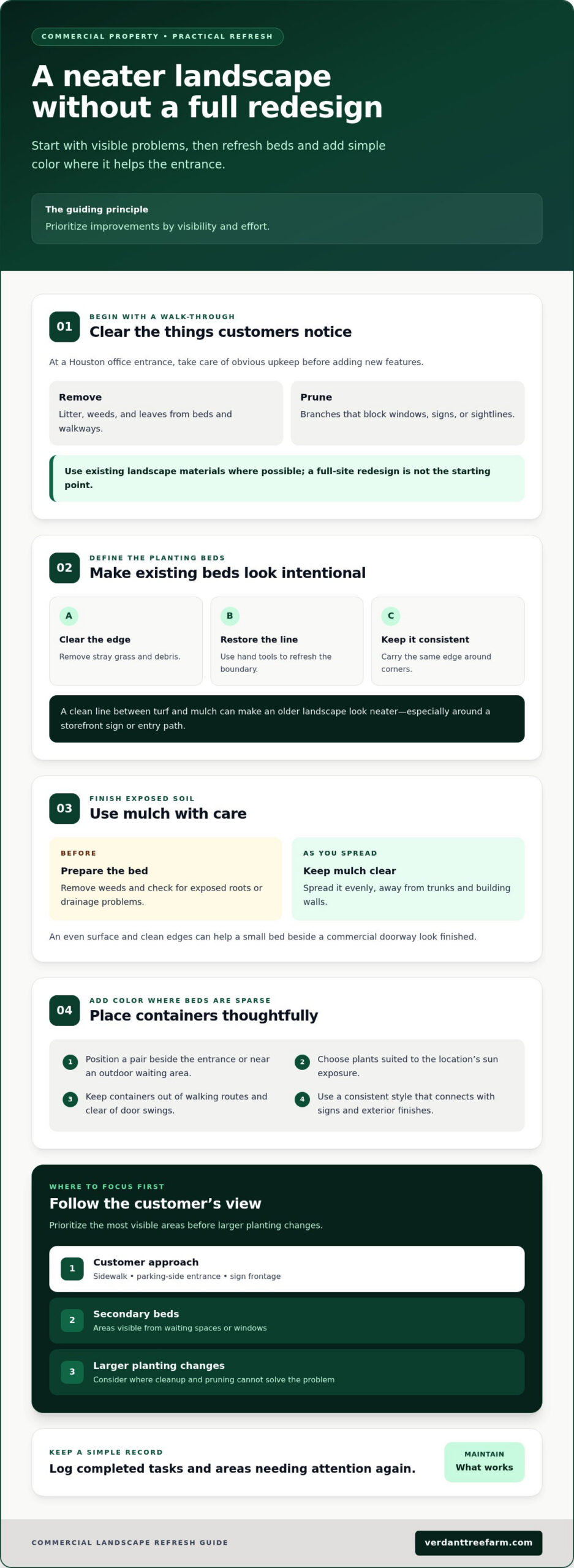
Start with a property walk-through and address visible problems before adding features. At a Houston office entrance, remove litter, pull weeds, and clear leaves from beds and walkways. Then prune branches that block windows, signs, or sightlines. These straightforward tasks use existing landscape materials and can make the grounds look cared for without redesigning the entire site.
Refresh bed edges to give planting areas a deliberate shape. A clean line between turf and mulch makes an older landscape look neater, especially around a storefront sign or entry path. First remove stray grass and debris, then restore the edge with hand tools. Keep the boundary consistent around corners to avoid extra shapes that need more trimming.
Use mulch to unify exposed soil and make patchy beds look more finished. Before adding it, remove weeds and check for exposed roots or drainage problems. Spread mulch evenly, keeping it away from trunks and building walls. A small bed beside a commercial doorway, for example, can look finished with clean edges and an even surface.
Moveable containers can add color where existing beds are sparse. Place a pair beside the entrance or near an outdoor waiting area, and choose plants suited to the location’s sun exposure. Keep containers out of walking routes and clear of door swings. A consistent container style can connect the entrance with the building’s signs and exterior finishes.
Prioritize improvements by visibility and effort. Start with the customer approach, including the sidewalk, parking-side entrance, and sign frontage. Then tidy secondary beds visible from waiting areas or windows. Save larger planting changes for areas where cleanup and pruning cannot solve the problem. A work log can record completed tasks and show which areas need attention again.
4. How can lighting, signage, and seating improve a business’s landscaped entrance?
Treat the entrance as one connected space, not three separate upgrades. Lighting should make the path and doorway easy to find, signs should identify the business, and seating should give visitors a place to pause. For a Houston storefront, map the route from the parking area or sidewalk to the door, then position each feature to serve that route without crowding the walkway.
Place signs where people can see them before reaching the entrance. Keep shrubs and branches from covering the business name, and use planting beds to frame the sign rather than compete with it. A sign beside a clear path is easier to notice than one hidden behind tall foliage. Position it to suit the approach, whether customers arrive on foot or from a parking area.
Use lighting to guide attention toward the entrance and make changes in the path visible. A fixture near a doorway can clarify the destination, while lights beside a walkway can define its edge. Avoid aiming bright beams at windows or drivers. After dark, check the view from the sidewalk and parking area, and adjust any fixtures that cause glare or make the door hard to distinguish.
Seating can make an entrance more useful for customers waiting for a pickup or meeting. Set a bench near the doorway, outside the main walking route and clear of door swings. A planter can define the seating area if it does not narrow access. Choose a spot with a clear view of the entrance and business sign.
Review the arrangement from several customer viewpoints before installing anything. A sign should remain visible, lighting should support the route, and seating should feel connected without blocking movement. A tree can also frame an entrance when its mature canopy and placement suit the site. Explore tree options for an entrance as part of a coordinated landscape plan.
Verdant Tree Farm: Live Oak
Verdant Tree Farm helps Houston businesses planning a landscape refresh choose trees suited to their property. A Live Oak can serve as a focal point for an entrance or commercial grounds, with placement planned around the building, customer routes, and available planting space.
For a different planting plan, compare options such as Shumard Oak, Mexican White Oak, and Drummond Red Maple. Consider the tree’s purpose, its location, and how it will fit alongside paths, signs, and existing landscape features. A considered choice ties the planting into the property instead of treating it as an isolated addition.
If a tree is part of your next landscape improvement, contact Verdant Tree Farm or visit verdanttreefarm.com.
Build Your Next Step Around What Customers Notice
A thoughtful strategy for landscaping to attract more customers can evolve as you learn which properties and projects best fit your business. Use each inquiry to refine your focus: note what prompted the customer to reach out, what they value about the property, and which improvements they’re considering. That insight can guide future marketing and help shape a landscape plan around real customer needs.
If a tree is part of your next project, consider how it will relate to the entrance, sign, and available space. Verdant Tree Farm offers Live Oak, Shumard Oak, and Mexican White Oak for landscape plans that call for a tree feature. Discuss your property’s goals and how tree selection can support them.
Contact Verdant Tree Farm to explore tree options for your landscape. A clear plan can help you move forward with confidence.
Frequently Asked Questions
How does landscaping attract more customers to a business?
Landscaping can draw customers by making a business easier to notice, approach, and remember. A distinctive tree or coordinated planting near the entrance can help visitors find the right storefront, especially among similar businesses. Clear routes and well-kept grounds also signal care. In Houston, landscaping to attract more customers works best when it improves visibility and makes the path inside clear.
What permits, zoning rules, or local landscaping restrictions should businesses check?
For accessible entrances, assess the design against applicable ADA requirements before construction.