Local ownership can bring useful knowledge of Houston’s growing conditions, but it should not be the only deciding factor. Knowing how to choose a commercial landscaping company means weighing local understanding alongside experience with commercial properties, clear communication, relevant references, and capable, safety-minded crews.
A local presence matters because a landscape plan needs to suit the property and its setting, not just look good on paper. You also need a company that understands the site’s day-to-day demands and can explain how it will manage the work. The right questions make those differences easier to spot.
This guide covers the factors that help you compare commercial landscapers with confidence. Learn how to assess local knowledge, communication, references from similar properties, staffing, training, safety, and qualifications. Focus on fit, reliability, and the working relationship, not just a polished proposal.
Key Takeaways
- Look beyond local ownership: match the company’s commercial experience and service scope to your property’s needs.
- Assess who will manage your account and how the company communicates about scheduling, delays, and follow-up work.
- Use references from similar properties to understand how the landscaping company performs in practice.
- Evaluate whether staffing, training, safety practices, insurance, and relevant certifications fit the work your site requires.
1. How to Choose a Commercial Landscaping Company: Are They Locally Owned?
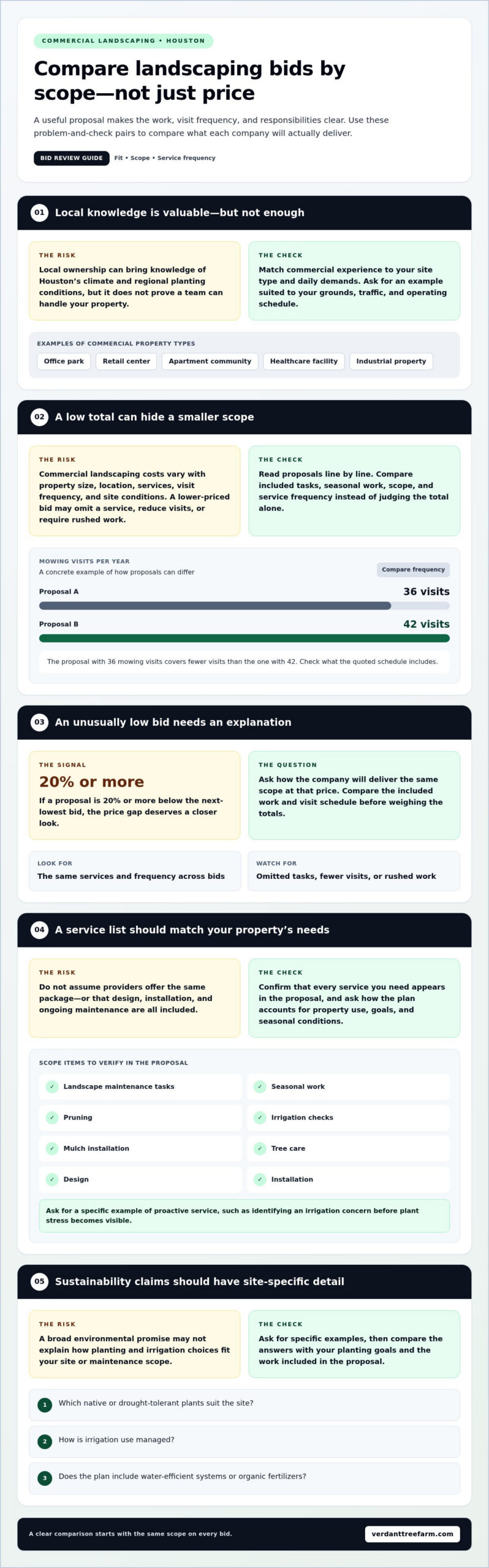
Local ownership can help a company understand Houston’s climate and regional planting conditions. Still, ownership alone does not show whether its team can handle your property. Compare experience with your site type, such as an office park, retail center, apartment community, healthcare facility, or industrial property. Ask for an example of work suited to your grounds, traffic, and operating schedule.
Commercial landscaping costs in the United States depend on property size, location, required services, visit frequency, and site conditions. There is no standard cost for every property, so compare what the scope includes and how often crews will work rather than judging the total alone.
Read each proposal line by line. Compare landscape maintenance tasks, seasonal work, scope, and service frequency. For example, a proposal with 36 mowing visits per year covers fewer visits than one with 42. Check whether pruning, irrigation checks, mulch installation, or tree care appears in the scope. A lower-priced bid may omit a service, reduce visits, or require rushed work. If a proposal is 20% or more below the next-lowest bid, ask how it delivers the same scope at that price.
Confirm that the company provides every service your property needs. Do not assume providers offer the same package. If you need design, installation, and ongoing maintenance, make sure each is included in the proposal. Ask how the plan accounts for your property’s use, goals, and seasonal conditions. Request an example of proactive service, such as identifying an irrigation concern before plant stress becomes visible.
To assess sustainability, ask which native or drought-tolerant plants suit the site, how irrigation use is managed, and whether the plan includes water-efficient systems or organic fertilizers. Compare the answers with your planting goals and maintenance scope. Specific examples make the company’s environmental approach easier to evaluate.
2. Assess account relationships and communication
A dependable account relationship starts with a clear point of contact. Identify who will coordinate crews, answer questions, and share updates. Ask whether that person will stay involved after hiring or whether your account will transfer. For a mixed-use property, clarify who handles concerns from office tenants, retail operators, and residents.
Compare maintenance plans by their included tasks, visit frequency, and reporting on completed work. Ask how the company handles urgent concerns, routine requests, and weather delays. Check that its equipment suits the site, such as mowers for open lawns or tools for pruning beds. These details show how providers will deliver the agreed scope.
Review the contract for responsibilities, scheduling, seasonal adjustments, and procedures for added work. It should explain what the company will do and what requires approval, such as extra pruning after storm damage. Ask how installation or enhancement work affects routine maintenance. Clear terms help you track expectations and avoid confusion about requests outside the plan.
Communication tools matter only when they fit your workflow. Find out whether updates come by email, phone, or a shared reporting system, and ask what each report includes. A useful report might note completed tasks, weather-related changes, and a developing irrigation issue. During proposal discussions, notice whether answers are timely and specific. That interaction offers a practical preview of future communication.
Look for a partner who explains recommendations, not just tasks. For example, ask why a pruning change is needed and when the crew plans to perform it. A proven account process includes follow-up on open concerns and clear notice when schedules shift. If ongoing tree care questions remain after installation, maintenance consultations can help guide care planning.
3. Request references for similar properties
Ask for references from commercial clients with properties like yours. An office campus, retail center, and industrial site have different traffic patterns and landscape demands. A reference from a similar property can help you assess whether the company understands the site’s daily use. Ask about comparable work, such as maintaining pedestrian areas or coordinating pruning around storefronts.
Ask about the working relationship, not just for a general endorsement. Find out how the landscaper handled schedule changes, reported concerns, and followed through on agreed tasks. Ask whether the reference would hire the company again and why. These questions can reveal what service is like after the proposal stage, including how crews handle issues affecting the property’s appearance.
If possible, inspect a nearby property the company maintains. Look at turf edges, plant health, pruning cuts, mulch beds, and the overall cleanliness of the grounds. Notice how the landscaping meets entrances, parking areas, and walkways. A site visit shows you routine results and gives you specific standards to discuss with the prospective company.
Compare the reference property’s needs with your own. A shaded office courtyard may need different plant care than a sunny retail frontage. Houston’s heat, seasonal rainfall, soil conditions, and applicable water restrictions can affect plant selection and irrigation planning. Ask how local conditions shape the property’s appearance and maintenance schedule. Include relevant watering limits in the scope to keep expectations clear.
References can also help you judge whether a proposal fits your priorities. If curb appeal is central, ask how the company maintains visible beds and entry points. If foot traffic wears down turf, ask what the reference observed and how the landscaper responded. Connect each answer to a need on your site, such as durable planting near walkways or consistent pruning around signs.
Use what you learn to set clear expectations before hiring. Record the tasks that matter most, areas needing attention, and reporting details you expect. Compare those points with the proposal. A relevant reference cannot replace a clear scope, but it can show how a company’s approach translates into work on a commercial property.
4. Ask about staffing, training, safety, and certifications
Match crew capacity to the property’s size and work schedule. A five-person crew may not have enough capacity for a 200-acre master-planned community. Ask how staffing changes for mowing, irrigation, pruning, and landscape enhancements. Find out whether the company uses subcontractors and which tasks they handle.
During an interview, ask how employees are trained to use equipment, care for plants, and work safely on site. Ask which qualifications apply to the work and how the company verifies them. For irrigation work, clarify who designs, installs, or monitors the system. Answers should identify responsible roles rather than rely on broad assurances.
Request evidence of liability insurance and workers’ compensation coverage. Review the coverage details and confirm they meet your property’s requirements. Clarify how the company handles incidents, reports hazards, and keeps crews and visitors away from active work areas.
Ask about the safety procedures crews follow around pedestrians, vehicles, and building entrances. For example, how do workers secure equipment and manage foot traffic while pruning near a busy walkway? Ask how supervisors inspect completed work and address unsafe conditions. These details show whether safety is part of daily operations.
Red flags include unclear staffing plans, evasive answers about subcontractors, and proposals that do not explain who handles specialized tasks. Missing insurance documentation, unexplained qualification claims, or no clear hazard-reporting process are reasons to pause and ask for specifics. Do not assume a large crew alone means a company can manage your site safely.
Before signing, ask for the crew structure, relevant qualifications, insurance details, and safety process in writing. Compare those answers with the demands of your commercial property. For tree and planting work, discuss your landscape project as you plan the site’s next improvements.
Verdant Tree Farm: Live Oak
Verdant Tree Farm can help you select trees for a commercial property’s landscape plan. If your project calls for a different tree than the one named in this section, consider options such as Shumard Oak, Mexican White Oak, Drummond Red Maple, October Glory Maple, or Mexican Redbud. Match the selection to the site’s layout, planting goals, and the role each tree should play in the overall design. Clear priorities make it easier to identify suitable choices for entrances, grounds, and other landscape areas. For a thoughtful next step, contact Verdant Tree Farm to discuss your tree selection.
Put Your Property Plan Into Motion
Apply what you have learned about how to choose a commercial landscaping company by turning your priorities into a concise planting brief. Note where you need shade, the appearance you want, and the space available for mature trees. This gives your project a clear starting point and connects plant selection to the property’s design goals.
Verdant Tree Farm offers Live Oak, Shumard Oak, and Mexican White Oak for commercial landscape plans in Houston. Consider which species best suits your site and intended use, then discuss the options as you refine the planting plan. Thoughtful choices can help create a cohesive landscape from the start.
Contact Verdant Tree Farm today to discuss tree options for your property and take the next step with confidence.
Frequently Asked Questions
How to Choose a Commercial Landscaping Company: Are They Locally Owned?
Local ownership can support familiarity with Houston’s conditions, but it does not prove that a company is the right fit. Consider how its team accounts for your property’s exposure, drainage, and daily use. A shaded courtyard and a sun-exposed parking entrance, for example, may need different planting plans. Look for answers grounded in your site rather than relying on ownership status alone.
How to Hire a Commercial Landscaping Company: Are They the Right Size to Meet Your Needs?
Choose a company with staffing and equipment suited to your site’s needs and property operations. Ask how it handles separate work zones, overlapping tasks, and seasonal workload changes. For a multi-building campus, clarify whether crews can maintain several areas while keeping entrances accessible. A clear staffing plan should explain who supervises the work and how the company covers schedule changes.
What services should a commercial landscaping company provide?
No single service package suits every commercial property. Match the scope to your goals: a newly developed site may need planting and installation, while an established campus may prioritize ongoing upkeep. Some plans also include irrigation management, pruning, seasonal color, or landscape enhancements. Separate essential tasks from optional improvements so the proposal reflects your property’s priorities and the work you expect.
What qualifications, licenses, insurance, and certifications should a commercial landscaping contractor have?
Qualifications should match the work. A basic maintenance plan and specialized irrigation or tree work call for different skills. Ask which credentials apply to assigned tasks and request supporting documentation. Review liability and workers’ compensation records as part of the contracting process. Focus on the work, the people performing it, and your property’s requirements rather than assuming every credential applies.
How do I verify a commercial landscaper’s experience and references?
Ask for commercial references that reflect your property’s use and operating environment. Discuss a specific challenge, such as coordinating work around deliveries or resolving a planting issue. Ask what the landscaper did and how the result held up. If a property visit is possible, observe active work as well as finished areas to understand both process and outcome.
What should a commercial landscaping contract include, including scope, schedule, and payment terms?
A useful contract identifies the areas covered, included tasks, work schedule, and process for approving changes. It should also explain invoicing, payment timing, and any terms for renewal or ending the agreement. For example, specify whether storm-related cleanup is part of routine service or needs separate approval. Clear written terms help both sides manage expectations throughout the agreement.